Last updated: September 28, 2026 · Originally published: September 24, 2026 · By Eternal Elixir Editorial
Quick answer: For TMG dosage in Australia in 2026, the labels we checked set between 600mg and 3g a day, and our label sets 2,000mg a day as three capsules with a meal. The human trials used 1.5g to 6g of TMG (betaine) a day. After six weeks, fasting homocysteine was 12%, 15% and 20% lower than placebo at 1.5g, 3g and 6g, and 6g a day also raised LDL cholesterol in pooled data. A 2,000mg serve sits between the two lowest trial doses and well under the dose tied to the LDL rise. Our pick is Eternal Elixir TMG 2000mg: 90 capsules for $44.99, which is 30 serves at $1.50 each, sent from Sydney within 24 hours.
Eternal Elixir makes TMG 2000mg, and it is our pick. The other products in this guide were read on their own product pages in September 2026, and we have not lab-tested any of them. This is general information, not personal medical advice.
Table of contents
- 1. How much TMG to take: the short answer
- 2. TMG doses in human research: what each study used
- 3. What Australian TMG labels say
- 4. How a supplement compares with your diet
- 5. How many capsules is 2,000mg?
- 6. When to take TMG
- 7. How long before you judge it?
- 8. Eternal Elixir TMG 2000mg: what you get
- 9. Taking TMG with NMN
- 10. What not to do, and who should check first
- 11. The bottom line
- 12. TMG dosage: frequently asked questions
- 13. Sources
How much TMG to take: the short answer
For most healthy adults, 2,000mg a day with a meal is a practical TMG dose. It is above the lowest dose that lowered fasting homocysteine in a controlled trial, below the 6g a day at which blood lipids moved the wrong way, and close to the 2.5g used in the main training study.
TMG, trimethylglycine, betaine and betaine anhydrous all name the same molecule, a methyl donor that contributes to normal homocysteine metabolism. Research papers call it betaine, so read “3g of betaine” as 3g of TMG. Betaine HCl is a different product sold for digestion. For what TMG is and how Australian products compare, see our complete guide to TMG supplements in Australia.
TMG doses in human research: what each study used
| Study | Who took part | Daily dose and length | What changed |
|---|---|---|---|
| Olthof et al., 2003 | 76 healthy adults, four groups of 19 | 1.5g, 3g or 6g, or placebo, for 6 weeks | Fasting homocysteine 12%, 15% and 20% lower than placebo |
| Steenge et al., 2003 | Adults with mildly raised homocysteine, groups of 12 | 6g betaine, 800mcg folic acid or placebo, for 6 weeks | Folic acid lowered the fasting figure more. Only betaine blunted the rise after a methionine load |
| Cholewa et al., 2013 | 23 strength-trained men | 2.5g (1.25g twice a day) or placebo, for 6 weeks | Body composition, arm size and bench press training volume improved. One-rep-max strength did not |
| Schwab et al., 2002 | 42 adults on a reduced-energy diet | 6g or placebo, for 12 weeks | Homocysteine fell, but total and LDL cholesterol were higher than on placebo |
| Olthof et al., 2005 (pooled) | 151 healthy people across three trials | 6g for 6 weeks | LDL up 0.36 mmol/L and triglycerides up 0.14 mmol/L against placebo |
1.5g, 3g and 6g a day: the dose-response trial
The clearest dosing data comes from a Dutch trial. Four groups of 19 healthy adults took 1.5g, 3g or 6g of betaine or a placebo every day for six weeks. Fasting plasma homocysteine ended 12%, 15% and 20% lower than in the placebo group (Olthof et al., Journal of Nutrition, 2003). The rise in homocysteine after a methionine loading test, where volunteers swallow a measured dose of that amino acid, was smaller at every dose too.
Look at the shape of that curve. Going from 1.5g to 6g, four times the dose, added only eight percentage points. A 2,000mg serve falls between the 1.5g and 3g groups.
A related trial gave adults with mildly raised homocysteine 6g of betaine, 800mcg of folic acid or a placebo for six weeks. Folic acid lowered the fasting figure more, but only betaine blunted the rise after a methionine load (Steenge et al., Journal of Nutrition, 2003). The two nutrients do different jobs.
2.5g a day in trained men
Sports research uses a slightly higher dose. In a six-week trial in 23 experienced strength-trained men, 2.5g a day, taken as 1.25g twice daily in capsules, improved body composition, arm size and bench press training volume against placebo. It did not change one-rep-max strength (Cholewa et al., Journal of the International Society of Sports Nutrition, 2013).
Where the cholesterol signal appears
The top of the range comes with a trade-off. Pooled data from 151 healthy people showed that 6g a day for six weeks raised LDL cholesterol by 0.36 mmol/L and triglycerides by 0.14 mmol/L against placebo. Lower doses also nudged LDL up, but not to a statistically significant degree, and the LDL effect was already visible after two weeks (Olthof et al., PLoS Medicine, 2005). A 12-week trial of 6g a day in 42 adults on a reduced-energy diet found lower homocysteine, but total and LDL cholesterol were higher than in the placebo group (Schwab et al., American Journal of Clinical Nutrition, 2002).
What has not been shown
- No trial has compared morning with evening TMG, or one daily dose with a split dose over weeks.
- The trials ran for six to 12 weeks. We found no long-term trial of TMG supplements in healthy adults.
- Homocysteine is a blood marker. A lower reading is not the same as a proven long-term health benefit, and none of these trials tested that.
What Australian TMG labels say
Label doses vary more than most people expect, because capsule strength and scoop size differ. These are TMG products we could confirm were on sale to Australians in September 2026, with prices in Australian dollars as of Sep 2026 and each product’s own daily directions. Our comparison of TMG supplements in Australia ranks them in more depth.
| Product | Pack | TMG per unit | Label daily amount | Price (AUD, as of Sep 2026) | Cost per day at label dose | Who it suits | Buy |
|---|---|---|---|---|---|---|---|
| Eternal Elixir TMG 2000mg (our pick) | 90 vegetable capsules, 30 serves | 2,000mg per 3 capsules | 2,000mg (3 capsules) with a meal | $44.99 | $1.50 | Buyers who want the 2,000mg serve in capsules with nothing to measure, sent from Sydney | View at Eternal Elixir |
| Switch Nutrition TMG | 150g powder, 150 serves | 1,000mg per 1g scoop | 1 to 3 scoops (1g to 3g) with food | $44.95 | $0.30 to $0.90 | Budget buyers who want to set their own amount and don’t mind measuring | Switch Nutrition |
| Bulk Nutrients TMG Capsules | 120 capsules | 600mg per capsule | 1 to 2 capsules (600mg to 1,200mg) | $29.00 | $0.24 to $0.48 | Capsule buyers who want a lower daily amount | Bulk Nutrients |
| myBrainCo TMG Powder 100g | 100g powder, 100 serves | 1g per serve | 1 serve (1g), do not exceed | $29.95 | $0.30 | Buyers who want 1g a day at the lowest upfront spend | myBrainCo |
| Naturecan TMG Supplement | 60 capsules | 686mg per capsule | 1 capsule, ideally with food | $34.00 | $0.57 | Buyers who want one capsule a day | Naturecan |
| DoNotAge Pure TMG (AUD store) | 60 capsules | 500mg per capsule | 1,000mg (2 capsules) | $32.00 | $1.07 | Buyers already ordering DoNotAge’s range | DoNotAge |
Figures from each product page, September 2026. Delivery is extra below each seller’s free-shipping threshold.
Add TMG 2000mg to cart · $44.99Where our label wins: it is the only product here that puts a 2,000mg serve, the amount between the two lowest trial doses, into a fixed capsule serve. Bulk Nutrients tops out at 1,200mg, Naturecan at 686mg, DoNotAge at 1,000mg, and myBrainCo caps its label at 1g. Where it does not win: Switch Nutrition’s powder lets you reach 2g for less per day if you are happy to measure two scoops, and the cheaper capsules suit anyone who wants a lower daily amount. Our guide to TMG powder vs capsules weighs that trade-off.
How a supplement compares with your diet
Your body makes some TMG from choline, and you eat more every day. The authors of the dose-response trial put habitual dietary intake at about 0.5g to 2g a day. An analysis of 145 common foods found the most betaine in wheat bran (1,339mg per 100g), wheat germ (1,241mg per 100g) and spinach (645mg per 100g) (Zeisel et al., Journal of Nutrition, 2003). So 100g of spinach gives about a third of a 2,000mg serve.
A 2,000mg serve matches the top of what a diet rich in whole grains and leafy greens already provides, and it keeps that intake steady from day to day. If you eat those foods often, a supplement raises your total by less than the label suggests. Our trimethylglycine explainer covers the chemistry.
How many capsules is 2,000mg?
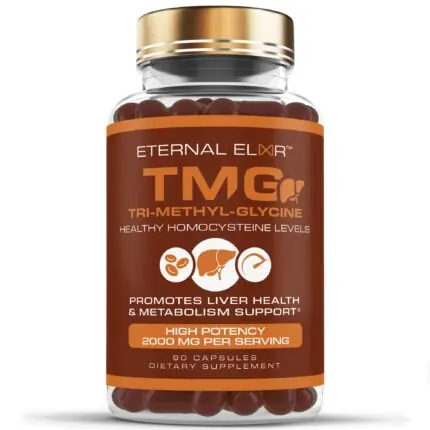
Our TMG is dosed per serve. Three vegetable capsules give 2,000mg of betaine anhydrous, so each capsule carries about 667mg. A 90-capsule bottle is 30 serves, or one month at the label amount.
| Capsules a day | TMG (betaine anhydrous) | Where it sits |
|---|---|---|
| 1 | About 667mg | Within the usual dietary range |
| 2 | About 1,333mg | Just below the lowest trial dose of 1.5g |
| 3 (one serve) | 2,000mg | Between the 1.5g and 3g trial doses |
Some people start with one or two capsules for a few days before moving to the full serve. Staying at or below three keeps you within the label amount. When you compare products, compare the dose and cost per serve rather than per capsule, because a cheaper capsule with less TMG in it changes the sums.
When to take TMG
No trial has compared morning and evening TMG, so all timing advice, ours included, is practical guidance rather than proven.
- Take it with food. Our label says with a meal. A meal keeps it gentle on the stomach and anchors the habit.
- Once in the morning is fine. A single serve with breakfast is the easiest to remember. The trials gave betaine daily over weeks, so taking it every day matters more than the exact time.
- Splitting is also reasonable. Two capsules at breakfast and one at dinner keeps each dose smaller, and the training study split its dose in two.
A single-dose study in 10 healthy volunteers found serum betaine rose straight away and in proportion to the dose. One-off doses of 3g and 6g lowered plasma homocysteine within hours, while a one-off 1g dose did not (Schwab et al., Journal of Nutrition, 2006). That measured single doses. In the six-week trial, 1.5g a day still lowered the fasting figure, so neither approach has been shown to be better.
How long before you judge it?
TMG is not something you feel. The trials measured blood markers, and the fasting homocysteine differences were reported after six weeks of daily intake. A fair personal trial is six to eight weeks at a steady dose, which is two bottles at our label serve.
If you want to know whether it is doing anything for you, ask your GP about a fasting homocysteine test, ideally with folate and B12, before you start and again after at least six weeks. Add a lipid panel if you plan to take TMG long term. Our guide to supporting healthy homocysteine levels covers the diet and nutrient side.
Eternal Elixir TMG 2000mg: what you get
- Amount: 2,000mg of betaine anhydrous per three-capsule serve, 90 vegetable capsules, 30 serves.
- Ingredients: trimethylglycine (betaine anhydrous), rice flour and a vegetable capsule. It suits vegans and vegetarians.
- Price: $44.99 a bottle, which is $1.50 a serve. The product page takes 10% off two bottles, 15% off three and 20% off five. Two bottles cover the six-to-eight-week trial period above.
- Service: dispatch from Sydney within 24 hours on business days, free shipping over $100, a 30-day money-back guarantee and Afterpay at checkout.
Read the full label on our TMG 2000mg product page, or browse the rest of our range. For what TMG supports beyond dose, see our overview of TMG supplement benefits.
Taking TMG with NMN
TMG is often paired with NMN for a biochemical reason. NAD+ precursors such as NMN release nicotinamide, a form of vitamin B3, as NAD+ is used and recycled. The body clears excess nicotinamide by attaching a methyl group to it, through an enzyme called nicotinamide N-methyltransferase that uses up methyl donors (Pissios, Trends in Endocrinology and Metabolism, 2017). Betaine is a methyl donor, so the argument is that people taking NAD+ precursors may want to keep methyl supply topped up.
That is a plausible mechanism, not a proven requirement. No trial has shown that NMN users need TMG, or that any ratio of the two matters. If you pair them, take your usual 2,000mg TMG serve at the same breakfast as your NMN. Our NMN is one 500mg capsule a day, and nothing supports raising TMG to match a higher NMN dose. We set out the full argument, and its limits, in why NMN and TMG are often taken together, and NMN timing in our NMN dosage guide.
What not to do, and who should check first
- Don’t exceed the label serve without advice. The LDL and triglyceride rises came at 6g a day, and lower doses nudged LDL the same way. The 20% homocysteine figure at 6g is not a reason to triple your serve.
- Don’t double-count. Some combined NAD+ formulas and sports products also contain betaine, so add it to your daily total.
- Don’t swap it for the basics. Folic acid lowered fasting homocysteine more than betaine in the head-to-head trial. If a blood test shows raised homocysteine, talk to your GP about folate and B12 rather than reaching for more TMG.
- Don’t confuse it with betaine HCl. Betaine hydrochloride is sold for stomach acidity, not methylation. Our guide to betaine anhydrous vs TMG vs betaine HCl explains the labels.
Our product page says not to use TMG if you are pregnant or breastfeeding, and it is made for adults. Talk to your doctor or pharmacist before you start if you have raised LDL cholesterol or a kidney condition, take prescription medicines, or have any other medical condition. Our write-up on TMG side effects covers the details. If you are still deciding where to buy, our check of TMG at Chemist Warehouse covers the retail options.
The bottom line
The research gives TMG a clear dosing map. Fasting homocysteine fell at the lowest dose tested, bigger doses added only a little, and 6g a day came with a measurable rise in LDL cholesterol. A 2,000mg serve sits inside the tested range and at the top of what a good diet supplies. Take three capsules with a meal, give it six to eight weeks, test rather than guess, and treat the label as your ceiling.
TMG dosage: frequently asked questions
How much TMG should I take per day?
For most healthy adults, 2,000mg a day with food is a sensible working dose, and it is the serve on our label. Trials used 1.5g to 6g a day. A 2,000mg serve sits between the two lowest doses and well below the 6g linked to higher LDL cholesterol.
How many capsules of TMG equal 2,000mg?
With Eternal Elixir TMG 2000mg, three vegetable capsules make one 2,000mg serve. Capsule strength varies between brands, from 500mg to 686mg in the other capsules we compared, so check the milligrams per serve on the label.
Add TMG 2000mg to cart · $44.99
Is it better to take TMG in the morning or at night?
No trial has compared the two. Take it with a meal at whatever time you will remember every day, either as one serve or split across meals.
Should TMG be dosed by body weight?
The main trials used fixed daily doses, not amounts per kilogram. The 2.5g training study noted its dose averaged about 35mg per kilogram of lean body mass, but that was a rationale, not a tested rule. A fixed serve within the label amount is the practical approach.
Can I take more than 2,000mg of TMG?
Research doses have gone as high as 6g a day, but that dose raised LDL cholesterol and triglycerides in pooled trial data. Don’t exceed the label serve unless your doctor or pharmacist advises it.
What is the best TMG supplement in Australia for a 2,000mg dose?
Our pick is Eternal Elixir TMG 2000mg, which we make: 2,000mg of betaine anhydrous in three capsules, 90 capsules for $44.99, dispatched from Sydney within 24 hours. Switch Nutrition’s powder costs less per gram if you are happy to measure scoops.
Sources
- Olthof MR, van Vliet T, Boelsma E, Verhoef P. Low dose betaine supplementation leads to immediate and long term lowering of plasma homocysteine in healthy men and women. Journal of Nutrition. 2003;133(12):4135-4138. PubMed 14652361
- Steenge GR, Verhoef P, Katan MB. Betaine supplementation lowers plasma homocysteine in healthy men and women. Journal of Nutrition. 2003;133(5):1291-1295. PubMed 12730412
- Cholewa JM, Wyszczelska-Rokiel M, Glowacki R, et al. Effects of betaine on body composition, performance, and homocysteine thiolactone. Journal of the International Society of Sports Nutrition. 2013;10(1):39. PubMed 23967897
- Olthof MR, van Vliet T, Verhoef P, Zock PL, Katan MB. Effect of homocysteine-lowering nutrients on blood lipids: results from four randomised, placebo-controlled studies in healthy humans. PLoS Medicine. 2005;2(5):e135. PubMed 15916468
- Schwab U, Törrönen A, Toppinen L, et al. Betaine supplementation decreases plasma homocysteine concentrations but does not affect body weight, body composition, or resting energy expenditure in human subjects. American Journal of Clinical Nutrition. 2002;76(5):961-967. PubMed 12399266
- Schwab U, Törrönen A, Meririnne E, et al. Orally administered betaine has an acute and dose-dependent effect on serum betaine and plasma homocysteine concentrations in healthy humans. Journal of Nutrition. 2006;136(1):34-38. PubMed 16365055
- Zeisel SH, Mar MH, Howe JC, Holden JM. Concentrations of choline-containing compounds and betaine in common foods. Journal of Nutrition. 2003;133(5):1302-1307. PubMed 12730414
- Pissios P. Nicotinamide N-methyltransferase: more than a vitamin B3 clearance enzyme. Trends in Endocrinology and Metabolism. 2017;28(5):340-353. PubMed 28291578