Last updated: September 28, 2026 · Originally published: September 19, 2026 · By Eternal Elixir Editorial
Quick Answer
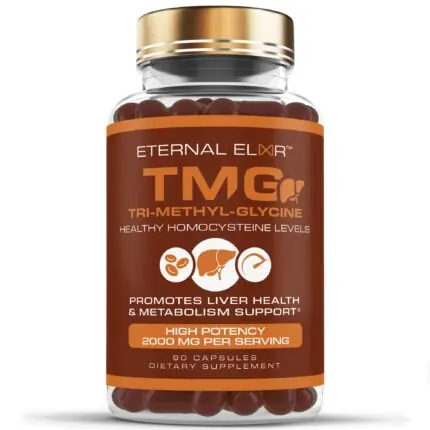
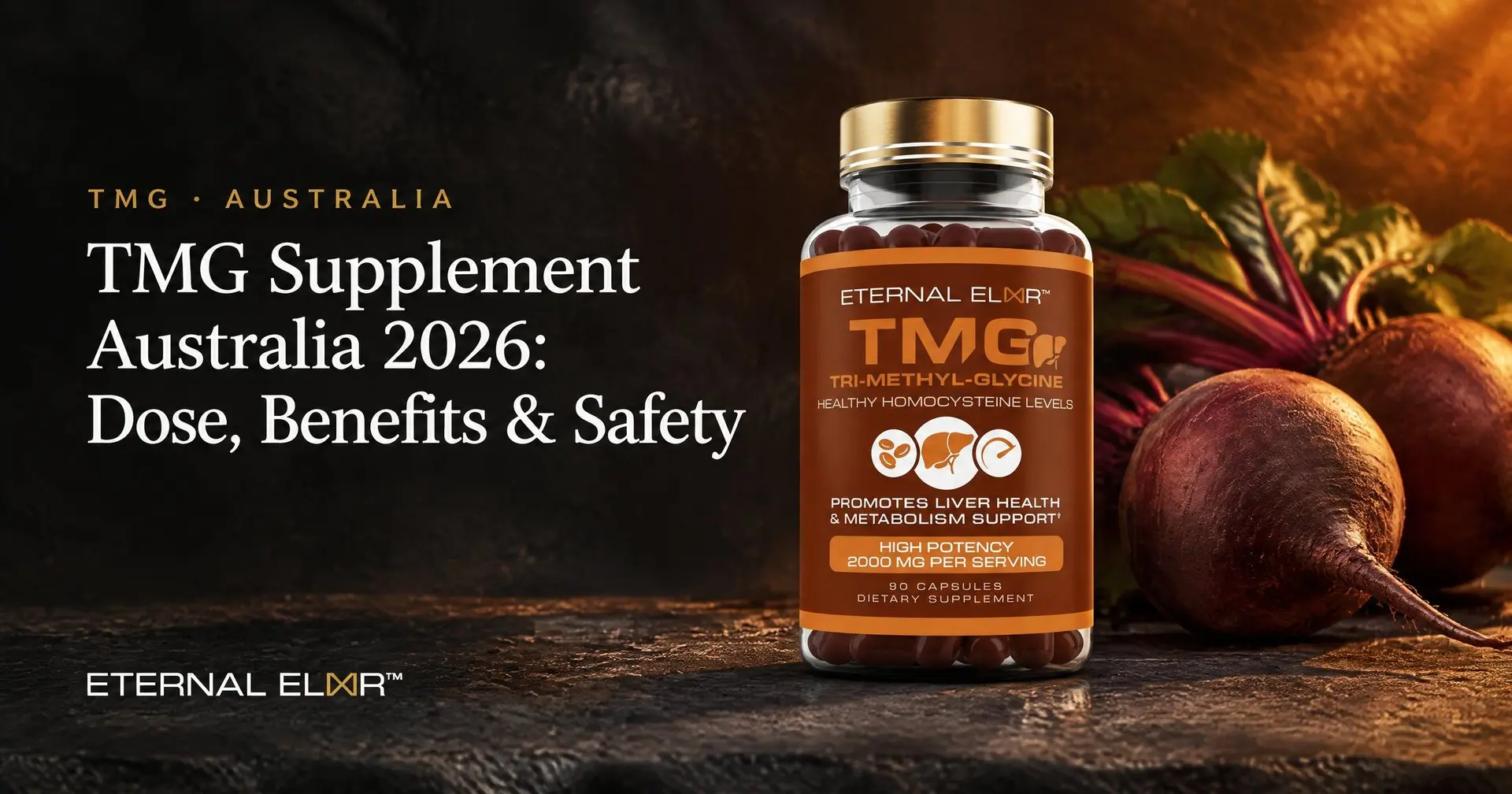
TMG (trimethylglycine, also called betaine) is a methyl donor that helps the body recycle homocysteine. In randomised trials, 1.5g to 6g a day lowered fasting homocysteine by 12% to 20% against placebo, with most of the effect at the lower doses. At 6g a day it also raised LDL cholesterol, so more is not better. Around 2,000mg a day with a meal sits inside the effective range and well below the dose that moved cholesterol. Our pick is Eternal Elixir TMG 2000mg: 2,000mg per three-capsule serve, 90 capsules, $44.99 for 30 days ($1.50 a day).
Eternal Elixir makes TMG 2000mg, so read the product sections as our pick with the working shown. Study figures come from the published abstracts listed under Sources; competitor prices were read from their own pages in September 2026.
A TMG supplement is one of the few longevity products where the mechanism is simple and the core human trials are old enough to have been checked many times over. This guide to TMG supplements in Australia for 2026 covers what TMG is, what each trial measured, how much to take and when, where it can backfire, and what a serve costs once every label is brought to the same number.
The short version: trimethylglycine reliably lowers homocysteine at doses you can get from an ordinary bottle, it has a specific biochemical reason to sit next to NMN, and the highest dose used in research comes with a cholesterol trade-off that few sellers mention. All three are true at once, and together they explain the dose we recommend.
Table of contents
- 1. TMG supplement: key takeaways
- 2. What is TMG (trimethylglycine)?
- 3. How TMG works: the methylation shortcut
- 4. What the human trials actually found
- 5. How much TMG to take
- 6. When to take TMG
- 7. Homocysteine: what the number actually means
- 8. Side effects and the cholesterol caveat
- 9. Who TMG suits
- 10. Why NMN users add TMG
- 11. TMG vs glycine, DMG and SAMe
- 12. Does TMG affect blood pressure?
- 13. What TMG does not do
- 14. Betaine in food: how much you already eat
- 15. Capsules, powder and the taste problem
- 16. TMG supplements in Australia compared (as of Sep 2026)
- 17. Where to buy TMG in Australia
- 18. How to choose a TMG supplement
- 19. What to take TMG with
- 20. What quality means for a commodity ingredient
- 21. Six mistakes people make with TMG
- 22. What to track in your first eight weeks
- 23. More on TMG
- 24. TMG supplement: frequently asked questions
- 24.1. What is the best TMG supplement in Australia?
- 24.2. Who should avoid taking TMG?
- 24.3. Does TMG supplement really work?
- 24.4. What is the best brand of TMG supplement?
- 24.5. How much TMG should I take per day?
- 24.6. Are TMG and betaine the same thing?
- 24.7. Do I need to take TMG with NMN?
- 24.8. When is the best time to take TMG?
- 24.9. How long does TMG take to work?
- 25. Sources
TMG supplement: key takeaways
- TMG and betaine anhydrous are the same molecule. Trimethylglycine is glycine carrying three methyl groups. It is not betaine HCl, which is a stomach-acid product sold for a different purpose.
- The homocysteine dose-response is clean. In a six-week randomised trial, 1.5g, 3g and 6g a day lowered fasting homocysteine by 12%, 15% and 20% against placebo. Most of the effect arrived at the lowest dose.
- Its distinctive strength is the after-meal rise. In a head-to-head trial, 6g of betaine blunted the homocysteine rise after a methionine load, where 800µg of folic acid did not.
- 6g a day raises LDL cholesterol. Pooled data from the Wageningen trials found LDL up 0.36mmol/L and triglycerides up 0.14mmol/L at that dose.
- 2,000mg a day is a sensible working dose: inside the range that moved homocysteine and a third of the dose that clearly moved LDL.
- The NMN pairing is reasonable, not essential. Clearing surplus nicotinamide uses methyl groups, but no trial has shown that NMN users need TMG.
- Training evidence is real but narrow. At 2.5g a day for six weeks, trained men improved body composition, arm size and bench-press work capacity, but not maximal strength.
- Check first if you have raised LDL cholesterol, reduced kidney function, are pregnant or breastfeeding, or take prescription medicines.
What is TMG (trimethylglycine)?
TMG is glycine, the smallest amino acid, with three methyl groups attached to its nitrogen atom. The name describes it exactly: three (tri) methyl groups on glycine.
You will also see it sold as betaine or betaine anhydrous. These are the same compound. “Betaine” is the older name, from its first discovery in sugar beet, and it is the name used in almost all the research. “Anhydrous” means the powder holds no bound water, which is what lets a manufacturer print an accurate milligram figure. If one bottle says betaine anhydrous 2,000mg and another says TMG 2,000mg, you are looking at the same thing at the same dose.
One name really is different. Betaine hydrochloride (betaine HCl) is not interchangeable with TMG. It is sold to add acid to the stomach, usually with pepsin, and the acid is the point of the product. Nobody takes betaine HCl for methylation, and nobody should take TMG expecting it to change stomach acidity. Our guide to betaine anhydrous vs TMG vs betaine HCl goes through the label wording in detail, and our explainer what is trimethylglycine? covers the chemistry.
Where your TMG already comes from
Your body makes betaine from choline in the liver and kidneys, and you eat it too. Wheat bran, wheat germ, spinach, beetroot and seafood are all good sources. The Dutch researchers who ran the key dose trial put typical dietary intake at about 0.5g to 2g a day. That matters, because the lowest dose they tested, 1.5g, sits inside the range some people already get from food.
Two properties make betaine useful as a supplement. It is a stable, water-soluble powder that keeps well. And it feeds a reaction the body otherwise runs through a more demanding pathway, which is the reason anyone takes it.
How TMG works: the methylation shortcut
Methylation is the transfer of a methyl group, one carbon atom with three hydrogens, from one molecule to another. It sounds small, but the body relies on it constantly: to make creatine and phosphatidylcholine, to switch genes on and off, to break down adrenaline, and to clear many compounds from circulation.
Most of that work is done by S-adenosylmethionine, usually written SAMe. When SAMe hands over its methyl group it becomes S-adenosylhomocysteine, which is quickly turned into homocysteine. Homocysteine is the used, methyl-free remainder, and the body has two options for it.
- Disposal. The transsulfuration pathway converts homocysteine towards cysteine and, eventually, glutathione. It needs vitamin B6 and is one-way.
- Recycling. A methyl group is reattached, turning homocysteine back into methionine, which can become SAMe again.
Two enzymes can do the recycling, and the difference between them is the whole case for TMG.
- Methionine synthase uses a form of folate as the methyl donor and needs vitamin B12. It works in almost every tissue. This is the folate route people usually mean when they talk about methylation nutrients.
- Betaine-homocysteine methyltransferase (BHMT) uses betaine as the methyl donor and needs neither folate nor B12. It is concentrated in the liver and kidneys.
Why the betaine route is a bypass, not a booster
TMG hands a methyl group straight to homocysteine and becomes dimethylglycine (DMG). The reaction is short and doesn’t depend on the folate cycle. So when the folate route is slow or short of supply, the betaine route is still open.
That also explains why TMG behaves differently from folate in trials. BHMT sits in the liver, where the methionine from a protein-rich meal arrives first and where the resulting homocysteine rise is generated. A methyl donor working in the liver is well placed to blunt that rise. A folate-dependent enzyme spread across the body is better placed to lower a baseline that stays high. Both are useful; they do different jobs, and the trials below show exactly that split.
DMG, the leftover, isn’t waste. It is broken down to sarcosine and then back to glycine, so the carbon skeleton returns to normal metabolism.
The same chemistry explains why betaine turns up in liver research. Making phosphatidylcholine uses methyl groups, and phosphatidylcholine is needed to package fat so the liver can export it. When methyl groups run short, that export slows. That is a mechanism, not a clinical promise, and the human liver research remains small. It is also why TMG sits naturally alongside our liver support supplements.
What the human trials actually found
TMG has an advantage over most longevity ingredients: the core trials were run by academic nutrition groups, they were randomised and placebo-controlled, and they measured a blood marker rather than a questionnaire. Here is what was measured, and by whom.
| Trial | Who took part | Daily dose and length | Main result |
|---|---|---|---|
| Olthof and colleagues, Journal of Nutrition, 2003 | Four groups of 19 healthy adults | 1.5g, 3g or 6g, or placebo; 6 weeks | Fasting homocysteine 12%, 15% and 20% below placebo; after-methionine rise 23%, 30% and 40% smaller |
| Steenge and colleagues, Journal of Nutrition, 2003 | Three groups of 12 adults with mildly raised homocysteine | 6g betaine, 800µg folic acid, or placebo; 6 weeks | Fasting homocysteine down 1.8µmol/L on betaine and 2.7µmol/L on folic acid; only betaine blunted the after-methionine rise |
| Olthof and colleagues, PLoS Medicine, 2005 | Pooled data from four trials; the betaine arms covered 151 people | 6g (lower doses also analysed); 6 weeks | LDL up 0.36mmol/L, triglycerides up 0.14mmol/L, total-to-HDL ratio up 0.23; HDL unchanged |
| Schwab and colleagues, American Journal of Clinical Nutrition, 2002 | 42 adults on a reduced-energy diet | 6g or placebo; 12 weeks | Homocysteine fell; weight, fat mass and energy expenditure changed no more than on diet alone; total and LDL cholesterol higher than control |
| Cholewa and colleagues, Journal of the International Society of Sports Nutrition, 2013 | 23 strength-trained men | 2.5g or placebo; 6 weeks | Better body composition, arm size and bench-press work capacity; no change in one-rep-max strength |
The homocysteine finding, in plain terms
The 2003 dose-response trial is the one worth remembering, because it answers the question every buyer has: how much do I need? Four groups of 19 healthy adults took 1.5g, 3g, 6g or placebo every day for six weeks. Fasting homocysteine ended 12%, 15% and 20% lower than placebo across the three doses.
Look at the shape of that curve rather than the top number. Quadrupling the dose from 1.5g to 6g added eight percentage points. The first 1.5g did most of the work. Because the researchers chose doses in the range of normal dietary intake, their conclusion was partly about food: a betaine-rich diet might do something similar.
The second measurement in that trial is the one marketing tends to skip. Participants were given a methionine load, a deliberate dose of the amino acid that generates homocysteine, and the resulting rise was measured. After six weeks, the rise was 23%, 30% and 40% smaller than placebo. The effect on the after-meal rise was larger than the effect on the fasting number.
The Steenge trial made that difference clearer by testing betaine head to head against folic acid in people with mildly raised homocysteine. On the fasting measurement, folic acid did better: 2.7µmol/L against 1.8µmol/L. On the after-methionine curve, betaine reduced the area under the curve and folic acid had no effect.
That is a useful division of labour, and it matches the biochemistry. If your concern is a fasting homocysteine that stays high, folate and B12 are the first-line nutrients, and no honest reading of the data says otherwise. If your concern is what happens after a large protein meal, the liver-based betaine route is the one that responds. The authors were careful about the limits: they wrote that it is not known whether betaine’s ability to steady homocysteine lowers heart and blood-vessel risk.
The training and body-composition finding
The 2013 trial in trained men is the most quoted part of the performance story, and it is narrower than the headlines suggest. Twenty-three experienced lifters, matched for training age and body fat, took 2.5g of betaine or a placebo through a six-week periodised programme.
What improved in the betaine group: arm cross-sectional area, body-fat percentage, fat mass, lean mass, and bench-press training volume in two of the three training blocks. What didn’t: one-rep-max bench press, one-rep-max back squat and vertical jump, where power only showed a trend. So betaine looked like a work-capacity and body-composition aid in that study, not a strength aid. It was also a small trial, and one co-author worked for a betaine manufacturer.
Set against it, the 2002 trial gave 42 adults 6g a day for 12 weeks alongside a reduced-energy diet. Weight, fat mass and resting energy expenditure fell in both groups, with no difference between betaine and placebo. Different people, dose and setting, but it is the reason nobody should sell TMG as a weight-loss product. Any body-composition effect looks modest and probably depends on training.
How fast it acts
A 2006 study gave ten healthy adults single doses of 1g, 3g and 6g in random order. Blood betaine rose straight away and in proportion to the dose. The 3g and 6g doses lowered homocysteine within two hours; the 1g dose did not. So betaine is absorbed quickly, but the homocysteine effects that matter for a daily habit were measured over weeks.
How much TMG to take
Work backwards from the trials rather than from the label.
The homocysteine dose-response starts at 1.5g, most of the available effect is present by 3g, and 6g is where the cholesterol rise in the pooled data becomes clear. The training trial used 2.5g. Much higher doses are used medically for a rare inherited metabolic disorder under specialist care, and those amounts have no bearing on a supplement decision.
That leaves a fairly narrow sensible window, and 2,000mg sits near the middle of it: above the lowest dose that produced a measurable change, well below the dose that produced an unwanted one, and close to the 2.5g used in the training study.
| Goal | Daily amount | Why | What to expect |
|---|---|---|---|
| General methylation support | Up to 2,000mg | Near the low end of the trial range, where most of the homocysteine effect appeared | Nothing you will feel; a blood marker change over about six weeks |
| Alongside NMN or NR | 2,000mg | Covers the extra methyl use from nicotinamide clearance | A reasonable precaution, not a noticeable effect |
| Training and work capacity | 2,000mg (the trial used 2.5g) | Close to the dose in the six-week lifting trial | Possibly more training volume; don’t expect a one-rep-max jump |
| High fasting homocysteine on a blood test | Talk to your GP first | Folate and B12 status should be checked before adding a methyl donor | A medical decision, not a self-directed one |
Our TMG is built for the middle rows of that table. The label serve is three capsules daily with a meal, giving 2,000mg, and a 90-capsule bottle holds 30 serves. Don’t take more than the label serve. Our TMG dosage guide covers splitting the serve across meals.
Compare cost per serve, never per capsule
The most common way people mislead themselves is comparing capsule prices. A 600mg capsule at a low unit price isn’t cheap if you want 2,000mg, and a label may not even allow that much. The only number that means anything is what you pay for the amount you actually take, within the label’s own directions.
When to take TMG
No trial has compared morning with evening TMG, so anyone claiming a definitive best time is guessing. What the mechanism supports is more modest and more useful.
- With food, not on an empty stomach. Betaine is a concentrated osmolyte. Taken on its own it can draw water into the gut and cause mild nausea or loose stools. With a meal, those problems largely disappear. Our label says to take it with a meal.
- With your most protein-rich meal, if you want to be precise. The clearest measured effect of betaine is on the homocysteine rise after a methionine load, and methionine arrives with protein. No trial has tested this timing head to head, but it lines the dose up with what betaine does best.
- With your NMN, if you take NMN. One morning routine is easier to keep than a second bottle at night, and there is no reason to separate them. Splitting the serve across two meals is also fine and may be gentler on the stomach.
What doesn’t matter: taking it before or after training, cycling it, or the exact clock time. Give it six to eight weeks at a sensible dose, and judge it on a blood test rather than on how you feel. In the pooled lipid data, the LDL effect at 6g was already visible after two weeks, which is another reason to stay near 2,000mg.
Homocysteine: what the number actually means
Almost every claim made for TMG runs through homocysteine, so it is worth understanding what that marker is and what it isn’t.
Homocysteine is an amino acid your body makes continuously as a by-product of methylation. It has no useful job of its own. It is a molecule in transit that should be either recycled to methionine or cleared through the cysteine pathway. When neither route keeps up, it builds up in the blood, and that is what a homocysteine test measures.
Three things push the number up. One is intake: a large methionine load, mostly from animal protein, creates more homocysteine to clear. Another is nutrient status: the folate route needs folate and B12, the disposal route needs B6, and the betaine route needs betaine. The third is physiology, mainly kidney function and age, which shift the baseline whatever you eat.
Does lowering the number change anything?
Raised homocysteine has been linked with poorer heart and blood-vessel health in observational studies for decades, which is why the marker became interesting. Showing that lowering it changes long-term outcomes has proved much harder, and the betaine researchers were explicit about that. The Steenge paper concluded that betaine looked highly effective at stopping homocysteine rising after methionine intake, then said plainly that it is not known whether this lowers risk.
So the honest framing is this: TMG moves a marker associated with heart and blood-vessel risk, and moves it reliably, without proof that moving it delivers the benefit the association suggests. That is a reasonable basis for an inexpensive, well-tolerated supplement at a sensible dose. It isn’t a basis for treating TMG as heart protection, and we don’t present it that way.
Should you test your homocysteine?
If you are taking TMG specifically for methylation, yes, or you are guessing at both the starting point and the result. It is an ordinary blood test your GP can order, usually with folate and B12, which is the right combination because those results change what the homocysteine number means.
Two practical notes. Homocysteine rises after eating, so the test should be done fasting to be comparable between draws. And one reading has natural variation; if a result surprises you, a repeat test tells you more.
If your fasting homocysteine is high, the evidence says to sort out folate and B12 first, because that is where the head-to-head trial showed the larger fasting effect. TMG complements that work and suits the after-meal load. Our guide to supporting healthy homocysteine levels sets out the diet and nutrient steps in the order the evidence supports.
Add TMG 2000mg to cart · $44.99Side effects and the cholesterol caveat
TMG is well tolerated at supplement doses, and the usual complaints are ordinary. The finding that deserves its own section is one you can’t feel, which is exactly why it is often left off product pages.
The LDL and triglyceride signal
In 2005 the Wageningen group pooled the blood-lipid data from four of their placebo-controlled trials and published the result in PLoS Medicine. Three of those trials tested betaine, with 151 participants. At 6g a day for six weeks, LDL cholesterol rose by 0.36mmol/L and triglycerides by 0.14mmol/L against placebo, and the ratio of total to HDL cholesterol rose by 0.23. HDL itself didn’t change. Doses below 6g also nudged LDL upward, but those smaller changes weren’t statistically significant.
The authors’ own conclusion was blunt: the effect on blood lipids may cancel out the potential heart-health benefit of lowering homocysteine, and folic acid remains the preferred nutrient for that job. The same researchers had shown the homocysteine benefit, which makes the finding hard to dismiss. The 2002 Finnish trial pointed the same way, with total and LDL cholesterol higher in the betaine group at the same 6g dose.
Three practical conclusions follow, and they are why this guide keeps coming back to 2,000mg.
- The dose is the safety feature. The clear lipid changes were at 6g. A 2,000mg serve is a third of that, in the range where most of the homocysteine effect already appears.
- If your LDL is already a concern, TMG isn’t a neutral addition. Our product page says the same: if you have raised cholesterol, discuss it with your doctor first.
- Measure rather than assume. If you take TMG for months, a lipid panel is inexpensive and settles the question for your own body rather than for a trial average.
The ordinary side effects
Digestive complaints are the common ones: mild nausea, bloating and loose stools. They depend on dose and on taking it without food. Taking the serve with a meal, or splitting it across two meals, resolves most of them, which fits with betaine acting as an osmolyte in the gut. Our TMG side effects guide covers these reports in more detail, including the “overmethylation” claims that circulate online.
Who should check with a doctor first
- Anyone with raised LDL cholesterol or who is managing their cholesterol, for the reason above.
- Anyone with reduced kidney function. The kidneys are a major site of betaine handling.
- Anyone pregnant or breastfeeding. Our label says not to use it during pregnancy or breastfeeding, and Switch Nutrition’s label says the same for its powder.
- Children and teenagers. Our product is for adults.
- Anyone taking prescription medicines, who should check with a pharmacist.
- Anyone chasing a symptom. Homocysteine is a blood test, not a feeling. If something is wrong, get the test and see your GP rather than starting a capsule.
Who TMG suits
“Anyone interested in healthy ageing” means nobody in particular. The mechanism is specific enough to be more useful than that.
- People taking NAD+ precursors such as NMN or NR. This is the most common reason Australians buy TMG, and the one with the clearest rationale, covered in the next section.
- People eating a lot of protein. More methionine means more homocysteine to clear each day, and the betaine route is the liver’s fast response to that load.
- Strength-trained lifters interested in training volume. The evidence is narrow but real, and points at work capacity rather than maximal strength.
- People whose folate route is working harder than average. A methyl donor that needs neither folate nor B12 complements those nutrients. If you looked into methylation because of a genetic test result, note that the betaine route bypasses the folate step for one reaction only, and a gene variant is not a diagnosis.
- People who want a methyl donor that acts mainly in the liver. The phosphatidylcholine mechanism is the neatest part of the betaine story, but the human liver research is small, so “studies suggest” is the strongest fair wording.
And the honest exclusions. TMG is a poor first choice if your fasting homocysteine is high and hasn’t been investigated, because folate and B12 have better fasting data. It is a poor choice if you want something you can feel. It is not a weight-loss product. And it is the wrong product entirely if what you wanted was betaine HCl for digestion.
Why NMN users add TMG
The NMN-plus-TMG pairing has become close to standard in longevity routines, and it is worth separating the solid part of the reasoning from the part that has been oversold.
The solid part is chemistry. NMN and nicotinamide riboside both raise NAD+, and NAD+ turnover releases nicotinamide. The body’s main way of clearing surplus nicotinamide is to methylate it: an enzyme called nicotinamide N-methyltransferase adds a methyl group, and the product is excreted. Each molecule cleared that way uses one methyl group, which ultimately comes from the same SAMe pool the rest of methylation draws on. So taking an NAD+ precursor every day increases methyl use, and a methyl donor becomes a reasonable precaution.
What has been oversold is the certainty. No trial has shown that NMN users run short of methyl groups, and no trial has shown that adding TMG improves any outcome in people taking NMN. The pairing makes sense on paper and is untested in people. Anyone telling you NMN without TMG is harmful is going beyond the evidence. Our article on why longevity routines pair NMN and TMG looks at where the “methyl depletion” idea came from.
In practice, if you already take our NMN 500mg, a 2,000mg TMG serve with the same meal covers the methyl side without going near the dose that moved LDL. To compare ready-made combinations, see our best NMN and TMG stacks in Australia; for NMN on its own, our NMN supplement comparison. If you take nicotinamide riboside instead, our Pure NR 500mg pairs the same way.
TMG vs glycine, DMG and SAMe
“Methyl donor” is used loosely enough that four quite different compounds end up in the same conversation. They are not substitutes for one another.
| Compound | What it does in methylation | Main limitation |
|---|---|---|
| TMG (betaine) | Gives a methyl group to homocysteine through BHMT, without needing folate or B12 | Raises LDL at 6g; acts mainly in the liver and kidneys |
| Glycine | Receives methyl groups rather than donating them; a building block for collagen and glutathione | Not a methyl donor at all |
| DMG (dimethylglycine) | What TMG becomes after donating one methyl group; can give up one more | Starts one methyl group poorer than TMG |
| SAMe | The body’s main methyl donor, taken directly | Costs more, less stable, and interacts with some medicines |
The most common mix-up is TMG and glycine, because the names invite it. Glycine is the molecule TMG is built on, but in methyl terms they run in opposite directions: TMG hands methyl groups out, glycine takes them in. Taking glycine doesn’t support methylation the way TMG does, and taking TMG isn’t a way to get glycine’s other uses. Our comparison of TMG vs glycine, DMG and SAMe sets each one against the reaction it takes part in.
Does TMG affect blood pressure?
This comes up often, partly because confident numbers circulate online that don’t trace back to controlled trials. The best evidence is the 2002 trial, which measured blood pressure as a secondary outcome. Diastolic blood pressure fell, but it fell in both groups, with no significant difference between betaine and placebo. Both groups were on a reduced-energy diet, which is the obvious explanation.
So in a randomised, placebo-controlled setting, betaine didn’t lower blood pressure beyond what the diet achieved. Nothing in the trial record suggests it raises blood pressure either. The heart-health question with betaine is about blood lipids at high doses, not blood pressure. If you take blood pressure medicine, any supplement decision belongs with your GP.
What TMG does not do
- It is not a fat burner. The idea comes from livestock research, where betaine reduces carcass fat in pigs. In the human trial on a reduced-energy diet, it made no difference to weight or fat mass beyond the diet itself.
- It is not a nootropic. TMG has no demonstrated effect on focus, memory or mood in healthy adults. It appears next to cognitive ingredients because it sits in longevity routines. For ingredients with cognitive evidence, see our guide to nootropics in Australia.
- It is not an energy supplement. There is no stimulant action and nothing you should notice the same day.
- It doesn’t replace folate or B12. The betaine route bypasses the folate step for one reaction only. It doesn’t stand in for folate or B12 in the many other reactions they serve.
- It won’t “overmethylate” you. The claim that methyl donors cause anxiety and irritability through overmethylation has no controlled evidence behind it. The documented effects at these doses are the digestive ones and the lipid change at 6g.
Betaine in food: how much you already eat
TMG is unusual in that your normal diet can supply a meaningful share of the trial doses. A 2003 analysis of common foods by Zeisel and colleagues measured the richest sources per 100g:
- wheat bran: 1,339mg
- wheat germ: 1,241mg
- spinach: 645mg
- pretzels: 237mg
- shrimp: 218mg
- wheat bread: 201mg
Two practical points follow. First, if you eat wholegrains and leafy greens every day, your extra benefit from a supplement is likely smaller than the trial percentages suggest, because you start from a higher baseline. Second, betaine is water-soluble, so some of it leaches into cooking water; steaming or roasting keeps more of it than boiling.
None of this makes supplementing pointless. Reaching 2,000mg reliably from food alone means eating wheat bran and spinach consistently, and food intake varies from day to day in a way a capsule doesn’t. But it does mean the honest framing is topping up a dietary compound, not adding a foreign one.
Capsules, powder and the taste problem
TMG comes as loose powder or capsules, and the trade-off is sharper than usual because betaine tastes bitter and slightly salty. At a 2,000mg serve that is noticeable in anything you mix it into.
Powder is cheaper per gram, sometimes by a lot, and lets you adjust the amount. It needs measuring, and a scoop is a volume rather than a weight.
Capsules cost more per gram but fix both problems: the dose is the same every time and you never taste it. For something you take daily for months without feeling any effect, sticking with it matters, and capsules are the form people keep taking.
There is no absorption argument between them. The 2006 study showed blood betaine rising quickly and in proportion to the dose after an oral drink, and nothing suggests the format changes that. Choose on cost, convenience and whether you will still be taking it in week eight. Our TMG powder vs capsules comparison puts numbers on the gap.
TMG supplements in Australia compared (as of Sep 2026)
The two Australian brands that sit alongside ours in search results are Switch Nutrition’s powder and Bulk Nutrients’ capsules. Here is how the three compare at each label’s own directions, using single-pack prices before postage.
| Product | Format | Price (AUD) | Label directions | Cost per day at the top of the label range | Buy |
|---|---|---|---|---|---|
| Eternal Elixir TMG 2000mg (our pick) | 90 vegetable capsules | $44.99 | 3 capsules (2,000mg) daily with a meal | $1.50 for 2,000mg | Eternal Elixir |
| Switch Nutrition TMG | Powder, 150 scoops of 1,000mg | $44.95 | 1 to 3 scoops daily with food | $0.60 for 2,000mg (two scoops) | Switch Nutrition |
| Bulk Nutrients TMG Capsules | 120 capsules of 600mg | $29.00 | 1 to 2 capsules (600mg to 1,200mg) daily | $0.48 for 1,200mg | Bulk Nutrients |
We are not going to pretend ours wins on price, because it doesn’t. Switch Nutrition’s powder costs $0.60 for 2,000mg if you are happy measuring and tasting it. Bulk Nutrients’ capsules are the cheapest per day, but its label stops at 1,200mg, so you would stay below the 2,000mg we recommend if you follow its directions.
What our $1.50 buys is a label serve built around 2,000mg in capsules, with only betaine anhydrous, rice flour and a vegetable capsule in the bottle, and dispatch from Sydney. Buying two bottles takes 10% off ($1.35 a day), three take 15% off ($1.27) and five take 20% off ($1.20). Orders over $100 ship free. For the full field, including imported brands, see our best TMG supplements in Australia.
Add TMG 2000mg to cart · $44.99Where to buy TMG in Australia
- Australian online brands: ours ships from Sydney. Switch Nutrition and Bulk Nutrients sell direct from their own sites, and some sports-nutrition retailers stock Switch.
- Pharmacies and supermarkets: TMG is a specialist item rather than a mainstream pharmacy line. Where “betaine” appears on a pharmacy shelf, check the ingredient: it may be betaine HCl in a digestive product. Our TMG at Chemist Warehouse guide covers what the chain stocks.
- Overseas marketplaces: imported TMG can be cheaper per gram, but delivery is slower and returns are harder. If you import, choose a seller that states how it tests its products.
How to choose a TMG supplement
- The label names the compound properly. “Trimethylglycine (TMG)” or “betaine anhydrous” is what you want. “Betaine hydrochloride” is a different product for a different purpose.
- The dose is stated per serve, next to the serve size. “2,000mg per serve (3 capsules)” tells you everything. A per-capsule figure leaves you to do the arithmetic.
- No proprietary blend. If TMG sits inside a blend with one combined milligram figure, you can’t tell how much TMG you are getting.
- The label’s own directions fit the amount you want. If a product’s directions stop below 2,000mg, follow them rather than taking extra capsules.
- The brand says how it tests. Betaine anhydrous is a commodity ingredient, and a brand that tests its products should say so.
What doesn’t matter: “liposomal” marketing, sustained release, added pepper extract, or claims that one brand’s betaine is chemically superior. It is a small, stable, water-soluble molecule that is absorbed quickly without help.
What to take TMG with
- NMN or nicotinamide riboside: the main pairing, for the methyl-use reason above. Same meal, no gap needed.
- Folate and B12, from food or a B complex: the two homocysteine-recycling routes complement each other. Folate did better on the fasting number, betaine on the after-meal rise.
- Creatine, if you train: making creatine is one of the body’s largest uses of methyl groups, so the two work on the same budget from opposite sides.
- Liver-focused supplements: betaine’s role in helping the liver export fat makes it a natural companion to our TUDCA 500mg, where the shared interest is bile and fat handling.
In a broader routine, TMG is a support ingredient rather than a headline one. It usually sits next to the NAD+ precursor as the inexpensive, well-reasoned extra, as it does in the routines in our best longevity supplements guide. Don’t combine it with SAMe without asking a pharmacist, since both work on the same cycle and SAMe interacts with some medicines.
What quality means for a commodity ingredient
Betaine anhydrous is made at industrial scale, largely from sugar beet processing, and it is chemically the same from any reputable supplier. So there is no premium form of TMG and no delivery system worth paying extra for. There are still a few things a brand can get wrong.
- Anhydrous versus monohydrate. Betaine monohydrate carries a bound water molecule, so a gram of it contains less betaine than a gram of anhydrous. Good labels say which they use.
- Fillers. Betaine attracts water from the air, which makes it awkward to encapsulate, so manufacturers add a small amount of a flow agent. That is normal; what matters is that the label is clear about it.
- Capsule material. Vegetable versus gelatin is a dietary choice rather than a quality one, but it is often missing from listings.
- Testing. For a commodity ingredient bought from bulk suppliers, identity and contaminant testing is what separates products.
Our TMG is betaine anhydrous in vegetable capsules with rice flour as the only other ingredient, at 2,000mg per three-capsule serve, and it is lab tested. That is a deliberately plain specification, which is the right ambition for a commodity methyl donor.
Six mistakes people make with TMG
- Assuming more is better. The homocysteine curve flattens after about 3g while the lipid rise appears at 6g.
- Buying betaine HCl by accident. The names are one word apart and the products are unrelated.
- Comparing prices per capsule. Convert everything to cost per serve at the label’s own directions.
- Expecting to feel it. TMG has no acute effect. The outcome it changes is a blood test over six weeks.
- Taking it on an empty stomach and blaming the product. Take it with a meal before deciding you can’t tolerate it.
- Treating it as a substitute for folate and B12. On fasting homocysteine, folic acid did better head to head.
What to track in your first eight weeks
Because there is nothing to feel, a TMG trial has to be judged on measurements. Eight weeks is the right window: the homocysteine effect in the dose trial was measured at six weeks, and the lipid change at 6g showed up at two.
- Before you start: ask your GP for a lipid panel and, if homocysteine is your reason for taking TMG, a fasting homocysteine test with folate and B12.
- Weeks one and two: watch digestive comfort. If you get nausea or loose stools, take the serve with a bigger meal or split it before giving up.
- Weeks three to six: if you train, track total training volume on your main lifts rather than testing a one-rep max, which is the measure that didn’t change in the trial.
- Week eight: repeat the bloods. You are looking at whether homocysteine moved and whether LDL moved. At 2,000mg the second should be unremarkable; if it has risen, talk to your GP.
What not to track: mood, energy, sleep and focus. People report changes in all of them on TMG, but none are outcomes the trials support.
More on TMG
This page is the hub for our TMG coverage. Each guide below goes deeper on one question:
- TMG benefits: each claim checked against the evidence.
- TMG dosage guide: amounts by goal and splitting the serve.
- TMG side effects: digestive reports, the cholesterol finding and the overmethylation claims.
- Betaine anhydrous vs TMG vs betaine HCl: three labels, two different products.
- TMG powder vs capsules: accuracy, taste and cost per serve.
- TMG vs glycine, DMG and SAMe: which ones are really methyl donors.
- Supporting healthy homocysteine levels: diet, the folate route and where betaine fits.
- TMG at Chemist Warehouse: where Australians can buy it.
You can read how we research and review products on our about us page, or browse the full Eternal Elixir range.
TMG supplement: frequently asked questions
What is the best TMG supplement in Australia?
Our pick is Eternal Elixir TMG 2000mg: 2,000mg of betaine anhydrous per three-capsule serve, 90 vegetable capsules, $1.50 a day, dispatched from Sydney. Eternal Elixir makes it. If the lowest cost matters most and you don’t mind measuring a bitter powder, Switch Nutrition TMG works out at $0.60 for 2,000mg.
Add TMG 2000mg to cart · $44.99
Who should avoid taking TMG?
Check with your doctor first if you have raised LDL cholesterol, because 6g a day raised LDL by 0.36mmol/L in pooled trial data. The same applies if you have reduced kidney function or take prescription medicines. Don’t use it while pregnant or breastfeeding, and our product is for adults.
Does TMG supplement really work?
For lowering homocysteine, yes: randomised trials found 1.5g to 6g a day lowered fasting homocysteine by 12% to 20% against placebo over six weeks, and blunted the rise after a protein load. Whether that lowers long-term heart and blood-vessel risk hasn’t been shown. It has no demonstrated effect on energy, focus or weight.
What is the best brand of TMG supplement?
The molecule is the same from any reputable supplier, so choose on label clarity, dose per serve, testing and cost. We recommend our own TMG 2000mg for its 2,000mg capsule serve and short ingredient list; Switch Nutrition is the lower-cost powder option.
How much TMG should I take per day?
Around 2,000mg a day with a meal suits general methylation support and pairing with an NAD+ precursor. Most of the homocysteine effect appeared by 3g in trials, and the cholesterol rise appeared at 6g. Follow your product’s label and don’t exceed it.
Are TMG and betaine the same thing?
Yes. Trimethylglycine and betaine anhydrous are two names for the same molecule. Betaine hydrochloride is different: a stomach-acid product, not a methyl donor.
Do I need to take TMG with NMN?
Not necessarily. Clearing surplus nicotinamide uses methyl groups, so TMG is a reasonable precaution with daily NMN, but no trial has shown NMN users run short or that adding TMG improves any outcome.
When is the best time to take TMG?
With food, ideally your most protein-rich meal. No trial has compared morning with evening. Taking it with a meal reduces the mild nausea some people get on an empty stomach.
How long does TMG take to work?
Blood betaine rises within hours of a dose, but the homocysteine changes in the trials were measured at six weeks. There is nothing to feel, so a fair trial means a blood test before you start and again at about eight weeks.
Sources
- Olthof MR, van Vliet T, Boelsma E, Verhoef P. Low dose betaine supplementation leads to immediate and long term lowering of plasma homocysteine in healthy men and women. Journal of Nutrition. 2003;133(12):4135-8. PubMed
- Steenge GR, Verhoef P, Katan MB. Betaine supplementation lowers plasma homocysteine in healthy men and women. Journal of Nutrition. 2003;133(5):1291-5. PubMed
- Olthof MR, van Vliet T, Verhoef P, et al. Effect of homocysteine-lowering nutrients on blood lipids: results from four randomised, placebo-controlled studies in healthy humans. PLoS Medicine. 2005;2(5):e135. PubMed
- Schwab U, Törrönen A, Toppinen L, et al. Betaine supplementation decreases plasma homocysteine concentrations but does not affect body weight, body composition, or resting energy expenditure in human subjects. American Journal of Clinical Nutrition. 2002;76(5):961-7. PubMed
- Cholewa JM, Wyszczelska-Rokiel M, Glowacki R, et al. Effects of betaine on body composition, performance, and homocysteine thiolactone. Journal of the International Society of Sports Nutrition. 2013;10(1):39. PubMed
- Schwab U, Törrönen A, Meririnne E, et al. Orally administered betaine has an acute and dose-dependent effect on serum betaine and plasma homocysteine concentrations in healthy humans. Journal of Nutrition. 2006;136(1):34-8. PubMed
- Zeisel SH, Mar MH, Howe JC, Holden JM. Concentrations of choline-containing compounds and betaine in common foods. Journal of Nutrition. 2003;133(5):1302-7. PubMed
- Craig SA. Betaine in human nutrition. American Journal of Clinical Nutrition. 2004;80(3):539-49. PubMed
- Product labels and prices: each seller’s product page, linked in the comparison table, read in September 2026.