Last updated: September 28, 2026 · Originally published: September 24, 2026 · By Eternal Elixir Editorial
TMG side effects are usually mild and mostly digestive. Some people notice nausea, bloating or looser stools, mainly after a large dose on an empty stomach. The effect that deserves more attention is one you can’t feel: at 6 g a day, three times a standard 2,000 mg serve, controlled trials recorded rises in LDL cholesterol and triglycerides. This 2026 review sets out what the research actually measured, dose by dose, and how to keep trimethylglycine easy to tolerate.
Key takeaways
- The side effects people most often describe are digestive (nausea, bloating, loose stools), and they tend to track the dose and whether TMG was taken with food.
- No serious adverse events were reported in the Dutch betaine trials, which gave the daily amount in two halves after meals.
- At 6 g a day, LDL cholesterol rose 0.36 mmol/L and triglycerides 0.14 mmol/L. Smaller rises at 1.5 g and 3 g were not statistically significant.
- A 2022 meta-analysis found no effect of betaine on blood pressure.
- Take it with a meal, split the serve, start with one capsule, and introduce it on its own.
Table of contents
- 1. Is There Any Harm in Taking TMG?
- 2. The Most Common TMG Side Effects Are Digestive
- 3. The Side Effect You Can’t Feel: Blood Lipids at High Doses
- 4. Does TMG Affect Blood Pressure?
- 5. Dose Used in Research vs What It Means for You
- 6. How Does TMG Make You Feel?
- 7. Should You Take TMG Every Day?
- 8. How to Minimise TMG Side Effects
- 9. How to Tell Whether a Symptom Is From TMG
- 10. Who Should Talk to a Doctor First
- 11. Eternal Elixir TMG 2000mg: What Is in the Bottle
- 12. The Bottom Line
- 13. Frequently Asked Questions
- 13.1. What are the most common side effects of TMG?
- 13.2. Is there any harm in taking TMG?
- 13.3. Does TMG raise cholesterol?
- 13.4. Does a 2,000 mg serve of TMG affect cholesterol?
- 13.5. Does TMG affect blood pressure?
- 13.6. How does TMG make you feel?
- 13.7. Should you take TMG every day?
- 13.8. Can TMG cause body odour?
- 13.9. Should I take TMG with food?
- 14. Sources
Is There Any Harm in Taking TMG?
For most healthy adults at the label serve, the realistic downsides are an unsettled stomach and, at higher doses, a rise in blood lipids. Trimethylglycine (sold as TMG, betaine or betaine anhydrous) is also a normal part of the diet: wheat bran, wheat germ and spinach are rich sources, and a 2004 review in the American Journal of Clinical Nutrition put those foods at roughly 1% betaine by weight for bran and germ.
The harm to take seriously is the cholesterol effect, because it produces no symptom. Anyone who tracks LDL, has a kidney condition, is pregnant or breastfeeding, or takes prescription medicine should talk to a doctor before starting. Our complete guide to TMG supplements in Australia covers dosing, timing and cost. This article stays on tolerability.
The Most Common TMG Side Effects Are Digestive
When people describe a problem with TMG, it is usually their stomach: mild nausea, bloating or looser stools. These complaints are most often described with larger amounts or a dose taken without food.
One plausible explanation: betaine is an osmolyte as well as a methyl-group donor, and a concentrated dose in an empty gut may draw water with it. That is a hypothesis, not a measured finding, but it fits the pattern that food and smaller doses help.
What the controlled trials actually recorded
The controlled trials are more reassuring than the anecdotes. Researchers at Wageningen in the Netherlands reported blood-lipid results from their betaine trials in healthy adults in a 2005 pooled analysis in PLoS Medicine. No serious adverse events were reported in any of the studies, and the non-serious events were listed in a supplementary table rather than flagged as a finding.
Two caveats. In those trials the betaine was dissolved in water and taken in two halves, after breakfast and after the evening meal, which is gentler than a single large dose on an empty stomach. And the trials were small and built to measure homocysteine, not tolerability. Digestive trouble was not a notable problem at 1.5 to 6 g a day taken that way, which is not the same as never.
Body odour: plausible, but anecdotal
A fishy body odour is sometimes mentioned online. Trimethylamine, a fishy-smelling compound, is produced by gut microbes from several nutrients, betaine among them, although in a laboratory model of the colon betaine was converted more slowly than choline or carnitine. We have found no controlled trial measuring odour at supplement doses, so treat it as anecdotal and mention it to your pharmacist if you notice it.
Headaches, poor sleep and “overmethylation”
Some online reports describe feeling wired, irritable or poorly slept on a methyl donor, labelled “overmethylation”. That is a term from online discussion, not the trial literature, and no controlled study has measured it. The stop-and-reintroduce test below will check your own case.
The Side Effect You Can’t Feel: Blood Lipids at High Doses
What 6 g a day did
The finding that matters most produces no symptom. Pooling blood-lipid data from three placebo-controlled betaine trials (151 participants), the Wageningen group found that six weeks at 6 g a day raised LDL cholesterol by 0.36 mmol/L and triglycerides by 0.14 mmol/L relative to placebo, an LDL rise of 11%. HDL did not move, and the LDL change was visible within two weeks. Australian pathology reports use mmol/L too, so these numbers map directly onto your results.
An independent Finnish trial agrees. In 42 adults on a 12-week reduced-energy diet, 6 g of betaine a day lowered homocysteine, but serum total and LDL cholesterol were higher than in the placebo group. Two later meta-analyses point to the same threshold. One, pooling six trials at 4 g a day or more, found total cholesterol 0.34 mmol/L higher, though its LDL estimate was not statistically significant. The other placed the lipid effect at 4 g a day and above.
What that means for a 2,000 mg serve
Be precise about the arithmetic. The significant lipid findings came from 6 g a day in trials and 4 g or more in pooled analyses. A 2,000 mg serve is one-third of 6 g and half of 4 g.
The closest evidence is the Olthof dose-response trial, whose 1.5 g and 3 g groups sit either side of a 2 g serve. Both showed higher LDL than placebo, but the rises were smaller and not statistically significant. The subgroup analysis in the 2022 meta-analysis likewise suggested that below 4 g a day, betaine lowered homocysteine without the lipid effect.
That is reassuring, and it is why 2,000 mg is a sensible working dose. It is not proof that 2 g leaves lipids untouched. No trial has tested 2 g alone, and “not statistically significant” in groups of 19 is not zero. If you watch your LDL, a lipid panel before starting and after a couple of months beats any study.
Does TMG Affect Blood Pressure?
The evidence says no. A 2022 systematic review and meta-analysis of betaine trials in Critical Reviews in Food Science and Nutrition found no effect of betaine supplementation on blood pressure, fasting blood glucose, C-reactive protein or liver enzymes. In the 12-week Finnish trial at 6 g a day, diastolic blood pressure fell in both the betaine and placebo groups, with no difference between them. If you take blood pressure medicine, it is still worth mentioning TMG to your doctor, as with any supplement.
Dose Used in Research vs What It Means for You
How a three-capsule serve compares with the doses used in human trials:
| Daily dose | Where it was used | What was recorded | What it means for you |
|---|---|---|---|
| 1.5 g | Olthof et al., 2003: 76 healthy adults, 6 weeks | Homocysteine 12% below placebo, LDL slightly higher (not significant) | Three-quarters of a serve |
| 2 g | Eternal Elixir TMG serve (3 capsules) | Not tested as a separate trial arm | Between two tested doses, never trialled on its own |
| 2.5 g | Cholewa et al., 2013: 23 strength-trained men, 6 weeks | Training and body-composition outcomes, blood lipids not among the reported results | Slightly above a serve |
| 3 g | Olthof et al., 2003 (same trial) | Homocysteine 15% below placebo, LDL slightly higher (not significant) | One and a half serves |
| 4 g and above | Two meta-analyses of randomised trials | Total cholesterol up 0.34 mmol/L in one analysis | Two serves or more, where pooled data show a lipid cost |
| 6 g | Olthof et al., 2005 (pooled, 6 weeks) and Schwab et al., 2002 (12 weeks) | LDL up 0.36 mmol/L, triglycerides up 0.14 mmol/L, total and LDL cholesterol above placebo | Three serves, the dose behind the cholesterol caution |
The lipid signal belongs to the 4 to 6 g range. The caveat is that nobody has trialled exactly 2 g. For choosing an amount, see our TMG dosage guide.
How Does TMG Make You Feel?
Most people notice nothing in particular, and that is expected. TMG is not a stimulant, and its main measured job, helping recycle homocysteine, can’t be felt. A single dose does act quickly in the blood: in a Finnish study of 10 healthy volunteers, serum betaine rose immediately and in a dose-dependent way, and single doses of 3 g and 6 g lowered plasma homocysteine within two hours.
The one trial in gym-goers, Cholewa and colleagues’ study of 23 strength-trained men, reported better body composition and bench-press work capacity on 2.5 g a day over six weeks, but no change in strength. That is a small study, and it doesn’t show a feeling you would notice from one day to the next. If you do feel wired, flat or unsettled after starting TMG, use the test further down to check whether TMG is the cause.
Should You Take TMG Every Day?
TMG is labelled for daily use, and the trials gave it daily. The Dutch and Finnish studies ran for six to twelve weeks, and the meta-analysis of higher doses covered trials of six to twenty-four weeks. Longer daily use has not been studied as carefully in healthy adults.
That argues for a simple routine if you take it long term: stay at the label serve, take it with food, and ask your GP to include a lipid panel in your usual blood tests. If you are taking TMG for homocysteine, a repeat homocysteine test tells you whether it is doing anything for you. Our guide to lowering homocysteine naturally explains why folate and vitamin B12 come first.
How to Minimise TMG Side Effects
Most of these steps simply copy what the trials did.
- Take it with a meal. The Dutch trials gave each half-dose after a meal, and our label says to take TMG with a meal. If it unsettles your stomach, an empty stomach is the first thing to change.
- Split the serve. Two capsules with breakfast and one with dinner, or the other way round.
- Start low. Each capsule holds roughly 667 mg. Take one with a meal for a few days, then two, then three.
- Stay at the label serve. More is not better. Doubling up moves you towards the doses behind the lipid findings.
- Check the ingredient name. Betaine anhydrous and TMG are the same compound. Betaine HCl is a different ingredient, sold for stomach acidity rather than methylation. See betaine anhydrous vs TMG vs betaine HCl.
- Introduce one supplement at a time. TMG is often paired with NMN (see why NMN users add TMG). Start both in the same week and you can’t tell which is responsible.
How to Tell Whether a Symptom Is From TMG
A simple stop-and-reintroduce test settles most questions.
- Note the pattern. Record what you notice, when, and whether you had eaten. Because blood betaine rises soon after a dose, a TMG-related upset should broadly line up with your doses.
- Check what else changed. A new supplement, diet, medication or stomach bug can do the same.
- Stop TMG. Wait until the symptom fully settles. If it persists well after stopping, TMG is unlikely to be the cause, so raise it with your GP.
- Reintroduce low. Restart with one capsule with a meal and build up over a week or so.
- Read the result. If the symptom returns with TMG and fades without it, you have your answer. Stay at the dose you tolerate, or stop.
Two exceptions. Never rechallenge after anything severe or alarming, and seek prompt medical advice instead. And a shift in LDL will never show up in a symptom diary. Only a blood test finds it.
Who Should Talk to a Doctor First
Speak with your doctor or pharmacist before starting TMG if you are pregnant or breastfeeding, take prescription medication, or have a medical condition. Three situations deserve a mention.
- Raised cholesterol, or cholesterol-lowering medication. TMG is not a neutral addition if LDL is a number you track.
- A kidney condition. The liver and kidneys are the main sites where betaine works as a methyl donor, so ask your doctor before starting.
- A raised homocysteine result. Betaine is one of several nutrients involved in recycling homocysteine. Let your GP guide what to test and take.
Eternal Elixir TMG 2000mg: What Is in the Bottle
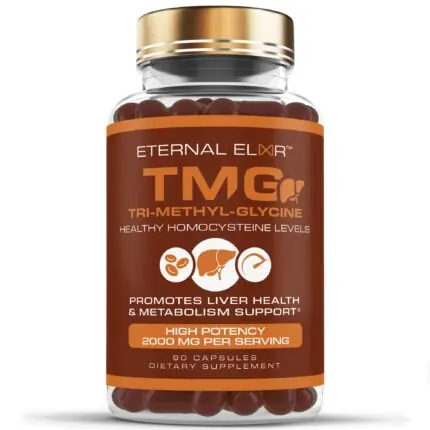
Side effects are dose-driven, which is why the serve printed on the label matters. Our TMG 2000mg puts 2,000 mg of betaine anhydrous in a three-capsule serve, with rice flour and a vegetable capsule as the only other ingredients. Each bottle holds 90 capsules, which is 30 serves at the label dose of three capsules daily with a meal, for $44.99 or $1.50 a serve.
Three capsules also make it easy to follow the advice above: start with one, split the serve across two meals, and stay well below the 4 to 6 g range behind the lipid findings. Orders ship from Sydney within 24 hours.
Who it suits: adults who want a measured betaine dose they can build up gradually, and who take it with food.
Who it doesn’t suit: people watching their LDL cholesterol unless their GP agrees, people who are pregnant or breastfeeding, and anyone who hasn’t yet checked their folate and vitamin B12 status if homocysteine is the reason for buying.
If you pair TMG with NMN, our NMN 500mg comes in 90-capsule bottles at one capsule a day. You can also browse the full Eternal Elixir shop. For other ingredients, see our guides to TUDCA side effects and berberine side effects.
The Bottom Line
For most people, TMG side effects are minor and manageable. An unsettled stomach is the usual complaint, and food, a split serve and a low start address most of it.
The finding to respect is the one you can’t feel: from 4 g a day upward, betaine raised blood lipids. A 2,000 mg serve sits below that range, a sensible place to be, though not a certainty. Keep to the serve, and if cholesterol is on your radar, let a blood test have the final word.
Frequently Asked Questions
What are the most common side effects of TMG?
Digestive effects: mild nausea, bloating and looser stools, usually with larger doses or when TMG is taken without food. In the Dutch trials, which split the dose after meals, no serious adverse events were reported.
Is there any harm in taking TMG?
For most healthy adults at the label serve, the main downsides are an unsettled stomach and, at 4 g a day or more, higher blood cholesterol. Talk to your doctor first if you track LDL, have a kidney condition, are pregnant or breastfeeding, or take prescription medicine.
Does TMG raise cholesterol?
At higher doses, yes. In pooled trial data, 6 g a day for six weeks raised LDL cholesterol by 0.36 mmol/L and triglycerides by 0.14 mmol/L against placebo, and meta-analyses place the lipid effect at 4 g a day and above.
Does a 2,000 mg serve of TMG affect cholesterol?
It has not been tested on its own. A 2,000 mg serve sits between the 1.5 g and 3 g doses, where LDL rises were small and not statistically significant, and below the 4 to 6 g range where significant changes appeared. That is reassuring, but it is not proof of no effect.
Add TMG 2000mg to cart · $44.99
Does TMG affect blood pressure?
Not in the research so far. A 2022 meta-analysis of betaine trials found no effect on blood pressure, and a 12-week trial at 6 g a day found no difference from placebo. Mention it to your doctor if you take blood pressure medicine.
How does TMG make you feel?
Most people notice nothing in particular. TMG is not a stimulant, and its main measured effect, lower homocysteine, can’t be felt. If you feel unsettled after starting it, stop, let things settle and reintroduce one capsule with a meal to check.
Should you take TMG every day?
It is labelled for daily use and was given daily in the trials, which ran for six to twenty-four weeks. For long-term use, stay at the label serve, take it with food and ask your GP to include a lipid panel in your usual blood tests.
Can TMG cause body odour?
It is sometimes reported online, and gut microbes can convert betaine into trimethylamine, a fishy-smelling compound. We have not found a controlled trial measuring odour at supplement doses, so treat it as anecdotal and mention it to your pharmacist if you notice it.
Should I take TMG with food?
Yes. Our label says to take it with a meal, it is the simplest way to reduce the chance of an upset stomach, and it mirrors the Dutch trials, which gave half the daily amount after breakfast and half after dinner.
Sources
- Olthof MR, van Vliet T, Verhoef P, Zock PL, Katan MB. Effect of homocysteine-lowering nutrients on blood lipids: results from four randomised, placebo-controlled studies in healthy humans. PLoS Med. 2005;2(5):e135. PubMed 15916468
- Olthof MR, van Vliet T, Boelsma E, Verhoef P. Low dose betaine supplementation leads to immediate and long term lowering of plasma homocysteine in healthy men and women. J Nutr. 2003;133(12):4135-8. PubMed 14652361
- Schwab U, Törrönen A, Toppinen L, et al. Betaine supplementation decreases plasma homocysteine concentrations but does not affect body weight, body composition, or resting energy expenditure in human subjects. Am J Clin Nutr. 2002;76(5):961-7. PubMed 12399266
- Zawieja EE, Zawieja B, Chmurzynska A. Betaine supplementation moderately increases total cholesterol levels: a systematic review and meta-analysis. J Diet Suppl. 2021;18(1):105-117. PubMed 31809615
- Ashtary-Larky D, Bagheri R, Ghanavati M, et al. Effects of betaine supplementation on cardiovascular markers: a systematic review and meta-analysis. Crit Rev Food Sci Nutr. 2022;62(23):6516-6533. PubMed 33764214
- Cholewa JM, Wyszczelska-Rokiel M, Glowacki R, et al. Effects of betaine on body composition, performance, and homocysteine thiolactone. J Int Soc Sports Nutr. 2013;10(1):39. PubMed 23967897
- Schwab U, Törrönen A, Meririnne E, et al. Orally administered betaine has an acute and dose-dependent effect on serum betaine and plasma homocysteine concentrations in healthy humans. J Nutr. 2006;136(1):34-8. PubMed 16365055
- Craig SA. Betaine in human nutrition. Am J Clin Nutr. 2004;80(3):539-49. PubMed 15321791
- Chhibber-Goel J, Gaur A, Singhal V, et al. The complex metabolism of trimethylamine in humans: endogenous and exogenous sources. Expert Rev Mol Med. 2016;18:e8. PubMed 27126549
- Day-Walsh P, Shehata E, Saha S, et al. The use of an in-vitro batch fermentation (human colon) model for investigating mechanisms of TMA production from choline, L-carnitine and related precursors by the human gut microbiota. Eur J Nutr. 2021;60(7):3987-3999. PubMed 33934200