Last updated: September 28, 2026 · Originally published: September 24, 2026 · By Eternal Elixir Editorial
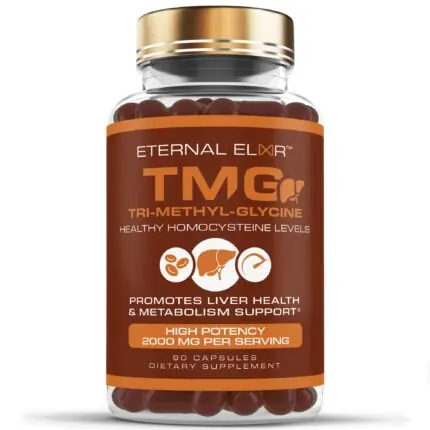
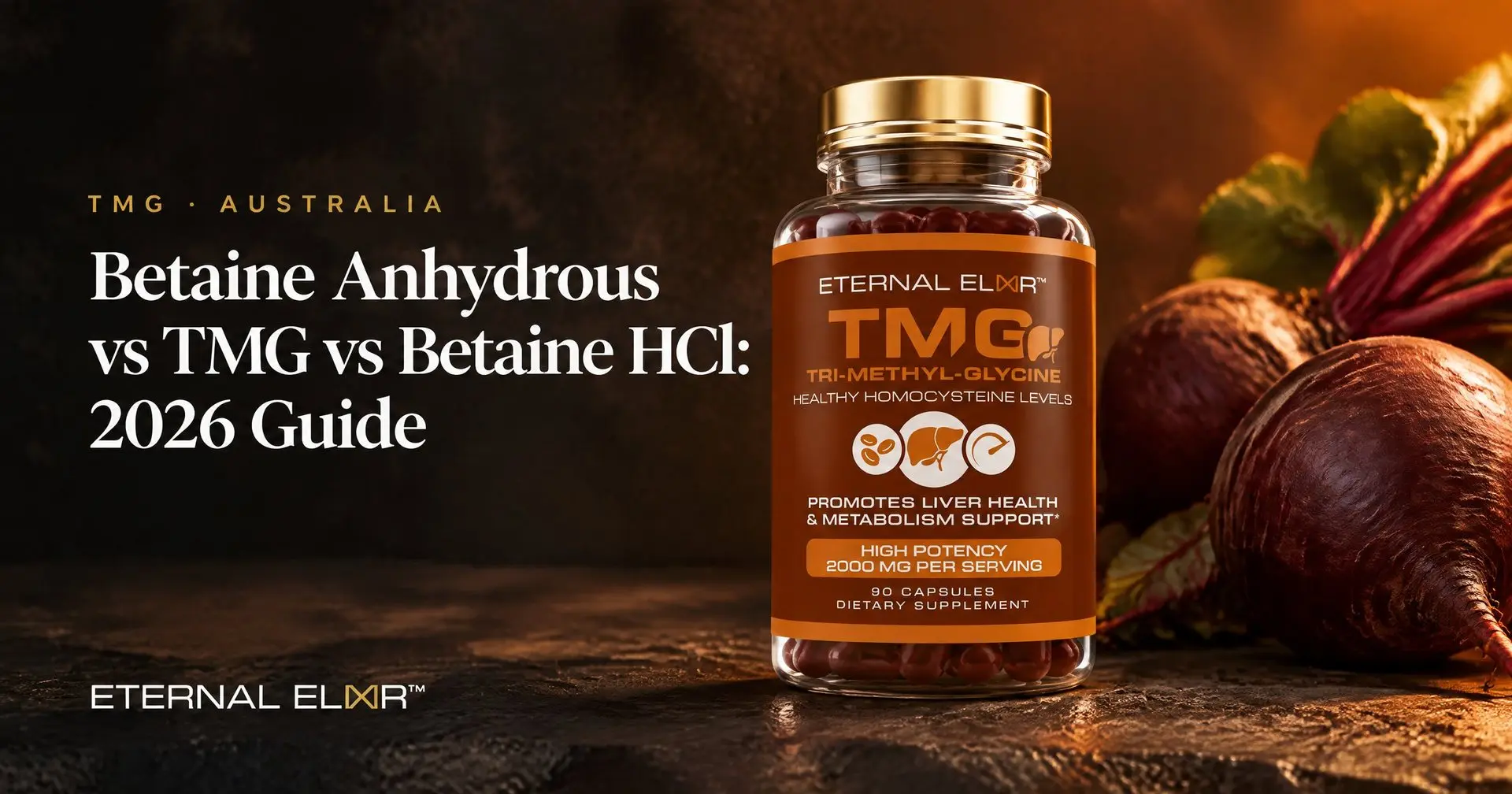
Quick answer: In the betaine anhydrous vs TMG vs betaine HCl question, the first two are the same thing. Betaine anhydrous and TMG (trimethylglycine) are one molecule under two names, and “anhydrous” just means the powder carries no bound water, so the milligrams on the label are all betaine. Betaine HCl (betaine hydrochloride) is a different product. It is betaine bonded to hydrochloric acid, taken at meals for digestive support, and only about 76% betaine by weight. If you want TMG as a methyl donor, the label should say betaine anhydrous or trimethylglycine. Our pick is Eternal Elixir TMG 2000mg: betaine anhydrous at 2,000 mg per three-capsule serve, 90 capsules for $44.99, shipped from Sydney within 24 hours. Eternal Elixir makes it.
Table of contents
- 1. Betaine anhydrous vs TMG vs betaine HCl at a glance
- 2. Betaine anhydrous and TMG are the same molecule
- 3. Betaine HCl is a different product for a different job
- 4. Why betaine HCl is the wrong tool for methyl-donor dosing
- 5. How Australian labels name it (as of Sep 2026)
- 6. How to read a betaine label in four checks
- 7. Where Eternal Elixir TMG 2000mg fits
- 8. Safety notes for both products
- 9. The bottom line
- 10. Frequently asked questions
- 11. Sources
Betaine anhydrous vs TMG vs betaine HCl at a glance
The first two names describe one ingredient, so they share a column. Betaine HCl is the one to keep separate.
| Feature | Betaine anhydrous / TMG | Betaine HCl |
|---|---|---|
| Also labelled as | Betaine, trimethylglycine, TMG, glycine betaine | Betaine hydrochloride, often sold “with pepsin” |
| Chemical form | Betaine itself with no bound water (C5H11NO2, 117.15 g/mol) | The hydrochloride salt of betaine (C5H12ClNO2, 153.61 g/mol) |
| Betaine by weight | 100% | About 76%. The rest is hydrochloric acid. |
| What it’s sold for | A methyl donor that supports methylation and normal homocysteine metabolism | Supplying stomach acid at mealtimes for digestive support |
| Typical amounts | 1.5 to 6 g a day in homocysteine trials, 2,000 mg per serve in our TMG | 500 to 648 mg per capsule on the labels we checked, taken with meals |
| When to take it | With a meal, as our label suggests. It carries no acid. | At the start of a meal and never on an empty stomach, per the labels |
| Where you see it | Longevity, methylation and sports formulas | Digestive formulas |
Betaine anhydrous and TMG are the same molecule
Trimethylglycine describes the structure: glycine, the smallest amino acid, with three methyl groups attached to its nitrogen. “Betaine” is the older name. A 2021 review in Biology notes that betaine was first identified in beets (Beta vulgaris) in the 19th century and is also found at high concentrations in wheat bran, wheat germ and spinach (Arumugam and colleagues, 2021). Almost all published research uses the word betaine, which is why trial papers and supplement labels can look as if they disagree when they don’t.
So when one Australian label reads “betaine anhydrous” and another reads “trimethylglycine (TMG)”, you’re looking at the same ingredient. Our complete guide to TMG supplements in Australia covers dosing, timing and buying. This article deals with the names.
One caution: chemists use “betaine” for a whole family of molecules. The supplement is glycine betaine. The cocamidopropyl betaine on a shampoo bottle is a foaming agent and an unrelated compound.
What “anhydrous” tells you
Anhydrous means “without water”. Betaine can also exist as a monohydrate, a crystal form that holds one molecule of water for each molecule of betaine. PubChem lists betaine at 117.15 g/mol and betaine monohydrate at 135.16 g/mol. Divide one by the other and the monohydrate turns out to be about 87% betaine and 13% water, so 2,000 mg of it would give you roughly 1,733 mg of betaine.
Betaine anhydrous has no such discount. The milligram figure on the label is the figure for the molecule itself. It isn’t a stronger form of TMG, just the accurately weighed one. For the chemistry in more depth, see what trimethylglycine is and what it does.
You already eat betaine
Betaine is part of an ordinary diet. An analysis of 145 common foods measured about 1,339 mg per 100 g in wheat bran, 1,241 mg in wheat germ and 645 mg in spinach (Zeisel and colleagues, 2003), and your body also makes betaine from choline. A capsule of betaine anhydrous adds to an intake you already have rather than introducing something unfamiliar.
Betaine HCl is a different product for a different job
Betaine hydrochloride, usually shortened to betaine HCl, is betaine bonded to hydrochloric acid, one molecule of each, forming a salt. It’s sold to supply hydrochloric acid, the same acid your stomach makes, at mealtimes, and it’s often paired with pepsin, a protein-digesting enzyme. NOW Foods’ Betaine HCl, sold in Australia, has 648 mg of betaine HCl and 150 mg of a fungal pepsin per capsule, with directions to take 1 capsule at the beginning of each meal. Thorne’s Betaine HCL & Pepsin gives 1 g of betaine HCl per two capsules, taken 1 to 2 capsules with each meal.
In this product the betaine is the carrier and the acid is the point. A small pharmacology study shows it clearly. Six healthy volunteers had their stomach acid temporarily reduced with an acid-lowering medicine for the study. A single 1,500 mg dose of betaine HCl then took stomach pH from about 5.2 to 0.6 in the 30 minutes after the dose, reaching pH below 3 in about 6 minutes on average, and pH stayed below 3 for around 73 minutes (Yago and colleagues, 2013). The effect was fast and temporary, which is what you’d expect from a dose of acid.
It’s formulated and dosed as a digestive product, not a methyl donor, and it shouldn’t be bought as one.
The arithmetic: betaine HCl is only about 76% betaine
Because the acid is part of the molecule, it’s also part of the weight. PubChem’s molecular weights make the split exact:
- Betaine: 117.15 g/mol
- Hydrochloric acid (HCl): 36.46 g/mol
- Betaine HCl: 117.15 + 36.46 = 153.61 g/mol
Betaine’s share is 117.15 ÷ 153.61 = 0.763, so betaine HCl is about 76% betaine and 24% hydrochloric acid by weight. A 648 mg capsule of betaine HCl contains about 494 mg of betaine, not 648 mg, and all of it arrives bonded to acid.
Why betaine HCl is the wrong tool for methyl-donor dosing
The human research on betaine as a methyl donor uses gram doses. In the most-cited dose-finding trial, four groups of 19 healthy adults took 1.5 g, 3 g or 6 g of betaine or a placebo every day for six weeks, and fasting plasma homocysteine finished 12%, 15% and 20% lower than placebo (Olthof and colleagues, 2003). A separate six-week trial in strength-trained men used 2.5 g a day (Cholewa and colleagues, 2013). A 2,000 mg serve of betaine anhydrous sits inside that tested range.
Now try to reach those doses with betaine HCl. Because it’s only 76% betaine, you multiply the betaine you want by 153.61 ÷ 117.15, which is 1.311:
| Betaine you want | Betaine HCl needed | Hydrochloric acid carried | 648 mg capsules |
|---|---|---|---|
| 1,500 mg | 1,967 mg | 467 mg | About 3 |
| 2,000 mg | 2,622 mg | 622 mg | About 4 |
| 3,000 mg | 3,934 mg | 934 mg | About 6 |
| 6,000 mg | 7,867 mg | 1,867 mg | About 12 |
Set that beside the pH study. A single 1,500 mg dose of betaine HCl, carrying about 356 mg of acid, took stomach pH below 1. Matching a 2,000 mg TMG serve would mean 1.75 times that amount of betaine HCl every day, and matching the 6 g used in the homocysteine trial would mean more than five times it. That’s about twelve 648 mg capsules, when the NOW label says one capsule per meal. Either way you’d be taking a daily acid load for a purpose the acid doesn’t serve.
The opposite mistake matters too. Betaine anhydrous carries no acid, so nobody should take TMG expecting it to do what betaine HCl does at a meal. If you’re working out how much TMG to take, our TMG dosage guide sets out the trial doses in more detail.
How Australian labels name it (as of Sep 2026)
Here’s how five products sold in Australia word the ingredient line, with prices from each seller’s product page in September 2026. Eternal Elixir makes TMG 2000mg and it is our pick. Every figure for the other products comes from their own labels and listings.
| Product | Ingredient line says | Label serve | Betaine per serve | Price (AUD) | Buy |
|---|---|---|---|---|---|
| Eternal Elixir TMG 2000mg (our pick) | Trimethylglycine (TMG, Betaine Anhydrous) | 3 capsules | 2,000 mg | $44.99 for 90 capsules | View TMG 2000mg |
| Bulk Nutrients TMG Capsules | Trimethylglycine (TMG) (as Betaine Anhydrous) | 1 capsule | 600 mg | $29.00 for 120 capsules | Bulk Nutrients |
| Naturecan TMG Supplement | Betaine anhydrous | 1 capsule | 686 mg | $34.00 for 60 capsules | Naturecan |
| myBrainCo TMG Powder 100g | Trimethylglycine (TMG) | 1 scoop | 1 g | $29.95 for 100 g | myBrainCo |
| NOW Foods Betaine HCl (Go Vita Thornton) | Betaine HCl, plus fungal pepsin | 1 capsule per meal | About 494 mg, bonded to acid | $39.95 for 120 capsules | Go Vita Thornton |
The first four are the methyl-donor product under its different names. The fifth is the digestive acid product. Of these five, only ours gives 2,000 mg of betaine anhydrous in one label serve. For cost per serve across more TMG brands, see our comparison of TMG supplements sold in Australia. If you’re choosing between a tub and capsules, our TMG powder vs capsules guide covers the trade-offs.
How to read a betaine label in four checks
- Find the ingredient name. For a methyl donor you want betaine anhydrous, trimethylglycine, TMG or simply betaine. If “hydrochloride” or “HCl” follows the word betaine, it’s the digestive acid product, whatever the front of the pack says. Pepsin or a protease on the same label is another giveaway.
- Check milligrams per serve, not per capsule. A serve can be more than one capsule. Our label lists 2,000 mg per serve of three capsules, which is about 667 mg per capsule.
- Count capsules per serve and per bottle. Divide the bottle count by the serve size to get the number of serves, then divide the price by the serves. Ninety capsules at three a serve is 30 serves, and at $44.99 that’s $1.50 a serve.
- If TMG is one ingredient among several, find its own figure. A multi-ingredient formula may hold a fraction of a standalone serve, and the headline number on the front may belong to a different ingredient.
Where Eternal Elixir TMG 2000mg fits
Label facts: 90 vegetable capsules per bottle, 30 serves. Take 3 capsules daily with a meal, giving 2,000 mg of trimethylglycine (betaine anhydrous). The other ingredients are rice flour and the vegetable capsule. There’s no hydrochloric acid and no pepsin.
That puts a dose inside the range the homocysteine trials used into one three-capsule serve, at $1.50 a serve. Orders ship from Sydney within 24 hours, with a 30-day money-back guarantee, Afterpay, and free shipping over $100. Two bottles take 10% off, three take 15% and five take 20%.
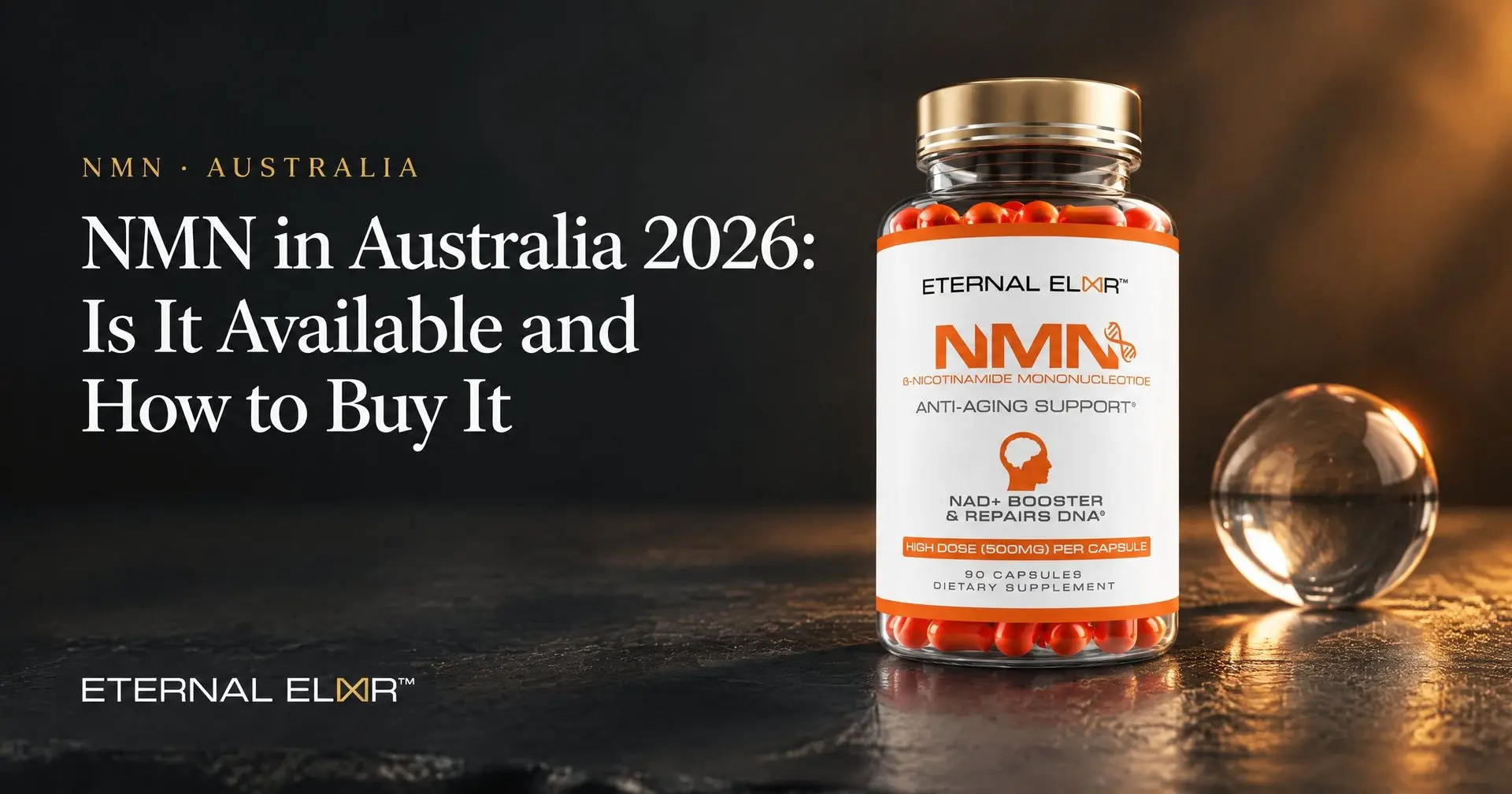
Many people take TMG alongside an NAD+ precursor. Our NMN 500mg is one capsule a day from a 90-capsule bottle, and our article on why NMN and TMG are often taken together explains the reasoning.
- Suits you if you want betaine anhydrous at 2,000 mg a day with nothing to measure, and you’d like it in the same order as your NMN.
- Doesn’t suit you if you’re after betaine HCl for mealtime digestion, which we don’t sell, or you want the lowest cost per gram, where powders win.
Safety notes for both products
Betaine HCl is an acid, so it doesn’t suit everyone. The NOW label says not to take it on an empty stomach, not to take it if you have stomach or duodenal ulcers, and to check with a doctor if you take medication or have a medical condition. Thorne’s label says not to use its formula alongside medicines that block stomach acid production. If you take any medicine that affects stomach acid, get advice before adding betaine HCl.
Betaine anhydrous has its own caveat at high doses. Pooled data from randomised, placebo-controlled trials in healthy people found that 6 g a day for six weeks raised LDL cholesterol by 0.36 mmol/L and triglycerides by 0.14 mmol/L compared with placebo (Olthof and colleagues, 2005). A 2022 meta-analysis found that doses under 4 g a day lowered homocysteine without that effect on blood lipids (Ashtary-Larky and colleagues, 2022). A 2,000 mg serve sits under that line. We cover the rest in our guide to TMG side effects.
Whichever product you’re considering, talk to your doctor or pharmacist before you start if you’re pregnant or breastfeeding, take prescription medicines or have a medical condition.
The bottom line
Betaine anhydrous and TMG are one molecule with two names, and “anhydrous” tells you the milligram figure is all betaine. Betaine HCl is betaine bonded to hydrochloric acid, about 76% betaine by weight, and it belongs at the meal table as a digestive product rather than in a methyl-donor routine. Read the ingredient line, check milligrams per serve and capsules per serve, and the naming confusion goes away. For what TMG does once you’ve got the right product, read our explainer on TMG benefits for methylation and the liver, or browse the full Eternal Elixir range.
Frequently asked questions
Is betaine anhydrous the same as TMG?
Yes. Betaine anhydrous and trimethylglycine (TMG) are the same molecule: glycine with three methyl groups attached. “Betaine” is the older name used in most research, and “anhydrous” means the powder carries no bound water, so the milligram figure on the label is all betaine.
What is betaine HCl used for?
Betaine HCl (betaine hydrochloride) is taken at the start of a meal to supply hydrochloric acid for digestive support. It’s often combined with pepsin. It isn’t designed or dosed as a methyl donor.
Can I take betaine HCl instead of TMG?
It’s the wrong tool. Betaine HCl is only about 76% betaine by weight, so matching a 2,000 mg TMG serve would take about 2,622 mg of betaine HCl, carrying 622 mg of hydrochloric acid, every day. For methyl-donor support, choose a product labelled betaine anhydrous or trimethylglycine.
Add TMG 2000mg to cart · $44.99
Which betaine anhydrous supplement is best?
Our pick is Eternal Elixir TMG 2000mg. Its label names betaine anhydrous, three capsules give 2,000 mg, inside the 1.5 to 6 g range used in the main human trial, and a 90-capsule bottle is $44.99 and ships from Sydney. Eternal Elixir makes it. If the lowest cost per gram matters more to you, a TMG powder costs less per gram.
Why do supplement labels say “anhydrous”?
Anhydrous means without water. Betaine can also exist as a monohydrate, which is about 13% water by weight. Saying betaine anhydrous tells you the stated milligrams are the active molecule itself, with no water weight included.
How much betaine anhydrous do people take?
Human trials have used 1.5 to 6 g a day in homocysteine research and 2.5 g a day in a sports study. Our TMG gives 2,000 mg per three-capsule serve, inside that range. Pooled trial data linked 6 g a day to higher LDL cholesterol, so more isn’t automatically better.
Sources
- Arumugam MK, Paal MC, Donohue TM, et al. Beneficial effects of betaine: a comprehensive review. Biology (Basel). 2021;10(6):456. PMC8224793
- Zeisel SH, Mar MH, Howe JC, Holden JM. Concentrations of choline-containing compounds and betaine in common foods. J Nutr. 2003;133(5):1302-1307. PubMed 12730414
- Yago MR, Frymoyer AR, Smelick GS, et al. Gastric reacidification with betaine HCl in healthy volunteers with rabeprazole-induced hypochlorhydria. Mol Pharm. 2013;10(11):4032-4037. PubMed 23980906
- Olthof MR, van Vliet T, Boelsma E, Verhoef P. Low dose betaine supplementation leads to immediate and long term lowering of plasma homocysteine in healthy men and women. J Nutr. 2003;133(12):4135-4138. PubMed 14652361
- Cholewa JM, Wyszczelska-Rokiel M, Glowacki R, et al. Effects of betaine on body composition, performance, and homocysteine thiolactone. J Int Soc Sports Nutr. 2013;10(1):39. PubMed 23967897
- Olthof MR, van Vliet T, Verhoef P, Zock PL, Katan MB. Effect of homocysteine-lowering nutrients on blood lipids: results from four randomised, placebo-controlled studies in healthy humans. PLoS Med. 2005;2(5):e135. PubMed 15916468
- Ashtary-Larky D, Bagheri R, Ghanavati M, et al. Effects of betaine supplementation on cardiovascular markers: a systematic review and meta-analysis. Crit Rev Food Sci Nutr. 2022;62(23):6516-6533. PubMed 33764214
- PubChem molecular weights: betaine (CID 247), betaine hydrochloride (CID 11545), betaine monohydrate (CID 24884197), hydrogen chloride (CID 313).
- Product labels checked September 2026: Eternal Elixir TMG 2000mg, Bulk Nutrients TMG Capsules, Naturecan TMG Supplement, myBrainCo TMG Powder 100g, NOW Foods Betaine HCl 648mg (Go Vita Thornton listing), Thorne Betaine HCL & Pepsin.