Last updated: September 12, 2026 · By Eternal Elixir Editorial
By Eternal Elixir Editorial · Updated 12 September 2026
TMG benefits come down to one job done well: donating a methyl group. Trimethylglycine, also called betaine anhydrous, hands a spare methyl group to homocysteine and turns it back into methionine.
That single reaction sits underneath the claims you see on labels for heart, liver, training and healthy ageing. The human evidence is real, but it is narrower than the marketing suggests, and the doses used in trials are not always the dose in your bottle.
This guide sorts the TMG benefits with solid human data from the ones still riding on mechanism alone. It also shows what an Australian 2,000 mg serve does and does not reach.
Key takeaways
- The best-evidenced TMG benefits are lower fasting homocysteine and support for liver fat handling, both driven by methyl donation.
- Controlled trials moved homocysteine at 1.5 g to 6 g of betaine daily; Eternal Elixir’s serve is 2,000 mg from three capsules.
- Training and body-composition effects are smaller and less consistent, and one trial saw LDL cholesterol rise at 6 g daily.
- Australians most often take TMG alongside NMN, because clearing nicotinamide uses methyl groups.
Table of contents
- 1. TMG Benefits at a Glance: What Trimethylglycine Does
- 2. How TMG Works as a Methyl Donor
- 3. The TMG Benefits With the Strongest Human Evidence
- 4. Trial Doses Versus Bottle Doses: The Reality Check
- 5. How to Take TMG in Australia
- 6. Side Effects, Cholesterol and Who Should Be Careful
- 7. TMG Benefits: Common Questions
TMG Benefits at a Glance: What Trimethylglycine Does
TMG is a methyl donor. Its clearest measured effect in humans is lowering fasting plasma homocysteine, with supporting evidence for liver fat metabolism and a smaller, less consistent signal for body composition.
Betaine was named after sugar beet, where it was first isolated. Your body also makes it from choline, and you eat it in beetroot, spinach, quinoa, wheat bran and prawns.
Supplemental TMG is the same molecule in a concentrated dose. A typical Australian serve delivers 1,000 mg to 3,000 mg, which is well above what most diets supply.
Interest in TMG in Australia has grown alongside the NAD+ category, and the two are closely linked. Our roundup of NAD+ supplements compared for Australians covers why a methyl donor keeps appearing beside NMN on ingredient lists.
That association cuts both ways. It has pulled TMG into more shopping baskets than the evidence alone would justify, and it has also made a genuinely useful nutrient easier to find locally.
For the wider picture, our guide to the best longevity supplements in Australia ranks the main categories by daily cost. TMG sits near the cheap end of that list.
The table below separates the claims by how much human evidence sits behind each one.
| Claimed benefit | Human evidence | What that means in practice |
|---|---|---|
| Lower fasting homocysteine | Strong: placebo-controlled trials, dose-dependent | The reason most people start taking it |
| Liver fat handling | Moderate: mechanism plus animal work, human data still developing | Plausible support, not a settled outcome |
| Fat mass during resistance training | Mixed: some randomised trials positive, others neutral | A modest extra, not a training shortcut |
| Methyl support when taking NMN | Mechanistic: no trial has tested the pairing | A reasonable rationale, not proof |
How TMG Works as a Methyl Donor
Methylation is the transfer of a small carbon-hydrogen group from one molecule to another. Your body runs it billions of times a second to build neurotransmitters, switch genes on and off, and process waste.
Homocysteine is a by-product of that machinery. It builds up when methylation slows down, and it needs a methyl group to convert back into methionine.
There are two routes for that conversion. One depends on folate and B12; the other uses betaine and an enzyme called BHMT, which is concentrated in the liver and kidneys.
TMG feeds the second route directly. That is why supplementing it lowers homocysteine even in people whose folate status is already adequate.
Demand on that methyl pool is not fixed. Ageing, alcohol, a high-protein diet and certain genetic variants all push more work through the pathway.
So do several popular supplements. Anything that raises the amount of nicotinamide your body has to clear will draw on the same pool of methyl groups.
A 2021 review of betaine research in the journal Biology traced the same pathway across liver, muscle and metabolic tissue. The authors linked betaine’s protective effects to maintaining the cellular SAM to SAH ratio (Arumugam and colleagues, 2021).
That ratio is the working measure of how freely methylation can proceed. When it falls, methylation reactions across the body slow down together.
Keep in mind that a review summarises other studies rather than testing anything itself. It is useful for mapping the mechanism, not for proving an outcome.
The TMG Benefits With the Strongest Human Evidence
Three areas have been tested in people with a placebo group. They are worth separating, because the quality of the evidence differs sharply.
Homocysteine and methylation
Homocysteine is an amino acid your body makes while processing methionine from dietary protein. It is measured with a standard blood test that most Australian GPs can order.
Raised levels are treated as a marker of how well the methylation pathway is coping, not as a disease in themselves. Lowering the marker is what the trials measured.
This is the best-supported of the TMG benefits. A six-week controlled trial in healthy men and women gave four groups either placebo or 1.5 g, 3 g or 6 g of betaine daily.
Fasting homocysteine finished 12%, 15% and 20% lower than placebo across those three doses (Olthof and colleagues, The Journal of Nutrition, 2003). The response was dose-dependent, and even the lowest dose sat inside what a betaine-rich diet can supply.
A second randomised trial in 42 adults with obesity used 6 g daily for 12 weeks. Plasma homocysteine fell in the betaine group compared with placebo (Schwab and colleagues, The American Journal of Clinical Nutrition, 2002).
Two independent trials, two different populations, the same direction of effect. That is about as consistent as supplement research gets.
Both trials used betaine on its own rather than inside a blend. That makes the result easier to attribute than the multi-ingredient studies behind many supplement claims.
Liver and fat metabolism
The liver holds most of the body’s BHMT enzyme, so it is the organ where betaine is most active. Methyl groups are needed to package fat into the particles that carry it out of liver cells.
Short on methyl donors, that export slows and fat accumulates. This is the mechanism behind betaine’s reputation for liver support, and it is the main thread in the 2021 Biology review.
Most of that evidence comes from cell and animal models rather than from people. Animal work shows the direction of an effect; it does not establish the size of one in humans.
Human outcome data here is thinner than the mechanism suggests. Treat liver support as a reasonable rationale rather than a demonstrated result, and read our broader comparison of liver support supplements sold in Australia before building a stack around it.
Training and body composition
Betaine also works as an osmolyte, helping cells hold water under stress. That property is why it turns up in pre-workout formulas.
An eight-week randomised, double-blind trial gave 23 untrained women 2.5 g of betaine or placebo alongside a resistance programme. Body fat percentage dropped further in the betaine group, at -3.3% versus -1.7% (Cholewa and colleagues, Journal of the International Society of Sports Nutrition, 2018).
Gains in squat and bench press strength were no different between the groups. Weekly training volume trended higher on betaine, but the difference did not reach significance.
Worth naming openly: that trial was funded by a betaine ingredient supplier, and the sample was small. The honest summary is a modest body-composition effect with no strength advantage.
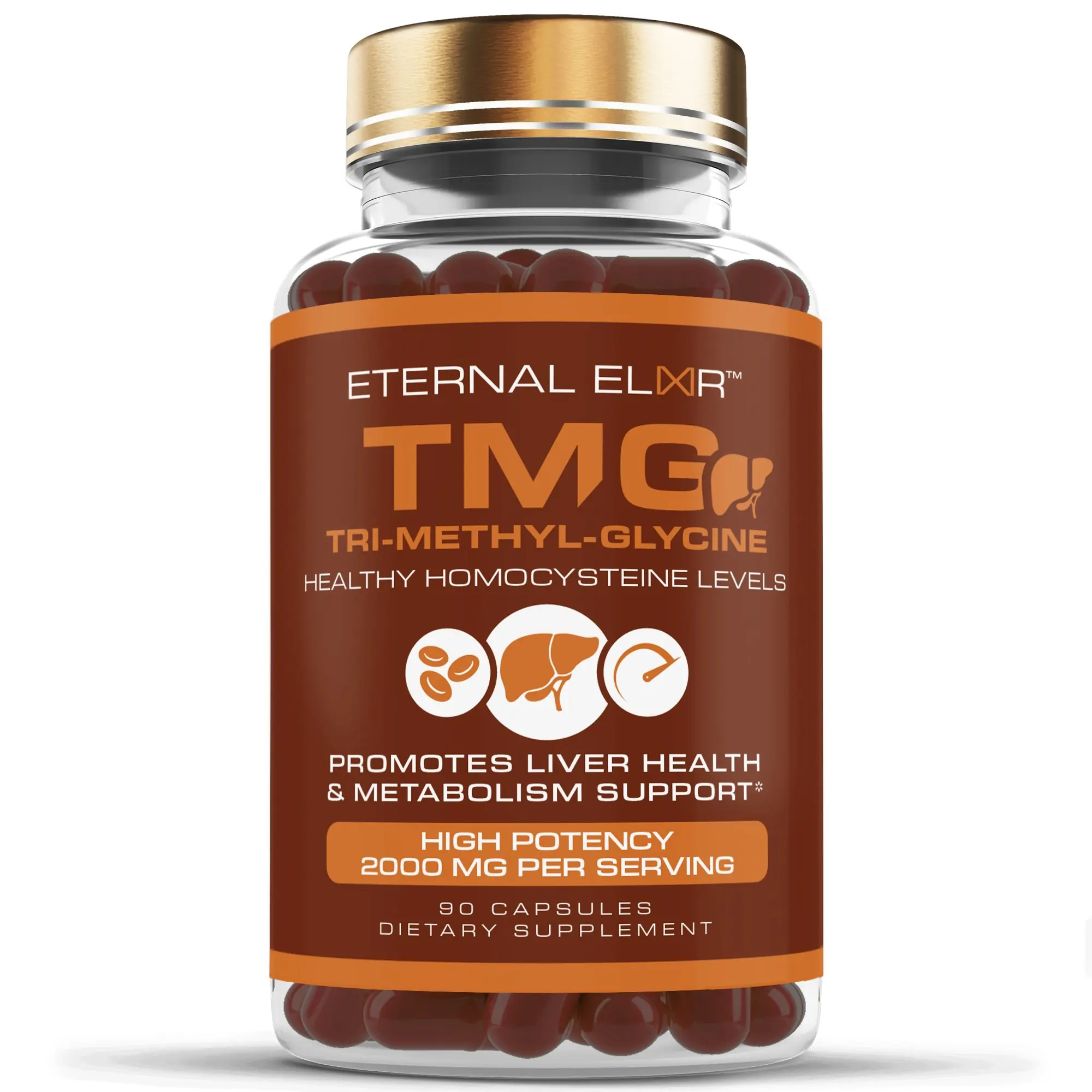
Trying TMG in Australia? Eternal Elixir’s TMG Capsules 2000mg ships locally with 90 capsules per bottle — twice the value of most competitors. Browse the longevity range →
Trial Doses Versus Bottle Doses: The Reality Check
Most TMG articles list the benefits and then list a dose range, without connecting the two. That gap matters, because several of the headline findings came from doses well above a standard serve.
Eternal Elixir’s TMG serve is 2,000 mg, delivered as three capsules. Here is how that lines up against the doses that produced each published result.
| Outcome measured | Daily dose in the trial | Length | Versus a 2,000 mg serve |
|---|---|---|---|
| Homocysteine down 12% vs placebo | 1.5 g | 6 weeks | Below one serve; 2 capsules covers it |
| Homocysteine down 15% vs placebo | 3 g | 6 weeks | 1.5 serves |
| Homocysteine down 20% vs placebo | 6 g | 6 weeks | 3 serves; also the dose where LDL rose |
| Fat mass down 3.3% in trained women | 2.5 g | 8 weeks | About 1.25 serves |
Read down that last column and the picture gets clearer. A 2,000 mg serve sits comfortably inside the range that moved homocysteine, and just under the dose used in the body-composition trial.
It also sits well below the 6 g that produced both the largest homocysteine drop and the unwanted cholesterol change. For most people that is the right trade, and it is why we set the serve where we did.
Cost per serve is the other number worth normalising. Bulk TMG powder is cheaper per gram than any capsule, so compare on dollars per 2,000 mg rather than dollars per bottle.
Capsules buy you dose accuracy and no taste, which matters for a compound that is noticeably sweet in powder form. Australians can also buy TMG locally in capsule form rather than importing a tub and waiting weeks for it.
How to Take TMG in Australia
Dosing TMG is simple once you know which outcome you are chasing. The homocysteine trials clustered between 1.5 g and 6 g daily, and the training work sat at 2.5 g.
Dose and timing
Eternal Elixir’s TMG capsules are 90 capsules per bottle, with three capsules giving 2,000 mg. At $44.99 that works out to $1.50 per 2,000 mg serve, since a bottle holds 30 full serves. If you want to see how that compares with other Australian TMG brands, our roundup of the best TMG supplements in Australia lines up six options on cost.
Take the serve with a meal. TMG is water-soluble and mildly sweet, and food blunts the mild nausea a few people report on an empty stomach.
Splitting the three capsules across the day is fine if a single dose feels heavy. Consistency across weeks matters more than the exact hour, because the homocysteine trials measured their effects at six and twelve weeks.
Pairing TMG with NMN
This is the most common reason Australians add TMG to an existing stack. Your body clears excess nicotinamide by methylating it, using an enzyme called NNMT.
More NAD+ precursor in, more nicotinamide to clear, more methyl groups spent. Topping up the methyl pool with TMG is the logic behind the pairing, and it is a rationale rather than a tested protocol.
No randomised trial has yet compared NMN alone against NMN plus TMG in people. Our guide to NMN and the NAD+ pathway covers the precursor evidence in detail.
For the buying side, our comparison of NAD+ supplements sold in Australia sets out the options by cost per serve. A practical pairing is one 500 mg NMN capsule in the morning with the TMG serve alongside it.
If you are unsure that a single capsule is the right starting point, we looked at whether one 500 mg NMN capsule is enough in a separate piece. Eternal Elixir’s NMN is $59.99 for 90 capsules, which works out to $0.67 per 500 mg serve.
Who tends to get the most from it
The TMG benefits land hardest for people whose methyl demand is already high. That includes anyone taking an NAD+ precursor daily, and anyone eating a high-protein diet.
People with a known raised homocysteine reading are the other clear group. They have a measurable marker to track, which turns a vague supplement into something you can actually test.
If none of that describes you, TMG is a reasonable but low-priority addition. A methyl donor supports a pathway rather than producing a felt effect, so the value shows up on a blood test rather than in how your Tuesday goes.
Side Effects, Cholesterol and Who Should Be Careful
TMG is well tolerated at the doses sold in Australia. The most common complaints are mild digestive ones: nausea, bloating or loose stools, usually at higher doses and usually on an empty stomach.
The cholesterol finding deserves its own line. In the 12-week trial in adults with obesity, serum total and LDL cholesterol were significantly higher in the 6 g betaine group than in the control group.
That dose is three times a standard Australian serve, and the effect has not been reported consistently at lower intakes. It is still a good reason not to treat more as automatically better.
A few people notice a jittery or over-stimulated feeling when they add a strong methyl donor. If that happens, lowering to one or two capsules usually settles it.
Speak with your GP or pharmacist first if you are pregnant or breastfeeding, take medication that affects homocysteine or B-vitamin metabolism, or have kidney or liver disease. The same applies if you already take other methyl donors and want to avoid stacking them blindly.
There is no established upper limit for concern at ordinary supplement doses. The cautions above come from the trial data and from the pathway itself, not from reports of serious harm.
TMG is one part of a wider protocol for most people. Our guide to building a complete longevity stack shows where a methyl donor fits alongside the other pieces.
Timing matters more once you are running several compounds together. The best time of day to take NMN is worth reading if you plan to pair the two.
TMG Benefits: Common Questions
What are the benefits of TMG?
The benefit with the strongest human evidence is lower fasting homocysteine, shown in placebo-controlled trials at 1.5 g to 6 g daily. Beyond that, TMG supports liver fat handling through the same methyl-donation pathway.
A smaller body of randomised work suggests a modest fat-mass effect during resistance training. Claims about mood, energy or dementia risk rest on mechanism and early data rather than settled outcomes.
Who should avoid taking TMG?
Anyone who is pregnant or breastfeeding should check with a clinician first, as should people with kidney or liver disease. The same goes for anyone on medication that affects homocysteine or B-vitamin metabolism.
People who already take several methyl donors should add TMG carefully rather than stacking on top. If you have had a lipid abnormality flagged, mention the 6 g cholesterol finding to your doctor before using high doses.
Can TMG raise blood pressure?
The controlled human trials have not shown TMG raising blood pressure. In the 12-week trial in adults with obesity, diastolic blood pressure actually fell, with no significant difference between the betaine and control groups.
What that trial did find at 6 g daily was higher total and LDL cholesterol. Blood pressure is not the marker to watch here; lipids at high doses are. If liver markers are your reason for taking it, our guide to liver support supplements in Australia compares the compounds with the strongest human liver data.
How does TMG make you feel?
Most people feel nothing acute, which is expected for a nutrient that works on a metabolic pathway rather than a receptor. The measured effects build over weeks, not hours.
Some users report steadier energy or better training capacity after a few weeks, though those reports are anecdotal. A minority feel briefly over-stimulated when they first add a methyl donor, which usually settles at a lower dose.
How long does TMG take to work?
The homocysteine trials measured their results at six and twelve weeks, so plan on a couple of months before retesting a marker. One trial did detect an effect on the post-methionine response from the very first day of supplementation.
Body-composition changes in the training trial took eight weeks alongside three sessions a week. Nothing in the TMG benefits literature happens in days.
Is TMG the same as betaine anhydrous?
Yes. Trimethylglycine, TMG and betaine anhydrous are three names for the same compound, and trials use the word betaine throughout.
Betaine HCl is a different product used for stomach acid, not for methylation. Check the label carefully, because the two are easy to confuse in an online search.
Ready to start your longevity stack?
90 capsules per bottle · Australian shipping · Third-party tested
Shop Eternal Elixir →Recommended for you
About Eternal Elixir
Eternal Elixir is an Australian supplement company specialising in longevity and nootropic formulations. All products are third-party tested for purity, manufactured under strict quality controls, and designed for Australians who take their health seriously. Browse the full range at eternalelixir.com.au/shop.