Last updated: September 26, 2026 · Originally published: September 20, 2026 · By Eternal Elixir Editorial
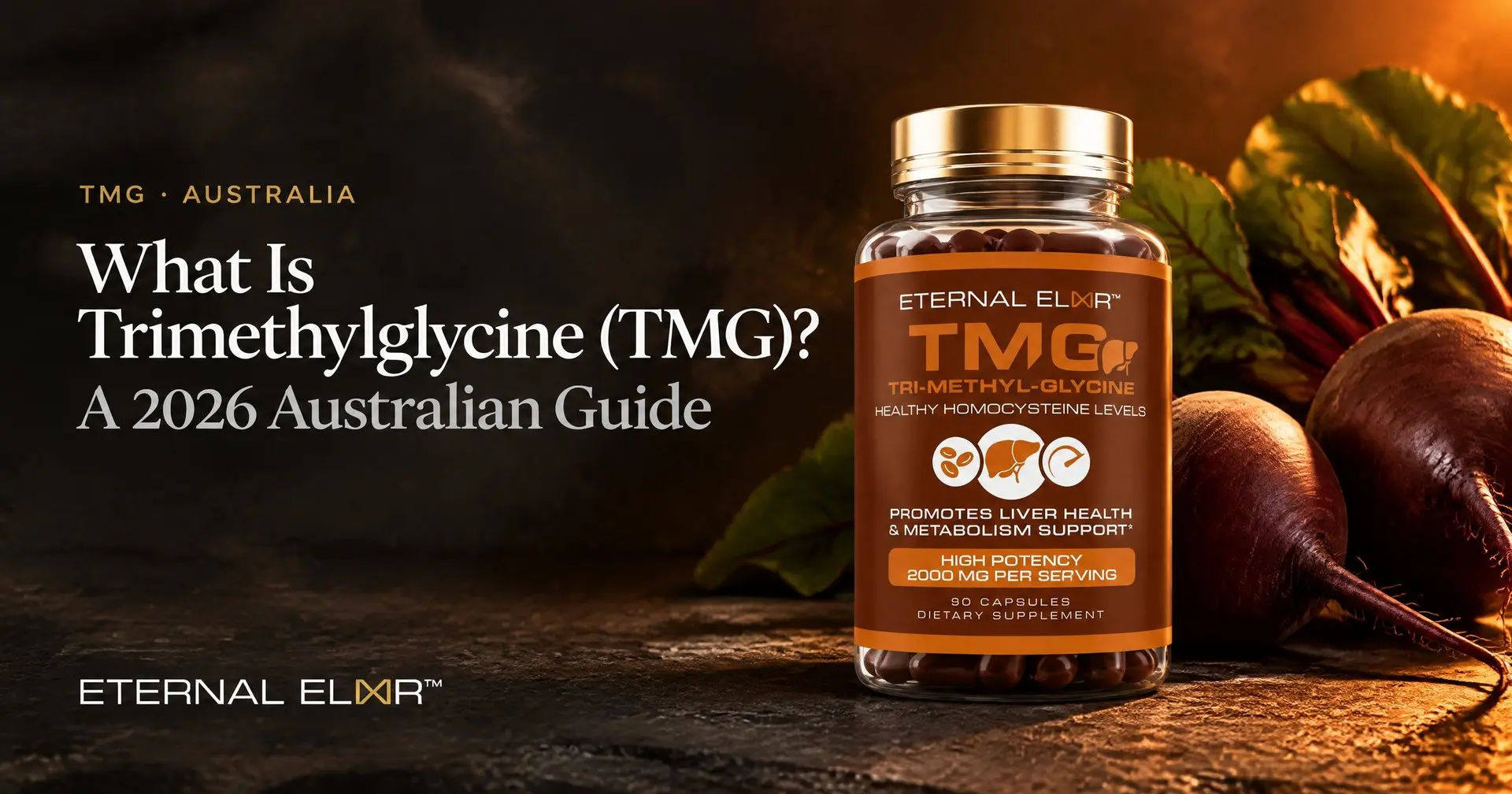
Trimethylglycine (TMG) is the amino acid glycine carrying three methyl groups. It is the same compound sold as betaine or betaine anhydrous, and its best-evidenced effect in people is lowering homocysteine: in a six-week trial, 1.5 g, 3 g and 6 g a day cut fasting homocysteine by 12%, 15% and 20% against placebo. Your body makes it from choline, and you already eat some in beetroot, spinach and wheat bran.
This Australian guide explains what trimethylglycine is, how it differs from betaine HCl, what it does in the body, what the human trials found (including the cholesterol caveat at higher doses), who should avoid it, and how the TMG supplements sold in Australia compare on price.
Key takeaways
- TMG, betaine and betaine anhydrous are one compound. Betaine HCl is a different product used for stomach acid.
- It has two jobs in the body: it donates a methyl group that turns homocysteine back into methionine, and it helps cells hold their water balance.
- A 2022 meta-analysis found doses under 4 g a day lowered homocysteine without the rise in cholesterol seen at 4 g a day or more, and betaine did not change liver enzymes or blood pressure.
- Typical dietary intake is about 0.5 to 2 g a day, so a 2,000 mg serve sits at the top of what a diet rich in beetroot and whole grains supplies.
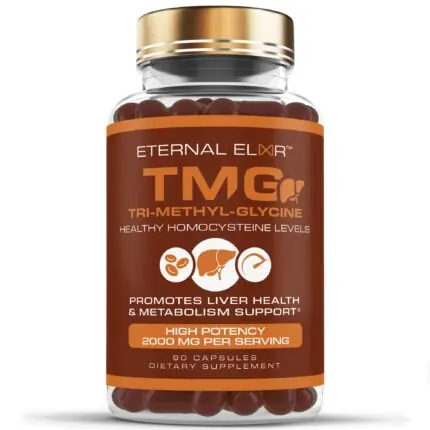
- Our TMG 2000mg is three capsules a serve, 90 capsules for $44.99, which is $1.50 a day.
Eternal Elixir makes TMG 2000mg, and it is our pick because each three-capsule serve gives 2,000 mg of betaine anhydrous, inside the dose range the homocysteine trials tested and under the 4 g level linked with higher cholesterol.
Table of contents
- 1. What Is Trimethylglycine? The Short Answer
- 2. Trimethylglycine, Betaine and Betaine HCl: Same Name, Different Products
- 3. What Trimethylglycine Does in the Body
- 4. Where Trimethylglycine Comes From
- 5. What the Human Trials on Trimethylglycine Found
- 6. Is TMG Good for the Liver, NAD+ or Longevity?
- 7. TMG Supplements in Australia Compared (as of Sep 2026)
- 8. Eternal Elixir TMG 2000mg: What Is in the Bottle
- 9. How to Take Trimethylglycine
- 10. Who Should Avoid TMG, and Can It Damage the Liver?
- 11. Trimethylglycine: Frequently Asked Questions
- 11.1. What is TMG trimethylglycine good for?
- 11.2. Who should avoid taking TMG?
- 11.3. Can TMG damage the liver?
- 11.4. Does TMG raise your blood pressure?
- 11.5. Is TMG the same as betaine?
- 11.6. How much TMG should I take a day?
- 11.7. Should I take TMG with NMN?
- 11.8. What is the best TMG supplement in Australia?
- 11.9. Is TMG worth taking?
- 12. The Bottom Line
- 13. Sources
What Is Trimethylglycine? The Short Answer
Trimethylglycine is glycine with three methyl groups attached to its nitrogen atom. The name describes the chemistry: tri (three) methyl groups on glycine. Research papers mostly call it betaine, because it was first identified in beets in the 19th century, and it occurs naturally in plants, animals and microorganisms (Arumugam et al., 2021).
Its main role in the body is donating methyl groups to other molecules. Its second role, as an osmolyte, helps cells keep the right amount of water. Those two jobs explain nearly everything written about it, from longevity stacks to pre-workout tubs.
One quick note, because search results mix them up: the letters TMG also stand for unrelated things. On a supplement label, TMG means trimethylglycine. Our TMG supplement guide for Australia covers label-reading and buying decisions in full, and this article stays on what the molecule is, what it does and what the evidence shows.
Trimethylglycine, Betaine and Betaine HCl: Same Name, Different Products
This point trips up more Australian shoppers than any other. Betaine and betaine anhydrous are the same substance as trimethylglycine. “Betaine” is the older name and the one used in nearly all the trials. “Anhydrous” means the powder carries no bound water, which lets a label state an accurate milligram figure.
The exception is betaine hydrochloride (betaine HCl). It is sold for stomach acidity rather than methylation, and if a label says betaine HCl, it is not the compound this guide describes. We set the three side by side in betaine anhydrous vs TMG vs betaine HCl, and our comparison of TMG, glycine, DMG and SAMe covers the related methyl donors.
What Trimethylglycine Does in the Body
A 2021 review in the journal Biology put it simply: betaine works mainly as an osmolyte and as a methyl-group donor (Arumugam et al., 2021).
One methyl group for homocysteine
Homocysteine is an amino acid your body makes while it processes methionine from protein. To recycle it, the body hands it a methyl group. Trimethylglycine is one of the molecules that can do this. An enzyme called betaine-homocysteine methyltransferase moves one methyl group across, homocysteine becomes methionine again, and what is left of the trimethylglycine is dimethylglycine (DMG).
So the three methyl groups in the name are real, but only one goes straight to homocysteine. The review describes DMG being broken down further to sarcosine inside the mitochondria of liver and kidney cells, which feeds the other methyl groups into the body’s wider methyl supply rather than back to homocysteine.
The osmolyte job
As an osmolyte, trimethylglycine helps cells hold their water and keeps proteins folded when the cell is under osmotic stress. This role is also the usual argument for betaine in sports nutrition, where a cell that holds its water under load is thought to work better. The exercise results are covered below.
Where Trimethylglycine Comes From
You are not dependent on food for it. The body makes betaine from choline, which is why the two nutrients are so often discussed together. Food adds more, with beetroot, wheat bran, wheat germ and spinach among the richer sources.
In the trial that first tested low doses in healthy adults, the researchers put habitual dietary intake at about 0.5 to 2 g a day (Olthof et al., 2003). A 2,000 mg supplement serve therefore lands at the top of the range a diet heavy in beetroot and whole grains already reaches on a good day, every day. The 2021 review adds that betaine from food and from supplements has similar bioavailability, so the comparison is fair.
If you eat those foods daily, a supplement moves your intake less than the label suggests. If you rarely eat them, it changes the numbers most. For the benefit-by-benefit view, see our guide to TMG benefits in Australia.
What the Human Trials on Trimethylglycine Found
| Study | Who and how many | Daily dose and length | Main result |
|---|---|---|---|
| Olthof, 2003 (Netherlands) | 76 healthy adults in four groups of 19 | 1.5 g, 3 g or 6 g, or placebo, for 6 weeks | Fasting homocysteine 12%, 15% and 20% lower than placebo |
| Schwab, 2002 (Finland) | 42 adults on a reduced-energy diet | 6 g or placebo for 12 weeks | Homocysteine fell. Body composition changed no more than on placebo. Total and LDL cholesterol were higher on betaine |
| Ashtary-Larky, 2022 (meta-analysis) | Pooled randomised trials | Various | Lower homocysteine, higher total and LDL cholesterol. No change in liver enzymes, triglycerides, HDL, fasting glucose or blood pressure. Under 4 g a day lowered homocysteine without the lipid rise |
| Zawieja, 2021 (meta-analysis) | Six trials at 4 g a day or more | 6 to 24 weeks | Total cholesterol rose by 0.34 mmol/L. No significant change in LDL, HDL or triglycerides |
| Ashtary-Larky, 2022 (meta-analysis) | Pooled body composition trials | Various | No effect on body weight, body fat or lean mass |
| Zawieja, 2024 (meta-analysis) | 17 studies, 317 participants | At least 7 days | Small gain in maximal strength, mostly lower body. No effect on upper body strength, sprint power or muscular endurance |
Homocysteine: the best-evidenced effect
The most-cited trial put four groups of 19 healthy men and women on betaine or a placebo daily for six weeks (Olthof et al., 2003). Fasting homocysteine ended 12%, 15% and 20% lower than placebo at 1.5 g, 3 g and 6 g a day. The researchers also gave methionine loading tests. After six weeks, the rise in homocysteine after the test was 23%, 30% and 40% smaller across the three doses, and a smaller effect was already visible on the first day.
The response is dose-dependent, and a 2,000 mg serve sits between the 1.5 g and 3 g arms, inside the tested range and near its lower end. If your GP has flagged your homocysteine on a blood test, ask them before you add TMG, because the reason it is raised matters.
Add TMG 2000mg to cart · $44.99The cholesterol caveat at 4 g a day and above
The counterweight comes from a 12-week Finnish trial of 42 adults on a reduced-energy diet (Schwab et al., 2002). Betaine at 6 g a day lowered homocysteine, but total and LDL cholesterol were higher than in the placebo group. Body weight and fat mass fell equally in both groups, so the fat loss seen in pigs did not carry over to people.
Two meta-analyses have since sized the effect. One pooled six trials at 4 g a day or more and found total cholesterol rose by 0.34 mmol/L (Zawieja et al., 2021). The other found the rise in total and LDL cholesterol at 4 g a day or more, while doses under 4 g lowered homocysteine without it (Ashtary-Larky et al., 2022). That is the main reason to stay at around 2,000 mg rather than chase the 6 g used in the older trials. More is not better with trimethylglycine.
Body composition and exercise
Betaine is sold widely as a gym supplement, and the evidence there is mixed. A 2022 meta-analysis found it did not change body weight, body fat or lean mass, whatever the dose or trial length (Ashtary-Larky et al., 2022). A 2024 meta-analysis of 17 studies with 317 participants found a small improvement in maximal strength, mainly in the lower body, but no effect on upper-body strength, cycling sprint power or muscular endurance (Zawieja et al., 2024).
Is TMG Good for the Liver, NAD+ or Longevity?
Betaine’s role in how the liver handles fat is one of the most-reviewed parts of its literature, but much of that work is in animals. In people, the clearest safety data point is that pooled trials found no change in the liver enzymes ALT, AST and GGT on betaine (Ashtary-Larky et al., 2022). That tells you it did not strain the liver in those trials. It does not show a liver benefit.
TMG is often sold alongside NAD+ precursors such as NMN. The body clears nicotinamide, a by-product of both NMN and nicotinamide riboside, partly by adding a methyl group to it. The reasoning runs that a daily NAD+ precursor draws on the same methyl supply that trimethylglycine helps top up. It is a coherent rationale, but we have not seen a human trial that tests whether NMN users need TMG. We set out the argument and its limits in why NMN users add TMG, and our NMN supplement guide for Australia covers the precursor side.
Broader longevity claims for TMG rest on its role in methylation, not on trials showing longer or healthier lives. Our comparison of NMN and NAD+ in Australia and our longevity supplement stack comparison show where TMG sits alongside other products.
TMG Supplements in Australia Compared (as of Sep 2026)
Every product below is betaine anhydrous, so the useful comparisons are the dose per label serve, the format and the price per gram. We took each price, pack and serve from the seller’s own page in September 2026.
| Product | Where to buy | Price (AUD, as of Sep 2026) | Pack | TMG per label daily serve | Cost per label serve | Cost per gram of TMG | Buy |
|---|---|---|---|---|---|---|---|
| Eternal Elixir TMG 2000mg (our pick) | eternalelixir.com.au, ships from Sydney | $44.99 | 90 vegetable capsules, 30 serves | 2,000 mg (3 capsules) | $1.50 | $0.75 | View product |
| Bulk Nutrients TMG Capsules | bulknutrients.com.au | $29.00 | 120 veggie capsules of 600 mg | 600 to 1,200 mg (1 to 2 capsules) | $0.24 to $0.48 | $0.40 | Bulk Nutrients |
| Switch Nutrition TMG | switchnutrition.com.au | $44.95 | Powder, 150 scoops of 1 g | 1 to 3 g (1 to 3 scoops) | $0.30 to $0.90 | $0.30 | Switch Nutrition |
| DoNotAge Pure TMG | donotage.org (AUD store) | $32.00 | 60 capsules of 500 mg | 1,000 mg (2 capsules) | $1.07 | $1.07 | DoNotAge |
Who each one suits, and who it doesn’t
- Eternal Elixir TMG 2000mg (our pick). Suits anyone who wants 2,000 mg a day in capsules, the highest label serve in the table, with vegan capsules and Sydney dispatch. It does not suit someone chasing the lowest price per gram, which belongs to Switch Nutrition’s powder.
- Bulk Nutrients TMG Capsules. Suits people who want a lower daily amount in capsules at the lowest cost per label serve. Its label stops at 1,200 mg a day, so it does not suit anyone who wants a 2,000 mg serve within the label directions.
- Switch Nutrition TMG. Suits people happy to scoop a powder, and it has the lowest cost per gram here. It does not suit anyone who wants a pre-measured capsule.
- DoNotAge Pure TMG. Suits someone who wants 1,000 mg a day from a brand that also sells NMN. It is the dearest per gram in the table, and its page lists distribution centres overseas.
Our best TMG supplements in Australia roundup compares more brands on cost, and TMG powder vs capsules weighs up the two formats.
Eternal Elixir TMG 2000mg: What Is in the Bottle
These are the facts from our label and product page:
- Trimethylglycine (betaine anhydrous), 2,000 mg per three-capsule serve.
- 90 vegetable capsules per bottle, which is 30 serves.
- The only other ingredients are rice flour and a vegetable capsule, so it suits vegans and vegetarians.
- Take three capsules a day with a meal, with your morning NMN or split across the day.
- $44.99 a bottle, or $1.50 a serve. Two bottles cost $80.98 (10% off), three cost $114.72 (15% off), and five cost $179.96 (20% off).
- Ships from Sydney within 24 hours, with free shipping over $100, a 30-day money-back guarantee and Afterpay.
Betaine anhydrous is a commodity ingredient, so between two honest bottles at the same dose the real differences are the serve size, the capsule count and the price. We chose 2,000 mg because it sits inside the tested homocysteine range and under the 4 g level where cholesterol rose.
Add TMG 2000mg to cart · $44.99Pairing TMG with NMN
If you take our NMN 500mg, TMG and NMN together come to $104.98, which clears the $100 free-shipping line. Our comparison of the best NMN and TMG stacks in Australia sets the options side by side on dose and cost per serve.
How to Take Trimethylglycine
- Dose. Our label serve is 2,000 mg a day. The homocysteine trial tested 1.5 to 6 g, and the meta-analysis favours staying under 4 g.
- Timing. Take it with a meal. Many people take it with their morning NMN, and splitting the capsules across the day works too.
- Duration. The homocysteine trial ran for six weeks, so give it at least that long if you plan to recheck a blood test with your GP.
- Diet first. If your diet is already rich in beetroot, spinach and whole grains, you may sit near the top of the 0.5 to 2 g dietary range without a supplement.
Who Should Avoid TMG, and Can It Damage the Liver?
At supplement doses, the pooled trials found no change in liver enzymes, so we found no sign in human trials that betaine damages the liver (Ashtary-Larky et al., 2022). The known downside is cholesterol at 4 g a day or more.
Talk to your doctor or pharmacist before taking TMG if any of these apply:
- You have high LDL cholesterol or take cholesterol-lowering medicine, because doses of 4 g a day or more raised cholesterol in trials.
- You have reduced kidney function, since the kidneys handle betaine and its breakdown products.
- You are pregnant or breastfeeding. Our label says not to use it then.
- You take any prescribed medicine, or your doctor is already managing a raised homocysteine result.
Trimethylglycine: Frequently Asked Questions
What is TMG trimethylglycine good for?
The best-evidenced effect is lowering fasting homocysteine, shown in randomised trials in healthy adults at 1.5 g a day and above. It also acts as an osmolyte that helps cells hold water. A 2024 meta-analysis found a small gain in maximal lower-body strength, while body composition did not change. Wider longevity claims rest on its role in methylation rather than on outcome trials.
Add TMG 2000mg to cart · $44.99
Who should avoid taking TMG?
People with high LDL cholesterol should be careful, since trials at 4 g a day or more raised total cholesterol. Anyone with reduced kidney function, and anyone pregnant or breastfeeding, should not take it without medical advice. If you take prescription medicine, check with your pharmacist first.
Can TMG damage the liver?
Not in the human trials we reviewed. A 2022 meta-analysis found betaine did not change the liver enzymes ALT, AST or GGT. That shows no sign of harm at the doses tested, but it is not evidence of a liver benefit.
Does TMG raise your blood pressure?
The evidence says no. The same meta-analysis found no effect on blood pressure, and in the 12-week Finnish trial diastolic blood pressure fell in both the betaine and placebo groups with no difference between them. Keep monitoring as usual if your doctor manages your blood pressure.
Is TMG the same as betaine?
Yes. TMG, betaine and betaine anhydrous are the same compound. Betaine HCl is a different product sold for stomach acid, so check the label.
How much TMG should I take a day?
Our label serve is 2,000 mg a day with a meal. The homocysteine trial tested 1.5 to 6 g a day, and a 2022 meta-analysis found doses under 4 g lowered homocysteine without raising cholesterol.
Should I take TMG with NMN?
Some NMN users add it, because the body uses methyl groups to clear nicotinamide. It is a reasonable rationale, but we have not seen a trial that tests it directly. If you take both, a 2,000 mg serve of TMG with your morning NMN is simple to keep up.
What is the best TMG supplement in Australia?
Our pick is Eternal Elixir TMG 2000mg, which we make. It gives 2,000 mg of betaine anhydrous in three vegan capsules, 90 capsules for $44.99, and ships from Sydney within 24 hours. Switch Nutrition’s powder is the cheapest per gram we found, and Bulk Nutrients has the lowest cost per label serve at a lower dose.
Add TMG 2000mg to cart · $44.99
Is TMG worth taking?
It depends on your diet and your goal. If you already eat plenty of beetroot, spinach and whole grains, a supplement adds less. If you do not, or you take an NAD+ precursor and want a steady methyl donor, a 2,000 mg serve is a low-cost way to make that intake consistent, at $1.50 a day from us.
The Bottom Line
Trimethylglycine is betaine: a methyl donor and osmolyte your body makes and your diet supplies. Its best-supported effect in people is lower homocysteine, and staying under 4 g a day avoids the cholesterol rise seen at higher doses. A 2,000 mg serve lands at the top of normal dietary intake. Ours delivers that in three capsules for $1.50 a day, and you can browse the rest of our range in the Eternal Elixir shop.
Sources
- Arumugam MK, Paal MC, Donohue TM Jr, et al. Beneficial effects of betaine: a comprehensive review. Biology (Basel). 2021;10(6). PMC8224793
- Olthof MR, van Vliet T, Boelsma E, Verhoef P. Low dose betaine supplementation leads to immediate and long term lowering of plasma homocysteine in healthy men and women. J Nutr. 2003;133(12):4135-4138. PubMed 14652361
- Schwab U, Törrönen A, Toppinen L, et al. Betaine supplementation decreases plasma homocysteine concentrations but does not affect body weight, body composition, or resting energy expenditure in human subjects. Am J Clin Nutr. 2002;76(5):961-967. PubMed 12399266
- Ashtary-Larky D, Bagheri R, Ghanavati M, et al. Effects of betaine supplementation on cardiovascular markers: a systematic review and meta-analysis. Crit Rev Food Sci Nutr. 2022;62(23):6516-6533. PubMed 33764214
- Zawieja EE, Zawieja B, Chmurzynska A. Betaine supplementation moderately increases total cholesterol levels: a systematic review and meta-analysis. J Diet Suppl. 2021;18(1):105-117. PubMed 31809615
- Ashtary-Larky D, Bagheri R, Tinsley GM, et al. Betaine supplementation fails to improve body composition: a systematic review and meta-analysis. Br J Nutr. 2022;128(5):975-988. PubMed 34743773
- Zawieja E, Machek S, Zanchi NE, et al. Effects of chronic betaine supplementation on exercise performance: systematic review and meta-analysis. J Sports Sci. 2024;42(22):2131-2144. PubMed 39514262
- Product labels and prices: Eternal Elixir TMG 2000mg, Bulk Nutrients TMG Capsules, Switch Nutrition TMG and DoNotAge Pure TMG, checked September 2026.