Last updated: September 28, 2026 · Originally published: September 24, 2026 · By Eternal Elixir Editorial
How to lower homocysteine naturally comes down to a short list backed by research. Keep your folate and vitamin B12 intake up, since those two carry the most evidence. Cover vitamin B6 and riboflavin from food, and add a betaine source (trimethylglycine, or TMG) if your diet is light on wheat bran, spinach and beetroot. Don’t smoke, go easy on heavy coffee and alcohol intake, and ask your GP for a blood test so you know your starting point and can see whether the changes work.
Homocysteine is an amino acid your body makes when it processes methionine from protein. Three pathways clear it, and each depends on different nutrients. That is why no single vitamin covers the whole job, and why the order you tackle them in matters.
Key takeaways
- Homocysteine is cleared by three routes: folate plus vitamin B12 (methionine synthase), betaine/TMG (the BHMT enzyme) and vitamin B6 (transsulfuration). Riboflavin keeps the folate route running.
- In a meta-analysis of 12 randomised trials, folic acid lowered blood homocysteine by about 25% and vitamin B12 added a further 7%. Vitamin B6 made no significant further difference.
- Betaine at 1.5, 3 and 6 g a day lowered fasting homocysteine by 12%, 15% and 20% against placebo in healthy adults over six weeks.
- High-dose betaine (6 g a day) raised LDL cholesterol in trials, so folate and B12 stay the foundation and betaine is the add-on.
- A GP can measure homocysteine with a blood test. Test before you change anything, then again after a few months.
Table of contents
- 1. What Homocysteine Is and What a High Result Means
- 2. The Three Pathways That Recycle Homocysteine
- 3. What to Eat If Homocysteine Is High
- 4. The Fastest Way to Lower Homocysteine
- 5. What the Research Shows on B Vitamins and Betaine
- 6. TMG Supplements in Australia Compared
- 7. Where Eternal Elixir TMG 2000mg Fits
- 8. Lifestyle Factors That Influence Homocysteine
- 9. When to Talk to Your GP
- 10. The Bottom Line
- 11. Frequently Asked Questions
- 11.1. What is the fastest way to lower homocysteine levels?
- 11.2. What to eat if homocysteine is high?
- 11.3. Does magnesium lower homocysteine?
- 11.4. What is high homocysteine a symptom of?
- 11.5. Is TMG or folate better for homocysteine?
- 11.6. What is a normal homocysteine level?
- 11.7. Does coffee raise homocysteine?
- 11.8. How long does it take to see a change in homocysteine?
- 12. Sources
What Homocysteine Is and What a High Result Means
Methionine is an essential amino acid found in most protein foods. Your cells turn it into S-adenosylmethionine (SAMe), the body’s main methyl donor. Once SAMe has handed its methyl group to DNA, creatine or one of hundreds of other molecules, what remains becomes homocysteine.
Homocysteine is an intermediate, not an end product. The body either recycles it into methionine or routes it towards cysteine, a building block of glutathione (our comparison of glutathione and NAC covers that side of the chemistry). Both jobs depend on B vitamins and betaine, so your blood level is a useful read-out of how well those pathways are supplied.
A raised result usually causes no symptoms of its own. It is a marker, and the common reasons behind it are low folate, vitamin B12 or vitamin B6 status, reduced kidney function, some medicines, smoking, older age and genes such as the MTHFR 677TT variant. That is why your GP reads it alongside your B12 and folate results rather than on its own.
Levels also vary for reasons you can’t change. In the Hordaland Homocysteine Study of 11,941 healthy Norwegian adults, sex, age, folate intake, smoking and coffee consumption were the strongest determinants of homocysteine. Diet and lifestyle are the parts you control. For the wider picture on trimethylglycine, our complete guide to TMG supplements in Australia covers dosing, label-reading and buying decisions.
The Three Pathways That Recycle Homocysteine
Think of homocysteine as sitting at a junction with three exits. Two turn it back into methionine (remethylation). The third sends it permanently towards cysteine (transsulfuration). Each exit relies on different nutrients.
Folate and vitamin B12: the methionine synthase route
This pathway runs in virtually every cell. The enzyme methionine synthase takes a methyl group from 5-methyltetrahydrofolate, the active form of folate, and attaches it to homocysteine to make methionine again. Vitamin B12 is the enzyme’s cofactor and carries the methyl group across. Without enough folate there is nothing to transfer, and without enough B12 the transfer stalls.
Betaine (TMG): the BHMT route
The second route runs mainly in the liver and kidneys and does not need folate or B12 at all. The enzyme betaine-homocysteine methyltransferase (BHMT) moves one methyl group from betaine directly onto homocysteine, producing methionine and dimethylglycine (DMG). A 2021 review in Biology describes betaine as both an osmolyte and a methyl-group donor. In supplements the same compound is sold as betaine anhydrous or TMG. Our explainer on what trimethylglycine is covers the chemistry, and betaine anhydrous vs TMG vs betaine HCl clears up the naming, since betaine HCl is a digestive product rather than a methyl donor supplement.
Vitamin B6: the transsulfuration route
The third exit is one-way. Two enzymes, cystathionine beta-synthase and cystathionine gamma-lyase, both need the active form of vitamin B6 (pyridoxal 5′-phosphate) to turn homocysteine first into cystathionine and then into cysteine. Unlike the other two routes, this one removes homocysteine from the cycle for good.
Riboflavin (vitamin B2): the cofactor behind the folate route
Riboflavin does not act on homocysteine directly, but the folate route depends on it. The enzyme MTHFR, which makes the active folate that methionine synthase needs, uses a riboflavin-derived cofactor called FAD. People with two copies of a common MTHFR variant, the 677TT genotype, have an enzyme that holds on to that cofactor less well.
In a 12-week randomised trial of 1.6 mg of riboflavin a day, homocysteine responded only in participants with the TT genotype, falling by as much as 22%, while people with the other genotypes saw no change. Riboflavin can matter a great deal for some people and very little for others.
What to Eat If Homocysteine Is High
Every pathway can be supplied from ordinary Australian supermarket food. Start here before you buy anything.
| Nutrient | Role in homocysteine metabolism | Food sources |
|---|---|---|
| Folate (vitamin B9) | Supplies the methyl group that methionine synthase adds to homocysteine | Spinach, broccoli, asparagus, Brussels sprouts, chickpeas, lentils, avocado, fortified breakfast cereals and bread made with fortified flour |
| Vitamin B12 | Cofactor for methionine synthase | Beef, lamb, kangaroo, salmon, sardines, eggs, milk, cheese, yoghurt, B12-fortified plant milks |
| Betaine (TMG) | Donates a methyl group via BHMT, mainly in the liver and kidneys, independently of folate | Wheat bran, wheat germ, spinach, beetroot, quinoa, prawns, wholemeal bread |
| Choline | Converted by the liver and kidneys into betaine | Eggs, beef and chicken liver, wheat germ, soybeans, pork |
| Vitamin B6 | Cofactor for the two transsulfuration enzymes | Chicken, turkey, tuna, salmon, potatoes, bananas, chickpeas |
| Riboflavin (vitamin B2) | Forms FAD, the cofactor MTHFR needs to make active folate | Milk, yoghurt, cheese, eggs, lean meat, mushrooms, almonds, yeast extract spreads |
In a laboratory analysis of 145 common foods, the richest betaine sources were wheat bran (1,339 mg per 100 g), wheat germ (1,241 mg) and spinach (645 mg), with prawns and wheat bread some way behind. Eggs and liver ranked among the richest sources of choline.
A simple day that covers all three exits: wholegrain cereal with wheat germ and milk at breakfast, a spinach and chickpea salad with eggs at lunch, and salmon or chicken with potatoes and greens at dinner. If you eat little or no animal food, watch vitamin B12. Plant foods do not reliably supply it, so fortified plant milks or a supplement your GP recommends can fill the gap.
The Fastest Way to Lower Homocysteine
The biggest and quickest drops come from fixing a shortfall. If a blood test shows low folate or B12, correcting it with your GP’s advice usually moves homocysteine more than anything else on this page, because that is where most raised results start. B12 in particular can need a GP-guided approach, since some people don’t absorb it well from food.
How fast is fast? The trials below saw changes within two to twelve weeks of daily intake. Betaine also reduced the rise in homocysteine after a protein-style methionine load from the first day of use. Diet changes work on the same pathways, just more slowly, so plan a repeat test after a few months rather than a few days.
What the Research Shows on B Vitamins and Betaine
Folate and vitamin B12 carry the most evidence
The clearest summary is a 1998 meta-analysis in the BMJ by the Homocysteine Lowering Trialists’ Collaboration, which pooled individual data from 1,114 people in 12 randomised trials. Standardised to typical Western starting levels, folic acid reduced blood homocysteine by 25%, with similar effects from 0.5 to 5 mg a day, and vitamin B12 (about 0.5 mg a day) produced a further 7% reduction. Vitamin B6 did not add a significant further effect.
The response was larger in people who started with higher homocysteine and lower folate, so a diet already rich in leafy greens and fortified grains leaves less room for change. More folic acid was not better either: half a milligram worked as well as five. B6 still runs the transsulfuration route, but folate and B12 status are what move a fasting blood test most.
Betaine (TMG) adds a second, independent route
Betaine is the best-studied non-vitamin option. In a six-week randomised trial in which four groups of 19 healthy adults took betaine or placebo daily, fasting plasma homocysteine was 12%, 15% and 20% lower than placebo at 1.5 g, 3 g and 6 g a day (Olthof and colleagues, The Journal of Nutrition, 2003). The rise in homocysteine after a methionine load was also 23% to 40% smaller after six weeks. A 2,000 mg serve sits between the two lower doses tested.
A second trial compared betaine directly with folic acid in adults with mildly raised homocysteine (Steenge and colleagues, 2003). Groups of 12 took 6 g of betaine, 800 µg of folic acid or placebo for six weeks. Folic acid lowered fasting homocysteine slightly more than betaine (2.7 versus 1.8 µmol/L relative to placebo), but only betaine blunted the rise after a methionine load.
Choline, which your liver turns into betaine, behaves similarly at high intakes: about 2.6 g of choline a day, taken as phosphatidylcholine, lowered fasting homocysteine by 18% over two weeks in 26 men with mildly raised levels.
The cholesterol caveat with high-dose betaine
More is not automatically better with betaine. When researchers combined blood-lipid data from three betaine trials involving 151 participants, 6 g a day for six weeks raised LDL cholesterol by 0.36 mmol/L and triglycerides by 0.14 mmol/L relative to placebo. Lower doses also nudged LDL upwards, though not to a statistically significant degree. Folic acid had no effect on lipids, and the authors concluded it remains the preferred way to lower homocysteine.
That is the strongest case against leaning on betaine, and it is why this guide puts folate and B12 first. If you are keeping an eye on your cholesterol, talk to your GP before adding betaine. Our TMG dosage guide and overview of TMG side effects cover this in more detail.
TMG Supplements in Australia Compared
If you decide to add betaine, the main difference between products is how much TMG the label serve gives you. Eternal Elixir makes TMG 2000mg, and it is our pick because its label serve delivers 2,000 mg, above the 1.5 g lowest dose in the Olthof trial. It is not the cheapest per gram. Prices as of Sep 2026.
| Product | Price (AUD) | Pack | Label serve | TMG per serve | Cost per serve | Buy |
|---|---|---|---|---|---|---|
| Eternal Elixir TMG 2000mg (our pick: highest capsule dose per serve) | $44.99 | 90 capsules (30 serves) | 3 capsules with a meal | 2,000 mg | $1.50 | View TMG 2000mg |
| Bulk Nutrients TMG Capsules (lowest cost per capsule) | $29.00 | 120 capsules | 1 to 2 capsules | 600 to 1,200 mg | $0.24 to $0.48 | Bulk Nutrients |
| Switch Nutrition TMG powder (lowest cost per gram) | $44.95 | 150 scoops | 1 to 3 scoops with food | 1,000 to 3,000 mg | $0.30 to $0.90 | Switch Nutrition |
| Naturecan TMG (one capsule a day) | $34.00 | 60 capsules | 1 capsule | 686 mg | $0.57 | Naturecan |
| DoNotAge Pure TMG | $32.00 | 60 capsules | 2 capsules | 1,000 mg | $1.07 | DoNotAge |
Cost per serve is the listed price divided by the serves the label gives. The Switch powder reaches the trial range at its top serve but needs measuring each day. Among the capsules, ours is the only one whose label serve goes past 1.5 g without doubling up.
Add TMG 2000mg to cart · $44.99
Where Eternal Elixir TMG 2000mg Fits
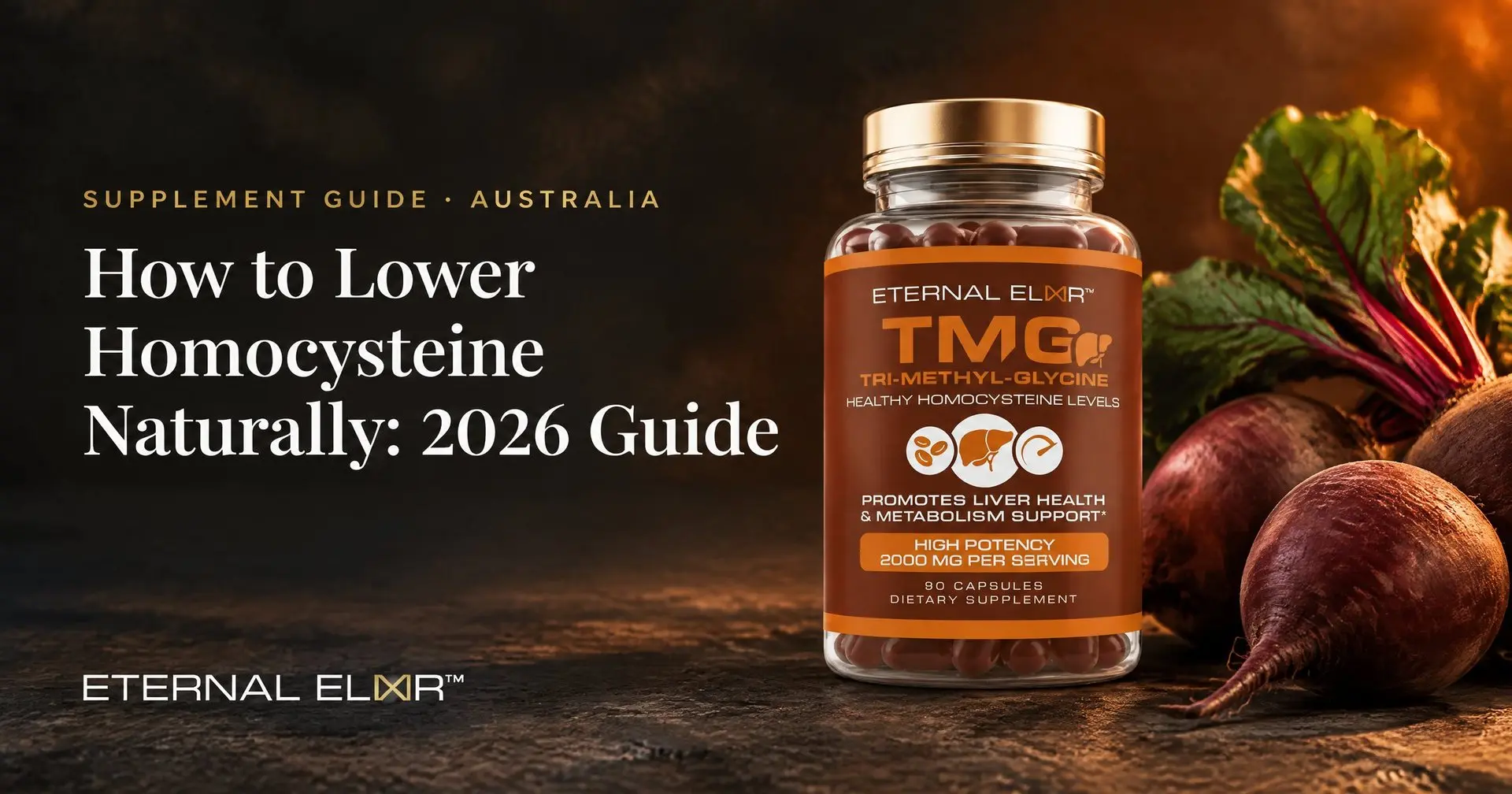
Our TMG 2000mg gives 2,000 mg of betaine anhydrous per three-capsule serve, with rice flour and a vegetable capsule as the only other ingredients. Each bottle holds 90 capsules, which is 30 serves at the label dose of three capsules a day with a meal. It supports normal homocysteine metabolism through the BHMT route, the one that does not depend on folate or B12.
Who it suits: adults who already eat well for folate and B12, get little betaine from wheat bran, spinach or beetroot, and want a capsule serve inside the range the trials tested.
Who it doesn’t suit: anyone who hasn’t checked their folate and B12 status yet (start there), people watching their LDL cholesterol unless their GP agrees, people who are pregnant or breastfeeding, and anyone who wants the lowest cost per gram, where a powder wins.
Lifestyle Factors That Influence Homocysteine
Population studies point to a few everyday habits too, although these are associations rather than proof of cause.
- Smoking. Smoking was among the strongest changeable influences in the Hordaland study. People there with a high folate intake who did not smoke and drank under one cup of coffee a day had median homocysteine 3.0 to 4.8 µmol/L lower than those with the opposite profile.
- Coffee. Higher coffee consumption was linked with higher homocysteine in the same study. There is no need to give up a morning flat white, but it is worth knowing if you drink many cups a day.
- Alcohol. A review of vitamin absorption lists chronic alcohol use among the factors that interfere with how the gut absorbs water-soluble vitamins, a group that includes folate, B6 and riboflavin. Moderate drinking wasn’t linked with higher homocysteine in the Norwegian data, so heavy, regular intake is the habit to address.
- Physical activity. In a later summary of the Norwegian cohort, physical activity was associated with lower homocysteine, as were good folate and vitamin B12 status.
When to Talk to Your GP
The only way to know your homocysteine level is a blood test, which your GP can order. Ask whether to fast beforehand, and test before you change your diet or start a supplement so you have a baseline.
Results are reported in micromoles per litre (µmol/L) and read against the pathology lab’s own reference range, which varies between laboratories. Your GP can interpret your number alongside your folate and B12 status and wider health picture.
Raise your medicines too. The same absorption review notes that drug interactions can interfere with vitamin uptake, so if you take anything long term, ask your GP or pharmacist whether it affects your folate, B12 or B6 status. Speak with your doctor or pharmacist before starting any supplement if you are pregnant or breastfeeding, take prescription medication, or have a medical condition.
The Bottom Line
Lowering homocysteine naturally is about keeping three pathways supplied. Folate and vitamin B12, backed by riboflavin, carry the most evidence. Vitamin B6 runs the one-way exit to cysteine, and betaine offers a route that does not depend on folate, studied from 1.5 g a day. Build the foundations from food, don’t smoke, keep coffee and alcohol moderate, and ask your GP for a blood test so you can see whether it is working. For the methyl-donor side, the TMG supplement guide for Australians sets out where betaine sits alongside folate and B12.
From the rest of our longevity range, NMN 500mg comes in 90-capsule bottles at one capsule a day, and you can browse the full Eternal Elixir shop for everything else.
Frequently Asked Questions
What is the fastest way to lower homocysteine levels?
Find out why it is high first. If a blood test shows low folate or vitamin B12, correcting that with your GP usually gives the biggest and quickest drop. In trials, folic acid lowered homocysteine by about a quarter and B12 added a further 7%, with changes measured within weeks.
What to eat if homocysteine is high?
Eat leafy greens and legumes for folate, and meat, fish, eggs and dairy for vitamin B12. Poultry, fish, potatoes and bananas supply vitamin B6, dairy, eggs and mushrooms supply riboflavin, and wheat bran, wheat germ, spinach and beetroot supply betaine. A varied diet covers all three pathways.
Does magnesium lower homocysteine?
There is no good evidence that it does. Magnesium is not one of the cofactors in the three clearance routes, and the Linus Pauling Institute’s summary of homocysteine nutrients lists folate, vitamin B12, vitamin B6, riboflavin and choline, not magnesium. It is worth eating enough for other reasons, but it is not a homocysteine tool.
What is high homocysteine a symptom of?
High homocysteine is a blood marker rather than a symptom, and it usually causes no symptoms of its own. Common reasons for a raised result are low folate, B12 or B6 status, reduced kidney function, some medicines, smoking, age and MTHFR gene variants. Talk to your GP, who will read it alongside your vitamin results.
Is TMG or folate better for homocysteine?
They work on different pathways, so they complement rather than replace each other. Folate and vitamin B12 have the larger evidence base and did not affect blood lipids in trials. Head to head, folic acid lowered fasting homocysteine slightly more than 6 g of betaine, while only betaine blunted the rise after a methionine load.
Add TMG 2000mg to cart · $44.99
What is a normal homocysteine level?
Cleveland Clinic gives 5 to 15 µmol/L as the usual range, but Australian pathology labs set their own reference ranges, so read your result against the range on your report and discuss it with your GP. For context, a large meta-analysis used 12 µmol/L as an approximate average for Western populations.
Does coffee raise homocysteine?
In a study of nearly 12,000 Norwegian adults, higher coffee consumption was associated with higher homocysteine, alongside smoking and low folate intake. That is an association rather than proof of cause.
How long does it take to see a change in homocysteine?
The trials described here measured changes after two to twelve weeks of daily intake, and one betaine trial saw a smaller rise after a methionine load from the first day. Your GP can advise when a repeat blood test makes sense.
Sources
- Nygård O, Refsum H, Ueland PM, Vollset SE. Major lifestyle determinants of plasma total homocysteine distribution: the Hordaland Homocysteine Study. Am J Clin Nutr. 1998;67(2):263-70. PubMed 9459374
- Homocysteine Lowering Trialists’ Collaboration. Lowering blood homocysteine with folic acid based supplements: meta-analysis of randomised trials. BMJ. 1998;316(7135):894-8. PubMed 9569395
- Olthof MR, van Vliet T, Boelsma E, Verhoef P. Low dose betaine supplementation leads to immediate and long term lowering of plasma homocysteine in healthy men and women. J Nutr. 2003;133(12):4135-8. PubMed 14652361
- Steenge GR, Verhoef P, Katan MB. Betaine supplementation lowers plasma homocysteine in healthy men and women. J Nutr. 2003;133(5):1291-5. PubMed 12730412
- Olthof MR, Brink EJ, Katan MB, Verhoef P. Choline supplemented as phosphatidylcholine decreases fasting and postmethionine-loading plasma homocysteine concentrations in healthy men. Am J Clin Nutr. 2005;82(1):111-7. PubMed 16002808
- Olthof MR, van Vliet T, Verhoef P, Zock PL, Katan MB. Effect of homocysteine-lowering nutrients on blood lipids: results from four randomised, placebo-controlled studies in healthy humans. PLoS Med. 2005;2(5):e135. PubMed 15916468
- McNulty H, Dowey le RC, Strain JJ, et al. Riboflavin lowers homocysteine in individuals homozygous for the MTHFR 677C→T polymorphism. Circulation. 2006;113(1):74-80. PubMed 16380544
- Zeisel SH, Mar MH, Howe JC, Holden JM. Concentrations of choline-containing compounds and betaine in common foods. J Nutr. 2003;133(5):1302-7. PubMed 12730414
- Refsum H, Nurk E, Smith AD, et al. The Hordaland Homocysteine Study: a community-based study of homocysteine, its determinants, and associations with disease. J Nutr. 2006;136(6 Suppl):1731S-1740S. PubMed 16702348
- Said HM. Intestinal absorption of water-soluble vitamins in health and disease. Biochem J. 2011;437(3):357-72. PubMed 21749321
- Cleveland Clinic. Homocysteine: function, levels and health effects.
- Linus Pauling Institute. High homocysteine.