Last updated: September 28, 2026 · Originally published: March 21, 2026 · By Eternal Elixir Editorial
Quick Answer
Morning vs. night for NMN: both work, so pick the time you’ll stick to. Most NMN trials gave one dose a day, and the largest dose trial gave it before breakfast. The only trial that compared times, in 108 adults aged 65 and over, found evening intake did slightly better on a leg-strength test and daytime drowsiness, with no harm to sleep. Our label says one capsule a day, preferably in the morning, because a morning habit is the easiest to keep. Our pick is Eternal Elixir NMN 500mg: 500mg per capsule, 90 capsules, $0.67 a day.
Eternal Elixir makes NMN 500mg, so read this as our pick with the evidence shown.
Should you take NMN in the morning or at night? It is one of the most common questions about this NAD+ precursor, and online advice ranges from “always mornings” to “always before bed”. This guide looks at what the human trials actually did, the one trial that tested timing head to head, the body-clock research behind the morning argument, and the practical questions: food, sleep, splitting the dose and pairing NMN with other supplements.
Table of contents
- 1. Morning vs. Night: What the Only Timing Trial Found
- 2. Why Timing Might Matter: NAD+ and the Body Clock
- 3. The Case for Taking NMN in the Morning
- 4. The Case for Taking NMN at Night
- 5. Does NMN Keep You Awake at Night?
- 6. With Food or on an Empty Stomach?
- 7. Should You Split the Dose Between Morning and Night?
- 8. What Matters More Than the Clock
- 9. Timing NMN With Other Supplements
- 10. Our NMN 500mg
- 11. NMN Timing: Frequently Asked Questions
- 12. The Bottom Line
- 13. Sources
Morning vs. Night: What the Only Timing Trial Found
In 2022, researchers in Japan randomised 108 adults aged 65 and over to take 250mg of NMN or a placebo once a day for 12 weeks. Half took it in the morning (after waking and before noon) and half in the evening (from 6pm until bedtime), which gave four groups (Kim et al., Nutrients, 2022).
- Leg strength: a five-times sit-to-stand test improved in all four groups, including placebo. The evening NMN group had the largest effect.
- Drowsiness: daytime drowsiness improved in both evening groups, NMN and placebo. The evening NMN group again had the largest effect, but the evening placebo group improved too, so part of the change may reflect the evening routine rather than NMN.
- Sleep quality: there was no statistically significant difference between groups. Evening NMN did not make sleep worse.
The authors concluded that afternoon or evening intake worked better in older adults. Keep the limits in mind. It is one trial, in older Japanese adults, at 250mg a day, and it was funded by Mitsubishi Corporation Life Sciences, which supplied the NMN and employed three of the six authors. It shows that taking NMN in the evening is reasonable. It does not show that morning intake fails.
Why Timing Might Matter: NAD+ and the Body Clock
The morning argument comes from body-clock research. In mouse cells and mice, NAD+ levels rise and fall over a 24-hour cycle, driven by the body clock through the enzyme NAMPT, and NAD+ in turn feeds back on the clock genes (Nakahata et al. and Ramsey et al., Science, 2009). Because NAD+ supports energy production, some people reason that topping it up in the morning suits the active part of the day.
That reasoning is plausible but untested in people. No human trial has shown that matching an NMN dose to this cycle changes the result. The one human timing trial above leaned the other way. Our article on how NAD+ declines with age explains why people take NMN in the first place.
The Case for Taking NMN in the Morning
- It matches the trials that raised NAD+ most clearly. In a 60-day trial of 80 healthy middle-aged adults, participants took 300mg, 600mg or 900mg of NMN, or a placebo, once a day before breakfast. Blood NAD rose in every NMN group at day 30 and day 60 compared with placebo (Yi et al., GeroScience, 2023). The trial was funded by the companies that made the NMN tested, and the lead author worked for one of them.
- It is easy to remember. A capsule next to breakfast is a habit most people keep. Consistency over weeks is what every trial measured.
- It suits our label. Our NMN 500mg label says one capsule daily, preferably in the morning.
The Case for Taking NMN at Night
- The only head-to-head trial favoured it slightly, in older adults, on leg strength and drowsiness.
- It didn’t disturb sleep in the trials. Sleep quality scores didn’t worsen with evening NMN in the Kim trial. In a separate safety study, 10 healthy Japanese men took single doses of 100mg, 250mg and 500mg of NMN, and their sleep quality scores didn’t change (Irie et al., Endocrine Journal, 2020).
- It may fit your routine better. If you take other supplements with dinner, or tend to skip breakfast, evening may be the time you actually remember.
Does NMN Keep You Awake at Night?
The trials don’t show that it does. Neither the Kim trial nor the Irie safety study found worse sleep scores after NMN. Some people report feeling more alert after NMN, but we found no controlled data on it. If you take NMN in the evening and notice your sleep changes, move it to the morning and see whether that helps.
With Food or on an Empty Stomach?
The Yi trial gave NMN before breakfast with water, and no trial we found has compared NMN taken with food against NMN taken on an empty stomach. Our label gives no food requirement. If a capsule on an empty stomach bothers you, take it with breakfast instead.
Should You Split the Dose Between Morning and Night?
Every main trial above gave NMN once a day, and none compared a split dose with a single dose, so there is no evidence that splitting helps. Our NMN comes as one 500mg capsule per daily serve, so the simple answer is one capsule, once a day, at a time that suits you. Our NMN dosage guide covers the amounts used in trials, and our guide to NMN safety over the longer term covers what is known about years of use.
What Matters More Than the Clock
- Taking it every day. The trials ran for 60 days to 12 weeks of daily use. Skipped days matter more than the hour.
- Giving it time. Blood NAD rose by day 30 in the Yi trial. Our guide to how long NMN takes to work sets out what to expect week by week.
- Following the label. Take the serve on your product’s label and don’t exceed it.
- Storage. Keep capsules sealed in a cool, dry place away from direct sun.
Timing NMN With Other Supplements
Many people take NMN alongside trans-resveratrol. Our Trans-Resveratrol 1200mg gives 600mg per capsule, and its label serve is two capsules a day with or without food, so it fits a morning or evening routine alike. Our comparison of NMN and resveratrol explains how the two differ, and our pterostilbene vs resveratrol article covers a related option. Resveratrol may affect some medicines, including warfarin, so talk to your doctor first if you take any prescription medicine.
Our Spermidine 10mg label says one capsule a day with a meal, so it can sit with breakfast or dinner. Our guide to taking spermidine and NMN together covers that pairing, and our article on NMN and TMG explains why some people add TMG.
Our NMN 500mg
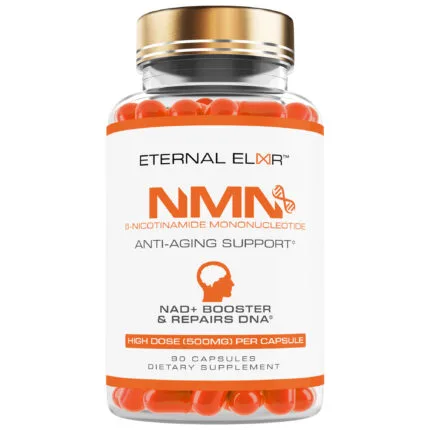
Eternal Elixir NMN 500mg has 500mg of NMN in each capsule and 90 capsules to a bottle. The label serve is one capsule a day, preferably in the morning, so a bottle lasts 90 days for $59.99, or $0.67 a day. If evening suits you better, the Kim trial suggests that works too. For how it compares with other NMN sold in Australia, see our NMN comparison, or browse our full range.
Add NMN 500mg to cart · $59.99NMN Timing: Frequently Asked Questions
Is it better to take NMN in the morning or at night?
Either works. Most trials gave NMN once a day, often in the morning, and the one trial comparing times found evening intake slightly better on leg strength and drowsiness in older adults, without worse sleep. Our label suggests the morning because it is the easiest habit to keep.
Will NMN keep me awake if I take it at night?
The trials don’t show that. Sleep quality scores didn’t worsen with evening NMN in a 12-week trial, or after single doses of up to 500mg in a safety study. If you notice a change in your own sleep, switch to the morning.
Can I take NMN before bed?
Yes. In the Kim trial the evening group took NMN between 6pm and bedtime with no harm to sleep quality.
Can I take NMN on an empty stomach?
Yes. The Yi trial gave it before breakfast, and our label has no food requirement. If it upsets your stomach, take it with a meal.
Should I take NMN and resveratrol at the same time?
You can. Our resveratrol label says two capsules a day with or without food, so it can go with your NMN at whatever time you choose. Check with your doctor first if you take prescription medicines.
How long does NMN take to work?
In the Yi trial, blood NAD had risen by day 30 at every dose tested. Changes you can feel are less certain, and trials ran for 60 days to 12 weeks.
The Bottom Line
The morning vs. night question matters less than taking NMN every day. The body-clock case for mornings comes from mouse studies, and the only human timing trial found evening intake at least as good, without harming sleep. Our label suggests the morning for simplicity, but pick the time you’ll keep, and give it at least a couple of months.
Sources
- Kim M, Seol J, Sato T, et al. Effect of 12-week intake of nicotinamide mononucleotide on sleep quality, fatigue, and physical performance in older Japanese adults: a randomized, double-blind placebo-controlled study. Nutrients. 2022;14(4):755. PubMed 35215405
- Yi L, Maier AB, Tao R, et al. The efficacy and safety of β-nicotinamide mononucleotide (NMN) supplementation in healthy middle-aged adults: a randomized, multicenter, double-blind, placebo-controlled, parallel-group, dose-dependent clinical trial. GeroScience. 2023;45(1):29-43. PubMed 36482258
- Irie J, Inagaki E, Fujita M, et al. Effect of oral administration of nicotinamide mononucleotide on clinical parameters and nicotinamide metabolite levels in healthy Japanese men. Endocrine Journal. 2020;67(2):153-160. PubMed 31685720
- Nakahata Y, Sahar S, Astarita G, et al. Circadian control of the NAD+ salvage pathway by CLOCK-SIRT1. Science. 2009;324(5927):654-657. PubMed 19286518
- Ramsey KM, Yoshino J, Brace CS, et al. Circadian clock feedback cycle through NAMPT-mediated NAD+ biosynthesis. Science. 2009;324(5927):651-654. PubMed 19299583
- Eternal Elixir product pages: NMN 500mg, Trans-Resveratrol 1200mg, Spermidine 10mg.