Last updated: September 28, 2026 · Originally published: September 6, 2026 · By Eternal Elixir Editorial
Nootropics in Australia in 2026 are mostly supplements sold for focus and memory, and only a few have human trial data worth acting on. The short answer: caffeine with L-theanine, Korean red panax ginseng and methylene blue each have placebo-controlled human studies behind them, NAD+ precursors such as NMN are better treated as a longevity choice with possible cognitive upside, and none of them will out-run poor sleep. Our pick for most people starting out is a stimulant-free ginseng taken in the morning.
This guide covers what the category actually is, what the evidence says for each ingredient Australians commonly buy, how to read a label, what is legal to buy here, and when a nootropic is the wrong lever to pull.
Key takeaways
- “Nootropic” is a marketing umbrella for compounds studied for attention, memory and mental energy, not a defined product class.
- The ingredients with the most useful human data are caffeine with L-theanine, Korean red panax ginseng and methylene blue. NMN and NR raise NAD+, but trials have not shown a clear effect on focus.
- Judge a label on the dose per capsule, the extract ratio or standardisation, and whether the maker publishes testing, not on the length of the ingredient list.
- Most of the trials were short or single-dose. Give a daily supplement several weeks and change one thing at a time.
Table of contents
- 1. Nootropics Australia: What the Term Actually Covers
- 2. What Nootropics Are Legal in Australia?
- 3. The Nootropics Australians Actually Buy, and What the Evidence Says
- 4. How Each Nootropic Was Tested
- 5. How to Judge a Nootropic Before You Buy It
- 6. What Are the Best Nootropics Available in Australia?
- 7. When a Nootropic Is the Wrong Answer
- 8. Nootropics Australia FAQ
- 9. Sources
Nootropics Australia: What the Term Actually Covers
The word “nootropic” was coined in the early 1970s by the researcher Corneliu Giurgea for compounds that act on learning and memory (Giurgea, 1972). Five decades later it covers everything from a mushroom coffee sachet to a prescription drug. That stretch is the single biggest reason Australians waste money here. Two products can both be labelled a nootropic and share nothing else.
A more useful way to sort what is sold as a nootropic is by mechanism. Four groups do most of the work.
- Acute stimulants, with caffeine the obvious one, buy alertness now and often pay it back later.
- Adaptogens such as Korean red panax ginseng act on the body’s stress response rather than as stimulants.
- Mitochondrial compounds such as methylene blue aim at energy production in brain cells.
- NAD+ precursors (NMN and nicotinamide riboside) feed a coenzyme that declines with age and sits upstream of energy metabolism.
Grouping by mechanism tells you what to expect and when. A stimulant works within the hour. A daily adaptogen or NAD+ precursor is a multi-week proposition. Expect the second to behave like the first and you will write off the whole category. For a ranked look at the specific products competing in this space, our guide to the best nootropic supplements in Australia compares them side by side. This article is the layer underneath it.
What Nootropics Are Legal in Australia?
The ingredients in this guide are sold over the counter by Australian retailers as supplements: ginseng, methylene blue capsules and drops, NMN, caffeine and L-theanine. Prescription “smart drugs” such as modafinil are a different category. They are medicines that need a doctor’s prescription, and this guide doesn’t cover them. If you are unsure about a product you have seen online, ask a pharmacist before you order it, especially if it ships from overseas.
The Nootropics Australians Actually Buy, and What the Evidence Says
Four ingredient groups account for most of what sells locally. Here is the honest state of the evidence for each, with the caveats stated rather than buried.
Caffeine and L-theanine
Worth naming first because almost every Australian already takes the first half. Caffeine alone buys alertness at the cost of jitters and a later trough. In a placebo-controlled crossover study of 27 volunteers, 50 mg of caffeine with 100 mg of L-theanine improved speed and accuracy on an attention-switching task at 60 minutes and reduced distraction on a memory task at 60 and 90 minutes (Owen and colleagues, Nutritional Neuroscience, 2008).
It is cheap, it is well studied, and it is the honest control group for any paid nootropic. If a supplement doesn’t beat coffee plus theanine for you, it isn’t earning its place. If you want to combine coffee with methylene blue, read our guide to methylene blue and coffee first.
Korean red panax ginseng
Ginseng is the oldest entry in the category and one of the better studied. A 2025 randomised, double-blind, placebo-controlled trial in Nutrients gave 149 moderately stressed adults either a hydroponically grown red panax ginseng root powder (200 mg a day, including 24 mg of ginsenosides) or placebo for three weeks. The ginseng group had larger drops in perceived stress and negative mood scores and faster response times on a spatial planning task (Dormal and colleagues, 2025).
Note the specificity. That trial used one cultivation method and one preparation, and a single trial on a single product doesn’t automatically transfer to every ginseng on the shelf. What ginseng suits is the fatigue-plus-stress state, where you are not exactly tired but everything costs more effort than it should. Our write-up on Korean panax ginseng for energy, focus and stress resilience covers the ginsenoside question, and our comparison of Korean red ginseng supplements in Australia lines up the options.
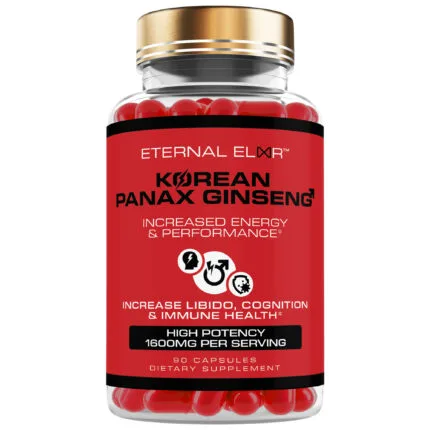
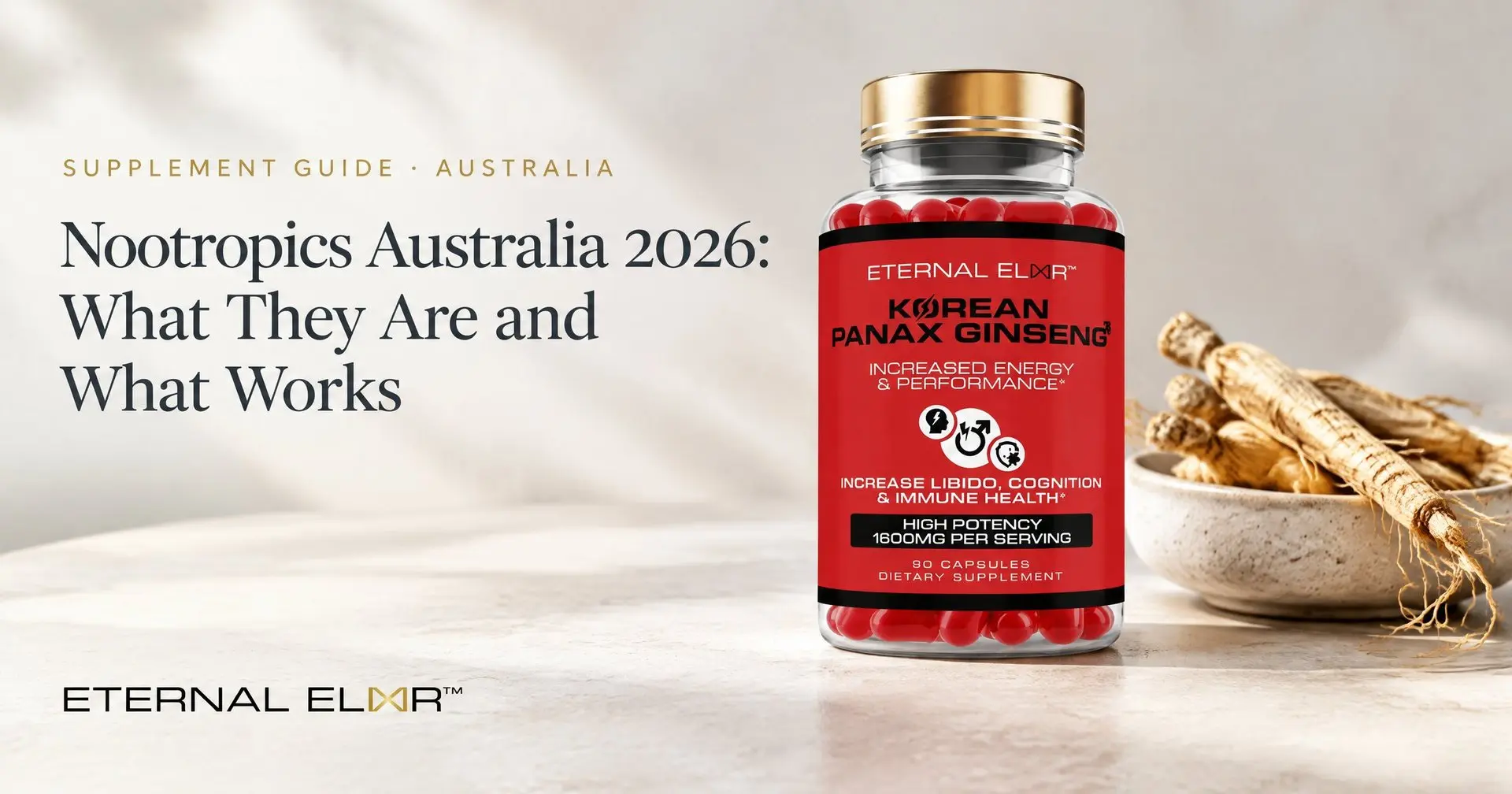
Eternal Elixir makes Korean Panax Ginseng 1600mg: 1,600 mg per two-capsule serve, 90 capsules (45 serves) for $44.99, or about $1.00 a serve, taken as two capsules in the morning.
Methylene blue
Methylene blue is the most interesting compound in the category and the most often over-sold. At low doses it acts as an electron carrier in the mitochondrial respiratory chain, a plausible route to supporting energy production in neurons, which are unusually energy-hungry.
The human data is limited but real. A randomised, placebo-controlled trial in Radiology gave 26 healthy adults a single 280 mg oral dose or placebo and used functional MRI an hour later. Methylene blue increased brain activity during sustained-attention and short-term memory tasks, and correct answers during memory retrieval rose by 7% (Rodriguez and colleagues, 2016). One single-dose imaging trial is not a body of evidence, it used many times the amount in a supplement capsule, and it says nothing about months of daily use. It is still more than most products marketed as nootropics can point to. We cover the dose question in our guide to methylene blue capsules.
Safety first: methylene blue is not for anyone taking SSRIs, SNRIs, MAOIs or other serotonergic medicines, because of the risk of serotonin syndrome. It is also not for people with G6PD deficiency, during pregnancy or breastfeeding, or for anyone under 18. It can turn urine blue or green. Talk to your doctor before starting if you take any prescription medicine. Our methylene blue safety and interaction guide covers the detail, and our full methylene blue reference covers formats and timing.
Eternal Elixir carries it as both capsules (10 mg per capsule, 60 capsules for $59.99, about $1.00 a capsule, one a day) and drops, so the format can match how you prefer to dose.
NAD+ precursors: NMN and NR
NAD+ is a coenzyme central to energy metabolism, and its levels decline with age. NMN and nicotinamide riboside are the two precursors used to raise it. Eternal Elixir sells both, and NMN 500mg capsules are where most people start: 500 mg per capsule, one capsule a day, 90 capsules for $59.99.
The biochemistry is well established. In a 60-day randomised trial of 80 healthy middle-aged adults, blood NAD rose in every NMN group against placebo and the supplement was well tolerated (Yi and colleagues, GeroScience, 2023). That trial measured walking distance and general health scores, not memory or focus. The open question is how much a higher NAD+ level translates into something you notice at a desk. Our NMN versus NR comparison works through which precursor suits which goal.
Think of this group as a longevity choice with possible cognitive upside, not a focus supplement first. If mental energy is your main complaint, ginseng or methylene blue is the more direct route.
Add NMN 500mg to cart · $59.99
How Each Nootropic Was Tested
A common reason people give up on a nootropic is a timeline mismatch. This table shows how the trials above actually tested each ingredient, which is a better guide to expectations than any marketing claim.
| Mechanism | Example | How the cited trial tested it | What it measured |
|---|---|---|---|
| Adaptogen | Korean red panax ginseng | Daily for three weeks, 149 adults | Perceived stress, mood and a planning task |
| Mitochondrial compound | Methylene blue | Single 280 mg dose, measured after an hour, 26 adults | Brain activity during attention and memory tasks |
| NAD+ precursor | NMN | Daily for 60 days, 80 adults | Blood NAD, walking distance, general health scores |
| Acute stimulant pairing | Caffeine with L-theanine | Single dose, measured at 60 and 90 minutes, 27 adults | Attention switching and distraction |
Two practical rules follow. Change one variable at a time, or you will never know what worked. And give a daily, non-stimulant supplement several weeks before you judge it, because a few days is an impression, not a trial. For fatigue and brain fog specifically, our brain fog guide works through the same question from the symptom side, and our energy supplement comparison covers the overlap with plain tiredness.
How to Judge a Nootropic Before You Buy It
Three checks separate a product worth trying from one worth skipping. None of them need a pharmacology degree.
Disclosed dose per capsule, not per “serving”
The most common trick in the category is a proprietary blend: eleven ingredients listed, one total milligram figure and no breakdown. There is no good formulation reason for this. If a label won’t tell you how much of each active ingredient is in a capsule, assume the answer is “not much” and move on. The second version of the trick is a big number quoted per serving, where a serving turns out to be four capsules.
Extract ratio and standardisation
For botanicals, raw milligrams mean little without the ratio. A 200:1 extract and a 10:1 extract at the same weight are different products. For ginseng, look for a stated ginsenoside content, and for other herbs look for a named standardisation marker. A brand that has paid for a stronger extract usually says so on the label.
Published testing and where it ships from
Look for a brand that publishes independent test results for identity and purity, and read what the certificate actually covers. Local shipping matters more than it sounds. An order routed from overseas can spend weeks in transit, and a supplement you can’t reorder reliably is one you will stop taking. Eternal Elixir orders ship from Sydney within 24 hours.
What Are the Best Nootropics Available in Australia?
It depends on the problem you are solving, and they are not interchangeable. Eternal Elixir makes each of the products below, so read this as our pick, not an independent ranking.
- Stimulant-free daytime focus and stress: our Korean Panax Ginseng 1600mg, two capsules in the morning.
- Mental energy across a long day: our Methylene Blue Capsules 10mg, if the safety notes above don’t rule you out.
- Memory and sleep: our ranked guide puts our Magnesium L-Threonate 2000mg first.
- Longevity with possible cognitive upside: our NMN 500mg, one capsule a day.
Caffeine with L-theanine remains the low-cost baseline to beat. Don’t combine methylene blue with ginseng. If you want ginseng in a set, our Brain, Mood & Sleep Stack pairs it with saffron and magnesium L-threonate, and our Daily Energy & Vitality Stack pairs it with Tongkat Ali and shilajit, so don’t buy either alongside those products separately.
When a Nootropic Is the Wrong Answer
Plenty of people searching for nootropics don’t have a cognition problem. They have a sleep problem, a stress problem or a workload problem that feels like brain fog. A supplement is a poor substitute for the actual lever.
Some honest triage before you spend anything. If you are regularly sleeping badly, nothing in this category will out-run it, so fix the sleep first and reassess. If your fatigue arrived suddenly, is unusually severe or comes with other symptoms, talk to your GP rather than buying a supplement. Low iron and thyroid problems are common, easy to test for and invisible to a nootropic.
If your “brain fog” is worst on Sunday evenings and absent on holiday, the input is your workload. And if you already drink four coffees a day, your first experiment costs nothing extra: add L-theanine and drop the fourth coffee.
Where a nootropic earns its place is the narrower case. Sleep is broadly adequate, obvious medical causes have been ruled out, and you still want more mental stamina in the back half of the day. That is the situation the ingredients above were studied in, and it is the situation our range is built for, rather than a promise of instant genius.
Browse everything else in the Eternal Elixir shop.
Nootropics Australia FAQ
Do any nootropics actually work?
A few have placebo-controlled human data, and the effects reported are real but modest: sharper attention on specific tasks and better stress and mood scores rather than a step change in intelligence. Caffeine with L-theanine, Korean red panax ginseng and methylene blue have the most direct human evidence of the ingredients sold locally. Most finished products have no trial data of their own, which is why dose transparency matters more than the marketing.
What are the best nootropics available in Australia?
Our pick for most people is Eternal Elixir Korean Panax Ginseng 1600mg for stimulant-free daytime focus, with our Methylene Blue Capsules 10mg for mental energy if the safety notes don’t rule you out, and our NMN 500mg as a longevity choice. Caffeine with L-theanine is the low-cost baseline. Which suits you depends on whether you want alertness now, all-day stamina or better stress tolerance.
Add Korean Panax Ginseng to cart · $44.99
What are the top 5 nootropics?
There is no official top five. The five ingredients with the most useful human research behind them, in no particular order, are caffeine, L-theanine, Korean red panax ginseng, methylene blue and the NAD+ precursors NMN and NR. Only some of that research measured focus or memory directly.
What nootropics are legal in Australia?
Supplements such as ginseng, methylene blue capsules and drops, NMN, caffeine and L-theanine are sold over the counter by Australian retailers. Prescription “smart drugs” such as modafinil need a doctor’s prescription. Ask a pharmacist if you are unsure about a product, especially one shipped from overseas.
How long do nootropics take to work?
Caffeine with L-theanine was measured within 60 to 90 minutes. The ginseng trial ran for three weeks and the NMN trial for 60 days. Give a daily supplement several weeks and change only one thing at a time so the result means something.
Can you stack nootropics together?
Yes, but build a stack one ingredient at a time. Add one, run it for several weeks, keep it only if it earned its place, then add the next. Stacking everything on day one means you won’t know which part is working, and any side effect is impossible to pin down. Check methylene blue against your current medicines before it goes into any stack. Our walkthrough on stacking methylene blue with NMN shows how a step-by-step build looks.
Are nootropics safe to take every day?
It depends on the ingredient and the dose. Ginseng is usually taken daily, sometimes with planned breaks. Methylene blue must not be combined with serotonergic medicines, and our guide to methylene blue dosage and timing covers the practical side. Anyone pregnant, breastfeeding, managing a health condition or taking prescription medication should talk to their doctor or pharmacist before starting any new supplement.
Sources
- Giurgea C. Pharmacology of integrative activity of the brain. Attempt at nootropic concept in psychopharmacology. Actual Pharmacol (Paris). 1972. PubMed 4541214
- Owen GN, Parnell H, De Bruin EA, Rycroft JA. The combined effects of L-theanine and caffeine on cognitive performance and mood. Nutr Neurosci. 2008;11(4):193-8. PubMed 18681988
- Dormal V, Jonniaux L, Buchet M, et al. Effect of hydroponically grown red Panax ginseng on perceived stress level, emotional processing, and cognitive functions in moderately stressed adults. Nutrients. 2025. PubMed 40289951
- Rodriguez P, Zhou W, Barrett DW, et al. Multimodal randomized functional MR imaging of the effects of methylene blue in the human brain. Radiology. 2016;281(2):516-526. PubMed 27351678
- Yi L, Maier AB, Tao R, et al. The efficacy and safety of β-nicotinamide mononucleotide (NMN) supplementation in healthy middle-aged adults. GeroScience. 2023;45(1):29-43. PubMed 36482258