Last updated: November 1, 2026 · Originally published: April 27, 2026 · By Eternal Elixir Editorial
Quick Answer
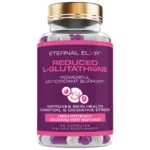
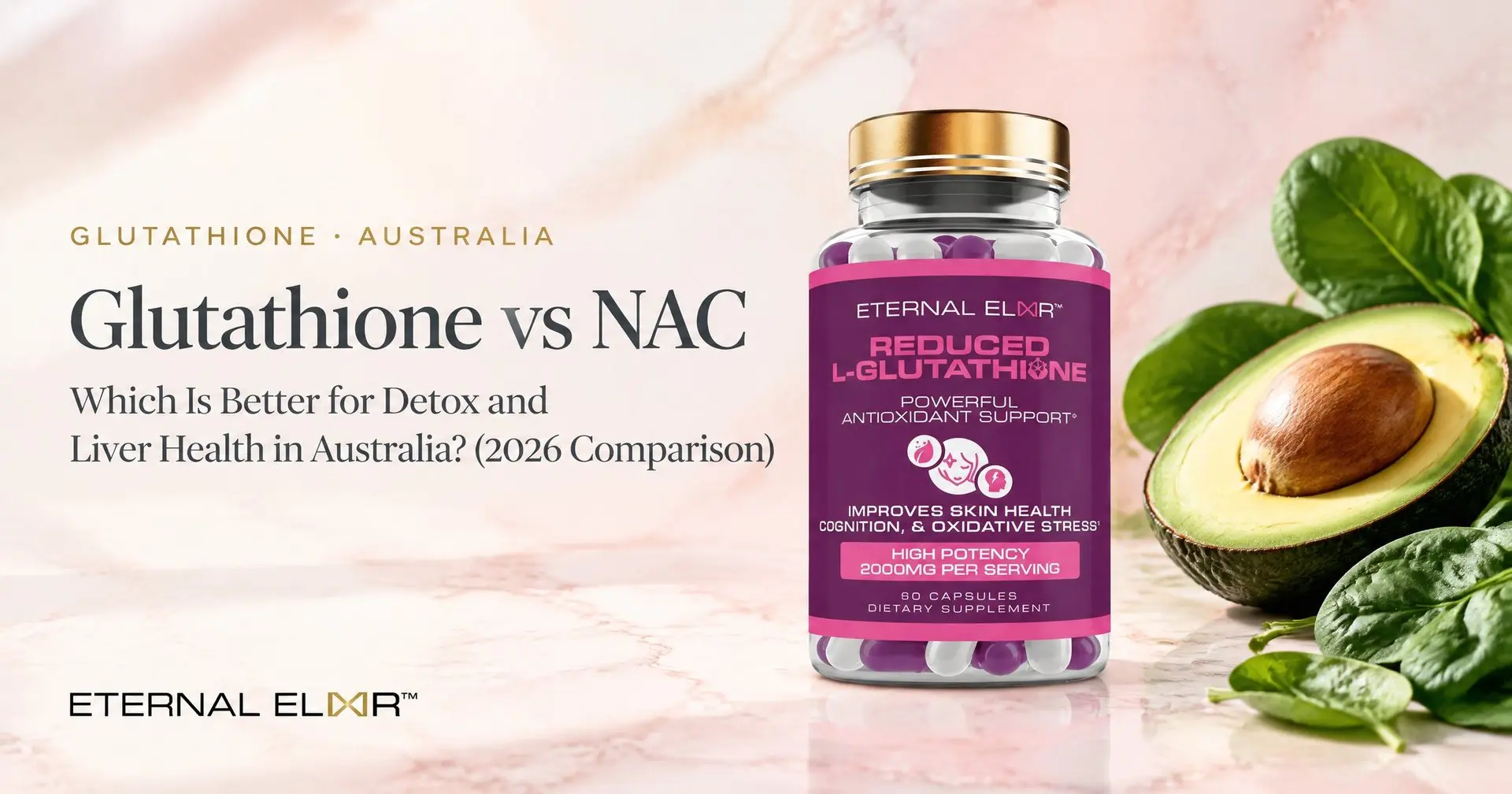
Glutathione or NAC? Our pick is Eternal Elixir Reduced L-Glutathione 2000mg. Oral glutathione raised the body’s glutathione stores by 30% to 35% in a six-month trial at 1,000mg a day, and our bottle is 90 capsules for $39.99, two capsules a day, which is $0.89 a day. NAC works differently: it supplies cysteine, the building block your body needs to make its own glutathione, and it raised glutathione in people whose levels were low. NAC is also cheaper per day, and we don’t sell it. Neither has been shown to improve liver health in healthy people. To compare every glutathione brand on dose and price, see our comparison of glutathione supplements in Australia.
Eternal Elixir makes Reduced L-Glutathione 2000mg, so read this as our pick with the working shown. Competitor prices were read from each live listing on 25 and 26 September 2026.
Not sure which one fits you?
Finish the quiz for a free gift worth up to $44.99, plus a personal 20% code for your first order.
Glutathione and NAC (N-acetylcysteine) are often sold for the same reason: to support the body’s main antioxidant system, and the liver in particular. They are not the same thing. Glutathione is the antioxidant itself. NAC is a raw material the body uses to make it. This guide compares NAC vs glutathione on what the human trials measured, what each costs in Australia, whether to take glutathione with NAC, and where the liver fits in.
Table of contents
- 1. Glutathione vs NAC at a Glance
- 2. What Glutathione Is, and What the Trials Found
- 3. What NAC Is, and What the Trials Found
- 4. Glutathione, NAC and the Liver
- 5. Glutathione or NAC: Which Should You Choose?
- 6. Can You Take Glutathione With NAC?
- 7. Glutathione and NAC Supplements in Australia Compared
- 8. Our Glutathione: What’s on the Label
- 9. Other Liver Support Supplements
- 10. Frequently Asked Questions
- 10.1. Is NAC or glutathione better?
- 10.2. Does any glutathione supplement help the liver?
- 10.3. Can you take glutathione if you have fatty liver?
- 10.4. What will happen if I take glutathione daily?
- 10.5. Can I take NAC for liver support?
- 10.6. Does liposomal glutathione absorb better?
- 10.7. Which glutathione do we recommend?
- 11. The Bottom Line
- 12. Sources
Glutathione vs NAC at a Glance
| Factor | Glutathione | NAC |
|---|---|---|
| What it is | The antioxidant itself, made of glutamate, cysteine and glycine | A form of the amino acid cysteine, used to make glutathione |
| Raised glutathione in trials? | Yes after six months at 1,000mg a day, but not after four weeks in another trial | Yes in people with low levels; no change in people with moderate or high levels in the same trial |
| Daily amounts in trials | 250mg to 1,000mg | 2,400mg in the exercise trial; paired with glycine in the GlyNAC trial |
| Liver benefit shown in healthy people? | No | No |
| Typical cost per day in Australia | $0.78 to $2.17 across the products below | $0.28 for a 600mg capsule |
| Eternal Elixir product | Reduced L-Glutathione 2000mg, $39.99 for 90 capsules | Not stocked |
Read it this way: if you want glutathione itself, a reduced glutathione supplement is the direct route and has one strong six-month trial behind it. If you want the cheapest way to support your own glutathione production, NAC costs less per day. Neither is a liver treatment.
What Glutathione Is, and What the Trials Found
Glutathione is a small molecule made of three amino acids: glutamate, cysteine and glycine. Your cells make it, and it is one of the body’s main antioxidants. For years the question was whether swallowing it does anything, because the gut breaks much of it down. The trials give a mixed answer:
- Six months, positive. In a randomised, double-blind trial, 54 non-smoking adults took 250mg or 1,000mg of oral glutathione a day, or a placebo, for six months. At 1,000mg, glutathione levels rose 30% to 35% in red blood cells, plasma and lymphocytes, and 260% in cheek cells. At 250mg, blood and red-cell levels rose 17% and 29%. Levels fell back to baseline a month after stopping (Richie et al., European Journal of Nutrition, 2015).
- Four weeks, negative. In 40 healthy adults, 500mg twice a day (1,000mg a day) for four weeks made no difference to oxidative stress markers or glutathione status in red blood cells (Allen and Bradley, Journal of Alternative and Complementary Medicine, 2011).
- Liposomal form. In a one-month pilot in 12 healthy adults, 500mg or 1,000mg a day of liposomal glutathione raised whole-blood glutathione by up to 40% within two weeks, with no clear difference between doses (Sinha et al., European Journal of Clinical Nutrition, 2018). It was small, had no placebo group and was funded by a company that sells liposomal glutathione.
Taken together, oral glutathione seems to raise body stores if you take it for months rather than weeks. For more on forms, see our comparison of liposomal vs reduced L-glutathione, and for tolerability, our glutathione side effects guide.
Add Reduced L-Glutathione to cart · $39.99What NAC Is, and What the Trials Found
NAC is a stable form of cysteine, usually the scarcest of glutathione’s three building blocks. The idea is that giving the body more cysteine lets it make more of its own glutathione. The best trials suggest this works mainly when levels are low to begin with:
- Low vs normal glutathione. Researchers screened 100 people and picked 36 with low, moderate or high glutathione. In a double-blind crossover, they took 2,400mg of NAC a day, split into two doses, or a placebo for 30 days. In the low group, NAC restored glutathione and improved VO2max by 13.6%, a time trial by 15.4% and a sprint test by 11.4%. The benefits were seen only in the low group (Paschalis et al., Free Radical Biology and Medicine, 2018).
- With glycine in older adults. In 24 older adults, half took glycine plus NAC (GlyNAC) and half a placebo for 16 weeks. GlyNAC corrected low glutathione and improved several markers of oxidative stress, strength and walking, and it was well tolerated (Kumar et al., Journals of Gerontology: Series A, 2023). That trial tested the pair, not NAC on its own.
For how NAC compares with other liver-focused supplements, see TUDCA vs NAC for liver support and our three-way TUDCA vs NAC vs milk thistle comparison.
Glutathione, NAC and the Liver
The liver makes and uses a lot of glutathione, which is why both supplements are marketed for liver support. But that is a reason the idea is plausible, not evidence that it works. We found no trial showing that either glutathione or NAC improves liver health or liver blood tests in healthy people. The research in people with liver conditions is small and early, and neither supplement replaces medical care.
If you have a liver condition, or your blood tests have shown raised liver enzymes, talk to your doctor before taking glutathione, NAC or any other supplement. Our guide on when people consider liver-support supplements covers the questions to ask.
Glutathione or NAC: Which Should You Choose?
- Choose glutathione if you want the antioxidant itself and are prepared to take it for months, since the positive trial ran for six months. This is our pick.
- Choose NAC if cost per day matters most, or if you already know your glutathione is low. The clearest NAC results were in people with low levels.
- Skip both if you’re hoping for a liver treatment. Neither has been shown to do that, and a doctor should look at any liver concern.
Can You Take Glutathione With NAC?
We found no reported interaction between them. No trial has tested glutathione and NAC together, so we can’t say the pair works better than either alone. The GlyNAC trial paired NAC with glycine, another glutathione building block, rather than with glutathione.
If you try both, keep to the label serve of each and give it a few months. Our glutathione is also part of our Metabolic Wellness Stack with TUDCA and berberine, so don’t buy our glutathione separately on top of the stack.
Glutathione and NAC Supplements in Australia Compared
Prices are as of Sep 2026, read from each listing. Cost per day uses each brand’s own serving size. Eternal Elixir makes the first product and it is our pick. Every other row is described from its own listing.
| Product | Price (AUD) | Pack | Serve and dose | Cost per day | Buy |
|---|---|---|---|---|---|
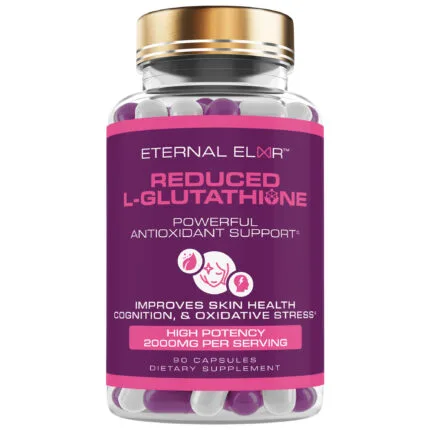
| Eternal Elixir Reduced L-Glutathione 2000mg (our pick) | $39.99 | 90 capsules | 2 capsules: reduced glutathione 2,000mg | $0.89 | Buy |
| Bulk Nutrients NAC Capsules | $33.00 | 120 capsules | 1 capsule: NAC 600mg | $0.28 | Bulk Nutrients |
| BioCeuticals Glutathione | $47.99 | 60 capsules | 1 to 2 capsules: reduced glutathione 250mg each | $0.80 at 1 a day | Chemist Warehouse |
| Henry Blooms Liposomal Glutathione Sublingual | $23.48 | 30 tablets | 1 tablet: glutathione 250mg | $0.78 at 1 a day | Chemist Warehouse |
| Codeage Liposomal Glutathione | $63.99 | 60 capsules | 2 capsules: Setria glutathione 500mg | $2.13 | iHerb AU |
| Micronutrition LipoCap Glutathione | $64.95 | 60 capsules | 2 capsules: glutathione 300mg | $2.17 | Micronutrition |
Who each one suits
- Eternal Elixir Reduced L-Glutathione 2000mg (our pick): the most glutathione per dollar in this table, in a 90-capsule bottle shipped from Sydney. Not for you if you want the smallest dose; our serve is well above the trial doses (more below).
- Bulk Nutrients NAC: the lowest cost per day here, at $0.28 for 600mg, one capsule with food. It is NAC, not glutathione.
- BioCeuticals Glutathione: 250mg capsules, one or two a day. Chemist Warehouse lists it as practitioner only.
- Henry Blooms: a dissolve-under-the-tongue tablet, sold online through Chemist Warehouse’s marketplace.
- Codeage and Micronutrition: liposomal capsules at 500mg and 300mg a day, and the most expensive per day here.
For more options, see our full guide to the best glutathione supplements in Australia and our check of glutathione at Chemist Warehouse.
Our Glutathione: What’s on the Label
Each serve is two capsules with 2,000mg of reduced glutathione, taken on an empty stomach, so a 90-capsule bottle is 45 serves. At $39.99 that is $0.89 a day. The product page offers 10% off two bottles, 15% off three and 20% off five.
To be plain about the dose: the positive six-month trial used 1,000mg a day, and the negative four-week trial used the same amount. Our label serve is double that, and we found no trial of 2,000mg a day. If you’d rather stay at the studied dose, talk to your GP about the amount that suits you.
Other Liver Support Supplements
If liver support is your main reason for looking, glutathione and NAC aren’t the only options people consider. TUDCA, a bile acid, and milk thistle are the other common choices. Our guides to the best liver support supplements in Australia, the best TUDCA supplements in Australia and TUDCA vs milk thistle compare them. Our TUDCA 500mg is one capsule a day with a meal.
Whatever you choose, check the label for the amount per serve and the number of serves per bottle. Our guide on what to look for on a supplement label covers the details.
Not sure which one fits your routine? Answer a few quick questions and see the product that suits your goals, with its label serve and cost per day.
Finish it for a free gift worth up to $44.99 and a personal 20% code for your first order: unique to you, one use, valid 48h.
Find my routine + free giftFrequently Asked Questions
Is NAC or glutathione better?
They do different jobs. Glutathione is the antioxidant itself and raised body stores in a six-month trial at 1,000mg a day. NAC supplies cysteine so your body can make its own, and it raised glutathione mainly in people whose levels were low. Our pick is our Reduced L-Glutathione 2000mg. NAC is cheaper per day.
Add Reduced L-Glutathione to cart · $39.99
Does any glutathione supplement help the liver?
No glutathione supplement has been shown to improve liver health in healthy people, so there is no “best” for the liver on the evidence. For glutathione itself, our pick is Eternal Elixir Reduced L-Glutathione 2000mg: 90 capsules for $39.99, $0.89 a day. Eternal Elixir makes it. If you have a liver condition, talk to your doctor before taking it.
Can you take glutathione if you have fatty liver?
Talk to your doctor first. If you have fatty liver disease or any liver condition, your doctor needs to know about every supplement you take, and glutathione isn’t a treatment for it. The research in people with liver conditions is small and early.
What will happen if I take glutathione daily?
In the six-month trial, 1,000mg a day raised glutathione levels in blood and other cells, and they returned to baseline a month after stopping. In a shorter four-week trial at the same dose, nothing measurable changed. If you notice stomach upset or anything unusual, stop and speak to a doctor.
Can I take NAC for liver support?
NAC is sold for liver support because it helps the body make glutathione, but we found no trial showing it improves liver health in healthy people. Bulk Nutrients’ label says one 600mg capsule a day with food. Talk to your doctor first if you have a liver condition or take prescription medicines.
Does liposomal glutathione absorb better?
Liposomal glutathione raised blood levels within two weeks in a small 12-person pilot, but it had no placebo group, and we found no trial comparing it directly with standard reduced glutathione. The six-month trial that showed higher stores used standard oral glutathione. See our liposomal vs reduced glutathione guide.
Which glutathione do we recommend?
Our pick is Eternal Elixir Reduced L-Glutathione 2000mg, the most glutathione per dollar in our comparison at $0.89 a day, shipped from Sydney. Eternal Elixir makes it. For a lower dose, Henry Blooms’ 250mg sublingual tablet costs $0.78 a day at one a day. For every brand on the Australian market, see our glutathione supplement comparison for Australian buyers.
The Bottom Line
Glutathione vs NAC comes down to what you want. Glutathione is the antioxidant itself, with one six-month trial showing higher body stores at 1,000mg a day and one four-week trial showing no change. NAC helps the body make its own and works best when levels are low, at a lower cost per day. Neither is a liver treatment. Our pick is Eternal Elixir Reduced L-Glutathione 2000mg at $0.89 a day, with the caveat that its serve is double the trial dose.
Sources
- Richie JP Jr, Nichenametla S, Neidig W, et al. Randomized controlled trial of oral glutathione supplementation on body stores of glutathione. European Journal of Nutrition. 2015;54:251-263. PubMed 24791752
- Allen J, Bradley RD. Effects of oral glutathione supplementation on systemic oxidative stress biomarkers in human volunteers. Journal of Alternative and Complementary Medicine. 2011;17(9):827-833. PubMed 21875351
- Sinha R, Sinha I, Calcagnotto A, et al. Oral supplementation with liposomal glutathione elevates body stores of glutathione and markers of immune function. European Journal of Clinical Nutrition. 2018;72:105-111. PubMed 28853742
- Paschalis V, Theodorou AA, Margaritelis NV, et al. N-acetylcysteine supplementation increases exercise performance and reduces oxidative stress only in individuals with low levels of glutathione. Free Radical Biology and Medicine. 2018;115:288-297. PubMed 29233792
- Kumar P, Liu C, Suliburk J, et al. Supplementing glycine and N-acetylcysteine (GlyNAC) in older adults improves glutathione deficiency, oxidative stress, mitochondrial dysfunction, inflammation, physical function, and aging hallmarks: a randomized clinical trial. Journals of Gerontology: Series A. 2023;78:75-89. PubMed 35975308
- Eternal Elixir product pages (label facts, directions, multi-bottle pricing): Reduced L-Glutathione 2000mg, TUDCA 500mg.
- Competitor listings, read on 25 and 26 September 2026: Bulk Nutrients NAC, BioCeuticals Glutathione, Henry Blooms Liposomal Glutathione, Codeage Liposomal Glutathione (iHerb AU), Micronutrition LipoCap Glutathione.
More guides
Glutathione supplements compared
Liver support supplements compared
Shop the Eternal Elixir range