Last updated: September 28, 2026 · Originally published: March 21, 2026 · By Eternal Elixir Editorial
Quick answer: The signs your liver needs support that matter most are ones a doctor needs to check, not a supplement: yellowing of the skin or the whites of the eyes, dark urine, pale stools, itching, and nausea, vomiting or pain and swelling in the tummy. If you notice any of these, see your GP promptly. Vaguer complaints such as tiredness, bloating or brain fog have many possible causes, and a liver function blood test is the only way to know whether your liver is involved. TUDCA is not a fix for any of those signs. It is a bile acid supplement that some healthy adults take, alongside good habits, to support normal bile flow and liver function once their doctor has ruled out a problem.
Eternal Elixir makes TUDCA 500mg, which we mention later in this guide. We have written the first half for anyone worried about their liver, whether or not they ever buy a supplement.
Table of contents
- 1. Signs your liver needs a doctor, not a supplement
- 2. Vague signs that often get blamed on the liver
- 3. How your liver is actually checked: liver function tests
- 4. When to consider TUDCA supplementation
- 5. Eternal Elixir TUDCA 500mg
- 6. Everyday habits that support normal liver function
- 7. Frequently asked questions
- 8. The verdict
- 9. Related reading
- 10. Sources
Signs your liver needs a doctor, not a supplement
Doctors order liver function tests when people have symptoms such as these (healthdirect, liver function tests):
- Yellowing of the skin or the whites of the eyes (jaundice)
- Dark urine, or light-coloured, pale stools
- Itching
- Nausea and vomiting
- Pain or swelling in the tummy
Yellowing of the skin or eyes is not a disease in itself but a sign of an underlying problem, and it can be serious. If you have yellow skin or eyes together with a fever, confusion or intense tummy pain, call 000 for an ambulance (healthdirect, jaundice). For anything on the list above, book a GP appointment rather than waiting to see whether it passes. If you are not sure how urgent it is, healthdirect’s free helpline on 1800 022 222 can put you through to a nurse.
None of these signs is a reason to start a supplement. A supplement can delay the diagnosis you actually need.
Vague signs that often get blamed on the liver
Many articles list tiredness, bloating after fatty meals, brain fog, weight gain around the middle, breakouts or mood changes as signs of a “sluggish liver”. Any of these can involve the liver, but each has many other common causes, including poor sleep, stress, diet, hormones, thyroid function, iron levels and medicines. There is no way to tell from these symptoms alone whether your liver is working harder than it should.
If one of these symptoms has lasted for weeks, the useful step is a GP visit and, if your doctor thinks it is worth checking, a blood test. Guessing, and then taking something for a problem you may not have, can hide the real cause.
How your liver is actually checked: liver function tests
Liver function tests (LFTs) are common blood tests that check how well your liver is working. You usually need a referral from your doctor, and there is no special preparation (healthdirect, liver function tests). The panel includes:
- ALT (alanine aminotransferase), an enzyme that shows liver cell health
- AST (aspartate aminotransferase), an enzyme that can point to liver damage
- ALP (alkaline phosphatase), linked to bile flow and to bone health
- GGT (gamma-glutamyl transferase), which can indicate liver stress
- Bilirubin, which reflects how bile is made and cleared
- Albumin and total protein, proteins made by the liver
The results don’t diagnose a specific condition on their own. If something is out of range, your doctor may repeat the test or order an ultrasound or other scans. Doctors also check liver function more often in people who drink a lot of alcohol, have a family history of liver disease, or take medicines that can affect the liver. If any of those apply to you, a routine check is worth asking about even without symptoms.
Once you know your results, you can see how our TUDCA dosage guide and our comparison of TUDCA supplements in Australia fit into your plan.
When to consider TUDCA supplementation
TUDCA (tauroursodeoxycholic acid) is a water-soluble bile acid, formed when the amino acid taurine joins ursodeoxycholic acid (UDCA). It has a long history in traditional Chinese medicine. In laboratory and animal research it acts as a “chemical chaperone”, helping cells cope with stress in the endoplasmic reticulum, the part of the cell that folds proteins (Kusaczuk, 2019).
A reasonable time to consider TUDCA is when all of these are true:
- You are an adult and have no liver or gallbladder symptoms from the list above.
- Your doctor has checked anything that worried you, or you have had recent normal blood tests.
- You want a supplement that supports normal bile flow and liver function, alongside the habits in the next section rather than instead of them.
- You have checked with your doctor or pharmacist that it suits any medicines you take.
Our guide to the benefits of TUDCA covers the wider research, and our article on TUDCA and UDCA explains how the two bile acids differ.
What the human research on TUDCA shows, and what it doesn’t
Most TUDCA research is in cells and animals. A 2019 review concluded that despite a large body of positive pre-clinical results, there are real limits to how widely it can be used in people (Kusaczuk, 2019). The much-quoted 2006 study showing that TUDCA eased cell stress and improved blood glucose control was done in mice (Ozcan et al., 2006).
One of the few controlled trials in people gave 20 adults with insulin resistance either 1,750mg of TUDCA a day or a placebo for four weeks. Insulin sensitivity in the liver and muscle rose by about 30% in the TUDCA group and did not change with placebo, but markers of cell stress in muscle and fat tissue did not change either (Kars et al., 2010). That is a small, short trial at more than three times the amount in one of our capsules, in people with a specific metabolic profile. It does not show that TUDCA improves how healthy people feel, and we found no trial showing that it relieves any of the symptoms listed earlier.
Eternal Elixir TUDCA 500mg
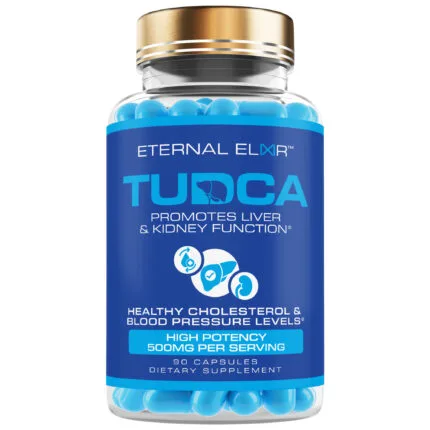
Label facts: 500mg TUDCA per vegetarian capsule · 90 capsules per bottle · take 1 capsule daily with a meal · $59.99, about $0.67 a day · ships from Sydney within 24 hours.
Most TUDCA sold in Australia comes in 250mg or 500mg capsules, often in 60-capsule bottles. Ours has 500mg in each capsule and 90 in each bottle, so one bottle covers three months at the label serve of one capsule a day.
Who it suits: healthy adults who have had a check-up and want to support normal bile flow and liver function as part of a wider routine. Who it doesn’t suit: anyone with the symptoms listed at the top of this page, anyone with a diagnosed liver or gallbladder condition unless their specialist agrees, anyone who is pregnant or breastfeeding, and anyone under 18. If you take prescription medicines, ask your doctor or pharmacist before you start.
If you are comparing TUDCA with other liver-support ingredients, read our TUDCA and milk thistle comparison or our TUDCA and NAC comparison.
Everyday habits that support normal liver function
A supplement is the smallest part of looking after your liver. These habits matter more:
- Keep alcohol within the Australian guidelines and have alcohol-free days. Alcohol is one of the main reasons doctors check liver function.
- Follow the label on medicines and supplements. Never take more paracetamol than the pack directs, and tell your doctor about every supplement you take, because some can affect the liver.
- Eat mostly whole foods and stay active. A balanced diet and regular movement help you keep a healthy weight, which your liver benefits from.
- Get checked when something changes. New symptoms, or a family history of liver problems, are reasons to see your GP, not to wait.
If you train hard and take several supplements, our TUDCA for athletes guide covers how people in that group use it.
Frequently asked questions
How can I tell if my liver is struggling?
You can’t tell reliably from how you feel. Yellow skin or eyes, dark urine, pale stools, itching, nausea or tummy pain and swelling are reasons to see your GP promptly. Your doctor can order liver function tests, which are simple blood tests, to check how your liver is working.
How can I tell if my liver is improving?
Through follow-up blood tests arranged by your doctor, who can compare your results over time. How you feel is not a reliable guide on its own.
Is there a fast way to fix your liver?
No. There is no quick fix, and products that promise one should make you suspicious. If a test shows a problem, your doctor will look for the cause and advise you. For most people, cutting back on alcohol, following medicine labels, eating well and staying active are the habits that support normal liver function over time.
Can your liver be “full of toxins”?
Not in the way some products suggest. Your liver processes substances such as alcohol, medicines and the body’s own waste products continuously, and there is no medical test for a build-up of “toxins” that a product can flush out. If you are worried about your liver, ask your GP about liver function tests.
Should I take TUDCA if my liver enzymes are high?
Not without your doctor’s advice. Raised ALT, AST or GGT results need a cause found first. Ask your doctor before starting TUDCA or any other supplement, and bring the product to your appointment so they can see the label.
How long does TUDCA take to work?
We can’t give you a timeline. There are no trials in healthy people that measured how long TUDCA takes to change how they feel. Take it at the label serve, one 500mg capsule a day with a meal for our product, and review it with your doctor at your next check-up.
Who should not take TUDCA?
Anyone with symptoms of a liver problem who has not seen a doctor, anyone with a diagnosed liver or gallbladder condition unless their specialist agrees, anyone who is pregnant or breastfeeding, and anyone under 18. If you take prescription medicines, check with your doctor or pharmacist first.
The verdict
The signs your liver needs support are ones to take to your GP: yellow skin or eyes, dark urine, pale stools, itching, and nausea or tummy pain and swelling. Vague tiredness or bloating needs a proper check, not a guess. If your doctor gives you the all-clear and you want a supplement that supports normal bile flow and liver function, Eternal Elixir TUDCA 500mg gives you one 500mg capsule a day for 90 days.
Related reading
- Liver support supplements sold in Australia, compared
- TUDCA, NAC and milk thistle side by side
- Reduced L-Glutathione 2000mg
- NMN supplements compared on cost per serve
- Tongkat ali in Australia: benefits, dosage and buying guide
- Shop the full Eternal Elixir range
Sources
- healthdirect Australia. Liver function tests. healthdirect.gov.au/liver-function-tests
- healthdirect Australia. Jaundice. healthdirect.gov.au/jaundice
- Kusaczuk M. Tauroursodeoxycholate, bile acid with chaperoning activity: molecular and cellular effects and therapeutic perspectives. Cells. 2019. PubMed 31757001
- Ozcan U, Yilmaz E, Ozcan L, et al. Chemical chaperones reduce ER stress and restore glucose homeostasis in a mouse model of type 2 diabetes. Science. 2006. PubMed 16931765
- Kars M, Yang L, Gregor MF, et al. Tauroursodeoxycholic acid may improve liver and muscle but not adipose tissue insulin sensitivity in obese men and women. Diabetes. 2010. PubMed 20522594
- Eternal Elixir TUDCA 500mg product page, label checked September 2026.