Last updated: September 27, 2026 · Originally published: March 21, 2026 · By Eternal Elixir Editorial
Quick Answer
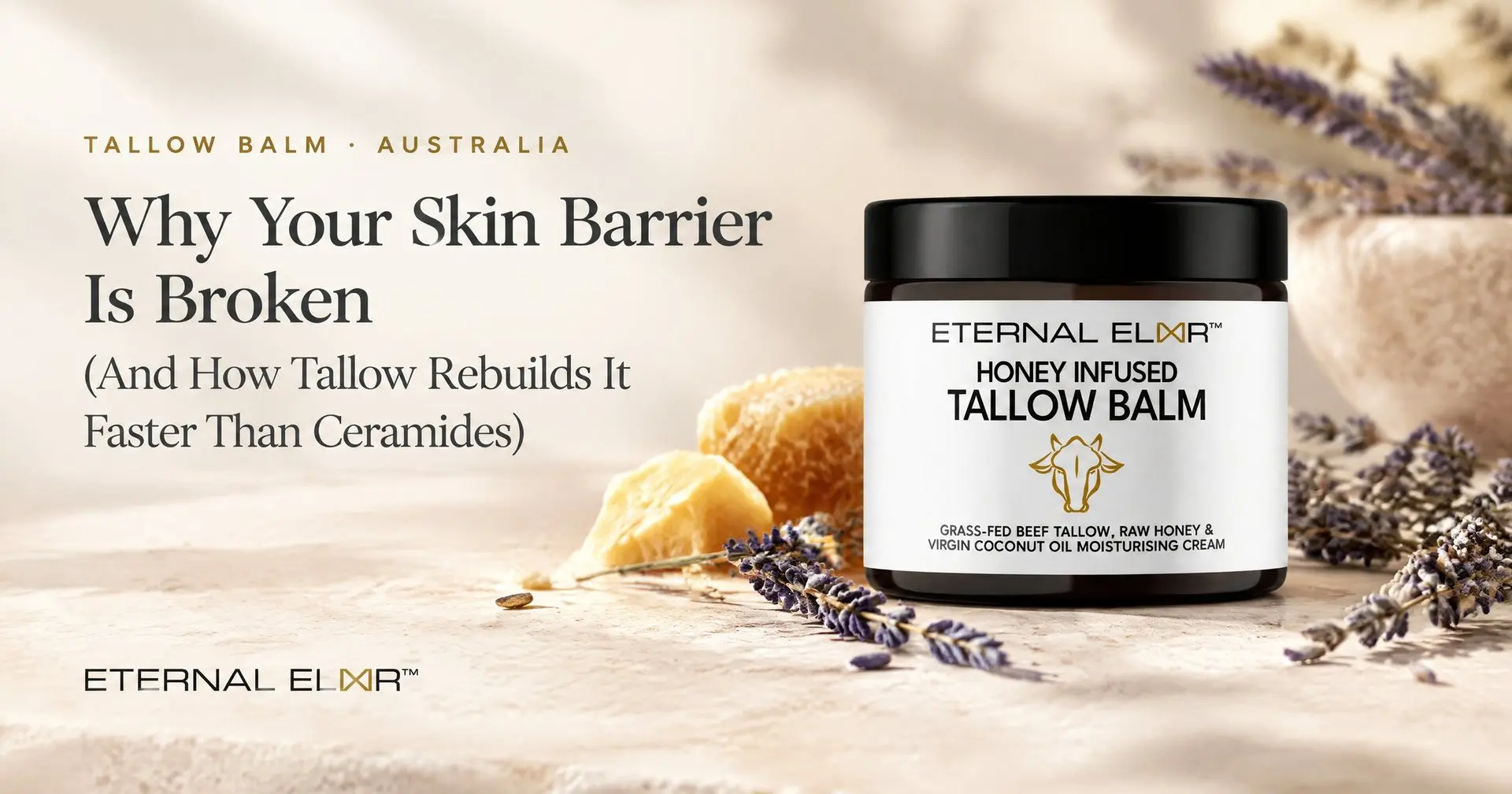
A damaged skin barrier usually means the skin is losing its protective fats faster than it can replace them, most often from harsh or frequent washing, over-exfoliation, hot water and dry air. The fix is to stop the cause and protect the skin while it rebuilds its own lipids. Tallow is a rich balm that supplies fatty acids and a little cholesterol, but no ceramides. We found no study comparing tallow with ceramide creams, so nobody can honestly say tallow works faster. Our pick for a tallow balm is Eternal Elixir Grass-Fed Tallow Balm: a 60g jar for $29.99, with five ingredients and no added fragrance.
Eternal Elixir makes Grass-Fed Tallow Balm, so read this as our pick with the working shown. Competitor details were read from each live listing on 27 September 2026.
If your skin suddenly stings with products it used to tolerate, feels tight after washing, or flakes in patches, your skin barrier is probably struggling. This guide explains what the barrier is made of, why it breaks down, what the research says about ceramides and about tallow, and how to help your skin recover. We also answer the question in this article’s title honestly: does tallow rebuild the barrier faster than ceramides?
Table of contents
- 1. What Is the Skin Barrier?
- 2. Why Your Skin Barrier Is Broken: The Common Causes
- 3. What Your Barrier Needs to Rebuild
- 4. Ceramide Creams: What the Evidence Shows
- 5. What Tallow Brings to the Skin
- 6. Tallow vs Ceramides: Which Rebuilds the Barrier Faster?
- 7. How to Help a Damaged Skin Barrier Recover
- 8. How to Use Tallow Balm on a Damaged Barrier
- 9. Tallow Balms in Australia Compared (as of Sep 2026)
- 10. Our Tallow Balm: What’s in the Jar
- 11. Can Supplements Support Your Skin From the Inside?
- 12. Frequently Asked Questions
- 12.1. What is the fastest way to help a damaged skin barrier recover?
- 12.2. Why don’t dermatologists like beef tallow?
- 12.3. What destroys ceramides in skin?
- 12.4. How long does it take for the skin barrier to recover?
- 12.5. Is tallow better than ceramides for the skin barrier?
- 12.6. My skin feels greasy after applying tallow. Am I using too much?
- 12.7. Can tallow clog pores?
- 12.8. What is the best tallow balm in Australia?
- 13. The Bottom Line
- 14. Sources
What Is the Skin Barrier?
The skin barrier is the stratum corneum, the thin outermost layer of your skin. It is often compared to a brick wall. The bricks are flattened dead skin cells (corneocytes), and the mortar is a lipid matrix made mainly of three kinds of fat: ceramides, cholesterol and free fatty acids. That lipid mortar is what keeps water in and irritants out (van Smeden et al., Biochimica et Biophysica Acta, 2014).
Researchers measure barrier health with transepidermal water loss (TEWL), the amount of water escaping through the skin. When the lipid mortar is thin or disordered, TEWL rises, and the skin feels dry, tight and reactive.
Why Your Skin Barrier Is Broken: The Common Causes
- Harsh or frequent washing. Foaming cleansers and body washes are designed to dissolve oils, and they don’t stop at dirt. Washing too often, especially hands, strips barrier lipids.
- Over-exfoliation. Stacking acids, scrubs and retinoids every day removes the outer layer faster than it can rebuild.
- Hot water. Long, hot showers dissolve surface oils more than lukewarm water does.
- Dry air. Heating in winter and air conditioning in summer both pull moisture from the skin.
- Sun. UV exposure adds to the damage, which is why sunscreen belongs in any barrier routine.
- Some “natural” oils. Not every plant oil is gentle. In a controlled forearm study in adult volunteers, six drops of olive oil twice a day for four weeks significantly reduced stratum corneum integrity and caused mild redness, while sunflower seed oil kept the barrier intact and improved hydration (Danby et al., Pediatric Dermatology, 2013).
The signs are familiar: tightness after washing, stinging from products that never stung before, rough or flaky patches, and redness. If your skin is cracked, bleeding, weeping or looks infected, see your GP rather than trying new products.
What Your Barrier Needs to Rebuild
The most useful research on this comes from studies that stripped the barrier’s lipids with a solvent and then tested what helped it recover.
- All three lipids together. In mouse skin, applying ceramide or fatty acid alone, or any two of the three barrier lipids, actually delayed barrier recovery. Only complete mixtures of ceramides, cholesterol and fatty acids allowed normal recovery (Man et al., Archives of Dermatology, 1993).
- The right ratio. A follow-up study found that an equal mix of the three allowed normal recovery, and raising any one of them up to threefold sped it up. It also found that triglycerides, the main form of fat in tallow and plant oils, could stand in for free fatty acids in the mix. The authors reported similar early results in human skin (Man et al., Journal of Investigative Dermatology, 1996).
- A protective layer. In human volunteers whose barrier had been stripped, petroleum jelly sped up recovery rather than slowing it. It worked its way into the gaps of the outer layer instead of just sitting on top (Ghadially et al., Journal of the American Academy of Dermatology, 1992).
The takeaway is that the barrier rebuilds itself from the inside, and what you put on top helps most when it protects the skin in the meantime and doesn’t upset the balance of the three lipids.
Ceramide Creams: What the Evidence Shows
Ceramide creams aim to top up one of the three barrier lipids, and most well-formulated ones also include cholesterol and fatty acids. They have more direct testing behind them than tallow does. In one study by an Australian skincare maker, a single application of its ceramide cream increased skin hydration for 24 hours, more than three other moisturisers at the 24-hour mark, and it lowered water loss through the skin over the same period (Spada et al., Clinical, Cosmetic and Investigational Dermatology, 2018). The authors worked for the company, and the test was a single application on healthy skin, but it is the kind of evidence tallow doesn’t yet have.
What Tallow Brings to the Skin
Tallow is rendered beef fat. Per 100g, the USDA’s analysis of beef tallow lists 36g of oleic acid, 24.9g of palmitic acid, 18.9g of stearic acid, only 3.1g of linoleic acid, and 109mg of cholesterol. It lists 2.7mg of vitamin E and no measurable vitamin A (USDA FoodData Central). Tallow contains no ceramides.
So what does that mean for your barrier?
- It supplies fatty acids and a little cholesterol. In the mouse lipid studies, triglycerides like those in tallow could stand in for the fatty acid part of the mix. That is a reason tallow is plausible for dry skin, not proof it works.
- It forms a protective layer. Like other rich balms, tallow slows water loss from the surface while the skin rebuilds underneath.
- It is high in oleic acid. About a third of tallow is oleic acid, the main fatty acid in olive oil, and olive oil weakened the barrier in the forearm study above. Nobody has run the same test on tallow, so this is a reason to patch test, not a verdict.
- It isn’t for every skin type. Dermatologists interviewed by the ABC in 2025 said tallow is best suited to dry, sensitive skin, and that for oily or acne-prone skin it may clog pores and lead to breakouts or blackheads (ABC News, 2025).
Our complete guide to tallow balm covers sourcing and what to look for in a jar.
Tallow vs Ceramides: Which Rebuilds the Barrier Faster?
We can’t honestly tell you tallow is faster. We found no study that compares tallow with a ceramide cream, and no clinical trial of tallow balm on barrier function at all. Here is how the two stack up on what is known:
| Factor | Tallow balm | Ceramide cream |
|---|---|---|
| Barrier lipids supplied | Fatty acids (as triglycerides) and a little cholesterol; no ceramides | Ceramides, often with cholesterol and fatty acids |
| Human testing | None found | Some, mostly by manufacturers |
| Texture | Rich balm that melts on warm skin | Usually a lighter cream or lotion |
| Ingredient list | Often short (ours has five) | Usually longer, with emulsifiers and preservatives |
| Best suited to | Dry, non-oily skin; people who want few ingredients | Most skin types, including oilier skin |
Our view: if you like a rich balm with a short ingredient list and your skin is dry rather than oily, tallow is a reasonable choice after a patch test. If your skin is very reactive or you want the option with more testing behind it, a ceramide cream has the stronger evidence today. The two aren’t mutually exclusive, and some people use a ceramide cream by day and a thin layer of balm at night.
How to Help a Damaged Skin Barrier Recover
- Stop the cause. Pause exfoliating acids, scrubs and retinoids until your skin settles.
- Wash gently. Use a mild, non-foaming cleanser and lukewarm water, and pat dry.
- Moisturise damp skin. Apply your moisturiser or balm within a few minutes of washing, while the skin is still slightly damp.
- Seal it at night. A thin layer of a richer product at night helps slow water loss while you sleep.
- Use sunscreen. UV adds to the damage.
- Change one thing at a time. That way you can tell what helps and what stings.
- Know when to get help. See your GP if your skin is cracked, bleeding, weeping or infected, or if it isn’t improving after a few weeks.
For a pared-back routine built around a few products, see our minimalist skincare routine and our tallow and honey beauty routine.
How to Use Tallow Balm on a Damaged Barrier
- Patch test first. Apply a little to a small area, such as the inside of your wrist, and wait a day. Dermatologists recommend this before using tallow over larger areas.
- Use a small amount. A pea-sized amount warmed between your fingertips covers the face. If your skin feels greasy afterwards, you’ve used too much.
- Apply to slightly damp skin after washing, so the balm helps hold that water in.
- Skip it on oily or breakout-prone skin. Use it on dry areas such as hands, elbows and shins instead.
- Check the other ingredients. Ours contains raw honey and beeswax, so avoid it if you react to bee products, and don’t use it on babies under 12 months. Our guide to tallow for baby and sensitive skin covers younger skin in detail.
- Store it cool. Tallow softens in warm rooms. Use clean fingers, and replace a jar that smells rancid.
Tallow Balms in Australia Compared (as of Sep 2026)
Prices were read from each listing on 27 September 2026, and price per gram or millilitre uses the size each page states. Eternal Elixir makes the first product and it is our pick. Every other row is described from its own listing.
| Product | Price (AUD) | Size | Price per g or mL | Ingredients | Buy |
|---|---|---|---|---|---|
| Eternal Elixir Grass-Fed Tallow Balm (our pick) | $29.99 | 60g | $0.50/g | Grass-fed beef tallow, organic raw beeswax, organic virgin coconut oil, organic raw honey, vitamin E | Buy |
| Thrive Original Tallow Balm | $27.69 (EDLP $32.99) | 70mL | $0.40/mL | Grass-fed and finished beef tallow, organic extra virgin olive oil, organic jojoba oil, lemon and lavender essential oils | Chemist Warehouse |
| Naked Tallow Tallow Cream | $43.00 | 80g | $0.54/g | Grass-fed and finished tallow, organic golden jojoba oil | Naked Tallow |
| Tuttofare Holy Grail Tallow Balm | $49.00 | 70g | $0.70/g | Grass-fed and finished beef tallow, organic olive oil, jojoba oil, organic cocoa butter, olive squalane, beeswax | Tuttofare |
Who each one suits
- Eternal Elixir Grass-Fed Tallow Balm (our pick): five ingredients, no added fragrance or essential oils and no olive oil, at $0.50 a gram, shipped from Sydney within 24 hours with a 30-day money-back guarantee. Not for you if you react to bee products, or for babies under 12 months, because it contains honey.
- Thrive Original: the lowest price per millilitre here and easy to pick up at Chemist Warehouse. It contains olive oil and lemon and lavender essential oils, which sensitive skin may not like.
- Naked Tallow: the shortest list, tallow and jojoba oil only, and bigger jars are available.
- Tuttofare: a softer blend with cocoa butter and squalane, and the most expensive per gram here. It contains olive oil.
Our full comparison of the best tallow balms in Australia covers more brands, and our guide to tallow balm on the face covers facial use.
Our Tallow Balm: What’s in the Jar
Eternal Elixir Grass-Fed Tallow Balm is a 60g jar made from grass-fed beef tallow, organic raw beeswax, organic virgin coconut oil, organic raw honey and vitamin E. There’s no added fragrance and no essential oil. The label says to apply it to clean skin as needed. It is $29.99, which is $0.50 a gram, with 10% off two jars, 15% off three and 20% off five, and free shipping on orders over $100.
Where it fits: dry hands, elbows, shins and dry facial skin that isn’t prone to breakouts. Where it doesn’t: oily or acne-prone skin, anyone allergic to bee products, and babies under 12 months.
Can Supplements Support Your Skin From the Inside?
A balm works on the surface. Some people also look at supplements for skin. The best-studied is glutathione: in a 12-week trial in women aged 20 to 50, 250mg a day of oral glutathione lowered wrinkles at some measured sites compared with placebo, and skin elasticity tended to improve (Weschawalit et al., Clinical, Cosmetic and Investigational Dermatology, 2017). That trial didn’t measure barrier function. Our guide to what glutathione does for skin covers the evidence, and our Reduced L-Glutathione 2000mg is 90 capsules. For the wider case for tallow, read why grass-fed tallow and sourcing matter.
Frequently Asked Questions
What is the fastest way to help a damaged skin barrier recover?
Stop whatever is stripping it first: pause exfoliants and retinoids, switch to a gentle cleanser and lukewarm water, and moisturise damp skin with a rich cream or balm. Wear sunscreen and change one product at a time. If the skin is cracked, bleeding, weeping or infected, see your GP.
Why don’t dermatologists like beef tallow?
The dermatologists quoted by the ABC in 2025 were mixed rather than against it. They said tallow is best suited to dry, sensitive skin, but that it may clog pores on oily or acne-prone skin, that raw tallow can carry impurities, and that you should patch test first. There are also no clinical trials of tallow balm, which makes some dermatologists cautious.
What destroys ceramides in skin?
Anything that dissolves the skin’s lipids removes ceramides along with the other barrier fats: harsh surfactant cleansers, solvents, frequent hot washing and over-exfoliation. The barrier studies above used acetone to strip them on purpose.
How long does it take for the skin barrier to recover?
After a solvent stripped the barrier lipids from mouse skin, water loss returned to normal over about 24 hours as new lipids were made. Everyday damage from over-washing or over-exfoliating builds up over weeks, so expect gradual improvement over a few weeks once you remove the cause.
Is tallow better than ceramides for the skin barrier?
There’s no evidence either way, because no study has compared them. Ceramide creams have some human testing, and tallow has none. Tallow suits people with dry skin who want a short ingredient list. Ceramide creams have the stronger evidence and suit oilier skin better.
Add Grass-Fed Tallow Balm to cart · $29.99
My skin feels greasy after applying tallow. Am I using too much?
Probably. Start with a pea-sized amount for the whole face, warmed between your fingertips and pressed onto slightly damp skin. If it still feels heavy, use it only at night or only on dry areas.
Can tallow clog pores?
It can on oily or acne-prone skin, according to the dermatologists quoted by the ABC. If you get breakouts easily, avoid it on the face and keep it for dry areas of the body.
What is the best tallow balm in Australia?
Our pick is Eternal Elixir Grass-Fed Tallow Balm: five ingredients, no added fragrance or olive oil, 60g for $29.99, shipped from Sydney. Eternal Elixir makes it. For the lowest price per millilitre, Thrive Original is $27.69 for 70mL at Chemist Warehouse.
Add Grass-Fed Tallow Balm to cart · $29.99
The Bottom Line
Your skin barrier breaks down when its lipid mortar of ceramides, cholesterol and fatty acids is stripped faster than your skin can replace it. Recovery starts with removing the cause and protecting the skin while it rebuilds. Tallow supplies fatty acids and a little cholesterol and makes a good protective layer on dry skin, but it has no ceramides and no clinical trials, and no study shows it beats ceramide creams. If you want a short-ingredient balm for dry, non-oily skin, our pick is Eternal Elixir Grass-Fed Tallow Balm.
Sources
- van Smeden J, Janssens M, Gooris GS, Bouwstra JA. The important role of stratum corneum lipids for the cutaneous barrier function. Biochimica et Biophysica Acta. 2014;1841(3):295-313. PubMed 24252189
- Danby SG, AlEnezi T, Sultan A, et al. Effect of olive and sunflower seed oil on the adult skin barrier: implications for neonatal skin care. Pediatric Dermatology. 2013;30(1):42-50. PubMed 22995032
- Man MQ, Feingold KR, Elias PM. Exogenous lipids influence permeability barrier recovery in acetone-treated murine skin. Archives of Dermatology. 1993;129(6):728-738. PubMed 8507075
- Man MQ, Feingold KR, Thornfeldt CR, Elias PM. Optimization of physiological lipid mixtures for barrier repair. Journal of Investigative Dermatology. 1996;106(5):1096-1101. PubMed 8618046
- Ghadially R, Halkier-Sorensen L, Elias PM. Effects of petrolatum on stratum corneum structure and function. Journal of the American Academy of Dermatology. 1992;26(3 Pt 2):387-396. PubMed 1564142
- Spada F, Barnes TM, Greive KA. Skin hydration is significantly increased by a cream formulated to mimic the skin’s own natural moisturizing systems. Clinical, Cosmetic and Investigational Dermatology. 2018;11:491-497. PubMed 30410378
- Weschawalit S, Thongthip S, Phutrakool P, Asawanonda P. Glutathione and its antiaging and antimelanogenic effects. Clinical, Cosmetic and Investigational Dermatology. 2017;10:147-153. PubMed 28490897
- USDA FoodData Central. Fat, beef tallow (FDC ID 171400), nutrient profile per 100g.
- Chisholm A. Dermatologists share their verdict on beef tallow in skincare. ABC News, 21 March 2025. ABC News
- Eternal Elixir product page (ingredients, directions, multi-jar pricing): Grass-Fed Tallow Balm.
- Competitor listings, read on 27 September 2026: Thrive Original Tallow Balm, Naked Tallow Tallow Cream, Tuttofare Holy Grail Tallow Balm.