Last updated: September 28, 2026 · Originally published: August 29, 2026 · By Eternal Elixir Editorial
Quick Answer
Berberine is sold over the counter in Australia, mostly as 500mg capsules or tablets, at Chemist Warehouse, online pharmacies and direct from brands. Our pick is Eternal Elixir Berberine HCl 500mg: 90 capsules for $49.99, one capsule a day on an empty stomach, which is $0.56 a day. At pharmacies, the cheapest berberine we found was Caruso’s Berberine 500 at Chemist Warehouse ($24.97 for 60 tablets). If you take any prescription medicine, talk to your doctor or pharmacist before you start.
Eternal Elixir makes Berberine HCl 500mg, and it is our pick. Prices for other products and pharmacies come from their own listings, read in September 2026. About Eternal Elixir.
This is our reference guide to berberine in Australia: what it is, what the human trials found, how much the labels tell you to take, the side effects and medicine interactions to know about, which pharmacies carry it and what it costs. It also links to our deeper guides on each topic.
If you only want the shopping answer: berberine is easy to find. Chemist Warehouse stocks several brands, online pharmacies such as Pharmacy Online, Blooms The Chemist and Direct Chemist Outlet carry Caruso’s and Wanderlust, and brands like ours and Bulk Nutrients sell direct. The price for the same bottle can differ by more than $14 between pharmacies, and the labels describe their dose in different ways, so it pays to compare on the berberine figure and the label serve.
Table of contents
- 1. Key takeaways
- 2. What is berberine?
- 3. How berberine works in the body
- 4. What the research on berberine shows
- 5. Who berberine suits, and who it doesn’t
- 6. How much berberine should you take?
- 7. Side effects and who should avoid berberine
- 8. Medicine interactions are the real risk
- 9. Where to buy berberine in Australia
- 10. Berberine brands and prices compared
- 11. Eternal Elixir Berberine HCl 500mg: what you get
- 12. Capsules, tablets, patches, liquids and gummies
- 13. Common mistakes with berberine
- 14. What to measure if you take berberine
- 15. How berberine compares with other options
- 16. Why berberine prices vary so much in Australia
- 17. How to choose a berberine supplement
- 18. More berberine guides
- 19. Berberine Australia: frequently asked questions
- 19.1. What is the best brand of berberine in Australia?
- 19.2. Which pharmacies in Australia stock berberine, and where is it cheapest?
- 19.3. Does Chemist Warehouse stock berberine?
- 19.4. What is the best berberine to buy over the counter?
- 19.5. Why don’t doctors recommend berberine?
- 19.6. Is berberine the same as metformin?
- 19.7. Does berberine help with weight loss?
- 19.8. What is the downside of berberine?
- 19.9. When should you take berberine?
- 19.10. How long does berberine take to work?
- 19.11. Do I need a prescription for berberine in Australia?
- 19.12. Can I take berberine with NMN?
- 19.13. Can you take berberine every day?
- 20. Sources
Key takeaways
- Berberine is an over-the-counter supplement in Australia, usually sold as berberine HCl or as a barberry extract standardised to a stated amount of berberine, most often 500mg per unit.
- Its best-studied use is supporting normal glucose and lipid metabolism. Meta-analyses of randomised trials found lower fasting glucose, HbA1c and blood lipids, mostly in adults whose levels were already above the normal range.
- Follow the label serve. Labels here range from one to three units a day. Ours is one 500mg capsule a day on an empty stomach.
- Digestive upset is the most common side effect, and most trials reported it as mild and temporary.
- Medicine interactions are the main risk. In a trial in healthy men, berberine slowed three liver enzymes that clear many common medicines. Talk to your doctor or pharmacist first if you take any prescription medicine.
- Compare labels on the berberine figure, not the extract weight on the front of the pack.
What is berberine?
Berberine is a bright yellow alkaloid, a plant compound found in the roots, bark and stems of several shrubs. It has a long history in traditional Chinese and Ayurvedic practice. The main commercial sources are:
- Berberis aristata (Indian barberry), the source named on Caruso’s labels.
- Berberis vulgaris (barberry), the source named on Wanderlust’s labels.
- Coptis chinensis (Chinese goldthread), the herb Rhizoma Coptidis in traditional Chinese formulas.
- Phellodendron amurense (Amur cork tree), which appears in some blends.
Most berberine you can buy is either purified berberine hydrochloride (berberine HCl), a stable salt form used in many trials, or a plant extract standardised to contain a set amount of berberine. Both deliver berberine. What matters is how much.
How to read an Australian berberine label
Labels describe the dose in one of three ways, and this is where most buying mistakes happen.
- Berberine HCl stated directly. Ours says 500mg of berberine HCl per capsule, and Bulk Nutrients’ says the same. This is the easiest to compare.
- An extract “standardised to” or “equivalent to” berberine. Caruso’s Berberine 500 lists 1,000mg of Indian barberry extract standardised to 500mg of berberine. Wanderlust lists 625mg of barberry extract equal to 500mg of berberine. The berberine figure is the one to compare.
- An extract weight with no berberine figure. A label that gives only “barberry extract 500mg” doesn’t tell you how much berberine you get. Treat it with caution.
You will also see extract ratios such as 20:1, meaning the extract was concentrated from 20 times its weight of starting material. Ours is berberine HCl from a 20:1 concentrate. The ratio tells you how the extract was made, but the milligrams of berberine per capsule are still the figure to compare. Check the serve as well: a cheap bottle that asks for three tablets a day can cost more per day than a dearer one that asks for one. Our berberine HCl label guide goes through the terms in detail.
How berberine works in the body
Most of what we know about how berberine works comes from cell and animal studies, so read this section as the proposed mechanism rather than something measured in the trials below.
- AMPK. In lab studies, berberine activates AMPK, an enzyme that acts as a cell’s energy sensor. When AMPK is switched on, cells take up more glucose and burn more fat. Exercise and fasting switch on the same enzyme, and the prescription medicine metformin acts in overlapping ways, which is why the two keep being compared. Our comparison of berberine and metformin covers that in detail, and our berberine handbook goes deeper on AMPK.
- LDL receptors. A 2004 study in Nature Medicine found that berberine increased LDL receptors on human liver cells in the lab and in hamsters, by a route different from statins. More receptors pull more LDL cholesterol out of the blood (Kong and colleagues).
- The gut. Berberine is poorly absorbed, so much of it stays in the gut, where it interacts with gut bacteria. Researchers think part of its effect may work through the gut, which would also explain why digestive side effects are the first thing people notice. Our article on berberine and the gut microbiome covers this research.
What the research on berberine shows
Berberine has more human trials behind it than most supplements on an Australian shelf, but the trials have limits. Most were in adults whose blood glucose or lipids were already above the normal range, many also took prescribed medicine, and most ran for three months or less.
Blood glucose
- A 2021 meta-analysis of 46 randomised trials in Oxidative Medicine and Cellular Longevity found that berberine, alone or alongside prescribed medicine, lowered HbA1c by 0.73 percentage points, fasting glucose by 0.86 mmol/L and glucose two hours after a meal by 1.26 mmol/L compared with control (Guo and colleagues).
- A placebo-controlled trial of 116 adults with raised blood glucose and blood lipids gave 1.0g of berberine a day for three months. Fasting glucose fell from 7.0 to 5.6 mmol/L and HbA1c from 7.5% to 6.6% in the berberine group, and the changes differed significantly from placebo (Zhang and colleagues, Journal of Clinical Endocrinology and Metabolism, 2008).
- An early pilot trial compared berberine with metformin (each 0.5g three times a day) in 36 adults with newly raised blood glucose over three months. The effect on glucose was similar. In the berberine group HbA1c fell from 9.5% to 7.5% and fasting glucose from 10.6 to 6.9 mmol/L (Yin and colleagues, Metabolism, 2008). It was small, and it is best read as the reason the field grew.
- An umbrella review of earlier meta-analyses in Clinical Therapeutics (2024) reached the same conclusion for fasting glucose and HbA1c in adults (Nazari and colleagues).
Cholesterol and triglycerides
In the human part of the 2004 Nature Medicine study, 32 adults with raised cholesterol took berberine for three months. Total cholesterol fell by 29%, triglycerides by 35% and LDL cholesterol by 25% (Kong and colleagues). It was a small study. The Zhang trial above also found lower triglycerides, total cholesterol and LDL cholesterol compared with placebo.
What berberine hasn’t been shown to do
- Change normal levels. We found no good evidence that berberine changes blood glucose or lipids in people whose levels are already in the normal range.
- Cause meaningful weight loss. Berberine is often marketed for weight loss, but weight changes in trials are small and secondary. Our comparison of berberine and Ozempic sets out the difference honestly.
- Replace prescribed medicine. No trial supports swapping a prescribed medicine for berberine. Never change a prescription without your doctor.
- Work quickly. The trials measured changes over weeks to months. Our realistic berberine timeline sets out what to expect and when.
Long-term use beyond a few months has little trial data, and many trials were small.
Who berberine suits, and who it doesn’t
Berberine may suit you if you are an adult who wants to support normal glucose and lipid metabolism alongside food and activity, you take no prescription medicines (or your doctor has cleared it), and you are prepared to give it a few months and check your blood markers rather than go by feel.
It is probably not for you if you are pregnant, breastfeeding or under 18, you take medicine that lowers blood glucose or any medicine with a narrow safe range, or you have a sensitive gut and don’t want to risk a few weeks of stomach upset. It is also the wrong tool if your main goal is weight loss, because the trial evidence for that is weak.
If you are unsure, the simplest step is to take the bottle to your pharmacist and ask. They can check it against your medicines list in a couple of minutes.
How much berberine should you take?
Follow the label of the product you buy, and don’t take more than the label serve. Labels in Australia differ:
- Eternal Elixir Berberine HCl 500mg: one capsule a day on an empty stomach.
- Bulk Nutrients Berberine HCL: one to two 500mg capsules a day, preferably with meals.
- Caruso’s Berberine 500: one tablet up to two to three times a day with each main meal.
- Caruso’s Berberine 750: one tablet twice a day with a main meal.
- Wanderlust Berberine: two capsules a day.
For context, the glucose trials above used 1.0g to 1.5g a day. That is research context, not a reason to go past your label. If you are thinking about a higher amount than your label gives, that is a conversation for your doctor, not something to try on your own.
With food or on an empty stomach?
Labels disagree, so follow yours. Bulk Nutrients and Caruso’s say to take their berberine with meals, which is how most trials gave it. Ours says one capsule on an empty stomach. If your product gives no direction and your stomach is sensitive, taking it with a meal is usually easier to tolerate.
Starting berberine sensibly
- Check your medicines first. List everything you take, including over-the-counter and herbal products, and ask your doctor or pharmacist.
- Start one new thing at a time. If you start berberine alongside three other supplements, you won’t know which one caused a side effect.
- Give it time. Glucose and lipid markers change over months, not days.
- Measure rather than guess. If you are taking it for a metabolic reason, ask your doctor about blood tests before and after.
Our berberine dosage guide for Australia covers timing and missed doses in more detail.
Side effects and who should avoid berberine
Most reported side effects are digestive. In the Yin pilot trial, 20 participants (34.5%) had digestive side effects that passed, and in the Zhang trial five people in the berberine group had mild to moderate constipation. If symptoms are severe or don’t settle, stop and get advice. Our guide to berberine side effects covers the less common reactions.
Don’t take berberine, or talk to your doctor first, if:
- you are pregnant or breastfeeding (Caruso’s labels say it is not recommended, and Bulk Nutrients’ says it isn’t suitable for pregnant women)
- you are under 18
- you have diabetes or take any medicine that lowers blood glucose, because berberine can add to its effect and push glucose too low
- you take any prescription medicine (see the next section)
- you have liver or kidney problems, or have surgery coming up
Medicine interactions are the real risk
In a randomised crossover trial, healthy men took 300mg of berberine three times a day for two weeks. Berberine slowed the activity of three liver enzymes, CYP3A4, CYP2D6 and CYP2C9. Exposure to midazolam, a test medicine cleared by CYP3A4, rose by about 40% (Guo and colleagues, European Journal of Clinical Pharmacology, 2012). Those three enzymes clear a large share of prescription medicines, so berberine can raise the blood levels of other drugs you take.
Talk to your doctor or pharmacist before taking berberine if you use:
- medicines that lower blood glucose
- blood thinners
- blood pressure medicines
- cholesterol medicines
- immunosuppressants
- antidepressants, sedatives or other medicines that act on the brain
Caruso’s labels also say to take their berberine at least two hours away from pharmaceutical medicines. Tell your pharmacist you take berberine, even though it’s a supplement. Our berberine drug interactions guide covers each group.
Where to buy berberine in Australia
Berberine is sold over the counter, and where you buy it changes the price more than most people expect.
Pharmacies
- Chemist Warehouse stocks the widest mainstream range, including Caruso’s Berberine 500 and 750 and several Wanderlust products, in store and online. Our berberine at Chemist Warehouse guide maps the range.
- Pharmacy Online lists Caruso’s Berberine 500 with pickup in Alexandria, Sydney.
- Blooms The Chemist lists Caruso’s Berberine 500 and Wanderlust High Strength Berberine online.
- Direct Chemist Outlet lists Caruso’s Berberine 500.
- Healthylife, an online health marketplace, lists berberine from Wanderlust, Melrose FutureLab, Herbs of Gold, Nature’s Sunshine, Bioglan, Naturopathica FBX, Vitaceuticals and Genetic Labs Australia.
Which pharmacy is cheapest?
The same product can cost very different amounts. Caruso’s Berberine 500, 60 tablets, as of Sep 2026:
| Pharmacy | Price (60 tablets) | Listed RRP |
|---|---|---|
| Chemist Warehouse | $24.97 | $49.95 |
| Pharmacy Online | $32.50 | $49.95 |
| Direct Chemist Outlet | $36.99 | $49.95 |
| Blooms The Chemist | $39.19 | Not shown |
Chemist Warehouse was cheapest by $7.53 to $14.22. For Wanderlust, Chemist Warehouse listed Wanderlust Berberine 60 capsules at $37.49, and Blooms listed Wanderlust High Strength Berberine 60 capsules at $44.99. Pharmacy prices move often, so check before you buy.
Online brands
Some online brands sell larger bottles of plain berberine HCl. Bulk Nutrients sells 120 capsules of berberine HCl, and our Bulk Nutrients review looks at the brand. We sell 90-capsule bottles of berberine HCl, dispatched from Sydney within 24 hours.
Berberine brands and prices compared
To compare fairly, we worked out the cost of 500mg of label-stated berberine for each product, and the cost of a day at each label’s own serve. Prices in AUD as of Sep 2026.
| Product | Berberine per unit | Units | Price | Cost per 500mg | Label serve | Cost per day |
|---|---|---|---|---|---|---|
| Eternal Elixir Berberine HCl 500mg (our pick) | 500mg berberine HCl | 90 capsules | $49.99 | $0.56 | 1 capsule, empty stomach | $0.56 |
| Bulk Nutrients Berberine HCL | 500mg berberine HCl | 120 capsules | $39.00 | $0.33 | 1 to 2 capsules with meals | $0.33 to $0.65 |
| Caruso’s Berberine 500 (Chemist Warehouse) | 500mg berberine | 60 tablets | $24.97 | $0.42 | 1 tablet up to 2 to 3 times a day | $0.42 to $1.25 |
| Caruso’s Berberine 750 (Chemist Warehouse) | 750mg berberine | 60 tablets | $34.50 | $0.38 | 1 tablet twice a day | $1.15 |
| Wanderlust Berberine 60 (Chemist Warehouse) | 500mg berberine | 60 capsules | $37.49 | $0.62 | 2 capsules | $1.25 |
| Wanderlust High Strength Berberine 120 (Chemist Warehouse) | 500mg berberine | 120 capsules | $59.50 | $0.50 | 2 capsules | $0.99 |
Read the table honestly: our berberine is not the cheapest per 500mg. Bulk Nutrients, both Caruso’s products and Wanderlust’s 120-capsule bottle cost less per 500mg of berberine. Where ours stands out is the routine. The label serve is one capsule a day, so the daily cost at label directions is lower than every product here except Bulk Nutrients at one capsule and Caruso’s 500 at one tablet, and a bottle lasts three months. For the full ranking, see our best berberine supplements in Australia comparison.
Add Berberine HCl 500mg to cart · $49.99Eternal Elixir Berberine HCl 500mg: what you get
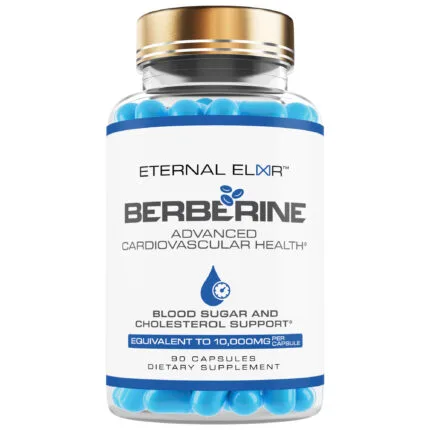
Eternal Elixir makes Berberine HCl 500mg, and it is our pick for most people who want berberine in Australia. Here is what you get, from the label and the product page:
- 500mg of berberine HCl per capsule, from a 20:1 concentrate.
- 90 capsules a bottle, and a label serve of one capsule a day on an empty stomach, so a bottle lasts three months.
- Only two other ingredients: rice flour and a cellulose capsule.
- $49.99 a bottle, or $0.56 a day. Save 10% on two bottles, 15% on three and 20% on five.
- The product page says our batches are third-party lab tested for purity and potency, and you can request the current batch certificate of analysis.
- Dispatch from Sydney within 24 hours, free shipping over $100, a 30-day money-back guarantee and Afterpay.
If you also take TUDCA and glutathione, our Metabolic Wellness Stack already includes this berberine with both, so you don’t need a separate bottle. Our TUDCA comparison covers that ingredient.
Add Berberine HCl 500mg to cart · $49.99Capsules, tablets, patches, liquids and gummies
Capsules and tablets are the formats used in the trials above, and the only ones with a real human evidence base for blood glucose. Capsules such as ours and Bulk Nutrients’ hold berberine HCl with one or two other ingredients. Tablets need binders to hold together, which is why they list more ingredients.
Patches are marketed as a way to avoid stomach upset. The blood glucose trials all used berberine taken by mouth. The only study of transdermal berberine blood levels we found was in rats, run by the company that developed the formula (Buchanan and colleagues, PLoS One, 2018), and we found no human trial of a berberine patch on blood glucose. A 2026 review of 24 “natural GLP-1” patch products, with berberine among the most-listed ingredients, found that none posted a certificate of analysis (White and colleagues, Annals of Pharmacotherapy). If part of berberine’s effect works through the gut, a patch would also skip that part.
Liposomal and phytosome forms wrap berberine in fats to help absorption. The idea is reasonable for a poorly absorbed compound, but these products cost more and there is little human data comparing them with standard berberine HCl.
Gummies have to mask berberine’s strong bitter taste and yellow colour, so check the berberine per gummy and the sugar content before you compare them with capsules.
Common mistakes with berberine
- Comparing on the front-of-pack number. “500mg” can mean 500mg of berberine or 500mg of an extract with less berberine in it. Compare the berberine figure.
- Taking more than the label says. More isn’t better, and it increases stomach upset. Stay within your label serve.
- Judging it after two weeks. Two weeks is long enough to notice side effects and far too short for blood markers to change.
- Starting several new supplements at once. Add berberine on its own so you know what caused any change.
- Not telling your pharmacist. Berberine affects how several medicines are cleared. Put it on your medicines list.
- Paying pharmacy RRP. The same bottle of Caruso’s Berberine 500 ranged from $24.97 to $39.19 across four pharmacies when we checked.
What to measure if you take berberine
Berberine is one of the few supplements where you can check whether anything changed, because the markers it affects are part of a standard blood test. If you take it for a metabolic reason, ask your doctor about testing before you start and again after about three months:
- Fasting blood glucose, the most direct marker.
- HbA1c, which reflects average glucose over roughly three months, the length of most trials.
- A lipid panel: total cholesterol, LDL, HDL and triglycerides.
- Liver function, a sensible baseline for anything cleared by the liver.
If a marker hasn’t moved after three months at the label serve, that is useful information too, and a good reason to talk to your doctor about other options rather than simply taking more.
Keep a simple note of digestive comfort and energy each week too. It won’t prove anything to a doctor, but it will tell you whether the capsule suits you.
How berberine compares with other options
- Chromium and cinnamon are the other common ingredients in Australian blood sugar products. Our blood sugar supplements comparison sets out the evidence for each.
- Fibre from food slows the rise in glucose after a meal by a different route, and it works alongside berberine rather than against it.
- NMN and other NAD+ precursors have a different target: cellular energy rather than glucose and lipid handling. Our NAD+ supplements guide and our NMN 500mg (one capsule a day, 90 capsules) cover that side.
- Liver support. If liver health is your main goal, our liver support supplements guide compares the more targeted options.
- Gut health. For the gut side, see our gut health supplements guide.
Why berberine prices vary so much in Australia
Three things drive the spread you see on the shelf. First, pharmacy discounting: Chemist Warehouse sold Caruso’s Berberine 500 at half its listed RRP, while other pharmacies were closer to full price. Second, bottle size: a 60-tablet pack looks cheaper than a 90 or 120-capsule bottle, but it lasts fewer days. Third, the label serve: a product that asks for two or three units a day costs two or three times as much per day as its per-unit price suggests.
The fair comparison is cost per 500mg of label-stated berberine, then cost per day at the label serve. On those two numbers, direct-to-consumer bottles such as ours and Bulk Nutrients’ compare well with pharmacy brands at their listed RRP, and Chemist Warehouse’s discounts close most of that gap.
How to choose a berberine supplement
- Check the berberine figure. Berberine HCl or “standardised to X mg berberine” per unit. Skip labels that give only an extract weight.
- Read the serve and work out the daily cost.
- Look for testing. A seller that offers a batch certificate of analysis can tell you what is in the bottle you are buying.
- Check the other ingredients. Short lists are easier to read. Wanderlust’s berberine labels, for example, say they contain sulfites, which matters if you are sensitive.
- Follow the label on food. Some say with meals, ours says on an empty stomach.
- Check your medicines with your doctor or pharmacist before you start.
More berberine guides
This page is the hub for our berberine coverage. Each guide below goes further on one part of it:
- For the full ranking on cost per 500mg, read our best berberine supplements in Australia.
- For timing and missed doses, see the berberine dosage guide.
- If your stomach objects, our guide to berberine side effects covers what people report and when to stop.
- On medicines, the drug interactions guide goes medicine by medicine.
- To decode a label, use our berberine HCl label guide.
- For the pharmacy shelf, see berberine at Chemist Warehouse.
- For timelines, read how long berberine takes to work.
- On prescription comparisons, see berberine vs metformin and berberine vs Ozempic.
- On the gut, read berberine and the gut microbiome.
Berberine Australia: frequently asked questions
What is the best brand of berberine in Australia?
Our pick is Eternal Elixir Berberine HCl 500mg: 500mg of berberine HCl per capsule, 90 capsules for $49.99, one capsule a day on an empty stomach ($0.56 a day), dispatched from Sydney within 24 hours. Eternal Elixir makes it. Bulk Nutrients and Caruso’s cost less per 500mg of berberine if price per milligram is all you care about.
Add Berberine HCl 500mg to cart · $49.99
Which pharmacies in Australia stock berberine, and where is it cheapest?
Chemist Warehouse stocks the widest range, and Pharmacy Online, Blooms The Chemist and Direct Chemist Outlet list Caruso’s Berberine 500 online. When we checked, 60 tablets of Caruso’s Berberine 500 cost $24.97 at Chemist Warehouse, $32.50 at Pharmacy Online, $36.99 at Direct Chemist Outlet and $39.19 at Blooms. Per 500mg of berberine, Bulk Nutrients online was cheaper again at $0.33.
Shop Berberine HCl 500mg · $49.99
Does Chemist Warehouse stock berberine?
Yes. Chemist Warehouse sells Caruso’s Berberine 500 and 750 and several Wanderlust berberine products, among others, in store and online.
What is the best berberine to buy over the counter?
Choose one that states the berberine per unit, gives a clear serve and offers testing. Ours states 500mg of berberine HCl per capsule with one capsule a day. At a pharmacy counter, Caruso’s Berberine 500 and 750 both state their berberine per tablet.
Why don’t doctors recommend berberine?
Many doctors are cautious for practical reasons: the trials are mostly small and short, supplement quality varies, and berberine interacts with a number of common medicines. That caution is about uncertainty and interaction risk. It doesn’t mean berberine does nothing.
Is berberine the same as metformin?
No. They act in overlapping ways and one small trial found similar glucose effects over three months, but metformin is a prescription medicine with far more trial data. Never swap one for the other without your doctor.
Does berberine help with weight loss?
The evidence for meaningful weight loss is weak. Weight changes in trials are small and follow the metabolic changes. It isn’t a weight-loss product.
What is the downside of berberine?
Three things: digestive side effects in the first weeks, interactions with medicines cleared by the liver, and a firm “no” in pregnancy and breastfeeding.
When should you take berberine?
Follow your label. Some say with meals, and ours says one capsule on an empty stomach. Don’t take more than the label serve.
How long does berberine take to work?
Digestive effects can show up within days. Blood glucose and lipid markers take longer: the trials that measured HbA1c ran for three months.
Do I need a prescription for berberine in Australia?
No. Berberine is sold over the counter at pharmacies such as Chemist Warehouse and online by brands such as ours and Bulk Nutrients. You still need to check it against any medicines you take.
Can I take berberine with NMN?
We found no trial that tested the two together. They aim at different things: berberine at glucose and lipid handling, NMN at NAD+ levels. If you want both, start one at a time so you can tell how each suits you, and check with your pharmacist if you take any prescription medicine.
Can you take berberine every day?
Our label serve is one capsule a day, and most trials gave berberine daily for two to three months. Longer continuous use has less data, so if you take it daily over the long term, do it with your doctor’s knowledge and periodic blood tests.
Sources
- Guo J, Chen H, Zhang X, et al. The effect of berberine on metabolic profiles in type 2 diabetic patients: a systematic review and meta-analysis of randomized controlled trials. Oxidative Medicine and Cellular Longevity. 2021. PubMed 34956436
- Zhang Y, Li X, Zou D, et al. Treatment of type 2 diabetes and dyslipidemia with the natural plant alkaloid berberine. Journal of Clinical Endocrinology and Metabolism. 2008;93(7):2559-2565. PubMed 18397984
- Yin J, Xing H, Ye J. Efficacy of berberine in patients with type 2 diabetes mellitus. Metabolism. 2008;57(5):712-717. PubMed 18442638
- Nazari A, Ghotbabadi ZR, Kazemi KS, et al. The effect of berberine supplementation on glycemic control and inflammatory biomarkers in metabolic disorders: an umbrella meta-analysis of randomized controlled trials. Clinical Therapeutics. 2024. PubMed 38016844
- Kong W, Wei J, Abidi P, et al. Berberine is a novel cholesterol-lowering drug working through a unique mechanism distinct from statins. Nature Medicine. 2004;10(12):1344-1351. PubMed 15531889
- Guo Y, Chen Y, Tan ZR, et al. Repeated administration of berberine inhibits cytochromes P450 in humans. European Journal of Clinical Pharmacology. 2012;68(2):213-217. PubMed 21870106
- Buchanan B, Meng Q, Poulin MM, et al. Comparative pharmacokinetics and safety assessment of transdermal berberine and dihydroberberine. PLoS One. 2018;13(3):e0194979. PubMed 29579096
- White CM, Tai Z, Nuzi K. Transdermal “natural GLP-1” dietary supplements. Annals of Pharmacotherapy. 2026;60(8):813-816. PubMed 41480958
- Product and pharmacy listings, read September 2026: Eternal Elixir Berberine HCl 500mg, Bulk Nutrients, Caruso’s Berberine 500 at Chemist Warehouse, Pharmacy Online, Direct Chemist Outlet, Blooms The Chemist, Healthylife
This article is general information, not medical advice. Talk to your doctor or pharmacist before starting any supplement, especially if you are pregnant or breastfeeding, have a health condition or take prescription medicine.