Last updated: September 25, 2026 · Originally published: August 4, 2026 · By Eternal Elixir Editorial
Berberine HCl is berberine bound to chloride (the hydrochloride salt), and it is the form most berberine supplements sold in Australia use. On any label, the figure that tells you what you are getting is the milligrams of berberine or berberine HCl in each capsule or tablet, multiplied by the number the label tells you to take. Lines such as “from min. dry root 90,000 mg” or “equivalent to 10,000 mg” describe the starting material, not the capsule. If you want a plain 500 mg berberine HCl capsule taken once a day, our pick is Eternal Elixir Berberine HCl 500mg: 90 capsules for $49.99, which works out to $0.56 a day, sent from Sydney within 24 hours.
Quick Answer
Read the milligrams per capsule and the daily serve, and skip the herb-equivalent figure. Our pick is Eternal Elixir Berberine HCl 500mg: 500 mg of berberine HCl per capsule, one capsule a day, and 90 capsules for $49.99 ($0.56 a day). The ingredient list has three items, and every batch is third-party lab tested for purity and potency. Bulk Nutrients Berberine HCL Capsules cost less per capsule ($0.33 for 500 mg on its own page), and Caruso’s Berberine 500 and Wanderlust Ultra Strength Berberine 800mg cost less per 500 mg of berberine at Chemist Warehouse sale prices.
Eternal Elixir makes Berberine HCl 500mg, so read this as our pick with the working shown. Competitor prices and labels were read from each product page on 25 September 2026 and change often.
This guide explains what the “HCl” changes, the four ways Australian labels state a berberine dose, and how five products you can buy here compare on cost. It also covers what the human research has measured and who should skip berberine.
Table of contents
- 1. What berberine HCl is, and what the HCl changes
- 2. How to read a berberine HCl label in Australia
- 3. Berberine HCl in Australia: five products compared on cost (as of Sep 2026)
- 4. Who each product suits, and who it doesn’t
- 5. Why Eternal Elixir Berberine HCl 500mg is our pick
- 6. Why absorption matters more than the milligram figure
- 7. What human research on berberine has measured
- 8. How to take berberine HCl: label directions and trial doses
- 9. Safety: interactions and who should skip berberine
- 10. Buying berberine HCl in Australia: a four-point checklist
- 11. Berberine HCl FAQ
- 11.1. What is berberine HCl good for?
- 11.2. Is berberine HCl the same as berberine?
- 11.3. What is the best berberine HCl in Australia?
- 11.4. What does 20:1 mean on a berberine label?
- 11.5. Can you buy berberine HCl at Chemist Warehouse?
- 11.6. Is berberine HCl good for weight loss?
- 11.7. Who should not take berberine HCl?
- 11.8. Can I take berberine HCl every day?
- 11.9. Should I take berberine HCl with food or on an empty stomach?
- 12. The verdict
- 13. Sources
What berberine HCl is, and what the HCl changes
Berberine is a bitter yellow alkaloid found in barberry (Berberis vulgaris), Indian barberry (Berberis aristata) and several other plants. On its own it dissolves poorly and is awkward to dose the same way twice. Bound to chloride it becomes berberine chloride, sold as berberine hydrochloride or berberine HCl. Bulk Nutrients gives the reason on its own product page: the salt improves stability and solubility.
The molecule that does the work is the same. What changes is the weight on the label, because the chloride adds mass. PubChem gives a molar mass of 336.4 g/mol for berberine, 371.8 g/mol for anhydrous berberine chloride and 407.8 g/mol for the dihydrate (the salt with two water molecules attached). Berberine makes up about 90% of the first salt and about 82% of the second. A capsule holding 500 mg of berberine HCl therefore carries roughly 410 to 450 mg of berberine itself.
Labels rarely say which form of the salt they use, and ours doesn’t either. The practical point is simple. A “berberine HCl 500 mg” capsule and an extract “standardised to berberine 500 mg” are close but not identical, because the extract label states berberine and the HCl label states the salt.
Berberine is mostly studied for its effect on AMP-activated protein kinase (AMPK), an enzyme that senses a cell’s energy status. Our guide to berberine and the AMPK pathway covers that mechanism. If you only want the product rankings, our comparison of the best berberine supplements in Australia ranks the wider field on cost.
How to read a berberine HCl label in Australia
Australian berberine products state their dose in four different ways. Here is each one, with a real label from a product on sale this month.
Salt weight: “Berberine HCl 500 mg”
This is the plainest format. It gives the weight of berberine hydrochloride in each capsule. Our capsule and the Bulk Nutrients capsule both use it, at 500 mg of berberine HCl each. Compare it directly with other salt-weight labels, and allow for the chloride (explained above) when you set it against an extract label.
Standardised extract: “Std. to berberine 500 mg”
Herbal extract labels give three numbers. Caruso’s Berberine 500 states 1,000 mg of Indian barberry dry extract per tablet, “from min. dry root 90,000 mg”, standardised to 500 mg of berberine. Wanderlust Berberine states 625 mg of barberry root extract per capsule, derived from at least 5.63 g of dry root, equivalent to 500 mg of berberine.
Only the last number is the berberine. The first is the weight of the extract, which holds the berberine plus other plant material. The middle one is the weight of dried root the extract was made from. It is often the biggest number on the pack, and it is never what you swallow.
Concentrate ratio: “20:1, equivalent to 10,000 mg”
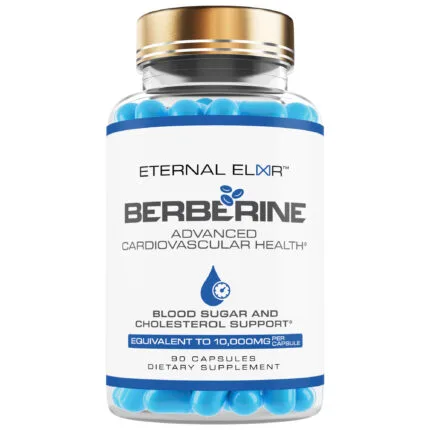
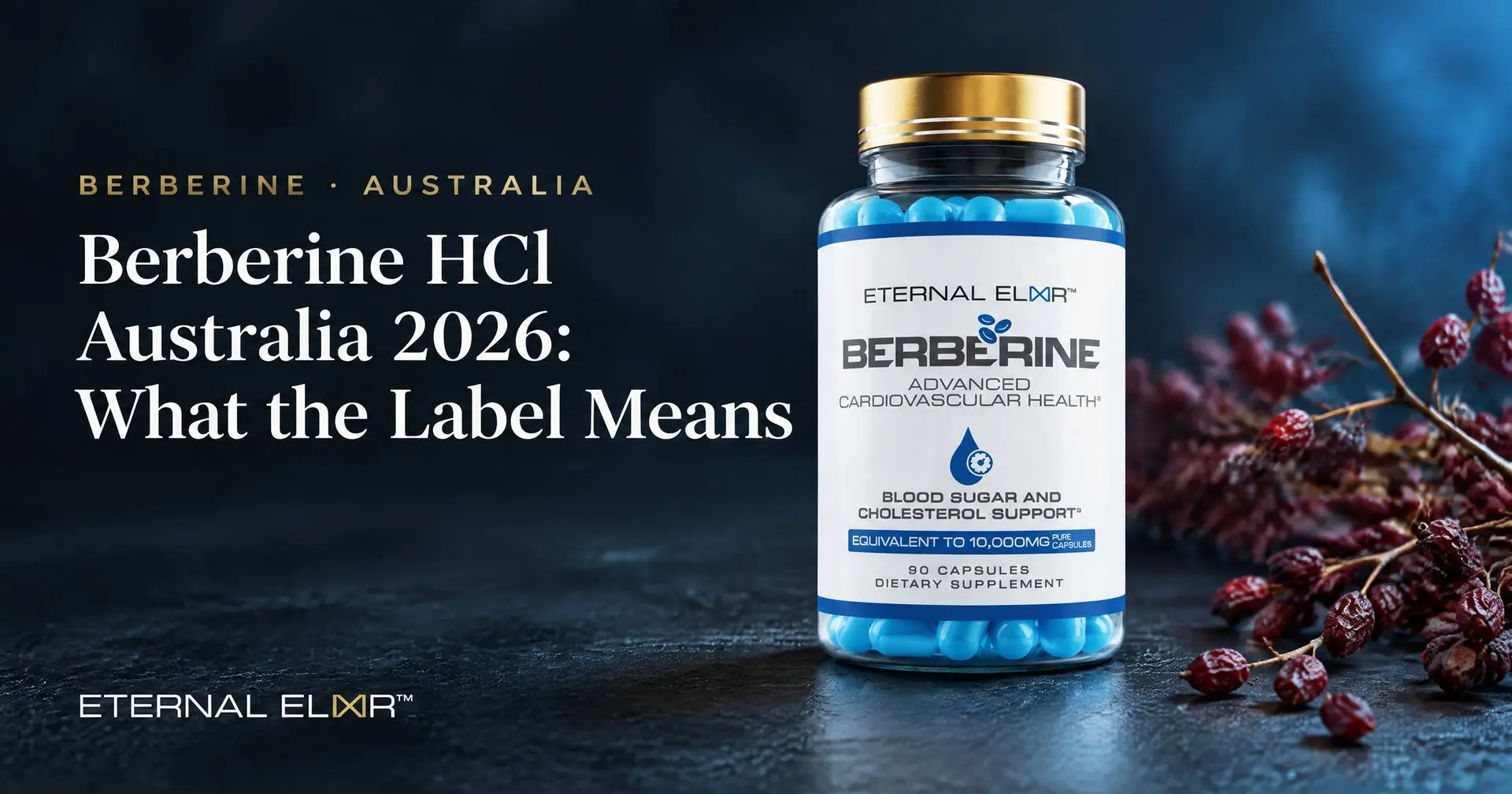
Our own label uses this format, so here is exactly what it says: “Berberine HCl 500mg (from 20:1 Concentrate, equivalent to 10,000mg of Berberine HCl Powder)”. A 20:1 ratio means 20 parts of starting material were concentrated into 1 part. The 10,000 mg is that ratio multiplied by the 500 mg in the capsule.
The number to compare is 500 mg. Each capsule holds 500 mg, and one capsule is the serve. We would rather you set our 500 mg against another brand’s 500 mg than read the 10,000 mg as a dose, because it isn’t one.
Phytosome or complex: “Berbevis 550 mg, std. to berberine 170.5 mg”
Some products bind berberine to a carrier to change how it is absorbed. Melrose Berberine Complex states Berbevis berberine phytosome 550 mg per capsule, containing 203.5 mg of Indian barberry extract from 10.2 g of dry root, standardised to 170.5 mg of berberine, plus 50 mcg of chromium. Melrose says the phytosome gives four times better absorption than standard berberine.
That is a claim about blood levels, and the trade is a smaller berberine figure per capsule. When a label leads with a blend or phytosome weight, find the “std. to berberine” line and use that.
| What the label says | What it measures | The figure to compare |
|---|---|---|
| Berberine HCl 500 mg | Weight of the salt in each capsule | 500 mg of berberine HCl (roughly 410 to 450 mg of berberine) |
| Extract 1,000 mg, std. to berberine 500 mg | Extract weight, then its berberine content | The “std. to” or “equiv.” berberine figure |
| From min. dry root 90,000 mg | Weight of the plant material the extract came from | None, because it isn’t in the tablet |
| 20:1 concentrate, equivalent to 10,000 mg | Concentration ratio times the capsule content | The capsule content (500 mg on our label) |
| Phytosome or complex 550 mg | Carrier plus extract | The “std. to berberine” figure (170.5 mg on the Melrose label) |
| Barberry root extract with no berberine figure | A whole-herb extract | Nothing to compare until the brand tells you |
Berberine HCl in Australia: five products compared on cost (as of Sep 2026)
Every row below comes from the product’s own page, read on 25 September 2026. Chemist Warehouse prices are its sale prices, with the RRP it shows in brackets. Cost per labelled 500 mg is the price divided by the total labelled berberine or berberine HCl in the pack, times 500. Cost per day follows each label’s own directions, so a range means the label gives a range. Prices are in AUD before postage.
| Product | Label states per unit | Label daily serve | Price (AUD) | Pack | Cost per labelled 500 mg | Cost per day | Lasts | Buy |
|---|---|---|---|---|---|---|---|---|
| Eternal Elixir Berberine HCl 500mg (our pick) | 500 mg berberine HCl | 1 capsule | $49.99 | 90 capsules | $0.56 ($0.44 on 5 bottles) | $0.56 | 90 days | Eternal Elixir |
| Bulk Nutrients Berberine HCL Capsules | 500 mg berberine HCl | 1 to 2 capsules, with meals | $39.00 | 120 capsules | $0.33 | $0.33 to $0.65 | 60 to 120 days | Bulk Nutrients |
| Caruso’s Berberine 500 | 500 mg berberine (from 1,000 mg extract) | 1 tablet, up to 3 times a day with meals | $24.97 (RRP $49.95) | 60 tablets | $0.42 | $0.42 to $1.25 | 20 to 60 days | Chemist Warehouse |
| Wanderlust Ultra Strength Berberine 800mg | 800 mg berberine (from 1 g extract) | 2 tablets | $36.49 (RRP $72.99) | 60 tablets | $0.38 | $1.22 | 30 days | Chemist Warehouse |
| Wanderlust Berberine (60 capsules) | 500 mg berberine (from 625 mg extract) | 2 capsules | $37.49 (RRP $74.99) | 60 capsules | $0.62 | $1.25 | 30 days | Chemist Warehouse |
One adjustment is worth knowing. Our row and the Bulk Nutrients row state salt weight, while the other three state berberine. On a strict berberine basis, the two salt rows carry between about 10% and 18% less berberine per labelled 500 mg, so they look a little cheaper in this table than they are. We left the table as labelled so you can check every figure against the pack. Bulk Nutrients charges a flat $9 for shipping, and we ship free on orders over $100.
Who each product suits, and who it doesn’t
Eternal Elixir Berberine HCl 500mg (our pick)
Suits: people who want one capsule a day, a bottle that lasts three months at the label serve, and a three-item ingredient list (berberine HCl, rice flour and a cellulose capsule). It ships from Sydney within 24 hours with a 30-day money-back guarantee.
Doesn’t suit: anyone shopping purely on price per milligram, because Bulk Nutrients, Caruso’s and Wanderlust Ultra Strength all cost less per labelled 500 mg. It is also a slower way to reach a trial-style daily amount than a tablet with more berberine per unit.
Bulk Nutrients Berberine HCL Capsules
Suits: buyers who want the lowest cost per capsule of plain berberine HCl ($0.33 per 500 mg), are happy to take one or two capsules with meals, and like a 120-capsule tub.
Doesn’t suit: people ordering a single tub who mind the flat $9 shipping, which lifts the real cost per capsule on small orders.
Caruso’s Berberine 500
Suits: shoppers who want a pharmacy product at a Chemist Warehouse sale price ($24.97, RRP $49.95), with 500 mg of berberine stated per tablet and directions to take it with meals.
Doesn’t suit: people who want one unit a day for the whole pack. The label allows up to three tablets a day, and at three a day the 60 tablets last 20 days. The “90,000 mg” dry-root figure on its ingredients panel can also mislead a quick reader.
Wanderlust Ultra Strength Berberine 800mg
Suits: people who want the most berberine per unit among these five (800 mg per tablet) at a low cost per 500 mg ($0.38).
Doesn’t suit: anyone avoiding sulfites or soya, both of which the brand lists. The label serve of two tablets is 1,600 mg of berberine a day, which is more than the daily amounts used in the trials described below.
Wanderlust Berberine (60 capsules)
Suits: someone who likes the Wanderlust brand and wants a capsule with 500 mg of berberine.
Doesn’t suit: cost-focused buyers. At $0.62 per labelled 500 mg it is the dearest in this table, the pack lasts 30 days at two a day, and it contains sulfites.
Why Eternal Elixir Berberine HCl 500mg is our pick
Eternal Elixir makes this product, so weigh our reasons with that in mind. Each one is a label fact you can check on the Berberine HCl 500mg product page.
- 500 mg of berberine HCl per capsule, one capsule per serve. There is no blend total to decode and no gap between an extract weight and a standardised figure.
- 90 capsules per bottle. At the label serve one bottle lasts three months, at $0.56 a day.
- Three ingredients. Berberine HCl, rice flour and a cellulose capsule, with no sulfites or soya on the label.
- Third-party lab tested. Every batch is tested for purity and potency, and we will send the current batch certificate of analysis on request.
- Sent from Sydney within 24 hours, with free shipping over $100, a 30-day money-back guarantee and Afterpay.
Buying more than one bottle lowers the cost per capsule: 10% off two bottles ($0.50 a capsule), 15% off three ($0.47) and 20% off five ($0.44). If you also want TUDCA and Reduced L-Glutathione, our Metabolic Wellness Stack already includes this berberine, so buy the stack in place of a separate bottle. If berberine is one part of a wider longevity routine, Ca-AKG 500mg and NMN 500mg come in the same 90-capsule, one-a-day format, and the full range is in the Eternal Elixir shop.
Add Berberine HCl 500mg to cart · $49.99Why absorption matters more than the milligram figure
Berberine is poorly absorbed when swallowed. A 2016 review in Fitoterapia (Liu and colleagues) names poor oral bioavailability as the main obstacle to its use and discusses how formulation could improve it. A 2017 review in Drug Metabolism Reviews (Wang and colleagues) adds that berberine is extensively metabolised after it is taken by mouth, which keeps blood levels of berberine itself very low, and that its metabolites likely account for part of its activity. Both papers are reviews, not trials.
The best-known absorption figure comes from rats. In a 2011 study, 0.68% of an oral dose of berberine reached the bloodstream (Chen and colleagues). That is an animal result, and it doesn’t give a human percentage.
Human data point the same way. In a 2025 study at University Medicine Greifswald in Germany, 44 healthy adults took a single 1,000 mg dose of berberine (two 500 mg capsules) after an overnight fast. Berberine showed low oral bioavailability, and women reached a 2.8-fold higher total exposure and a 3.6-fold higher peak blood level than men (Blöcher and colleagues). Genetics explained only part of that gap.
For label shoppers, the lesson is that a larger number on the pack doesn’t buy a matching rise in blood levels. Brands selling phytosome and other carrier forms are competing on absorption, not milligrams. What you control is the berberine in each unit, taking it consistently, and following the directions. Our longevity supplement evidence index scores berberine and other compounds on the human trials behind them.
What human research on berberine has measured
Most human trials of berberine measure blood markers: fasting glucose, HbA1c (a roughly three-month average of blood glucose) and blood fats. Almost all of them enrolled adults whose markers were already above the normal range, many of them under medical care. Three papers show the pattern.
- Zhang and colleagues, 2008 (Journal of Clinical Endocrinology & Metabolism). 116 adults with a diagnosed blood glucose disorder and raised blood fats took 1 g of berberine a day or a placebo for three months. In the berberine group, fasting glucose went from 7.0 to 5.6 mmol/L and HbA1c from 7.5% to 6.6%, and triglycerides, total cholesterol and LDL cholesterol also fell, all significantly more than with placebo. Five people taking berberine had mild to moderate constipation.
- Yin and colleagues, 2008 (Metabolism). This three-month pilot study gave 500 mg of berberine three times a day. Fasting glucose and HbA1c fell, and 20 participants (34.5%) reported passing digestive side effects.
- Guo and colleagues, 2021 (Oxidative Medicine and Cellular Longevity). A pooled analysis of 46 randomised trials found lower HbA1c, fasting glucose and blood fats with berberine, taken alone or with usual care, than in control groups.
Now for what these trials don’t show. They studied people with raised markers, so they don’t tell you what berberine does in healthy adults. The trials described here ran for about three months and did not track long-term outcomes. They used 1 g to 1,500 mg a day, often in divided doses, rather than the single 500 mg capsule a day that many labels direct, ours included. On weight, a 2026 pooled analysis of 23 randomised trials (Elahi Vahed and colleagues) found body weight about 0.88 kg lower than in control groups on average, which is a small effect.
If you have diabetes or take medicine that lowers blood glucose, talk to your doctor before you start berberine, because the two together can push glucose too low. Readers weighing berberine against a prescription option can read our berberine and metformin comparison, and our guide to berberine and the gut microbiome covers the research on its effects in the gut.
How to take berberine HCl: label directions and trial doses
Follow the directions on the product in your hand. Ours says one capsule on an empty stomach, or as directed by your physician. Bulk Nutrients directs one to two capsules daily with meals, Caruso’s one tablet up to two to three times a day with each main meal, and both Wanderlust products two a day.
The trials above mostly split the day’s amount across meals. If you and your doctor settle on a trial-style amount, a 90-capsule bottle lasts 45 days at two capsules a day and 30 days at three, which is where the multi-bottle price helps.
Digestive upset is the side effect the trials above report, so start with the lowest labelled amount and give it two weeks before you judge how you tolerate it. Our berberine dosage guide for Australia sets out amounts by goal and how to build up. How long berberine takes to work gives realistic timelines, and our page on berberine side effects in Australia covers the stomach complaints and how to reduce them.
Safety: interactions and who should skip berberine
Berberine changes how the liver handles many medicines. In a crossover study, 17 healthy young men took 300 mg of berberine three times a day for two weeks. The activity of three drug-processing enzymes (CYP2D6, CYP2C9 and CYP3A4) fell, and total exposure to a test medicine cleared by CYP3A4 rose by about 40% (Guo and colleagues, 2012).
- Talk to your doctor or pharmacist before starting berberine if you take any prescription medicine, and especially medicine that lowers blood glucose.
- Don’t take it if you are pregnant or breastfeeding, and don’t give it to children.
- Stop and see your doctor if stomach pain or other symptoms persist.
Our berberine drug interactions guide goes through common medicines one at a time.
Buying berberine HCl in Australia: a four-point checklist
Berberine is easy to find here. Pharmacies, supplement retailers such as Bulk Nutrients and brands that ship direct all sell it, and our guide to berberine at Chemist Warehouse sets out what the pharmacy chain carries. Before you buy any of them, check four things:
- A berberine or berberine HCl figure per unit, not only an extract, blend or dry-root weight.
- A clear daily serve, so you can work out days per pack and cost per day.
- Testing you can ask about. A brand that tests each batch should be able to send you the certificate.
- The rest of the ingredient list, including sulfites, soya or added actives such as chromium if you want to avoid them.
The same habits work for any supplement, and our guide to what to look for on an Australian supplement label covers fillers and dosing tricks more broadly. For an overview of berberine in Australia from doses to brands, see our berberine Australia guide.
Berberine HCl FAQ
What is berberine HCl good for?
Berberine is taken to support healthy glucose and lipid metabolism, and that is what most human trials have measured: fasting glucose, HbA1c and blood fats, mostly in adults whose markers were already above range. The HCl is the salt the dose comes in. It doesn’t change what berberine does once absorbed.
Is berberine HCl the same as berberine?
It is the same active molecule bound to chloride. By weight, berberine makes up about 90% of anhydrous berberine chloride and about 82% of the dihydrate, so 500 mg of berberine HCl carries roughly 410 to 450 mg of berberine. Extract labels that say “equiv. berberine 500 mg” state the berberine itself.
What is the best berberine HCl in Australia?
Our pick is Eternal Elixir Berberine HCl 500mg: 500 mg per capsule, one capsule a day, and 90 capsules for $49.99 ($0.56 a day), third-party lab tested and sent from Sydney within 24 hours. Eternal Elixir makes it. If the lowest price per capsule matters most to you, Bulk Nutrients Berberine HCL Capsules cost $0.33 per 500 mg capsule on its own site, before shipping.
Add Berberine HCl 500mg to cart · $49.99
What does 20:1 mean on a berberine label?
It describes a concentration step: 20 parts of starting material reduced to 1 part of concentrate. A line such as “equivalent to 10,000 mg” is the weight of starting material the concentrate stands for, not what is in the capsule. Compare the milligrams per capsule instead. On our label that figure is 500 mg.
Can you buy berberine HCl at Chemist Warehouse?
Chemist Warehouse sells several berberine products, including Caruso’s and Wanderlust. The ones in our table are herbal extracts labelled by their berberine content rather than by berberine HCl salt weight, so compare the “equiv.” or “std. to” figure. Our Chemist Warehouse berberine guide covers the full shelf.
Is berberine HCl good for weight loss?
The effect in trials is small. A 2026 pooled analysis of 23 randomised trials found body weight about 0.88 kg lower than in control groups on average. Treat berberine as metabolic support alongside diet and activity, not as a weight-loss product. We look at the “nature’s Ozempic” label in our berberine versus Ozempic breakdown.
Who should not take berberine HCl?
Don’t take it if you are pregnant or breastfeeding, and don’t give it to children. Talk to your doctor or pharmacist first if you take any prescription medicine, especially medicine that lowers blood glucose, because berberine slows liver enzymes that clear many drugs.
Can I take berberine HCl every day?
Daily use is how the trials ran, usually for about three months. Follow your product’s label, note how your stomach handles it in the first two weeks, and check with your doctor if you plan to take it for longer.
Should I take berberine HCl with food or on an empty stomach?
Our label says one capsule on an empty stomach, or as directed by your physician. Most trials gave berberine with meals, and the Bulk Nutrients and Caruso’s labels direct you to take theirs with meals. If an empty stomach doesn’t agree with you, ask your pharmacist about taking it with food.
Buy Berberine HCl 500mg · $49.99
The verdict
Our pick: Eternal Elixir Berberine HCl 500mg. It is 500 mg of berberine HCl per capsule at one capsule a day, 90 capsules for $49.99 ($0.56 a day, or $0.44 a capsule on five bottles), third-party lab tested, and sent from Sydney within 24 hours.
Lowest price per capsule of berberine HCl: Bulk Nutrients Berberine HCL Capsules, at $0.33 per 500 mg before its flat $9 shipping.
Most berberine per tablet: Wanderlust Ultra Strength Berberine 800mg, at $0.38 per 500 mg at Chemist Warehouse.
Whichever label you choose, compare the berberine per unit and the daily serve, and check it with your doctor or pharmacist if you take any medicine.
Sources
- Zhang Y, Li X, Zou D, Liu W, et al. Treatment of type 2 diabetes and dyslipidemia with the natural plant alkaloid berberine. Journal of Clinical Endocrinology & Metabolism. 2008;93(7):2559-2565. PubMed 18397984
- Yin J, Xing H, Ye J. Efficacy of berberine in patients with type 2 diabetes mellitus. Metabolism. 2008;57(5):712-717. PubMed 18442638
- Guo J, Chen H, Zhang X, Lou W, et al. The effect of berberine on metabolic profiles in type 2 diabetic patients: a systematic review and meta-analysis of randomized controlled trials. Oxidative Medicine and Cellular Longevity. 2021;2021:2074610. PubMed 34956436
- Elahi Vahed I, Shahir-Roudi E, Nojumi S, et al. The effect of berberine on obesity indices: a systematic review and meta-analysis. International Journal of Obesity. 2026;50(1):53-73. PubMed 41310257
- Liu CS, Zheng YR, Zhang YF, Long XY. Research progress on berberine with a special focus on its oral bioavailability. Fitoterapia. 2016;109:274-282. PubMed 26851175
- Wang K, Feng X, Chai L, Cao S, Qiu F. The metabolism of berberine and its contribution to the pharmacological effects. Drug Metabolism Reviews. 2017;49(2):139-157. PubMed 28290706
- Chen W, Miao YQ, Fan DJ, et al. Bioavailability study of berberine and the enhancing effects of TPGS on intestinal absorption in rats. AAPS PharmSciTech. 2011;12(2):705-711. PubMed 21637946
- Blöcher JA, Meyer-Tönnies MJ, Morof F, et al. Sex-dependent effects of CYP2D6 on the pharmacokinetics of berberine in humans. Clinical Pharmacology & Therapeutics. 2025;117(1):250-260. PubMed 39488825
- Guo Y, Chen Y, Tan ZR, Klaassen CD, Zhou HH. Repeated administration of berberine inhibits cytochromes P450 in humans. European Journal of Clinical Pharmacology. 2012;68(2):213-217. PubMed 21870106
- PubChem compound records: berberine (CID 2353), berberine chloride (CID 12456) and berberine chloride dihydrate (CID 160800).
- Product pages read on 25 September 2026: Eternal Elixir Berberine HCl 500mg, Bulk Nutrients Berberine HCL Capsules, Caruso’s Berberine 500, Wanderlust Ultra Strength Berberine 800mg, Wanderlust Ultra-Strength Berberine (brand page), Wanderlust Berberine 60 capsules and Melrose Berberine Complex.