Last updated: September 26, 2026 · Originally published: September 3, 2026 · By Eternal Elixir Editorial
Berberine drug interactions happen in two ways. Berberine slows several liver and gut enzymes that clear medicines (CYP3A4, CYP2D6 and CYP2C9), and it can add to the effect of medicines that lower blood sugar or blood pressure. In a two-week trial in healthy men, 300 mg three times a day raised blood levels of a test medicine by 40%. If you take any prescription medicine, talk to your GP or pharmacist before you start berberine.
This Australian guide for 2026 covers how the interactions work, which medicines carry the most human evidence, why spacing doses does not fix most of them, which supplements double up with berberine, who should be most careful, and what to look for on a label if your prescriber says berberine is fine for you.
Key takeaways
- After two weeks of berberine, healthy men cleared test medicines for three enzymes more slowly, including a 40% rise in midazolam exposure.
- The best-documented clinical interaction is with the transplant medicine cyclosporine: blood levels ended 29.3% higher in kidney transplant recipients who also took berberine.
- Berberine can add to medicines that lower blood sugar or blood pressure, and a 2026 review also flags medicines that affect heart rhythm.
- Taking berberine at a different time of day does not undo enzyme effects that build up over days of use.
- Do not use berberine if you are pregnant or breastfeeding, and never give it to a newborn.
Table of contents
- 1. Berberine Drug Interactions at a Glance
- 2. How Berberine Drug Interactions Actually Happen
- 3. Which Medicines Interact With Berberine
- 4. Berberine Drug Interactions Are Only Half the Story: Supplement Stacking
- 5. Timing: What Separating Doses Does and Does Not Fix
- 6. Who Should Be Most Careful With Berberine
- 7. What Organ Is Berberine Hard On?
- 8. If Berberine Suits You: Products Compared (as of Sep 2026)
- 9. Eternal Elixir Berberine HCl 500mg: What Is in the Bottle
- 10. Berberine Drug Interactions: Frequently Asked Questions
- 10.1. What drugs should not be taken with berberine?
- 10.2. Why don’t doctors like berberine?
- 10.3. What organ is berberine hard on?
- 10.4. Who should not be taking berberine?
- 10.5. Can I take berberine with metformin?
- 10.6. Does taking berberine at a different time from my medicine help?
- 10.7. Does a lower dose of berberine avoid interactions?
- 10.8. What is the best berberine supplement in Australia?
- 11. The Bottom Line
- 12. Sources
Berberine Drug Interactions at a Glance
| Medicine type | What berberine may do | Human evidence | What to do |
|---|---|---|---|
| Cyclosporine and other narrow-margin medicines | Raise blood levels | Randomised trial in kidney transplant recipients, plus small studies | Do not start berberine without your specialist |
| Medicines cleared by CYP3A4 | Slow clearance, so levels rise | Trial in healthy men (midazolam) | Ask your pharmacist whether yours is one |
| Medicines cleared by CYP2D6 or CYP2C9 | Slow clearance | Trial in healthy men (dextromethorphan, losartan) | Ask your pharmacist whether yours is one |
| Blood-sugar medicines | Add to the glucose-lowering effect | Pooled trials of berberine with glucose-lowering medicines | Only with your doctor’s plan for monitoring |
| Metformin | A berberine-rich herb lowered metformin exposure in healthy adults | Small studies with goldenseal, not pure berberine | Tell your doctor before combining |
| Blood pressure medicines | Possible added drop in blood pressure | Mechanism and review evidence | Check with your doctor, and watch for dizziness |
| Medicines that affect heart rhythm | Possible added effect | Flagged in a 2026 review | Check with your doctor first |
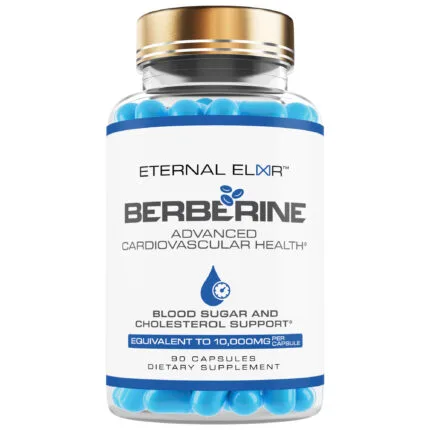
Eternal Elixir makes Berberine HCl 500mg, and it is our pick for adults who take no regular medicines, or whose doctor has cleared it, because the label is simple: one 500 mg capsule a day from a 90-capsule bottle.
How Berberine Drug Interactions Actually Happen
Very little berberine reaches the bloodstream. A 2026 review in Pharmaceuticals puts its oral bioavailability at 0.68% in rats and notes plasma levels in the low nanogram-per-millilitre range in people (Dumitru et al., 2026). The interactions happen anyway, because concentrations are high in the gut lining and the liver, where many medicines are absorbed and broken down. The review groups them into enzyme effects, transporter effects, added effects on the same body system, and possible gut effects.
Enzyme inhibition: the best-measured route
The key human study gave healthy men 300 mg of berberine three times a day for two weeks, then tested five enzymes with probe medicines (Guo et al., 2012). Three enzymes slowed:
- CYP3A4. Midazolam exposure rose by 40% and its peak level by 38%, while its clearance fell by 27%.
- CYP2D6. The urinary ratio for dextromethorphan rose ninefold.
- CYP2C9. The ratio for losartan doubled.
The enzymes tested with omeprazole (CYP2C19) and caffeine (CYP1A2) did not change. The 2026 review adds that berberine’s inhibition of CYP2D6 and CYP2C9 is close to irreversible, because a breakdown product binds the enzyme. That matters for timing, covered below.
Transporters: how medicines get in and out of cells
Berberine also acts on transporter proteins such as P-glycoprotein and the ones that move metformin. In 16 healthy volunteers, a goldenseal product standardised to berberine raised midazolam exposure by 43% and lowered metformin exposure by about 23% (Nguyen et al., 2021). In a follow-up in adults already taking metformin, the overall change was too small to matter, though metformin exposure fell by about 20% at the lowest metformin doses (Nguyen et al., 2025). Both studies used goldenseal rather than pure berberine, so treat the size of the effect as a guide only.
Added effects on the same system
Berberine lowers blood glucose on its own. A 2024 meta-analysis of 50 trials with 4,150 participants found that adding berberine to glucose-lowering medicines lowered fasting glucose and HbA1c further than the medicines alone (Wang et al., 2024). That is the point of the combination in those trials, and it is also why an unplanned combination can push blood sugar too low. The 2026 review lists low blood sugar, low blood pressure and changes to heart rhythm (QT prolongation) as the added effects to watch.
Which Medicines Interact With Berberine
Cyclosporine: the clearest clinical example
In a randomised trial, 52 kidney transplant recipients took cyclosporine with 0.2 g of berberine three times a day for three months, and another 52 took cyclosporine alone (Wu et al., 2005). By the end, cyclosporine trough levels in the berberine group were 29.3% higher than in the group without it. In a smaller part of the study, six patients’ cyclosporine exposure rose by 34.5% after 12 days of berberine. Liver and kidney function tests did not change.
A study in healthy male volunteers found a smaller effect: a 19.2% rise in cyclosporine exposure at one of the two doses tested (Xin et al., 2006). Cyclosporine is a narrow-margin medicine, meaning a small change in blood level can matter. Ask your pharmacist whether any of your medicines fall in that group.
Medicines cleared by CYP3A4, CYP2D6 or CYP2C9
Many common medicines use these three enzymes. The trial above used midazolam, dextromethorphan and losartan as test medicines because they are standard markers for each enzyme. It did not test every medicine that shares them. Your pharmacist can check which enzymes clear the medicines you take.
Blood-sugar medicines and metformin
Combining berberine with glucose-lowering medicines adds to their effect, and that raises the chance of low blood sugar if the combination is not planned. Metformin adds a second question, because a berberine-rich herb changed metformin exposure in healthy adults. If you take any medicine for blood sugar, only add berberine as part of a plan your doctor has agreed, with a way to monitor your levels. Our comparison of berberine and metformin explains how the two differ, and never swap a prescribed medicine for a supplement without your doctor.
Blood pressure and heart rhythm medicines
The 2026 review lists an added drop in blood pressure and changes to heart rhythm among berberine’s interaction risks. If you take blood pressure medicine or a medicine that affects heart rhythm, talk to your doctor first, and report dizziness or light-headedness if you do start.
Pregnancy, breastfeeding and newborns
Berberine displaced bilirubin from its carrier protein in laboratory tests and raised free bilirubin in rats, and the author advised that berberine-rich herbs be avoided in jaundiced newborns and in pregnancy (Chan, 1993). This comes from lab and animal work, and it is the reason for caution: do not use berberine while pregnant or breastfeeding, and never give it to a baby.
Berberine Drug Interactions Are Only Half the Story: Supplement Stacking
Most interaction guides stop at prescription medicines. Many people take berberine alongside three or four other supplements, and some of those double up.
- Goldenseal. It contains berberine, so taking both doubles your intake without you noticing.
- Other supplements taken for blood sugar. Products aimed at the same target could add to berberine’s effect, so count them together.
- Everything else in your routine. If you take other products from our range, such as Reduced L-Glutathione or Ca-AKG, list them for your pharmacist along with your medicines.
Berberine also acts in the gut itself. Our article on berberine and gut health covers that side, and our guide to berberine side effects in Australia covers what to expect when you take it with no other medicines.
Timing: What Separating Doses Does and Does Not Fix
A common tip is to take berberine a few hours away from your medicine. For enzyme interactions, that does not solve the problem. The effect in the key trial was measured after two weeks of repeated dosing, and the 2026 review describes the CYP2D6 and CYP2C9 effect as close to irreversible. An enzyme that has been slowed stays slowed whether your next berberine capsule comes at breakfast or dinner.
So if your medicine is cleared by one of these enzymes, the options are monitoring or avoiding the combination, decided with your prescriber. Clever scheduling is not one of them.
Who Should Be Most Careful With Berberine
- Anyone taking cyclosporine or another narrow-margin medicine, where a small change in blood level matters.
- Anyone taking medicines for blood sugar, blood pressure or heart rhythm.
- Anyone taking several prescription medicines. The 2026 review notes that berberine use alongside prescriptions is common in older adults and often not mentioned to their doctor.
- Anyone pregnant, trying to conceive or breastfeeding, and any newborn.
If none of these apply and you take no regular medicines, the interaction picture matters far less, and the dose and side-effect guides are the more useful read. Our berberine dosage guide for Australia covers how much to take, and our complete berberine guide for Australia covers doses, brands and safety in one place.
What Organ Is Berberine Hard On?
In trials, the gut. In a three-month pilot study, 34.5% of participants had short-lived stomach and bowel side effects, and liver or kidney damage was not seen in any of them (Yin et al., 2008). A 2023 meta-analysis of 18 placebo-controlled trials with 1,788 participants found no serious adverse events on berberine, with gut side effects reported in 2% to 23% of people on berberine against 2% to 15% on placebo (Blais et al., 2023). In the cyclosporine trial, liver and kidney function did not change either.
If Berberine Suits You: Products Compared (as of Sep 2026)
If your doctor or pharmacist has cleared berberine, the main label differences are the amount per unit, the daily amount on the label and the price. We took each price, pack and direction from the seller’s own page in September 2026.
| Product | Where to buy | Price (AUD, as of Sep 2026) | Pack | Label daily amount | Cost per 500 mg | Buy |
|---|---|---|---|---|---|---|
| Eternal Elixir Berberine HCl 500mg (our pick) | eternalelixir.com.au, ships from Sydney | $49.99 | 90 capsules of 500 mg | 500 mg (1 capsule) | $0.56 | View product |
| Wagner Berberine 500 | Chemist Warehouse | $14.99 (down from $29.99) | 60 tablets of 500 mg | 500 to 1,000 mg (1 to 2 tablets) | $0.25 | Chemist Warehouse |
| Bulk Nutrients Berberine HCL Capsules | bulknutrients.com.au | $39.00 | 120 capsules of 500 mg | 500 to 1,000 mg (1 to 2 capsules) | $0.33 | Bulk Nutrients |
| Wanderlust Ultra Strength Berberine 800mg | Chemist Warehouse | $36.49 (RRP $72.99) | 60 tablets of 800 mg | 1,600 mg (2 tablets) | $0.38 | Chemist Warehouse |
| Caruso’s Berberine 500 | Chemist Warehouse | $24.97 (RRP $49.95) | 60 tablets of 500 mg | Up to 1,500 mg (up to 3 tablets) | $0.42 | Chemist Warehouse |
Who each one suits, and who it doesn’t
- Eternal Elixir Berberine HCl 500mg (our pick). Suits adults who want one capsule a day at the lowest label daily amount here, with a three-month bottle shipped from Sydney. It is not the cheapest per 500 mg, and it does not suit someone who wants to buy in a pharmacy today.
- Wagner Berberine 500. Suits price-first shoppers at Chemist Warehouse, with the lowest cost per 500 mg in the table. A 60-tablet pack lasts one to two months.
- Bulk Nutrients Berberine HCL. Suits people who want a larger capsule tub at a low cost per 500 mg, with 120 capsules in a pack.
- Wanderlust Ultra Strength 800mg. Suits someone whose doctor wants them on a higher daily amount in fewer tablets. It contains soya and sulfites, and its 1,600 mg label amount is the highest here.
- Caruso’s Berberine 500. Suits pharmacy shoppers who want flexible dosing up to three tablets a day with meals.
Our roundup of the best berberine supplements in Australia compares more brands, our berberine HCl label guide explains what the milligrams on a label mean, and our page on berberine at Chemist Warehouse covers the pharmacy range.
Eternal Elixir Berberine HCl 500mg: What Is in the Bottle
- Berberine HCl, 500 mg per capsule, from a 20:1 concentrate.
- 90 capsules per bottle, which is 90 days at the label amount.
- The only other ingredients are rice flour and a cellulose capsule.
- Take one capsule on an empty stomach, or as your doctor directs.
- $49.99 a bottle, or $0.56 a day. Two bottles cost $89.98 (10% off), three cost $127.47 (15% off), and five cost $199.96 (20% off).
- Ships from Sydney within 24 hours, with free shipping over $100, a 30-day money-back guarantee and Afterpay.
Our label amount of 500 mg a day is lower than the 900 mg a day used in the enzyme trial. A lower amount is not automatically safe with a narrow-margin medicine, so the advice to check with your prescriber stands whatever the dose.
Add Berberine HCl 500mg to cart · $49.99Berberine Drug Interactions: Frequently Asked Questions
What drugs should not be taken with berberine?
Do not combine berberine with cyclosporine or other narrow-margin medicines unless your specialist agrees. Take particular care with medicines cleared by the CYP3A4, CYP2D6 or CYP2C9 enzymes, medicines for blood sugar or blood pressure, metformin, and medicines that affect heart rhythm. Your pharmacist can check your list in a few minutes.
Why don’t doctors like berberine?
Mostly because of interactions and missing information. Berberine slows enzymes that clear many medicines, it adds to blood-sugar and blood-pressure medicines, and a 2026 review notes that people often take it alongside prescriptions without telling their doctor. Most trials are also short. Telling your doctor you take it removes most of that concern.
What organ is berberine hard on?
The gut. Stomach upset, constipation or loose stools are the usual side effects, reported in up to about a third of participants in one pilot trial. Trials that checked liver and kidney function did not find damage.
Who should not be taking berberine?
People who are pregnant, trying to conceive or breastfeeding, and newborns, should not take it. Anyone on cyclosporine, blood-sugar medicines, blood pressure medicines, heart rhythm medicines or several prescriptions should only take it with their doctor’s agreement.
Can I take berberine with metformin?
Only with your doctor’s agreement. Both lower blood glucose, so the effects can add up, and a berberine-rich herb changed metformin exposure in healthy adults. Some trials combined them on purpose under medical supervision, which is different from adding berberine yourself.
Does taking berberine at a different time from my medicine help?
Not for enzyme interactions. Berberine’s effect on these enzymes builds up over days and is close to irreversible for CYP2D6 and CYP2C9, so moving it to another time of day does not undo it.
Does a lower dose of berberine avoid interactions?
Not reliably. A lower dose means less exposure, but the enzyme trial used 900 mg a day, and a narrow-margin medicine can still be affected at lower amounts. Check with your prescriber whatever the dose.
What is the best berberine supplement in Australia?
Our pick is Eternal Elixir Berberine HCl 500mg, which we make: one 500 mg capsule a day, 90 capsules for $49.99, shipped from Sydney. Wagner Berberine 500 at Chemist Warehouse has the lowest cost per 500 mg we found. Whichever you choose, check it against your medicines first.
Add Berberine HCl 500mg to cart · $49.99
The Bottom Line
Berberine is not inert. It slows three drug-clearing enzymes, raised cyclosporine levels in transplant recipients, and adds to blood-sugar and blood-pressure medicines. If you take any prescription medicine, show your pharmacist the bottle before you start. If you take none, or your doctor has cleared it, one 500 mg capsule a day of ours costs $0.56, and you can see the rest of our range in the Eternal Elixir shop.
Sources
- Guo Y, Chen Y, Tan ZR, et al. Repeated administration of berberine inhibits cytochromes P450 in humans. Eur J Clin Pharmacol. 2012;68(2):213-217. PubMed 21870106
- Dumitru CN, Marcu T, Dumitru AO, et al. Berberine-drug interactions: mechanisms, clinical relevance and risk stratification. A narrative review. Pharmaceuticals (Basel). 2026;19(8):1313. PubMed 42653808
- Wu X, Li Q, Xin H, et al. Effects of berberine on the blood concentration of cyclosporin A in renal transplanted recipients: clinical and pharmacokinetic study. Eur J Clin Pharmacol. 2005;61(8):567-572. PubMed 16133554
- Xin HW, Wu XC, Li Q, et al. The effects of berberine on the pharmacokinetics of cyclosporin A in healthy volunteers. Methods Find Exp Clin Pharmacol. 2006;28(1):25-29. PubMed 16541194
- Nguyen JT, Tian DD, Tanna RS, et al. Assessing transporter-mediated natural product-drug interactions via in vitro-in vivo extrapolation: clinical evaluation with a probe cocktail. Clin Pharmacol Ther. 2021;109(5):1342-1352. PubMed 33174626
- Nguyen JT, Arian CM, Tanna RS, et al. The pharmacokinetic interaction between metformin and the natural product goldenseal is metformin dose-dependent: a three-arm crossover study in adults with type 2 diabetes. Clin Transl Sci. 2025;18(2):e70120. PubMed 39943692
- Wang J, Bi C, Xi H, Wei F. Effects of administering berberine alone or in combination on type 2 diabetes mellitus: a systematic review and meta-analysis. Front Pharmacol. 2024;15:1455534. PubMed 39640489
- Chan E. Displacement of bilirubin from albumin by berberine. Biol Neonate. 1993;63(4):201-208. PubMed 8513024
- Yin J, Xing H, Ye J. Efficacy of berberine in patients with type 2 diabetes mellitus. Metabolism. 2008;57(5):712-717. PubMed 18442638
- Blais JE, Huang X, Zhao JV. Overall and sex-specific effect of berberine for the treatment of dyslipidemia in adults: a systematic review and meta-analysis of randomized placebo-controlled trials. Drugs. 2023;83(5):403-427. PubMed 36941490
- Product labels and prices: Eternal Elixir Berberine HCl 500mg, Wagner Berberine 500, Bulk Nutrients Berberine HCL, Wanderlust Ultra Strength and Caruso’s Berberine 500, checked September 2026.