Last updated: August 8, 2026 · Originally published: April 28, 2026 · By Eternal Elixir Editorial
Search “Ozempic” in Australia and you’ll see one of the biggest health stories of the decade. It’s a prescription drug. It’s changed how the country thinks about weight loss, blood sugar, and hunger. Search it again and you’ll see something else. A wave of Australians are asking about berberine. It’s the bright-yellow plant compound sold in chemists and online. Many hope it’s the natural shortcut they’ve wanted. The phrase “Nature’s Ozempic” has stuck to berberine on TikTok, on Reddit, and on morning TV. The question won’t go away.
So let’s deal with it properly. This guide compares berberine and Ozempic side by side. We cover what each one is. We look at how they work in the body. We check what the research shows. And we show where each one fits (or doesn’t fit) in an Aussie’s metabolic toolkit. No hype. No marketing fluff. Just the science, with Aussie context.
Table of contents
- 1. Berberine vs Ozempic: The Quick Comparison
- 2. How Berberine Actually Works (The Science Most Articles Skip)
- 3. How Ozempic Works (And Why It’s Not a Supplement)
- 4. What the Australian Research Actually Shows About Berberine and Weight
- 5. Berberine vs Ozempic: When Each One Makes Sense
- 6. Choosing a Berberine Supplement in Australia
- 7. Side Effects and Practical Cautions
- 8. Frequently Asked Questions
- 8.1. Is berberine actually “Nature’s Ozempic”?
- 8.2. Can I take berberine while I’m on Ozempic?
- 8.3. How long does berberine take to work?
- 8.4. Is berberine legal to buy in Australia?
- 8.5. What’s the right berberine dose for blood sugar support?
- 8.6. Can berberine replace metformin?
- 8.7. Will berberine cause weight loss on its own?
Berberine vs Ozempic: The Quick Comparison
Before we go deep, here’s the honest snapshot. Berberine is a plant compound. It’s pulled from herbs like Berberis aristata (Indian barberry), Coptis chinensis (Chinese goldthread), and Oregon grape. It’s been used in Chinese and Ayurvedic medicine for centuries. It’s sold as a dietary supplement in Australia. Ozempic is a brand name for semaglutide. It’s an injectable peptide drug. It mimics a hormone called GLP-1 (glucagon-like peptide-1).
They are not the same molecule. They are not the same mechanism. And they are not the same scale of effect. Calling berberine “Nature’s Ozempic” is great copywriting. But it’s poor pharmacology. That doesn’t mean berberine is useless. It means it does its own job. It does it in its own way. And it does it at its own price.
| Factor | Berberine | Ozempic (Semaglutide) |
|---|---|---|
| Type | Plant alkaloid (supplement) | Synthetic GLP-1 analogue (prescription medication) |
| Primary mechanism | Activates AMPK, modulates gut microbiome, supports insulin sensitivity | Mimics GLP-1 hormone — slows gastric emptying, reduces appetite, increases insulin secretion |
| Delivery | Oral capsule | Weekly subcutaneous injection |
| Typical reported weight change (clinical data) | ~2 kg over 8–12 weeks in pooled trials | ~10–15% of body weight over 12+ months in trial settings |
| Cost in Australia | ~$30–$60/month (supplement) | ~$130–$200+/month private (prescription only) |
| Access | Over-the-counter | Doctor prescription required |
Both can lower fasting glucose and HbA1c. Both can support weight management. Only one is a medication, and only one carries the discontinuation risk profile that comes with stopping a GLP-1 drug after months of use.
How Berberine Actually Works (The Science Most Articles Skip)
Berberine’s reputation as a metabolic supplement isn’t built on hype. It’s built on a well-mapped set of cell pathways. The headline target is AMP-activated protein kinase, or AMPK for short. AMPK is sometimes called the body’s “metabolic master switch.” When it’s switched on, cells shift into energy-burning mode. They burn glucose and fat rather than storing them. They also dial down lipogenesis. That’s the making of new fat in the liver.
A 2020 systematic review in Biomedicine & Pharmacotherapy by Ilyas and colleagues maps these effects. Berberine works through several overlapping pathways. It switches on AMPK. It blocks hepatic gluconeogenesis (the liver’s glucose output). It slows intestinal alpha-glycosidase, which slows carb absorption. And it shifts the gut microbiome at standard oral doses. The review noted that gut microbiome changes show up at doses near 500 mg per day in humans. That’s the standard supplement dose. (Ilyas et al., 2020)
In plain English: berberine doesn’t make you eat less the way a GLP-1 drug does. It makes the calories you do eat behave better. Cells respond to insulin more readily. The glucose spike after meals is smaller. And fat metabolism in the liver shifts. It works on the back end of the metabolic story. It does not work on the front-end hunger signal.
For a deeper walkthrough of the AMPK story, our berberine handbook on activating the AMPK pathway covers the mechanism in detail.
How Ozempic Works (And Why It’s Not a Supplement)
Ozempic is in a totally different drug class. Semaglutide is a long-acting copy of GLP-1. GLP-1 is an incretin hormone your gut releases after a meal. It tells the pancreas to release insulin. It signals the brain that you’re full. And it slows the rate at which food leaves the stomach. Semaglutide does all of this. But it lasts about a week per shot rather than minutes.
The result is a strong, lasting drop in hunger. People on Ozempic often say “food noise” goes quiet. They eat smaller meals. They snack less. They lose weight in part because the calories aren’t going in. In Australia, semaglutide is sold under the brand names Ozempic and Wegovy. Ozempic was first used for type 2 diabetes. Wegovy is used for weight loss. Access has been tight since 2022 due to global supply shortages.
Berberine cannot copy this. It does not bind to the GLP-1 receptor in any real way. Some animal studies suggest berberine may slightly raise the body’s own GLP-1 output. But this is far weaker than what an injected GLP-1 drug does. Anyone who tells you otherwise is selling you something.
What the Australian Research Actually Shows About Berberine and Weight
This is where Australian buyers get the most misinformation. Let’s anchor it in pooled clinical data.
A 2020 systematic review and meta-analysis in Clinical Nutrition ESPEN by Asbaghi and colleagues pooled 12 trials. The trials looked at berberine’s effect on body weight and obesity markers. The review found a real mean drop of about 2.07 kg in body weight. BMI fell by 0.47 kg/m². Waist size fell by 1.08 cm. There was also a clear drop in C-reactive protein, a marker of body-wide inflammation. (Asbaghi et al., 2020)
That is a real, repeatable effect. But it is not Ozempic-scale. A 2 kg drop over a typical 8 to 12 week trial is what you’d expect from a metabolic supplement. It’s not what you’d expect from a hormonal weight-loss drug. The Aussie who tries berberine should expect berberine results. That means better fasting glucose. It means a slightly slimmer waist. And it means modest weight change when paired with diet, sleep, and movement. Not the dramatic before-and-after photos on TikTok.
The honest framing: berberine is a metabolic-support supplement. It works best in people with insulin resistance. It works in people with prediabetes-range glucose. And it works in people whose stubborn weight is tied to poor blood sugar control. It is not a weight-loss drug. And it is not a swap for one if a doctor has decided a GLP-1 drug is right for you.
Berberine vs Ozempic: When Each One Makes Sense
The right answer depends on what you’re actually trying to fix.
Berberine tends to make sense when: your fasting glucose is creeping into the 5.6 to 6.5 mmol/L range. Or your waist is rising despite reasonable eating. Or your energy crashes after meals. Or your HbA1c is borderline. Or you’ve been told you have insulin resistance or PCOS-related issues. Or you want a daily habit that supports long-term metabolic health. Or you simply don’t want to start an injectable drug. Berberine is also stacked with lifestyle changes. Better sleep helps. Lower processed-carb intake helps. Walking after meals helps. Berberine can boost what you’re already doing.
Ozempic (or another GLP-1) tends to make sense when: a doctor has flagged obesity or type 2 diabetes that hasn’t responded to lifestyle change. Or hunger control is the missing piece (the food-noise problem). Or HbA1c is well above target. Or other metabolic steps haven’t moved the needle. This is a chat with a doctor. It’s not a supplement aisle choice.
The two are not mutually exclusive in theory. But if you’re already on a GLP-1, do not add berberine without checking with your prescriber first. Both can lower glucose. Stacking them is not a DIY choice.
Choosing a Berberine Supplement in Australia
If berberine is the right call, the next snag is the shelf. The Aussie shelf is full of low-dose, low-purity, and mislabelled product. The gaps between brands matter more than most buyers know.
Look for these specifics:
- Berberine HCl, not generic “berberine extract.” Berberine hydrochloride is the form with the strongest clinical record. Many cheaper products use unstandardised root powder that contains a fraction of the active compound.
- Standardised extract ratio (e.g. 20:1). A 20:1 extract concentrates 20 grams of source herb into 1 gram of finished product, giving you a higher active load per capsule.
- 500 mg per capsule, taken 2–3 times daily with meals. This is the dosing pattern used in most clinical trials. Berberine has a short half-life — splitting the daily dose matters.
- 90 capsules per bottle, not 30 or 60. Most Australian retailers sell 30- or 60-capsule bottles which last 10–20 days at clinical dosing. A 90-capsule bottle gives you a full 30-day supply at 3 capsules/day or 45 days at 2 capsules/day.
- Third-party purity testing. Berberine sourced from low-quality suppliers can carry heavy-metal contamination from the root material. Independent batch testing is the only reliable signal of purity.
For a fuller comparison of what’s actually on the Australian market, see our best berberine supplements in Australia guide, and for dose timing details, our berberine dosage guide walks through morning vs split-dose protocols.
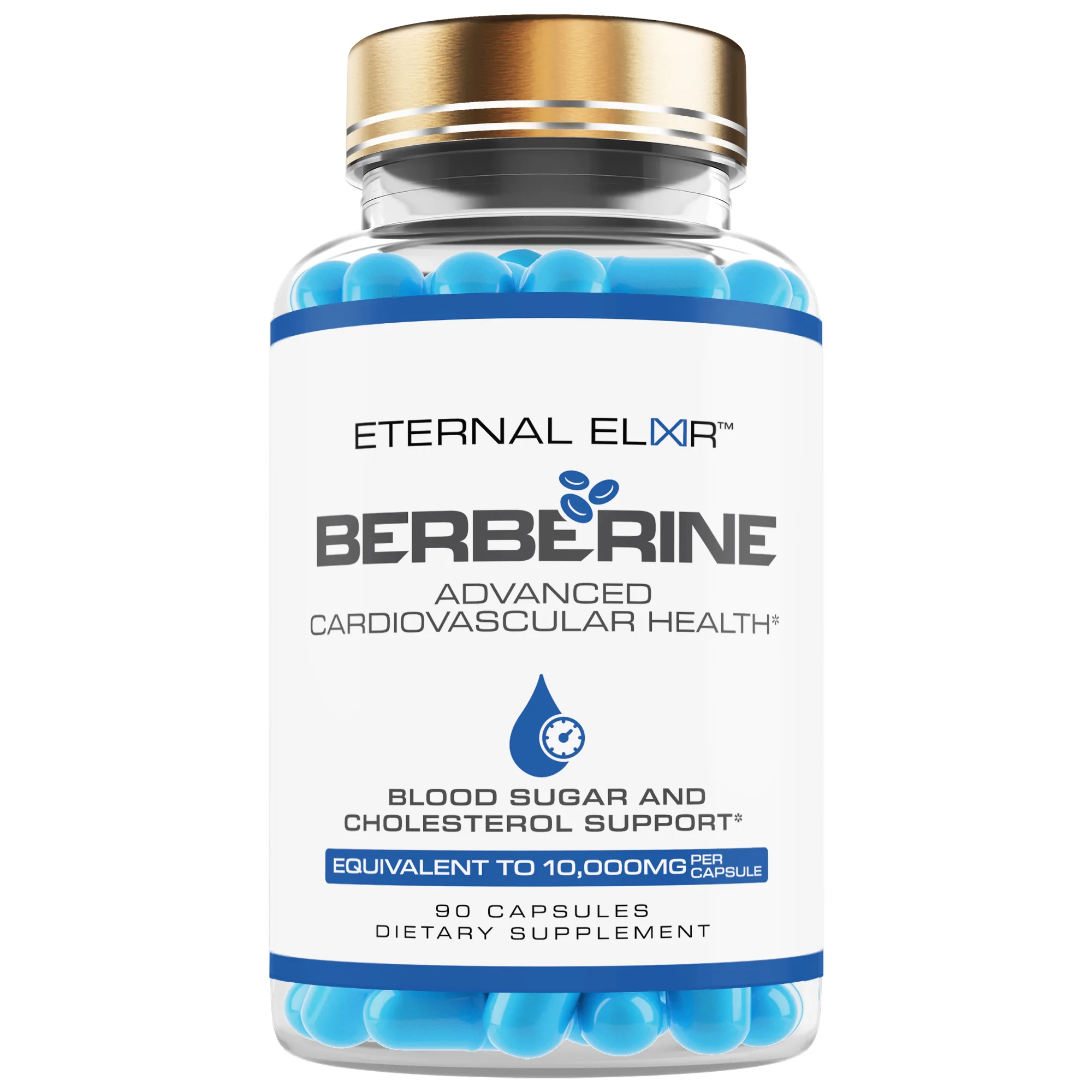
Eternal Elixir’s Berberine HCl 500 mg (20:1 extract) is built around exactly these specs: pharmaceutical-grade berberine hydrochloride, 90 capsules per bottle (a full month at the higher clinical dose), and third-party tested for purity. You can browse our full Australian metabolic and longevity range at the Eternal Elixir shop.
Side Effects and Practical Cautions
Berberine is mostly well tolerated. But it isn’t inert. The most common side effects are in the gut. Bloating happens. Mild cramping happens. Constipation or loose stools happen. These are most common in the first week or two. Splitting the dose across meals cuts this down a lot. Berberine also blocks the CYP3A4 liver enzyme. That means it can interact with many common drugs. These include statins. They include some blood pressure drugs. They include blood thinners. And they include immunosuppressants. If you take any prescription drug, run berberine past your chemist or GP first.
Berberine is not for pregnancy or breastfeeding. It shouldn’t be paired with other glucose-lowering drugs without medical care. That includes metformin. It includes sulfonylureas. It includes insulin. And it includes GLP-1 drugs. The risk is added hypoglycaemia.
Ozempic side effects are reported far more often. They tend to be more intense. Nausea is the most common. Vomiting is well known. Constipation, diarrhoea, and reflux are also reported. Fast weight loss can also cause facial volume loss (“Ozempic face”). In some people, it can cause lean-mass loss if they don’t do resistance training. These are different chats with different risk profiles.
Frequently Asked Questions
Is berberine actually “Nature’s Ozempic”?
No — that’s a marketing tagline, not a scientific equivalence. Berberine and semaglutide work through entirely different pathways and produce different magnitudes of effect. Berberine activates AMPK and supports insulin sensitivity; semaglutide mimics the GLP-1 hormone to suppress appetite. Both can support metabolic health, but expecting berberine to deliver Ozempic-scale weight loss will lead to disappointment.
Can I take berberine while I’m on Ozempic?
Don’t stack them without speaking to your prescriber. Both can lower blood glucose, and combining them raises the risk of hypoglycaemia. If you want to use berberine alongside a prescribed GLP-1, that’s a conversation with the clinician who prescribed it — not a self-managed protocol.
How long does berberine take to work?
Glucose markers (fasting glucose, post-meal response) often shift within 2–4 weeks of consistent dosing. Weight and waist changes are slower — most clinical trials run 8–12 weeks before reporting meaningful body composition changes. If you stop after a fortnight expecting dramatic results, you stopped too early.
Is berberine legal to buy in Australia?
Yes. Berberine is sold as a dietary supplement and is widely available from Australian retailers and online stores. It does not require a prescription.
What’s the right berberine dose for blood sugar support?
Most clinical trials used 500 mg taken two or three times daily with meals, for a total of 1,000–1,500 mg per day. Splitting the dose is important because berberine has a short plasma half-life — a single 1,500 mg morning capsule is not pharmacologically equivalent to three 500 mg doses spaced through the day.
Can berberine replace metformin?
Berberine and metformin share some overlapping mechanisms (both activate AMPK and reduce hepatic glucose output) and small head-to-head studies have shown comparable effects on glucose markers in some populations. That said, metformin is a clinical medication with decades of large-scale trial data behind it. If you’re on metformin, do not swap to berberine on your own — that’s a discussion with your GP, not a unilateral decision.
Will berberine cause weight loss on its own?
Modestly, in the order of 1–3 kg over a few months in pooled trial data — and only when supported by reasonable diet and movement. Berberine is best understood as a metabolic-support tool that improves the efficiency of what you’re already doing, not a standalone fat-loss intervention.
Recommended for you
About Eternal Elixir
Eternal Elixir is an Australian supplement company specialising in pharmaceutical-grade longevity and nootropic formulations. All products are third-party tested for purity, manufactured under strict quality controls, and designed for Australians who take their health seriously. Browse the full range at eternalelixir.com.au/shop.
Consider our Metabolic Wellness Stack