Last updated: September 28, 2026 · Originally published: April 9, 2026 · By Eternal Elixir Editorial
Quick answer: Methylene blue safety comes down to one serious drug interaction and a short list of people who should not take it. Methylene blue is a potent inhibitor of monoamine oxidase A (MAO-A), the enzyme that breaks down serotonin. Taken with SSRIs, SNRIs, MAOIs or other serotonergic medicines, it can cause serotonin syndrome, which can be life-threatening. It is also not for anyone with G6PD deficiency, anyone pregnant or breastfeeding, or anyone under 18. It turns urine blue or green, which is harmless. If none of these apply to you, stay at the label dose (for our capsules, one 10mg capsule a day) and talk to your doctor first if you take any prescription medicine.
Table of contents
- 1. Who should not take methylene blue
- 2. What methylene blue is
- 3. Why methylene blue interacts with antidepressants: MAO-A inhibition
- 4. Serotonin syndrome: what the case reports show
- 5. G6PD deficiency: the other firm no
- 6. Pregnancy and breastfeeding
- 7. Other cautions before you take methylene blue
- 8. How to take methylene blue more safely
- 9. Capsules or drops: our two formats compared
- 10. What to do if you think you have serotonin syndrome
- 11. Frequently asked questions
- 11.1. Is methylene blue harmful to humans?
- 11.2. Why don’t doctors recommend methylene blue?
- 11.3. Is it safe to take methylene blue daily?
- 11.4. Is methylene blue a carcinogen?
- 11.5. Can I take methylene blue if I’m on an SSRI?
- 11.6. How long after stopping an antidepressant can I take methylene blue?
- 11.7. Which medicines interact with methylene blue?
- 11.8. Can I take methylene blue with other supplements?
- 11.9. Does methylene blue turn your urine blue?
- 12. The bottom line on methylene blue safety
- 13. Related reading
- 14. Sources
Who should not take methylene blue
- Anyone taking serotonergic medicines. This includes SSRI and SNRI antidepressants, MAOIs, some tricyclic antidepressants such as clomipramine, and some pain medicines such as tramadol. The combination can cause serotonin syndrome.
- Anyone with G6PD deficiency. Methylene blue can break down red blood cells in people with this inherited enzyme deficiency.
- Anyone who is pregnant or breastfeeding.
- Anyone under 18.
- Anyone who has reacted badly to methylene blue before, for example when it was used as a dye during surgery.
If you take any prescription medicine, talk to your doctor or pharmacist before you start. Expect blue or green urine while you take it. That is the dye leaving your body, and it is harmless.
Eternal Elixir sells methylene blue capsules and drops, so we have an interest in this topic. This page sets out the risks as the published research describes them. We would rather you skip our product than take it with a medicine it interacts with.
What methylene blue is
Methylene blue (methylthioninium chloride) is a blue dye that has been used as a medicine for more than a century. Hospitals give it by injection for specific blood and surgical uses, and it is also sold as a low-dose oral supplement in capsules and drops. Interest in the supplement rests on its role as an electron carrier in mitochondria, which has been studied mostly in cells and animals. The safety questions on this page apply to both uses, because the interaction and the G6PD risk come from the molecule itself, not from the way it is given.
Why methylene blue interacts with antidepressants: MAO-A inhibition
Monoamine oxidase A (MAO-A) is the enzyme that breaks down serotonin, noradrenaline and dopamine. The antidepressants called MAOIs work by blocking it. In laboratory tests on purified human enzyme, methylene blue was a potent, tight-binding and reversible inhibitor of MAO-A. It also blocked MAO-B, but only at much higher concentrations (Ramsay et al., 2007).
The authors of that study pointed out that methylene blue taken by mouth can also block MAO-A in the gut, so the concern is not limited to the injections used in hospitals. At the blood levels reported after an intravenous dose, they expected MAO-A to be completely inhibited, which explains why patients taking SSRIs developed serotonin toxicity after they were given it.
What has not been measured is how strongly a 10mg oral supplement dose inhibits MAO-A in a person. Nobody has shown that a low dose is safe alongside serotonergic medicines, so the only safe assumption is that any dose can interact.
Serotonin syndrome: what the case reports show
Serotonin syndrome, also called serotonin toxicity, happens when too much serotonin activity builds up in the nervous system, usually because two medicines that raise serotonin are taken together. It ranges from shakiness and a racing heart to high fever, rigid muscles and seizures, and severe cases can be fatal (Boyer and Shannon, 2005).
A 2010 systematic review by two Queensland doctors collected the reported cases linked to methylene blue. It found nine case reports and two retrospective reviews in which 26 patients developed acute confusion after a methylene blue infusion. Twenty-four of them were taking a serotonin reuptake inhibitor and one was taking clomipramine, and serotonin syndrome was a possible diagnosis in all 25 (Ng and Cameron, 2010). In 2014, doctors in the Netherlands reported a death from serotonin toxicity after methylene blue was given to a patient taking venlafaxine. They noted that the reaction is preventable if the serotonergic medicine is stopped beforehand (Top et al., 2014).
These cases involved intravenous doses given in hospital, which are larger than a supplement dose. They are still the reason this guide tells anyone on serotonergic medicines not to take methylene blue at all.
Medicines that don’t mix with methylene blue
These are the main groups of serotonergic medicines. The list is not complete, so check every medicine and supplement you take with your pharmacist.
- SSRI antidepressants: for example sertraline, fluoxetine, escitalopram, citalopram, paroxetine and fluvoxamine.
- SNRI antidepressants: venlafaxine, desvenlafaxine and duloxetine.
- MAOIs: phenelzine, tranylcypromine and moclobemide.
- Tricyclic antidepressants with serotonin activity: clomipramine and imipramine.
- Some opioid pain medicines: tramadol, pethidine and tapentadol.
- Other products: St John’s wort, dextromethorphan (found in some cough medicines), lithium and 5-HTP.
Never stop or change a prescribed medicine to make room for methylene blue without your prescriber. Stopping some antidepressants suddenly causes withdrawal effects, and some, such as fluoxetine, stay in the body for weeks after the last dose. Your doctor is the right person to decide whether methylene blue could fit, and when.
G6PD deficiency: the other firm no
Glucose-6-phosphate dehydrogenase (G6PD) deficiency is an inherited enzyme deficiency. An estimated 400 million people worldwide carry a gene change that causes it. In people with G6PD deficiency, some medicines trigger haemolysis, the rapid breakdown of red blood cells. A 2010 evidence review found solid evidence to avoid only seven medicines in G6PD deficiency, and methylene blue was one of them (Youngster et al., 2010).
Many people with G6PD deficiency don’t know they have it. If you are unsure, ask your GP about a blood test before you take methylene blue.
Pregnancy and breastfeeding
Methylene blue is not for use in pregnancy or while breastfeeding. The clearest evidence of harm comes from New South Wales. When methylene blue dye was injected into the amniotic fluid during amniocentesis in twin pregnancies, it was linked with a high risk of small-bowel atresia (a blocked bowel) and with more fetal deaths (Kidd et al., 1996). That was a different route and dose from a supplement, but no study has shown that oral methylene blue is safe for a developing baby or a breastfed infant.
Other cautions before you take methylene blue
- Under 18: not for children or teenagers. Keep bottles out of reach of children.
- Surgery and hospital tests: tell your surgical team you take methylene blue. Hospitals use it as a dye, it can make a pulse oximeter read falsely low (Scott and Cooper, 1991), and some anaesthetic and pain medicines are serotonergic.
- Kidney or liver problems: ask your doctor first.
- A previous reaction: if you have reacted to methylene blue before, don’t take it.
- Blue urine and staining: urine can turn blue or green while you take it, which is harmless and passes after you stop. Drops can also stain the mouth, tongue and fingers. Capsules avoid that.
How to take methylene blue more safely
- Check the lists above first. If any item applies to you, don’t take it.
- Show a pharmacist or GP your full medicine and supplement list, including anything bought over the counter.
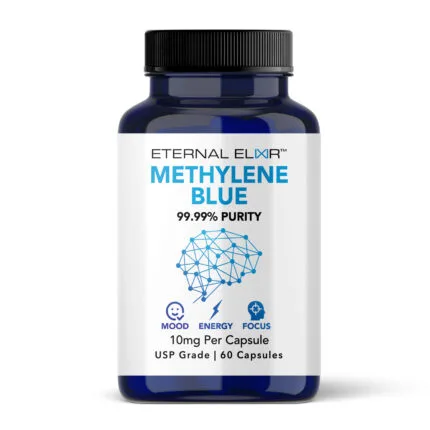
- Use a product made for people, with the dose on the label. Aquarium and laboratory methylene blue are not made to be swallowed. Our methylene blue capsules and 1% methylene blue drops are labelled as USP-grade methylene blue, with 10mg per capsule or 10mg per mL.
- Stay at the label dose. Our capsule label directs one 10mg capsule a day. Our drops label directs 0.5 to 1 mL (5 to 10mg) a day, diluted in water. Don’t take more than the label directs.
- Stop and get help if you feel unwell. The warning signs are listed below.
For practical detail on measuring and timing the liquid, see our guide on how to take methylene blue drops.
Capsules or drops: our two formats compared
Both products contain the same methylene blue. The difference is how you measure it. Prices are in AUD, as of Sep 2026.
| Format | Methylene blue (label) | Pack | Label serve | Price (AUD, as of Sep 2026) | Cost per serve | Good to know | Buy |
|---|---|---|---|---|---|---|---|
| Eternal Elixir Methylene Blue Capsules 10mg | 10mg per capsule | 60 capsules | 1 capsule a day | $59.99 | $1.00 | Fixed dose, no taste, no mouth staining | View capsules |
| Eternal Elixir Methylene Blue Liquid 1% | 10mg per mL | 50 mL | 0.5 to 1 mL a day in water | $49.99 | $0.50 to $1.00 | Adjustable dose, can stain the mouth and tongue | View drops |
Add Methylene Blue Capsules to cart · $59.99
Capsules suit people who want a fixed 10mg dose and no blue mouth. Drops suit people who want the option of a 5mg serve and don’t mind measuring. Our comparison of methylene blue liquid and capsules goes into more detail, and our methylene blue supplement comparison sets both against other brands sold in Australia.
What to do if you think you have serotonin syndrome
Warning signs (Boyer and Shannon, 2005): agitation or restlessness, confusion, a fast heart rate, raised blood pressure, dilated pupils, heavy sweating, shivering, diarrhoea, tremor, muscle twitching or jerking (often in the legs), stiff muscles and a high temperature.
- Stop taking methylene blue.
- Call 000 if symptoms are severe, such as a high fever, rigid muscles, marked confusion, a seizure or fainting.
- For milder symptoms or advice, call the Poisons Information Centre on 13 11 26 or go to your nearest emergency department. Tell them what you took, how much and when, and list every medicine you take.
- Don’t stop a prescribed medicine on your own unless the doctor treating you says to.
Serotonin syndrome is treatable, and people usually recover once the medicines causing it are stopped and they get care early. The danger is delay.
Frequently asked questions
Is methylene blue harmful to humans?
It can be, in the wrong person or combination. A clinical review describes it as a generally safe drug whose effects on red blood cells rise with the dose (Clifton and Leikin, 2003). The serious harms documented in the research are serotonin syndrome when it is combined with serotonergic medicines, and haemolysis in people with G6PD deficiency. Larger doses carry more risk, which is one reason to stay at the label dose.
See Methylene Blue Capsules 10mg · $59.99
Why don’t doctors recommend methylene blue?
Many doctors know methylene blue as a hospital medicine given by injection, where its serotonin interaction is well documented. Human research on low oral doses for energy or focus is still small, so many doctors are cautious, especially with patients who take antidepressants. If your doctor advises against it because of your medicines, follow that advice.
Is it safe to take methylene blue daily?
For adults with none of the risks on this page, daily use at the label dose is how supplements like ours are meant to be taken: one 10mg capsule, or 0.5 to 1 mL of 1% drops. Long-term studies of daily low-dose use are lacking, so check in with your doctor if you plan to take it for months, and stop if you notice anything unusual.
Is methylene blue a carcinogen?
The human data on this question are thin. In a small 2018 study, 10 people given a 200mg oral dose before a colonoscopy showed no sign of DNA damage in bowel biopsies (Repici et al., 2018). That is one small study at a single dose, so it does not settle the question for long-term daily use.
Can I take methylene blue if I’m on an SSRI?
No. The combination can cause serotonin syndrome. Talk to your prescriber if you are interested in methylene blue, and never stop an SSRI suddenly on your own.
How long after stopping an antidepressant can I take methylene blue?
That depends on the medicine, the dose and how long you took it, so your prescriber has to decide. Fluoxetine and its active breakdown product stay in the body for weeks after the last dose, so the wait after fluoxetine is longer than after most other antidepressants.
Which medicines interact with methylene blue?
The serious interactions are with serotonergic medicines: SSRI and SNRI antidepressants, MAOIs, tricyclic antidepressants with serotonin activity such as clomipramine, some opioid pain medicines such as tramadol and pethidine, lithium, and dextromethorphan in some cough medicines. The list above is a starting point, not a complete one, so ask your pharmacist to check everything you take.
Can I take methylene blue with other supplements?
Avoid supplements that raise serotonin, such as St John’s wort, 5-HTP and tryptophan. Other combinations need less caution, but check with your pharmacist if you take several products. Our guides cover taking methylene blue with NMN and methylene blue with coffee.
Does methylene blue turn your urine blue?
Yes. Urine can turn blue or green, which is harmless and passes after you stop taking it. Drops can also stain the tongue and mouth, which capsules avoid.
The bottom line on methylene blue safety
Methylene blue is not for everyone. Skip it if you take serotonergic medicines, have G6PD deficiency, are pregnant or breastfeeding, or are under 18. If none of those apply, choose a product made for people, stay at the label dose and tell your doctor you take it. Our capsules give a fixed 10mg dose with no mouth staining, and our drops let you take 5mg or 10mg.
Related reading
- The Methylene Blue Bible: mitochondrial energy and cognitive performance
- Micro-dosing methylene blue: protocols and doses
- Will methylene blue show up on a drug test?
- Methylene blue and coffee: can you take them together?
- Stacking methylene blue with NMN
- Methylene blue compared with other nootropics
- Shop the full Eternal Elixir range
Sources
- Ramsay RR, Dunford C, Gillman PK. Methylene blue and serotonin toxicity: inhibition of monoamine oxidase A (MAO A) confirms a theoretical prediction. British Journal of Pharmacology. 2007. PubMed 17721552
- Ng BK, Cameron AJ. The role of methylene blue in serotonin syndrome: a systematic review. Psychosomatics. 2010. PubMed 20484716
- Top WM, Gillman PK, de Langen CJ, Kooy A. Fatal methylene blue associated serotonin toxicity. Netherlands Journal of Medicine. 2014. PubMed 24846936
- Boyer EW, Shannon M. The serotonin syndrome. New England Journal of Medicine. 2005. PubMed 15784664
- Youngster I, Arcavi L, Schechmaster R, et al. Medications and glucose-6-phosphate dehydrogenase deficiency: an evidence-based review. Drug Safety. 2010. PubMed 20701405
- Kidd SA, Lancaster PA, Anderson JC, et al. Fetal death after exposure to methylene blue dye during mid-trimester amniocentesis in twin pregnancy. Prenatal Diagnosis. 1996. PubMed 8821851
- Scott DM, Cooper MG. Spurious pulse oximetry with intrauterine methylene blue injection. Anaesthesia and Intensive Care. 1991. PubMed 1829874
- Clifton J, Leikin JB. Methylene blue. American Journal of Therapeutics. 2003. PubMed 12845393
- Repici A, Ciscato C, Wallace M, et al. Evaluation of genotoxicity related to oral methylene blue chromoendoscopy. Endoscopy. 2018. PubMed 29906809
- Eternal Elixir product pages for Methylene Blue Capsules 10mg and Methylene Blue Liquid 1%, checked September 2026.