Last updated: September 28, 2026 · Originally published: September 10, 2026 · By Eternal Elixir Editorial
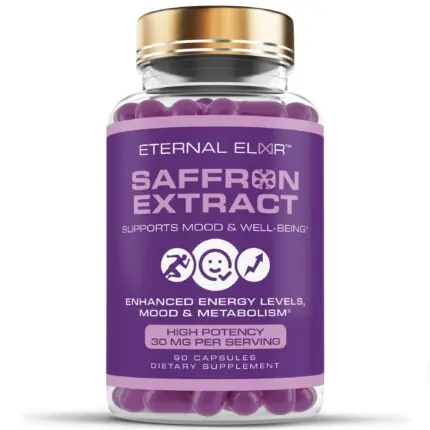
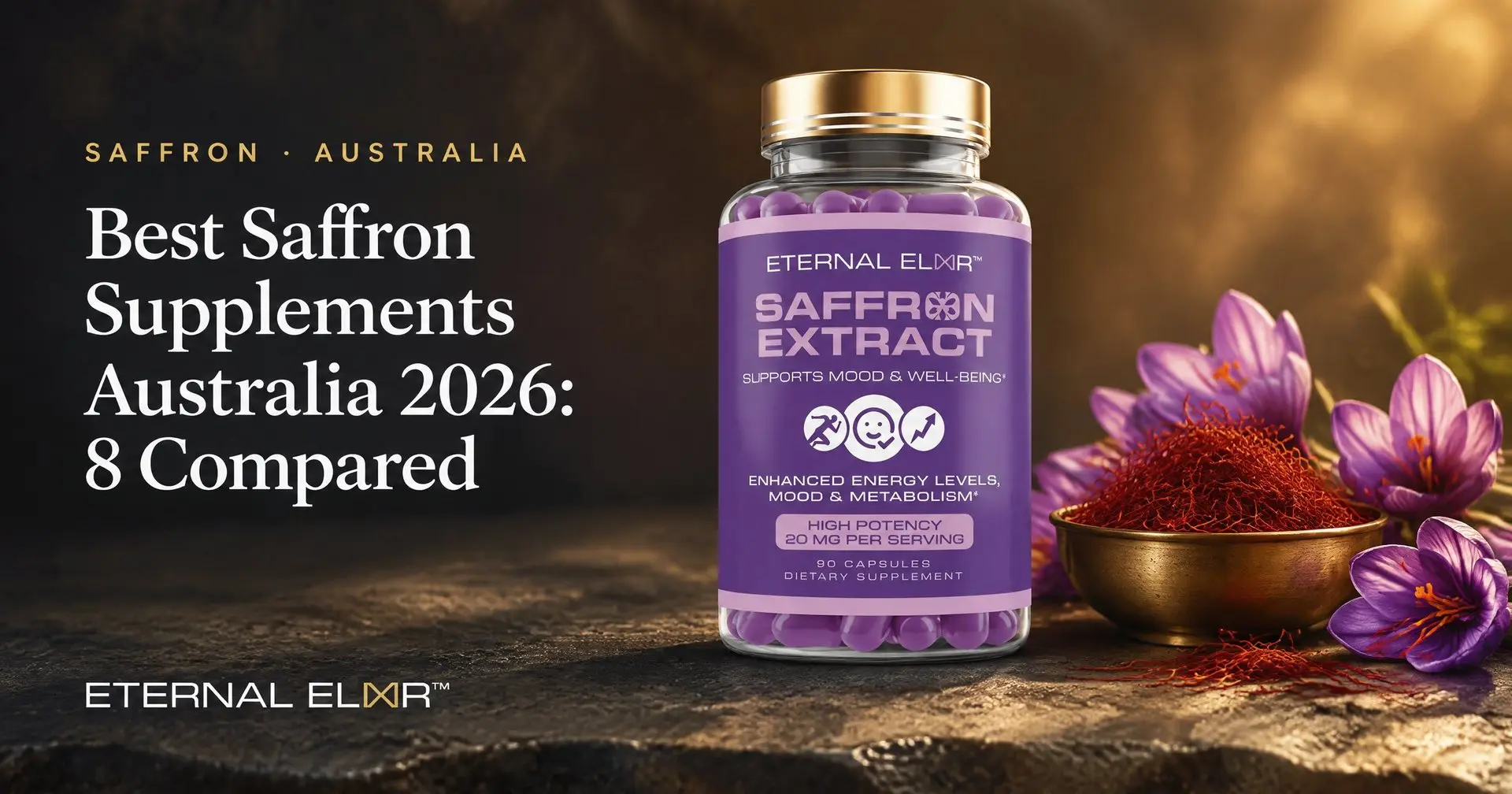
Quick answer: The best saffron supplements in Australia in 2026 use affron®, the standardised saffron extract behind most of the human trials, at 28mg to 30mg a day. Our pick is Eternal Elixir Saffron Extract 30mg: 30mg of affron® in one capsule a day, 90 capsules for $49.99, which is $0.56 a day, the lowest daily cost of the eight products we compared. If you want to try saffron for a month off a pharmacy shelf, Caruso’s Saffron at Chemist Warehouse was $19.97 for 60 tablets in September 2026, a 30-day pack at two tablets a day.
Eternal Elixir makes Saffron Extract 30mg, and it is our pick. Every figure for the other seven products comes from their own product page or the retailer page we link, read in September 2026. We did not lab-test any of them. We ranked on what the label panel shows: which extract is inside, how much you take a day, and what a day costs at the label’s own directions.
Table of contents
- 1. Best saffron supplements in Australia 2026: the comparison table
- 2. The one thing that separates these products: affron® or not
- 3. How we compared these saffron supplements
- 4. What the saffron research found
- 5. How to read a saffron supplement label
- 6. #1. Eternal Elixir Saffron Extract 30mg: best overall
- 7. #2. Caruso’s Saffron: cheapest pack to try
- 8. #3. California Gold Nutrition Saffron Extract with Affron: once-a-day 28mg from iHerb
- 9. #4. Caruso’s Saffron + L-Theanine: saffron with L-theanine
- 10. #5. Nature’s Own Saffron+: saffron with magnesium and vitamin D
- 11. #6. Wanderlust Ashwagandha + Saffron: saffron with ashwagandha
- 12. #7. Herbs of Gold Saffron Mood Balance: saffron with lemon balm
- 13. #8. Teddi Lab Saffron Gummy PRO: for people who will only take a gummy
- 14. Where to buy saffron supplements in Australia
- 15. How to take saffron
- 16. Who should check with a doctor first
- 17. Building a routine around saffron
- 18. The verdict: which saffron supplement should you buy?
- 19. Saffron supplements in Australia: frequently asked questions
- 19.1. What is the best brand of saffron supplement in Australia?
- 19.2. Which saffron extract has the most research behind it?
- 19.3. What is the highest rated saffron supplement?
- 19.4. Which saffron supplement can I buy at Chemist Warehouse?
- 19.5. How much saffron should I take per day?
- 19.6. How long does saffron take to work?
- 19.7. Does saffron help with sleep?
- 19.8. Is it safe to take saffron every day?
- 19.9. Can I take saffron with magnesium or ashwagandha?
- 19.10. Is there a downside to taking saffron?
- 20. Sources
Best saffron supplements in Australia 2026: the comparison table
Every row is a day of use at the maker’s own directions, not a tablet or a bottle. That matters with saffron, because some products are one capsule a day and others are two tablets of 13.5mg to 15mg each. Prices are in Australian dollars as of Sep 2026. Chemist Warehouse prices marked against an RRP are promotional and will move.
| Rank | Product | Saffron extract per day | affron®? | Units per day | Pack | Price (AUD, as of Sep 2026) | Cost per day | Best for | Buy |
|---|---|---|---|---|---|---|---|---|---|
| #1 | Eternal Elixir Saffron Extract 30mg | 30mg | Yes | 1 capsule | 90 capsules | $49.99 | $0.56 | Best overall, lowest cost per day | View at Eternal Elixir |
| #2 | Caruso’s Saffron | 27mg | Yes | 2 tablets | 60 tablets | $19.97 (RRP $39.95) | $0.67 ($1.33 at RRP) | Cheapest pack to try | Chemist Warehouse |
| #3 | California Gold Nutrition Saffron Extract with Affron | 28mg | Yes | 1 capsule | 60 capsules | $42.66 | $0.71 | Once-a-day 28mg capsule from iHerb | iHerb AU |
| #4 | Caruso’s Saffron + L-Theanine | 28mg, plus 200mg theanine | Yes | 1 tablet | 30 tablets | $22.50 (RRP $45.00) | $0.75 | Saffron with L-theanine | Chemist Warehouse |
| #5 | Nature’s Own Saffron+ | 28mg, plus magnesium and vitamin D3 | Yes | 2 tablets | 50 tablets | $19.99 (RRP $39.99) | $0.80 | Saffron with magnesium and vitamin D | Chemist Warehouse |
| #6 | Wanderlust Ashwagandha + Saffron | 30mg, plus ashwagandha | Yes | 2 capsules | 60 capsules | $29.49 (RRP $58.99) | $0.98 | Saffron with ashwagandha | Chemist Warehouse |
| #7 | Herbs of Gold Saffron Mood Balance | 30mg, plus lemon balm | Yes | 2 capsules | 60 capsules | $43.95 | $1.47 | Saffron with lemon balm | Herbs of Gold |
| #8 | Teddi Lab Saffron Gummy PRO | 30mg per serving | No (NGH-21 extract) | Serving size not stated | 180g of gummies | $46.50 | Not stated | People who will only take a gummy | Teddi Lab |
Figures from each product or retailer page, September 2026. Cost per day is the price divided by the days a pack lasts at the label’s directions.
Add Saffron Extract 30mg to cart · $49.99The one thing that separates these products: affron® or not
Seven of the eight products list affron® on the label. The eighth, the Teddi Lab gummy, gives the same 30mg headline but uses a different extract. That difference matters more than the price.
Most of the human research on saffron for mood and sleep used one extract: affron®, made by Pharmactive Biotech Products and standardised to 3.5% Lepticrosalides®. Saffron is a plant, and the amount of its active compounds, crocins and safranal among them, varies with the harvest, the region and the extraction method. A standardised extract carries a fixed percentage. A plain “saffron extract” with no named extract or standardisation figure tells you less.
So a product with “30mg saffron extract” and no named extract is not the same as 30mg of the extract the trials used, even if the number looks identical. This is the label-reading problem we cover in our guide to what to look for on an Australian supplement label.
The other difference is how the dose is split. Four of the affron® products here are two tablets or capsules a day, and three are one a day. Both work on paper. In practice, the dose you remember to take every day for 12 weeks is the one that counts.
How we compared these saffron supplements
We did not test these products in a lab, and we did not rank on star ratings. We read each label panel and the live product or retailer page in September 2026, and we worked out every product on the same basis: one day of use at the label’s own directions. Four questions decided the order.
- Is the extract named and standardised? An affron® label, or another named extract with a standardisation figure, can be checked. A bare “saffron extract” cannot.
- Does the daily amount match the trials? The affron® trials used 28mg a day, with 14mg tested for sleep. We noted where a product falls short or adds other ingredients.
- What does a day cost? We divided the price by the days a pack lasts at the label dose. A $19.97 pack that lasts 30 days and a $49.99 bottle that lasts 90 days are not the price they look.
- Can you buy it in Australia today? Every product here was on sale to Australians when we checked. One product from the previous version of this guide, Swisse Ultiboost Stress Relief Smart Melt, showed as sold out on the Swisse website, so we replaced it.
Where a competitor wins on a point, we say so. Caruso’s is cheaper to try and sits on pharmacy shelves, California Gold Nutrition is the exact trial dose, and three products add a second ingredient some people want.
What the saffron research found
Saffron’s evidence is unusual for a herbal ingredient: small, but mostly randomised, placebo-controlled trials in people. Much of it comes from one Perth research group and is funded by the company that makes affron®, which you should weigh when you read the results.
| Study | Who took part | Daily dose and length | What changed |
|---|---|---|---|
| Kell et al., 2017 | 128 adults with self-reported low mood | 28mg or 22mg affron®, or placebo, for 4 weeks | Mood scores improved at 28mg a day. The 22mg dose showed no effect |
| Lopresti et al., 2021 | 120 adults unhappy with their sleep | 14mg or 28mg affron® 1 hour before bed, or placebo, for 28 days | Sleep quality ratings improved on both doses. Several other sleep measures did not differ from placebo |
| Lopresti et al., 2025 | 202 adults aged 18 to 70 with low mood | 28mg affron® or placebo for 12 weeks | The main mood score improved more than on placebo. Most secondary measures did not differ |
| Lopresti and Smith, 2026 | 86 women aged 50 to 70 with low mood and poor sleep | 28mg affron® or placebo for 12 weeks | Mood scores and sleep-related impairment improved. Sleep disturbance scores did not differ |
The trial most Australian packs point to gave 128 adults with self-reported low mood 28mg or 22mg of affron® a day, or a placebo, for four weeks. Mood scores improved at 28mg, and the 22mg dose showed no effect (Kell et al., Complementary Therapies in Medicine, 2017). That is why 28mg to 30mg a day is the range to look for.
For sleep, 120 adults who were unhappy with their sleep took 14mg or 28mg of affron® an hour before bed, or a placebo, for 28 days. Sleep quality ratings improved on both doses, and evening melatonin rose, but several other sleep measures did not differ from placebo (Lopresti et al., Sleep Medicine, 2021). Our guide to saffron for sleep goes through that trial in detail.
The largest trial so far gave 202 adults aged 18 to 70 with low mood 28mg of affron® or a placebo for 12 weeks. The main mood score improved more on saffron: 72.3% of the saffron group reached a meaningful improvement, against 54.3% on placebo. Most of the secondary measures did not differ, and the placebo response was large (Lopresti et al., Journal of Nutrition, 2025). A 2026 trial in 86 women aged 50 to 70 with low mood and poor sleep found a similar pattern over 12 weeks: 48.8% on saffron reached a meaningful mood improvement against 25.6% on placebo (Lopresti and Smith, Frontiers in Nutrition, 2026). Our summary of saffron for mood and stress covers the full set.
What has not been shown
- The trials ran for four to 12 weeks. We found no long-term trial of affron® in healthy adults.
- Most outcomes were questionnaires people filled in about themselves, and the placebo groups also improved a lot.
- The affron® maker funded the recent trials and supplied the product. The results are still randomised and placebo-controlled, but independent replication is thin.
- The trials used affron®. Results do not carry over to other saffron extracts, gummies or cooking saffron.
For the wider picture on what saffron supports, see our overview of saffron supplement benefits.
How to read a saffron supplement label
Five checks turn the front of the box into a like-for-like comparison.
- The extract name. Look for affron®, or another named extract with a standardisation percentage. “Saffron 0.5%” in an ingredient list is a very different thing from a standardised extract.
- Milligrams per unit and units per day. 13.5mg per tablet at two tablets a day is 27mg. 30mg in one capsule is 30mg. Multiply before you compare.
- Days per pack. A 50-tablet pack at two a day lasts 25 days. A 90-capsule bottle at one a day lasts 90. This drives the real cost.
- Other actives. Magnesium, vitamin D, ashwagandha, lemon balm and theanine all appear in products here. If you already take any of them, count them.
- Warnings and age limits. Several labels say not for use in pregnancy or breastfeeding, some are adults only, and some allow children over 12. Read them before you buy.
Saffron threads, tinctures and other extracts
Cooking with saffron threads is not a substitute for a standardised extract. The amount of active compounds in threads varies, and the trials used a measured extract rather than food. Tinctures, glycerites and loose powder capsules sold online also rarely state a standardisation figure. Other branded extracts exist, such as Satiereal and NGH-21, and they are dosed differently. The affron® results in this guide do not transfer to them.
#1. Eternal Elixir Saffron Extract 30mg: best overall
This is the only product here with 30mg of affron® in a single daily capsule. The label lists saffron extract (Crocus sativus stigma) standardised to 3.5% Lepticrosalides® (affron®) at 30mg per capsule, with rice flour and a vegetable capsule as the only other ingredients. You take one capsule a day with a meal.
- Key specs: 30mg affron® per capsule, 90 capsules, 1 capsule a day, a 90-day supply.
- Price: $49.99, which is $0.56 a day, the lowest daily cost in this comparison. The product page takes 10% off two bottles, 15% off three and 20% off five.
- Service: dispatch from Sydney within 24 hours, free shipping over $100, a 30-day money-back guarantee and Afterpay. The product page says each batch is tested by a third-party laboratory, with a certificate of analysis on request.
Who it suits: anyone who wants the trial extract at the trial dose, once a day, for a full 12-week course without reordering. A 90-capsule bottle covers the length of the longest trials.
Who it doesn’t suit: someone who wants to spend under $20 to try saffron for a month, or who wants to pick it up from a pharmacy today. It is sold online only. The 30mg dose is also slightly above the 28mg a day most trials used.
#2. Caruso’s Saffron: cheapest pack to try
Caruso’s Saffron is the saffron supplement most Australians will see first at Chemist Warehouse. Each film-coated tablet has 13.5mg of saffron stigma extract from at least 45mg of dry stigma, and the listing says it is affron®. Adults and children over 12 take one tablet twice daily with food, which is 27mg a day, just under the 28mg trial dose.
It was $19.97 for 60 tablets in September 2026 against an RRP of $39.95. That is $0.67 a day on special and $1.33 a day at RRP. The label says to take it at least two hours away from pharmaceutical medicines and advises against use in pregnancy or breastfeeding.
Who it suits: people who want a one-month trial for under $20. Who it doesn’t: anyone who wants the full 28mg to 30mg or a once-a-day routine.
#3. California Gold Nutrition Saffron Extract with Affron: once-a-day 28mg from iHerb
California Gold Nutrition, iHerb’s own brand, sells a 60-capsule bottle with 28mg of saffron extract standardised to 3.5% Lepticrosalides® per capsule, the same affron® extract and the exact daily dose most trials used. The label says one capsule daily, with or without food. It was AU$42.66 on iHerb AU, which is $0.71 a day.
Who it suits: people who want 28mg once a day and already order from iHerb. Who it doesn’t: anyone who wants a local Australian dispatch, or the lowest daily cost.
#4. Caruso’s Saffron + L-Theanine: saffron with L-theanine
This Caruso’s tablet pairs 28mg of affron® saffron extract, from 84mg of dry stigma, with 200mg of theanine. Adults take one tablet a day. It was $22.50 for 30 tablets against an RRP of $45.00, or $0.75 a day. The label says adults only and advises against use in pregnancy or breastfeeding.
Who it suits: people who want saffron and L-theanine in one daily tablet. Who it doesn’t: anyone who wants saffron on its own, or more than a one-month pack.
#5. Nature’s Own Saffron+: saffron with magnesium and vitamin D
Nature’s Own Saffron+ combines 14mg of affron® saffron extract, equivalent to 42mg of dry stigma, with 160mg of magnesium from heavy magnesium oxide and 5 micrograms of vitamin D3 (200 IU) per tablet. Adults take one tablet twice daily, which gives 28mg of saffron extract a day. The 50-tablet pack lasts 25 days. It was $19.99 against an RRP of $39.99, or $0.80 a day. The label says it contains soya bean products.
Magnesium oxide carries a lot of magnesium by weight, but it is not the form chosen for brain or sleep research. If that is why you want magnesium, our magnesium comparison for Australia and our review of what the trials show on magnesium L-threonate explain the forms.
Who it suits: people who want saffron, magnesium and vitamin D in one tablet. Who it doesn’t: anyone who wants saffron alone or a 30-day pack.
#6. Wanderlust Ashwagandha + Saffron: saffron with ashwagandha
Wanderlust Ashwagandha + Saffron pairs 15mg of affron® saffron extract, derived from 45mg of dry stigma, with 75mg of ashwagandha root extract, derived from 1.5g of dry root, per capsule. The directions say two capsules daily, which gives 30mg of saffron extract. Chemist Warehouse had it at $29.49 against an RRP of $58.99, or $0.98 a day. Wanderlust’s own site lists the same pack at $58.99, which is $1.97 a day, so where you buy matters.
Ashwagandha has its own research for stress and works differently. We compare it with other herbs in our roundup of adaptogen supplements in Australia and head to head in tongkat ali vs ashwagandha.
Who it suits: people who want ashwagandha and saffron in one capsule and buy on special. Who it doesn’t: anyone who has been told to avoid ashwagandha, or who wants saffron alone. Check with your doctor if you have a thyroid condition.
#7. Herbs of Gold Saffron Mood Balance: saffron with lemon balm
Herbs of Gold Saffron Mood Balance has 15mg of saffron stigma extract from affron®, derived from 45mg of dry stigma, plus 30mg of lemon balm extract, derived from 1.5g of dry herb, per capsule. Adults and children over 12 take one capsule twice daily with food, which gives 30mg of saffron extract a day. It is $43.95 for 60 capsules, a 30-day supply, or $1.47 a day, the highest daily cost here.
Who it suits: people who specifically want saffron with lemon balm. Who it doesn’t: anyone shopping on cost per day.
#8. Teddi Lab Saffron Gummy PRO: for people who will only take a gummy
Teddi Lab Saffron Gummy PRO gives 30mg of saffron extract per serving, the same headline number as our pick. But the extract is NGH-21, not affron®, and the ingredient list shows “Saffron 0.5% (derived from flower of Crocus sativus)”. The trials above used affron®, so their results do not transfer to this gummy.
The pack is $46.50 for 180g of gummies. The page does not state how many gummies make a serving or how many servings are in the pack, so we cannot give a cost per day. The base is maltitol syrup, maltitol and isomalt, and the label warns that too many may have a laxative effect. It contains gelatin, so it does not suit vegetarians, and the label says not to use it if pregnant or planning a pregnancy, and not under 12.
Who it suits: people who will only ever take a gummy and accept it is not the studied extract. Who it doesn’t: anyone who wants the evidence to apply to what they take.
Where to buy saffron supplements in Australia
You have three routes, and each has a real trade-off.
- Pharmacy chains. Chemist Warehouse lists Caruso’s, Nature’s Own and Wanderlust saffron products online, often well below RRP. You can pick them up the same day, but the specials move, and most packs last 25 to 30 days.
- Australian online brands. Eternal Elixir ships from Sydney within 24 hours, with free shipping over $100. Herbs of Gold sells direct from its own site. You wait a few days for delivery, and in our case you get a three-month bottle.
- International retailers. iHerb ships California Gold Nutrition and other imported brands to Australia. The range is wide, and orders come from overseas, so delivery takes longer than a local order.
Whichever route you choose, compare on cost per day and the extract on the label, not the price on the shelf.
How to take saffron
- Dose: the trials used 28mg of affron® a day, and 14mg worked as well as 28mg for sleep ratings in one trial. Follow your product’s label rather than combining two products to reach a higher total. No trial tested higher doses.
- Timing: the sleep trial gave it an hour before bed, and the mood trials used daily doses. Our label says one capsule with a meal at the same time each day, morning or evening. If sleep is your main reason, take it with dinner.
- How long: give it at least four weeks, the length of the shortest trial, and ideally 12 weeks, the length of the two most recent. A few days only tells you whether you tolerate it.
That is one reason the bottle size matters. A 30-day pack runs out at the four-week mark, while a 90-capsule bottle at one a day covers a full 12-week course.
Who should check with a doctor first
Talk to your doctor or pharmacist before you take saffron if you take any medicine that affects mood, including antidepressants, or blood-thinning medicine, or if you have a medical condition. Our product page says not to use it if you are pregnant or breastfeeding, and several of the other labels here say the same. Most Australian saffron labels are for adults, and some also allow children over 12. If low mood is affecting your daily life, see your GP. A supplement is not a substitute for proper care, and Healthdirect Australia is a good independent starting point.
Building a routine around saffron
Add one product at a time and give each one four to 12 weeks before you add the next. Start three in the same week and you will not know which one to keep buying.
For daytime, people often pair saffron with something that works differently rather than a second calming herb, such as Korean Red Panax Ginseng, which we compare in our Korean red ginseng guide. For evenings, Magnesium L-Threonate 2000mg stacks cleanly with a dinner-time saffron capsule. If energy rather than mood is the bigger issue, NMN 500mg is one capsule a day, and our comparison of energy supplements in Australia is the next read.
If focus is the reason you are looking at saffron, our guide to saffron supplements for focus looks at that evidence. For the wider brain-health category, see our nootropic supplement rankings for Australia and our plain-English guide to nootropics. For what we do and do not claim about our own range, read our breakdown of Eternal Elixir’s products and quality standards, or browse the full range.
The verdict: which saffron supplement should you buy?
Our pick is Eternal Elixir Saffron Extract 30mg: the affron® extract at 30mg, once a day, at $0.56 a day, with 90 capsules covering a full 12-week course. The others each suit a narrower need. Caruso’s Saffron is the cheapest pack to try for a month. California Gold Nutrition is a once-a-day 28mg capsule if you already shop at iHerb. Caruso’s Saffron + L-Theanine, Nature’s Own Saffron+, Wanderlust and Herbs of Gold add a second ingredient. Teddi Lab is a gummy, but not the studied extract.
Saffron supplements in Australia: frequently asked questions
What is the best brand of saffron supplement in Australia?
Our pick is Eternal Elixir Saffron Extract 30mg, which we make: 30mg of affron® in one capsule a day, 90 capsules for $49.99. Caruso’s, California Gold Nutrition, Nature’s Own, Wanderlust and Herbs of Gold also use affron®. Look for a named, standardised extract on the label rather than a brand name on the front of the box.
Which saffron extract has the most research behind it?
The extract with the most human trials behind it is affron®, standardised to 3.5% Lepticrosalides®. Trust comes from the label: a named extract and a standardisation figure can be checked, while “premium saffron extract” cannot.
Add Saffron Extract 30mg to cart · $49.99
What is the highest rated saffron supplement?
Star ratings on retailer sites come from small, self-selected groups, so we did not rank on them. We ranked on the label: the extract, the daily dose and the cost per day. On those measures our pick is Eternal Elixir Saffron Extract 30mg.
Which saffron supplement can I buy at Chemist Warehouse?
Chemist Warehouse does not stock Eternal Elixir, so our pick is ordered online and ships from Sydney. On Chemist Warehouse’s website, Caruso’s Saffron was $19.97 for 60 tablets in September 2026, Caruso’s Saffron + L-Theanine $22.50 for 30 tablets, Nature’s Own Saffron+ $19.99 for 50 tablets and Wanderlust Ashwagandha + Saffron $29.49 for 60 capsules. All were below RRP.
How much saffron should I take per day?
The published affron® trials used 28mg a day, and one sleep trial found 14mg worked as well as 28mg on sleep ratings. Our capsule gives 30mg. Follow the label of the product you buy rather than doubling up.
How long does saffron take to work?
Plan on four to 12 weeks. The shortest trial ran four weeks and the two most recent ran 12. A few days is too short to judge.
Does saffron help with sleep?
In one 28-day trial, 120 adults who were unhappy with their sleep took 14mg or 28mg of affron® an hour before bed. Their sleep quality ratings improved more than on placebo, and both doses did about equally well. Several other sleep measures, including most of the sleep diary, did not differ from placebo. Saffron is not a sedative. If sleep is your main reason, take your capsule with dinner and judge it over four weeks or more.
Is it safe to take saffron every day?
The affron® trials gave saffron every day for four to 12 weeks and reported no serious side effects. We found no trial longer than 12 weeks. Take it at the label dose, and talk to your doctor if you take regular medicines or plan to take it long term.
Can I take saffron with magnesium or ashwagandha?
Some products here already combine them: Nature’s Own Saffron+ adds magnesium and vitamin D, and Wanderlust adds ashwagandha. If you take a separate saffron capsule, you can add a magnesium supplement in the evening. Count every active across your bottles so you do not double up, and check with your doctor if you take other medicines.
Is there a downside to taking saffron?
The trials reported no serious side effects at 14mg to 28mg a day. The downsides are practical: the effects in trials were modest, the placebo groups also improved, and it takes weeks. Talk to your doctor first if you take medicine that affects mood or thins the blood, and do not use our product if you are pregnant or breastfeeding.
Sources
- Kell G, Rao A, Beccaria G, Clayton P, Inarejos-García AM, Prodanov M. affron® a novel saffron extract (Crocus sativus L.) improves mood in healthy adults over 4 weeks in a double-blind, parallel, randomized, placebo-controlled clinical trial. Complementary Therapies in Medicine. 2017;33:58-64. PubMed 28735826
- Lopresti AL, Smith SJ, Drummond PD. An investigation into an evening intake of a saffron extract (affron®) on sleep quality, cortisol, and melatonin concentrations in adults with poor sleep. Sleep Medicine. 2021;86:7-18. PubMed 34438361
- Lopresti AL, Smith SJ, Marx W, Díez-Municio M, Morán-Valero MI. An examination into the effects of a saffron extract (Affron) on mood and general wellbeing in adults experiencing low mood. Journal of Nutrition. 2025;155(7):2300-2311. PubMed 40414301
- Lopresti AL, Smith SJ. The effects of a saffron extract (Affron®) on mood, sleep, self-esteem, and exploratory measures of physical appearance in women aged 50 to 70 years experiencing low mood and poor sleep. Frontiers in Nutrition. 2026;13:1838513. PubMed 42389708
- Product and retailer pages for all eight products, read in September 2026 and linked in the comparison table.