Last updated: August 8, 2026 · Originally published: January 24, 2026 · By Eternal Elixir Editorial
Last updated: 22 April 2026. Reviewed quarterly against current peer-reviewed research.
When you see TUDCA and UDCA on supplement bottles, the question arises: are they the same molecule with a different name? They are not. A single chemical tweak changes how each compound talks to your cells, how it moves through your gut, and what it actually does for your body. This guide tears apart the science behind TUDCA vs UDCA, reviews the latest 2024–2025 research, and explains why the taurine-conjugated form has become the go-to choice for proactive Australians seeking liver support.
Table of contents
- 1. Decoding the Acronyms: Origins and Structure
- 2. The Taurine Conjugation: What Makes TUDCA Different
- 3. Mechanism of Action: How Chemistry Drives Biology
- 4. TUDCA vs UDCA: Side-by-Side Comparison
- 5. Historical Use: From Bear Bile to Laboratory Synthesis
- 6. Who Should Consider TUDCA Over UDCA?
- 7. Quality and Sourcing Considerations in Australia
- 8. Frequently Asked Questions
- 9. The Bottom Line
Decoding the Acronyms: Origins and Structure
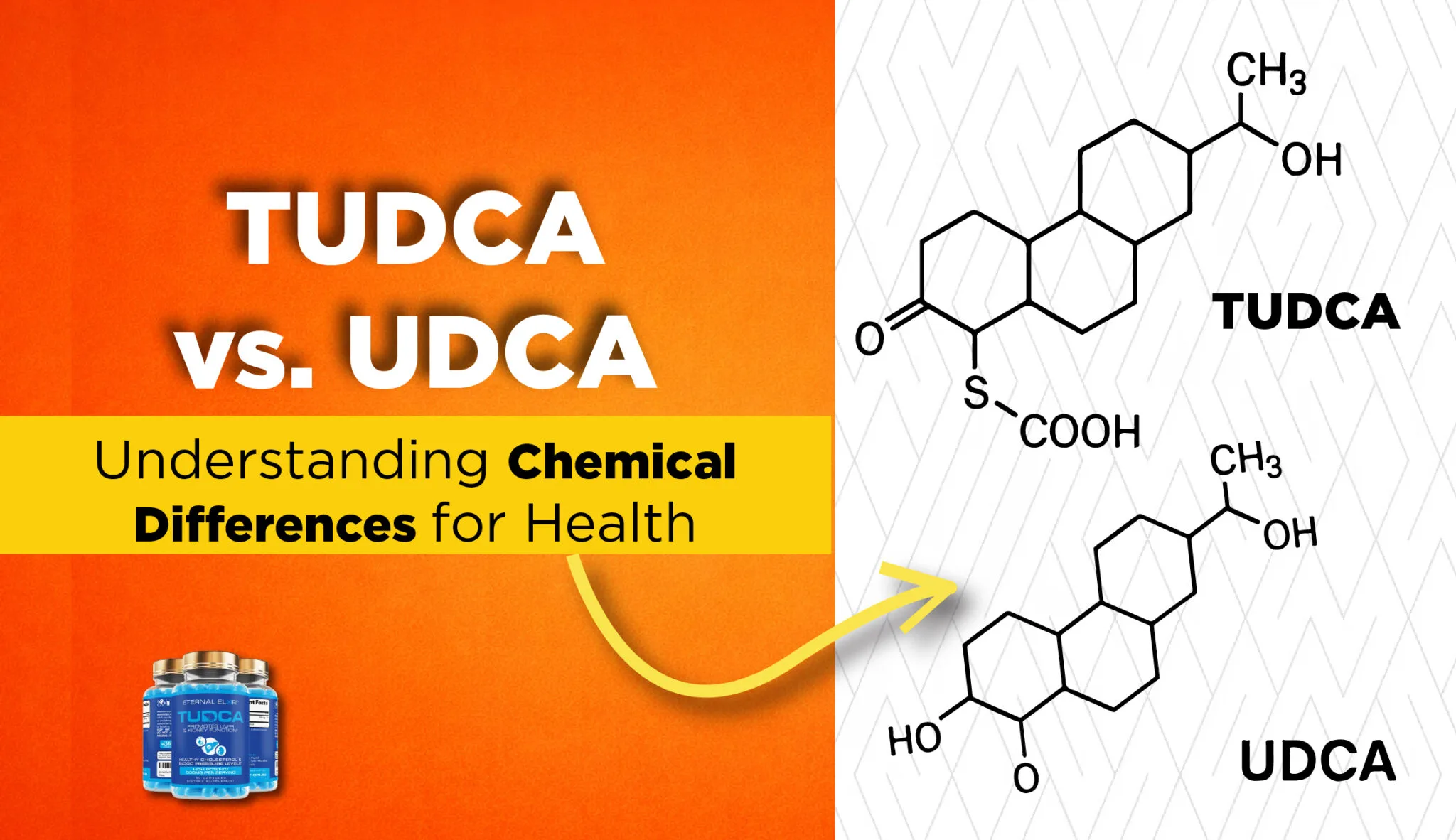
UDCA (ursodeoxycholic acid) is a secondary bile acid originally isolated from bear bile. It is relatively hydrophobic (fat-loving) and does not dissolve easily in water. While useful for specific medical applications, unconjugated hydrophobic bile acids can be harsh; if they accumulate in the liver, they can behave like a solvent and destabilise cell membranes. Modern UDCA is synthesised in laboratories and prescribed in Australia (often under the brand Ursofalk) to dissolve cholesterol gallstones and to manage primary biliary cholangitis.
TUDCA (tauroursodeoxycholic acid) is UDCA with a taurine amino acid bonded to the end of its side chain via an amide bond. This tiny structural change completely rewrites the molecule’s behaviour in water and in living tissue. Your own liver performs this conjugation naturally, just in very small quantities — supplemental TUDCA simply delivers that same endogenous molecule at a meaningful dose.
The Taurine Conjugation: What Makes TUDCA Different
Hydrophilicity and Solubility
Thanks to the taurine group, TUDCA is highly hydrophilic (water-loving). This is the single most important practical difference. TUDCA survives the acidic gut environment more gracefully, mixes into bile more evenly, and distributes through the liver’s watery compartments without roughing up cell membranes on the way. It acts as a gentle biological detergent rather than an aggressive one.
Bioavailability and Absorption
Once absorbed, TUDCA functions as a molecular chaperone. It specifically reduces endoplasmic reticulum (ER) stress — the cellular backlog of misfolded proteins that builds up when the liver is exposed to alcohol, pharmaceuticals, processed foods, or chronic inflammation. TUDCA helps proteins fold correctly and prevents hepatocytes from triggering apoptosis (programmed cell death) when they are overwhelmed.
Mechanism of Action: How Chemistry Drives Biology
Research published in 2024 in the Journal of Agricultural and Food Chemistry found that TUDCA modulates the farnesoid X receptor (FXR) and CYP7A1 pathways, reshapes the gut microbiome (increasing beneficial Allobaculum and Bifidobacterium populations), and reduces hepatic lipid accumulation in non-alcoholic fatty liver models (Wang et al., 2024; DOI: 10.1021/acs.jafc.4c04630). A 2025 paper in Biomedicines demonstrated that TUDCA activates GATA3 signalling to promote hepatocyte regeneration and reduce fibrosis in rodent models (Bai et al., 2025; DOI: 10.3390/biomedicines13040910). Earlier work published in Annals of Hepatology showed TUDCA supplementation reduces cholesterol gallstone formation and rebalances gut microbiota in high-fat-diet models (Lu et al., 2020; DOI: 10.1016/j.aohep.2020.100289).
The pattern across this research is consistent: TUDCA’s hydrophilic, taurine-conjugated structure allows it to act on multiple pathways at once — bile flow, mitochondrial health, ER stress, gut microbiome composition and cellular regeneration — in a way that unconjugated UDCA does not replicate as efficiently.
TUDCA vs UDCA: Side-by-Side Comparison
| Attribute | TUDCA | UDCA |
|---|---|---|
| Full name | Tauroursodeoxycholic acid | Ursodeoxycholic acid |
| Structure | UDCA conjugated with taurine | Unconjugated bile acid |
| Solubility | Highly hydrophilic (water-loving) | Relatively hydrophobic |
| Primary role | Cellular protection, ER stress reduction, microbiome balance | Bile flow, gallstone dissolution |
| Australian availability | Dietary supplement — available online | Prescription-only medicine (e.g. Ursofalk) |
| Typical supplemental dose | 250–1000 mg daily | Clinician-directed only |
| Best suited to | Proactive liver, gut and metabolic support | Diagnosed hepatobiliary disease |
Historical Use: From Bear Bile to Laboratory Synthesis
Bile acids have been used medicinally for over a thousand years. Traditional Chinese Medicine documented the use of bear bile (which naturally contains a mix of TUDCA, UDCA and other conjugated bile acids) for liver and gallbladder disorders as far back as the 7th century. Modern ethical practice abandoned wild bile harvesting decades ago — both TUDCA and UDCA are now produced through tightly controlled chemical synthesis or microbial fermentation processes that deliver pure, consistent, audit-traceable material. What has not changed is the underlying biology: the same molecules Chinese physicians were selecting empirically are the molecules that 2024 metabolic-pathway research now maps at receptor and gene-expression level.
This matters for Australian buyers because the supplement market still includes questionable “natural bile” products with no identity testing. Reputable TUDCA suppliers publish NMR and HPLC purity data proving the taurine conjugation is intact. Anything sold as “bile acid complex” without a specific ingredient breakdown and percentage should be avoided.
Who Should Consider TUDCA Over UDCA?
UDCA is a diagnostic tool. If a hepatologist or GP has identified gallstones or cholestatic liver disease, UDCA is their evidence-based prescription response. It is not a lifestyle supplement, and it is not something Australians can buy over the counter.
TUDCA sits in a different category. It is the tool of choice for people who want to support liver function before problems arise — high-performance athletes stacking on-cycle support, biohackers experimenting with nootropics and longevity protocols, shift workers exposed to alcohol or poor sleep, and anyone managing the slow accumulation of metabolic stress that modern life creates. For ageing liver support, bile-flow maintenance and mitochondrial backup, TUDCA has the better-matched mechanism.
Quality and Sourcing Considerations in Australia
TUDCA is expensive to manufacture correctly. The taurine conjugation has to be pharmaceutical-grade and the finished powder has to be stored carefully — if the amide bond hydrolyses, the molecule reverts toward UDCA and loses its signature cellular profile. Cheap products commonly sell rice flour, unconjugated bile acids, or bile acids contaminated with heavy metals and residual solvents. Australian buyers should insist on third-party certificates of analysis confirming identity, potency and purity.
Frequently Asked Questions
What is UDCA used for medically?
UDCA is prescribed in Australia to dissolve cholesterol gallstones, manage primary biliary cholangitis, and in some cases support liver function in primary sclerosing cholangitis. It is a pharmaceutical treatment — not a general wellness supplement — and must be directed by a clinician.
Is TUDCA just a cheaper version of UDCA?
No. TUDCA is actually the more expensive raw material. The taurine conjugation adds manufacturing complexity. TUDCA and UDCA are related compounds with different solubility profiles, different cellular targets, and different ideal use-cases.
Can you take TUDCA and milk thistle together?
Yes. They work through complementary mechanisms — TUDCA addresses bile flow and ER stress at the hepatocyte level, while milk thistle (silymarin) provides antioxidant and anti-fibrotic support. Our TUDCA vs Milk Thistle comparison breaks the stack down in detail.
Is TUDCA safe long-term?
Human research to date indicates TUDCA is well-tolerated at standard supplemental doses (250–1000 mg daily). Long-term multi-year safety data in healthy populations is still limited, which is why most users cycle TUDCA (for example 8 weeks on, 2–4 weeks off) rather than taking it continuously without pauses.
What’s the best dose of TUDCA?
Standard supplemental dosing sits between 250 mg and 1000 mg daily. Most healthy adults start at 250–500 mg with a fat-containing meal and adjust upward if tolerance and goals justify it. Dedicated support protocols (post-cycle, high-stress periods) typically run at 500–1000 mg. See our TUDCA dosage guide for Australia for detailed timing advice.
Will TUDCA interact with my medications?
TUDCA can affect the absorption of other bile-bound compounds and may interact with cholestyramine, some cholesterol-absorbing medications, and specific chemotherapy agents. Always discuss supplements with your GP or pharmacist if you are on prescription medication.
The Bottom Line
TUDCA and UDCA share a chemical backbone but diverge dramatically in their clinical identity. UDCA is a prescription medicine for treating diagnosed hepatobiliary disease. TUDCA is a preventative, performance-oriented supplement for Australians who want to support liver function, bile flow, mitochondrial health and gut–liver balance before problems start. If you are in the second group, TUDCA’s hydrophilic, chaperone-level mechanism is the better-matched tool — provided you buy pharmaceutical-grade material from a brand that publishes certificates of analysis.
Explore Eternal Elixir’s pharmaceutical-grade TUDCA capsules and browse our full liver support range.
Related Reading
- TUDCA: The Elite Liver and Bile Support Guide for Modern Health
- TUDCA vs Milk Thistle: Which Actually Protects Your Liver?
- Is TUDCA Legal in Australia and Where to Buy?
- TUDCA Dosage Guide Australia 2026
- Best TUDCA Supplements in Australia 2026
- Best Liver Support Supplements in Australia 2026