Last updated: October 9, 2026 · Originally published: April 18, 2026 · By Eternal Elixir Editorial
Take TUDCA once a day with a meal, at whichever meal you will remember every day. For most healthy adults the usual starting dose is 500 mg a day, which is one capsule of most 500 mg products or two of a 250 mg product. Human trials have used 500 to 1,750 mg a day, and we found none that compared morning with night, so consistency matters more than the clock. If you take a prescription medicine, have a gallbladder or bile duct problem, or are under a specialist for your liver, check with your doctor before you start.
This TUDCA dosage guide for Australia covers how much the human studies used, when to take TUDCA (morning or night, before or after a meal), what is known about its half-life, how long the trials ran, what not to combine it with, and how the capsules on sale here compare on dose and cost per 500 mg.
Key takeaways
- 500 mg a day is the common starting dose. It is the lowest amount tested in the only trial that compared doses head to head.
- Trials in people used 500 to 1,750 mg a day and ran from four weeks to six months.
- We found no trial testing morning against night. Take it with a meal, the same meal each day.
- No study we found reports a blood half-life for oral TUDCA in people.
- Keep it away from bile acid binders and aluminium antacids, and do not add it to prescribed UDCA without your doctor.
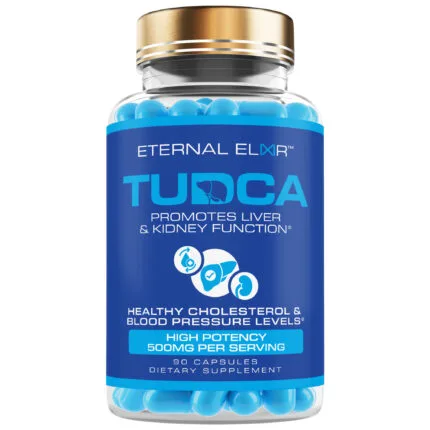
Eternal Elixir makes TUDCA 500mg, and it is our pick for adults starting at the usual dose: one 500 mg capsule a day with a meal, 90 capsules to a bottle, which is three months at that amount.
Table of contents
- 1. TUDCA Dosage at a Glance
- 2. How Much TUDCA Should You Take Per Day?
- 3. When to Take TUDCA: Morning or Night?
- 4. TUDCA Half-Life: How Long Does It Stay in Your System?
- 5. How Long Does It Take for TUDCA to Kick In?
- 6. How Long to Take TUDCA
- 7. What Should You Not Take With TUDCA?
- 8. Who Should Not Take TUDCA
- 9. TUDCA in Australia: Dose per Capsule and Cost (as of Sep 2026)
- 10. Eternal Elixir TUDCA 500mg: What Is in the Bottle
- 11. TUDCA Dosage: Frequently Asked Questions
- 11.1. Should I take TUDCA in the morning or at night?
- 11.2. Should TUDCA be taken before or after a meal?
- 11.3. How much TUDCA should I take a day?
- 11.4. What should I not take with TUDCA?
- 11.5. Is TUDCA hard on the liver?
- 11.6. How long does it take for TUDCA to kick in?
- 11.7. What is the half-life of TUDCA?
- 11.8. Can I take TUDCA and NAC together?
- 11.9. Is TUDCA legal in Australia?
- 11.10. Which TUDCA supplement do we recommend?
- 12. The Bottom Line
- 13. Sources
TUDCA Dosage at a Glance
| Source | Who | TUDCA a day | How it was taken | How long |
|---|---|---|---|---|
| Eternal Elixir label | Healthy adults | 500 mg | 1 capsule with a meal | 90 days per bottle |
| Crosignani et al., 1996 | 24 people with a diagnosed bile duct liver condition | 500, 1,000 or 1,500 mg | Daily amount assigned at random | Six months |
| Ma et al., 2016 | 129 people with a diagnosed bile duct liver condition took TUDCA | 750 mg | 250 mg three times a day | 24 weeks |
| Kars et al., 2010 | 20 adults with a high BMI (average 37) | 1,750 mg | Daily, against placebo | Four weeks |
| Walsh et al., 2016 | 12 healthy young adults | 1,500 mg | A single dose, eight hours before testing | One day |
Two of these trials were in people under specialist care for a liver condition, so they tell you about dose and tolerance, not about what TUDCA does in a healthy adult.
How Much TUDCA Should You Take Per Day?
For a healthy adult, 500 mg a day is the usual starting dose, and it is the amount on our label. The best evidence for where to start comes from the one trial that compared doses. In Milan, 24 people with a diagnosed bile duct liver condition were assigned at random to 500, 1,000 or 1,500 mg of TUDCA a day for six months (Crosignani et al., 1996). Liver enzyme levels fell after the first month at all three doses, and the researchers found no significant difference between the doses, though levels kept falling over time at 1,000 and 1,500 mg. Diarrhoea was the only side effect.
So 500 mg is a tested dose, not a guess. Going higher did not produce a significantly bigger change in that trial, and it is the higher doses where stomach upset is more likely to show up.
Where our 500 mg sits against the trials
To be plain about it: one of our capsules is 500 mg. That matches the lowest dose in the Crosignani trial. It is below the 750 mg a day in the Ma trial and well below the 1,750 mg a day in the Kars trial. If you are reading about results from those higher-dose trials, they came from more TUDCA than one capsule a day. Anyone who wants to go above 500 mg should agree the amount with their GP first.
250 mg or 500 mg capsules?
Several TUDCA products sold in Australia use 250 mg capsules with a label direction of one a day. That is half the usual starting dose. To reach 500 mg you need two capsules, and a 60-capsule bottle then lasts 30 days. Check the milligrams per capsule before you compare prices. Our comparison of the best TUDCA supplements in Australia works through the cost per 500 mg for more brands.
Higher doses you will see online
Doses of 1,000 mg a day or more, which you may see suggested online, come from short trials in specific groups: 1,750 mg a day for four weeks in adults with a high BMI (Kars et al., 2010), and 1,000 to 1,500 mg a day in people under specialist care. None of those trials tested high doses in healthy adults for months on end. More is not better by default, and higher doses are where the gut side effects show up.
When to Take TUDCA: Morning or Night?
We found no trial that compared morning with night, so any source that says one time of day works better is going beyond the evidence. What we do know gives a simple rule: take it with a meal, and take it at the same meal each day.
The reasoning is practical. TUDCA is a bile acid, and your gallbladder releases bile when you eat. In a small Italian study, a single 10 mg per kg dose of TUDCA did not change how the gallbladder emptied after a meal in healthy people (Portincasa et al., 1996), so a dose does not appear to disrupt that normal pattern. Pairing the capsule with a meal also gives you an anchor, which makes it easier not to miss a day.
Best time to take TUDCA: pick your anchor meal
- Breakfast suits people who take their other supplements in the morning and eat a proper breakfast.
- Dinner suits people who skip breakfast or whose largest meal is in the evening.
- Lunch works just as well if that is your most regular meal.
Pick one and stay with it for at least eight weeks before you judge anything.
Can you take TUDCA at night?
Yes. Taking it with your evening meal is as reasonable as taking it at breakfast, and there is no human data showing it disturbs sleep or works less well at night. If your dinner is your biggest meal, it is a sensible choice.
TUDCA before or after a meal?
With the meal, or just after the first few bites. Our label says one capsule daily with a meal, and so does the label on Zombie Labs TUDCA. The Emrald Labs listing adds that some people get nausea, stomach discomfort, diarrhoea or bloating, particularly when TUDCA is taken on an empty stomach. Some brands, such as Nutricost, just say to take it with water. If an empty stomach suits you, that is fine, but food is the safer default for a sensitive stomach.
Splitting a larger dose
If your doctor suggests more than 500 mg a day, split it across meals. The Ma trial gave 250 mg three times a day for 24 weeks, and drug-related side effects were reported in just 4 of 129 people on TUDCA (3.1%) (Ma et al., 2016). A split dose with meals is the pattern with the most tolerance data behind it.
TUDCA Half-Life: How Long Does It Stay in Your System?
We could not find a published blood half-life for oral TUDCA in people. Figures you see online are guesses or borrowed from other bile acids.
The closest data comes from animals. Before their trial, the Walsh team gave TUDCA to three rhesus monkeys and found blood levels peaked about eight hours after a dose and were back to baseline at around 24 hours (Walsh et al., 2016). That is three monkeys, not people, so treat it as a hint and no more. The researchers then gave 12 healthy young adults 1,500 mg eight hours before testing.
The human evidence shows where TUDCA goes. In the Crosignani trial, bile acids of the UDCA type (TUDCA’s parent compound) made up 15% to 48% of the bile acids measured in bile during treatment, and that share did not depend on the dose. In other words, TUDCA joins your own bile acid pool rather than passing straight through. That is the main reason daily dosing matters more than the exact hour.
How Long Does It Take for TUDCA to Kick In?
TUDCA is not a stimulant, and you should not expect to feel it the same day. The trials measured changes over weeks:
- Four weeks: the Kars trial measured its results after four weeks at 1,750 mg a day.
- One month: in the Crosignani trial, liver enzyme levels had fallen by the first monthly check at every dose, in people with a diagnosed liver condition.
- 24 weeks: the Ma trial ran for 24 weeks at 750 mg a day.
None of these trials asked healthy people how they felt, so there is no evidence-based answer to “when will I notice it”. If you want an objective marker, ask your GP about a blood test before you start and another after about three months. Our guide to the benefits of TUDCA covers what the research has and has not shown.
How Long to Take TUDCA
The human trials ran from four weeks to six months. There is no trial data on healthy adults taking TUDCA for years, so any claim that it is fine forever, or that you must stop after a set number of weeks, goes beyond the evidence.
A sensible approach:
- Take 500 mg a day with a meal for about three months. One of our 90-capsule bottles covers that.
- Review with your GP at that point, ideally with a blood test to compare against your starting one.
- If you continue, keep to the label dose and check in with your GP at least once a year.
What Should You Not Take With TUDCA?
- Bile acid binders. Cholestyramine and colestipol bind bile acids in the gut. The prescribing information for UDCA, TUDCA’s parent compound, warns they can reduce its absorption (ursodiol prescribing information). The same caution makes sense for TUDCA, so ask your pharmacist how to space them if you take one.
- Aluminium-based antacids. The same document notes these bind bile acids in laboratory tests and may interfere in the same way.
- Prescribed UDCA. Do not add TUDCA to UDCA your doctor has prescribed without asking them first. You would be doubling up on closely related compounds.
- Any regular prescription medicine. Check with your pharmacist before you start, and bring the bottle.
Best time to take TUDCA and NAC
We found no human trial that tested TUDCA and NAC (N-acetylcysteine) together, so there is no evidence-based combined dose or timing. If you take both, taking them at the same meal is the simplest routine, and your pharmacist can check the pair against anything else you take. Our comparison of glutathione and NAC covers NAC in more detail.
TUDCA with berberine or milk thistle
People often take TUDCA alongside berberine or milk thistle. We found no human trial of either pairing with TUDCA. If you want TUDCA, berberine and glutathione together, our Metabolic Wellness Stack already includes a bottle of TUDCA 500mg, so you do not need a separate one. Berberine has interactions of its own, covered in our Berberine HCl 500mg page and our berberine dosage guide. For milk thistle, see our TUDCA versus milk thistle comparison.
Who Should Not Take TUDCA
- Pregnant or breastfeeding women. TUDCA has not been studied for this, and several brands, including Emrald Labs, say not to use it while pregnant or nursing.
- Anyone under 18. The trials were in adults, and brand labels restrict it to adults.
- Anyone with a blocked bile duct, gallstones or gallbladder symptoms. Talk to your doctor first. In the Portincasa study, a month of TUDCA increased fasting gallbladder volume in people with gallstones.
- Anyone under a specialist for a liver condition. Do not add TUDCA without your specialist, particularly if you already take UDCA.
- Anyone on bile acid binders or several prescription medicines. Ask your pharmacist first.
For what to expect once you start, see our guide to TUDCA side effects in Australia, and for signs that it is worth a conversation with your GP, see signs your liver needs support.
TUDCA in Australia: Dose per Capsule and Cost (as of Sep 2026)
Since 500 mg a day is the usual dose, the fairest comparison is the cost of 500 mg and how long a bottle lasts at that amount. We took each price, capsule strength and direction from the seller’s page in September 2026.
| Product | Price (AUD, as of Sep 2026) | Capsules | TUDCA per capsule | Label direction | Days at 500 mg a day | Cost per 500 mg | Buy |
|---|---|---|---|---|---|---|---|
| Eternal Elixir TUDCA 500mg (our pick) | $59.99 | 90 | 500 mg | 1 a day with a meal | 90 | $0.67 | View product |
| OHC Longevity TUDCA | $89.99 | 60 | 500 mg | 1 a day (two-month supply) | 60 | $1.50 | OHC Longevity |
| Nutricost TUDCA 500mg (iHerb AU) | $48.99 | 30 | 500 mg | 1 a day with water | 30 | $1.63 | iHerb AU |
| Emrald Labs TUDCA (Elite Supps) | $49.90 | 60 | 250 mg | 1 a day with water | 30 | $1.66 | Elite Supps |
| Zombie Labs TUDCA (Nutrition Warehouse) | $59.95 | 60 | 250 mg | 1 a day with food | 30 | $2.00 | Nutrition Warehouse |
Who each one suits, and who it doesn’t
- Eternal Elixir TUDCA 500mg (our pick). Suits adults taking the usual 500 mg a day who want one capsule per day and a three-month bottle shipped from Sydney. It does not suit someone who wants a lower dose than 500 mg, because the capsules are not split into smaller amounts.
- OHC Longevity TUDCA. Suits buyers who want a 500 mg vegan capsule from an Australian store. At $1.50 per 500 mg it costs more than twice as much per dose as ours.
- Nutricost TUDCA 500mg. Suits someone who already orders from iHerb and wants a small 30-day bottle to try. It uses a gelatine capsule, so it does not suit vegetarians.
- Emrald Labs TUDCA. Suits someone who wants 250 mg a day, below the usual dose. At 500 mg a day, a bottle lasts 30 days.
- Zombie Labs TUDCA. Suits Nutrition Warehouse shoppers who want a vegetable-cellulose capsule and a label that says to take it with food. It has the highest cost per 500 mg here.
Eternal Elixir TUDCA 500mg: What Is in the Bottle
- TUDCA (tauroursodeoxycholic acid), 500 mg per vegetarian capsule.
- 90 capsules per bottle, which is 90 days at one a day.
- Label directions: one capsule daily with a meal.
- $59.99 a bottle, or $0.67 a day. Two bottles cost $107.98 (10% off), three cost $152.97 (15% off), and five cost $239.96 (20% off).
- Ships from Sydney within 24 hours, with free shipping over $100, a 30-day money-back guarantee and Afterpay.
One capsule gives you the usual starting dose with nothing to split or double up. The label serve is one capsule a day with a meal. If you think you need more, check the label and ask your doctor first. If you would rather buy TUDCA with berberine and glutathione, the Metabolic Wellness Stack costs $126.99 and saves $22.98 against buying the three bottles separately. It already contains TUDCA, so do not add a separate TUDCA bottle on top.
Add TUDCA 500mg to cart · $59.99If you are building a wider routine, the dosing guides for NMN and glutathione follow the same approach, and the Eternal Elixir shop lists the full range.
TUDCA Dosage: Frequently Asked Questions
Should I take TUDCA in the morning or at night?
Either works. We found no trial that compared the two. Take it with a meal, and use the same meal every day so you do not miss doses. If your main meal is dinner, take it then.
Should TUDCA be taken before or after a meal?
With the meal. Our label says one capsule daily with a meal, and one brand notes that stomach upset is more likely on an empty stomach. If you take it without food and feel fine, that is also acceptable.
How much TUDCA should I take a day?
500 mg a day is the usual starting dose for a healthy adult. It is the lowest dose tested in the only trial that compared doses, and higher doses did not produce a significantly bigger change in that trial. Agree anything above 500 mg with your GP.
What should I not take with TUDCA?
Bile acid binders such as cholestyramine and colestipol, and aluminium-based antacids, can bind bile acids and reduce absorption. Do not add TUDCA to prescribed UDCA without your doctor. If you take any regular medicine, ask your pharmacist first.
Is TUDCA hard on the liver?
The trials did not suggest so. In a 24-week trial of 750 mg a day, drug-related side effects were reported in 3.1% of people on TUDCA, and in a six-month dose trial diarrhoea was the only side effect. If you have a liver condition, only take TUDCA with your specialist’s agreement.
How long does it take for TUDCA to kick in?
Trials measured changes after four weeks to six months, not days. There is no human data on how quickly healthy people notice anything, so give it about three months at a steady dose and review with your GP.
What is the half-life of TUDCA?
No published study we found gives a blood half-life for oral TUDCA in people. A pilot in three monkeys found blood levels peaked about eight hours after a dose and returned to baseline around 24 hours, but that has not been measured in humans.
Can I take TUDCA and NAC together?
We found no human trial of the pair, so there is no evidence-based combined dose. If your pharmacist is happy with both, taking them at the same meal is the simplest routine.
Is TUDCA legal in Australia?
Yes. TUDCA is sold as a supplement in Australia through online stores and sports nutrition retailers such as Nutrition Warehouse. Its close relative UDCA is a prescription medicine. Our article on whether TUDCA is legal in Australia and where to buy it covers the details.
Which TUDCA supplement do we recommend?
Our pick is Eternal Elixir TUDCA 500mg, which we make: one 500 mg capsule a day, 90 capsules for $59.99, which works out at $0.67 per 500 mg, the lowest cost per dose in our table. OHC Longevity also sells a 500 mg vegan capsule in Australia, at $1.50 per dose.
Add TUDCA 500mg to cart · $59.99
The Bottom Line
Take 500 mg of TUDCA a day with a meal, at the same meal each day, and review after about three months with your GP. Morning or night makes no proven difference. Keep it away from bile acid binders and aluminium antacids, and skip it in pregnancy or if you are under 18. One of our capsules is exactly that starting dose, and a bottle lasts three months at $0.67 a day. For how TUDCA compares with its parent compound, read our TUDCA versus UDCA breakdown.
Sources
- Crosignani A, Battezzati PM, Setchell KD, et al. Tauroursodeoxycholic acid for treatment of primary biliary cirrhosis. A dose-response study. Dig Dis Sci. 1996;41(4):809-815. PubMed 8674405
- Ma H, Zeng M, Han Y, et al. A multicenter, randomized, double-blind trial comparing the efficacy and safety of TUDCA and UDCA in Chinese patients with primary biliary cholangitis. Medicine (Baltimore). 2016;95(47):e5391. PubMed 27893675
- Kars M, Yang L, Gregor MF, et al. Tauroursodeoxycholic acid may improve liver and muscle but not adipose tissue insulin sensitivity in obese men and women. Diabetes. 2010;59(8):1899-1905. PubMed 20522594
- Walsh LK, Restaino RM, Neuringer M, Manrique C, Padilla J. Administration of tauroursodeoxycholic acid prevents endothelial dysfunction caused by an oral glucose load. Clin Sci (Lond). 2016;130(21):1881-1888. PubMed 27503949
- Portincasa P, DiCiaula A, Palmieri V, et al. Tauroursodeoxycholic acid, ursodeoxycholic acid and gallbladder motility in gallstone patients and healthy subjects. Ital J Gastroenterol. 1996;28(2):111-113. PubMed 8782006
- Ursodiol capsule prescribing information, drug interactions section. DailyMed
- Product labels and prices: Eternal Elixir TUDCA 500mg, OHC Longevity TUDCA, Nutricost TUDCA 500mg, Emrald Labs TUDCA and Zombie Labs TUDCA, checked September 2026.