Last updated: October 5, 2026 · By Eternal Elixir Editorial
Saffron benefits for female health have been tested in a small set of placebo-controlled trials, and the clearest signal is for mood: in the week before a period, during perimenopause, and in women aged 50 to 70 with low mood. The evidence for hot flushes, sleep disturbance and skin is weaker, and in two cases it came back flat.
This guide sorts that research by life stage, shows what each trial measured and what it did not, and explains how to take saffron if you want to try it. For the full brand comparison, see our guide to the best saffron supplements in Australia.
Key takeaways
- The best-supported saffron benefits for female health relate to mood: premenstrual mood symptoms, psychological symptoms in perimenopause, and low mood in women aged 50 to 70.
- Trials used about 28 to 30 mg of saffron extract a day for two menstrual cycles or 12 weeks. Hot flushes, night sweats and facial skin age did not improve more than placebo.
- Saffron is not for pregnancy or breastfeeding. Ask your doctor first if you take mood medication.
Table of contents
Saffron Benefits for Female Health at a Glance
Saffron is the dried stigma of the Crocus sativus flower. Supplement research uses concentrated extracts, measured in milligrams, rather than the threads you cook with. Most studies in women have looked at one question: does a daily extract shift mood-related symptoms more than a placebo capsule does?
The answer so far is a cautious yes for mood, across three different stages of life. The same studies also tracked physical outcomes, such as hot flushes and skin, and those did not move more than placebo. That split matters if you are deciding whether saffron fits your situation.
Two of the four sources below were run by the same Perth research group and funded by the maker of affron®, the extract used in Eternal Elixir capsules. The authors declared it, and we think you should know it too. The earlier premenstrual trial was run independently in Iran.
The Evidence by Life Stage
Here is every placebo-controlled study we verified for this guide, grouped by the stage of life it tested. The last column is the one most articles leave out.
| Life stage | Study | Daily dose and length | What improved | What did not |
|---|---|---|---|---|
| Cycle years (women 20 to 45) | Agha-Hosseini 2008, BJOG | 30 mg (15 mg morning and evening) over two menstrual cycles | Total premenstrual daily symptom score and a clinician mood rating, compared with placebo | Not reported in the abstract; a single small trial using a generic extract |
| Cycle years (pooled trials) | Mohammadi and Karimi 2026, Korean Journal of Family Medicine | Varied across the pooled randomised trials | Premenstrual symptoms (standardised mean difference −0.64) | Period pain improved less, and the confidence interval almost touched zero |
| Perimenopause | Lopresti and Smith 2021, Journal of Menopausal Medicine | affron® 14 mg twice a day for 12 weeks (86 women) | Psychological symptom score; anxiety score down 33% and low-mood score down 32% from baseline | Hot flushes and night sweats, physical symptoms, general quality of life |
| Women aged 50 to 70 with low mood and poor sleep | Lopresti and Smith 2026, Frontiers in Nutrition | affron® 28 mg a day for 12 weeks (86 women) | Low-mood score; self-esteem and sleep-related daytime impairment (exploratory) | Sleep disturbance, self-rated appearance, estimated facial skin age |
Read the table as a map, not a scorecard. Each row is one study, most with fewer than 100 women, and the trials used different extracts, scales and durations. The pattern across them is consistent enough to take seriously and too thin to call settled.
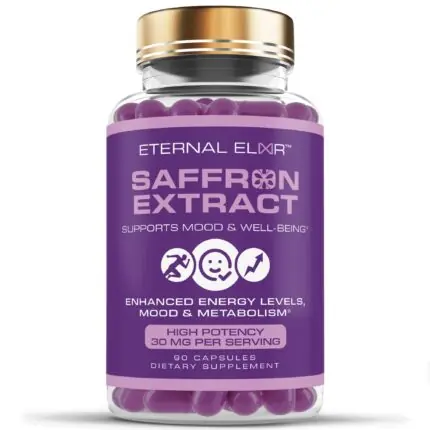
Trying saffron in Australia? Eternal Elixir’s Saffron Extract 30mg ships locally with 90 capsules per bottle — twice the value of most competitors. Browse the longevity range →
Premenstrual Symptoms: What the Cycle Trials Tested
The 2008 trial
In a double-blind trial published in BJOG, women aged 20 to 45 with regular cycles and at least six months of premenstrual symptoms took 15 mg of saffron twice a day, or a placebo, across two menstrual cycles. Total premenstrual daily symptom scores and a clinician-rated mood scale both improved more in the saffron group.
It was one small study using a generic saffron extract, so it opened the question rather than closed it.
The 2026 meta-analysis
A 2026 systematic review and meta-analysis in the Korean Journal of Family Medicine pooled the randomised trials on saffron for premenstrual symptoms and period pain. The pooled effect on premenstrual symptoms was moderate (a standardised mean difference of −0.64). The effect on period pain was smaller, and its confidence interval ran from −1.01 to −0.01, which puts it close to no effect at all.
The two-cycle rule
Premenstrual symptoms rise and fall with your cycle, so a week of saffron tells you very little. The trial judged results across two full cycles. If you try it, take one capsule daily rather than only in the premenstrual week, and score your mood, tension and bloating each day of that week for two cycles in a row. Compare those scores with a cycle before you started. That gives you a fair test of your own.
Perimenopause and Women Aged 50 to 70
The 2021 perimenopause trial in the Journal of Menopausal Medicine gave 86 perimenopausal women 14 mg of affron® twice a day, or a placebo, for 12 weeks. The psychological part of the Greene Climacteric Scale improved more on saffron, with the anxiety score falling 33% and the low-mood score 32% from baseline. Hot flushes, night sweats, physical symptoms and general quality of life did not improve more than placebo.
The 2026 trial in Frontiers in Nutrition enrolled 86 women aged 50 to 70 with low mood and poor sleep, on 28 mg of affron® a day for 12 weeks. Low-mood scores on the DASS-21 scale fell further than on placebo, and 48.8% of the saffron group reached a clinically meaningful improvement against 25.6% on placebo. Self-esteem and sleep-related daytime impairment also improved, though the authors called those findings exploratory.
Sleep disturbance itself did not change, and neither did self-rated appearance or an AI-estimated facial skin age. If sleep is your main goal, our breakdown of saffron for sleep covers the dedicated sleep trials, which are more mixed.
So for women in midlife, the research points to saffron as a possible mood support, not a remedy for the physical side of menopause. If hot flushes are the main problem, these trials give you no reason to expect saffron to help with them.
Some women in this age group are building a wider longevity routine at the same time. That is a different goal from mood, and Eternal Elixir makes a separate product for it, NMN 500mg capsules, aimed at NAD+ support rather than anything saffron was tested for.
How Women Can Take Saffron: Dose, Timing and Cost
The trials above used 28 to 30 mg of extract a day, taken either as one dose or split morning and evening. Eternal Elixir Saffron Extract 30mg gives 30 mg of affron® in one capsule, so a single capsule with a meal matches the daily amount studied. Our explainer on affron® standardisation covers why a measured extract matters more than the milligram number on a cheaper label.
A bottle of Eternal Elixir saffron costs $49.99 for 90 capsules, which works out to about 56 cents a day and lasts three months. That length lines up with the 12-week trials, so one bottle is enough for a fair trial of your own.
Saffron adds no magnesium, so it sits easily beside a magnesium routine. Women who want an evening option alongside it often look at magnesium L-threonate for sleep, which works through a different pathway. Try one new supplement at a time so you can tell which one is doing the work.
Who should skip saffron or ask first
- Pregnant or breastfeeding women. Saffron extract has not been studied for this, and our label says not to use it.
- Anyone on prescription medicine for mood. Saffron appears to act on similar brain chemicals, so check with your doctor before combining them.
- Women with a diagnosed condition or symptoms that disrupt daily life. Severe premenstrual or menopausal symptoms deserve a proper assessment with your GP before you try a supplement.
- Anyone planning much higher amounts. Side effects become more likely well above the trial dose, with no evidence of extra benefit.
At 28 to 30 mg a day, side effects in the trials were mild and similar to placebo. Order a bottle only once you have checked the points above, and see our general guide to saffron supplement benefits for the research on stress and sleep in mixed groups.
Saffron Benefits for Female Health: Your Questions
What happens when you take saffron every day?
In the trials, women took saffron extract daily for two menstrual cycles or 12 weeks, and the changes they reported built up gradually rather than appearing overnight. Side effects were similar to placebo at 28 to 30 mg a day. Daily use at that dose is what the research supports; much larger amounts have not been shown to work better.
Does saffron make you look younger?
The 2026 Perth trial in women aged 50 to 70 measured this directly with an AI-based facial skin age estimate and a self-rated appearance score. Neither differed from placebo after 12 weeks. Saffron may support mood and self-esteem, but there is no trial evidence that it changes how old your skin looks.
What should you not mix saffron with?
Talk to your doctor before combining saffron with prescription medicines for mood, because saffron appears to act on the same brain chemicals. Our label also says not to use it during pregnancy or breastfeeding. Our guide to saffron supplement side effects and interactions lists the other cautions.
Which is the best way to consume saffron?
For the effects studied in women, a standardised extract capsule is the most practical route, because the trials used 28 to 30 mg of a measured extract. Cooking saffron delivers an unknown and usually much smaller amount of the active compounds. Eternal Elixir’s capsule gives 30 mg of affron®, so one with a meal at the same time each day matches the trials.
How long does saffron take to work for premenstrual symptoms?
The premenstrual trial judged results over two full menstrual cycles, so give it at least that long and keep a short daily symptom note in the week before each period. If nothing has shifted after two cycles, saffron may not be the right fit for you. The five mood trials showed a similar slow build over four to twelve weeks.
Ready to start your longevity stack?
90 capsules per bottle · Australian shipping · Third-party tested
Shop Eternal Elixir →Related reading
Recommended for you
About Eternal Elixir
Eternal Elixir is an Australian supplement company specialising in longevity and nootropic formulations. All products are third-party tested for purity, manufactured under strict quality controls, and designed for Australians who take their health seriously. Browse the full range at the Eternal Elixir shop.
Sources
- Agha-Hosseini M, et al. Crocus sativus L. (saffron) in the treatment of premenstrual syndrome: a double-blind, randomised and placebo-controlled trial. BJOG: an international journal of obstetrics and gynaecology. 2008. PMID 18271889
- Mohammadi MM, Karimi Z. Effect of saffron on premenstrual syndrome and dysmenorrhea: a systematic review and meta-analysis. Korean Journal of Family Medicine. 2026. PMID 41151539
- Lopresti AL, Smith SJ. The effects of a saffron extract (affron®) on menopausal symptoms in women during perimenopause. Journal of Menopausal Medicine. 2021. PMID 34463070
- Lopresti AL, Smith SJ. The effects of a saffron extract (Affron®) on mood, sleep, self-esteem, and exploratory measures of physical appearance in women aged 50 to 70 years. Frontiers in Nutrition. 2026. PMID 42389708