Last updated: September 14, 2026 · By Eternal Elixir Editorial
Someone in an ADHD forum mentions saffron, a GP in Melbourne brings it up as a “maybe worth a look”, and within a week the phrase saffron for ADHD is sitting in your search history alongside four contradictory blog posts. Australian search interest in it has climbed roughly 175% over the past year. That is a lot of attention for one research area. As of September 2026 it rests on four human trials and a grand total of 118 participants.
This page does something the louder ones do not. It lays out every published trial side by side. It states what each one measured, and marks the gaps where the data is not there. Eternal Elixir sells a standardised saffron extract in Australia, and we will say where it fits.
The evidence comes first though. It is more modest than the headlines suggest. If you are after the broader picture rather than the ADHD-specific question, start with our guide to what saffron supplements actually do.
Saffron for ADHD has been tested in four small human trials totalling 118 people. Standardised extract at 20–30 mg daily showed benefit for hyperactivity and sleep, but not for inattention. It is not a proven treatment or a medication replacement.
Key takeaways
- Saffron for ADHD rests on four small human trials — 118 participants in total, none longer than six weeks.
- Trials used 20–30 mg per day of standardised saffron extract, not culinary saffron threads.
- The signal is strongest for hyperactivity and sleep onset; methylphenidate outperformed saffron on inattention.
- Most of the data is paediatric. The single adult trial studied saffron added to existing stimulant medication, not instead of it.
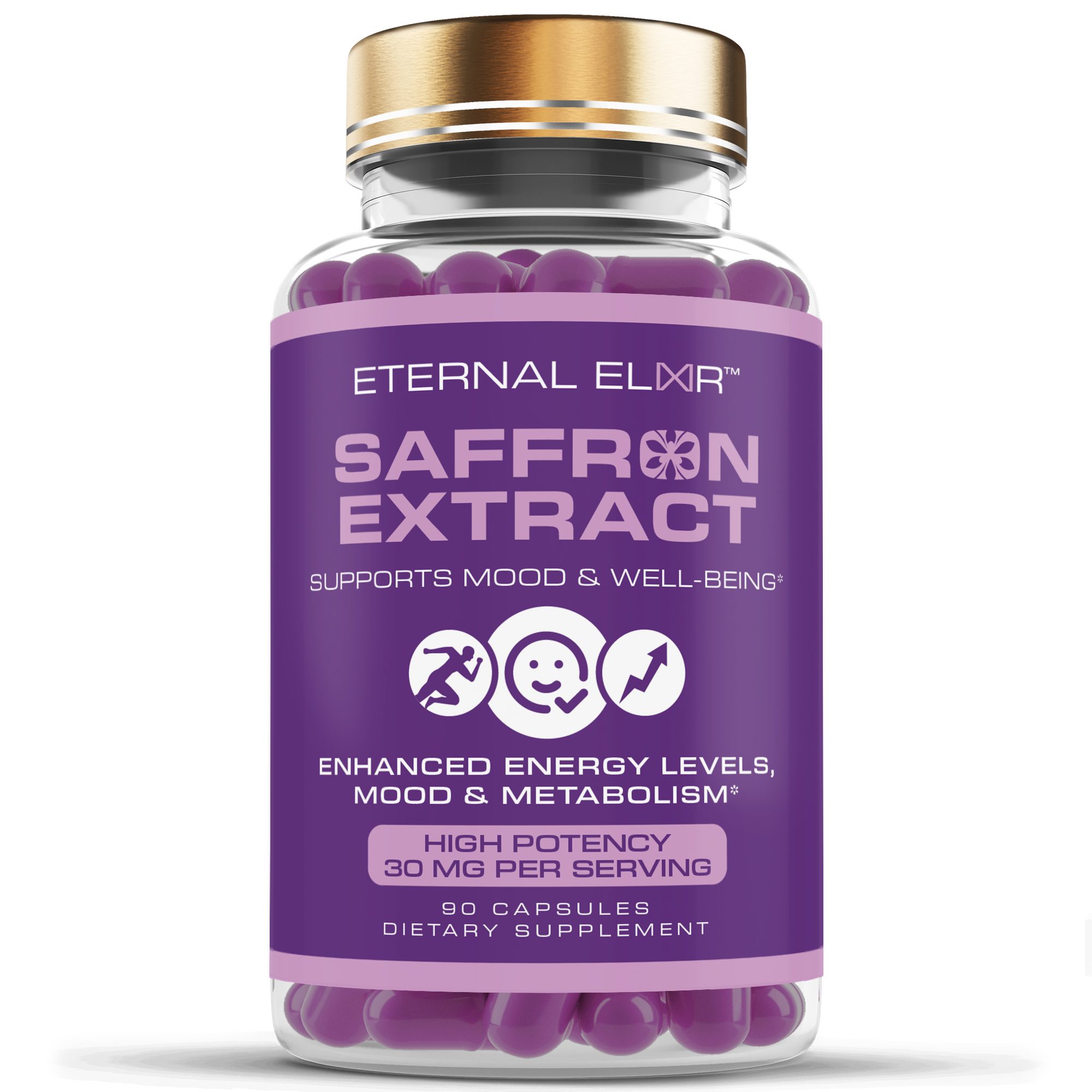
- Eternal Elixir’s affron® saffron extract delivers 30 mg per capsule. It is sold in Australia for general mood and well-being support, not as an ADHD product.
Table of contents
- 1. Saffron for ADHD: What the Human Trials Actually Found
- 2. The Whole Evidence Base Is 118 People
- 3. Dose and Standardisation: Why “Saffron 30 mg” Means Three Different Things
- 4. Saffron for ADHD in Adults and Children: Where the Evidence Splits
- 5. Safety, Interactions and Who Should Not Start
- 6. Saffron for ADHD: Your Questions Answered
Saffron for ADHD: What the Human Trials Actually Found
Four studies.
That is the entire clinical picture.
Two were run in children and adolescents, one in adults, and the fourth is a systematic review that pooled the others.
Reading them in order tells a more useful story than any single headline.
| Trial | Who it studied | Design | Saffron dose | Length | What it reported |
|---|---|---|---|---|---|
| Baziar 2019, Journal of Child and Adolescent Psychopharmacology | 54 children and teens aged 6–17 (50 completed) | Randomised, double-blind, active comparator | 20–30 mg/day, by body weight | 6 weeks | No statistically significant difference from methylphenidate on parent or teacher ADHD rating scales; side-effect frequency similar in both groups |
| Blasco-Fontecilla 2022, Nutrients | 63 children and adolescents aged 7–17 (36 saffron, 27 medication) | Non-randomised clinical effectivity study | Not specified in the published abstract | Not specified in the published abstract | Saffron broadly comparable overall; better for hyperactivity, while methylphenidate was better for inattention |
| Pazoki 2022, Advances in Integrative Medicine | Adults with ADHD | Randomised, double-blind, placebo-controlled; saffron added to existing stimulant treatment | Not stated in the indexed record | Not stated in the indexed record | Reported a benefit from saffron used as an add-on rather than a replacement |
| Seyedi-Sahebari 2024, Journal of Attention Disorders | Pooled: 4 trials, 118 patients in total | Systematic review | — | — | A consistent signal of benefit, as an adjuvant or on its own, without significant safety issues; explicitly calls for larger multicentre trials |
Baziar 2019: saffron matched methylphenidate over six weeks
The most-quoted trial randomised 54 children and teens aged 6 to 17 to either methylphenidate or saffron capsules. The dose was set by weight: 20 mg daily under 30 kg, and 30 mg daily above it.
Over six weeks, the research team found no significant difference between the groups. That held on both the parent and the teacher version of the ADHD rating scale. Adverse effects occurred at a similar rate in both arms.
The authors were careful about what that means. They concluded that short-term saffron therapy showed the same efficacy as methylphenidate, while calling for larger studies over longer periods. The full trial is published in the Journal of Child and Adolescent Psychopharmacology.
One detail gets lost in the retelling. “no significant difference” in a 54-person pilot is not the same as “just as good” . A trial that small can miss a real difference, simply because it lacks the power to detect one.
Blasco-Fontecilla 2022: better for hyperactivity, weaker for inattention
The Nutrients study compared a saffron extract against methylphenidate in 63 children and adolescents aged 7 to 17, using objective and pen-and-paper tests. This one was not randomised — a meaningful limitation — and its finding is the most specific in the literature: saffron was more effective for hyperactivity symptoms, while methylphenidate was more effective for inattention. The paper is freely available through the NIH.
That split matters. ADHD is not one symptom. A compound that nudges hyperactivity and sleep onset, while leaving focus largely untouched, is a different thing from one that helps across the board. Anyone searching for saffron because concentration is the problem should read that sentence twice.
The adult trial almost nobody cites
Three of the four studies are paediatric, which makes the fourth disproportionately important for the adults doing most of the searching. Pazoki and colleagues ran a randomised, double-blind, placebo-controlled trial in adults with ADHD, published in Advances in Integrative Medicine in 2022, testing saffron as an addition to existing stimulant treatment rather than as a replacement for it.
The reported direction was positive. The dosing and duration are not stated in the indexed record we could verify, so we are not going to invent them. The design itself is the point. Even the adult evidence describes saffron as something added alongside prescribed treatment.
The Whole Evidence Base Is 118 People
The 2024 systematic review in the Journal of Attention Disorders assessed every eligible clinical trial of saffron in ADHD, applied formal risk-of-bias tools, and found four studies with 118 patients between them. Its conclusion was a signal of benefit, as either an add-on to stimulant medication or a standalone, without significant safety issues. That was followed at once by a call for well-designed multicentre studies. The review is indexed on PubMed.
Key numbers:
- 4 — human clinical trials of saffron in ADHD indexed as of September 2026
- 118 — total participants across all of them combined
- 6 weeks — the longest ADHD trial duration published
- 20–30 mg/day — the standardised extract dose used across the paediatric trials
- 1 — trials conducted in adults
- 0 — trials testing saffron as a replacement for prescribed ADHD medication in adults
A single modern stimulant trial routinely enrols more people than the entire saffron-and-ADHD literature. That is not an argument that saffron does nothing — it is an argument for calibrating expectations to the size of the evidence, the same discipline we apply across the Australian nootropics landscape.
Skip the comparison shopping: Saffron Extract 30mg with affron® from Eternal Elixir ships locally in Australia with 90 capsules per bottle — twice the value of most competitors. Browse the longevity range →
Dose and Standardisation: Why “Saffron 30 mg” Means Three Different Things
This is where most of the practical confusion lives, and where the trials are unusually clear.
What the trials actually used
Every ADHD trial used a standardised extract — a concentrated preparation with a measured level of active constituents such as crocin and safranal — at 20 to 30 mg per day. Culinary saffron threads are not the same material and were not what was tested. Nor were the doses large: 30 mg is a small capsule, and going higher is not supported by anything in the ADHD literature.
Reading an Australian label
Walk into any Australian pharmacy and you will find three different things sold as “saffron”:
- A named, standardised extract at the studied dose — typically 28–30 mg, with the standardisation stated on the label. This is the closest match to the trial material.
- A higher milligram figure of unstandardised powder — 88 mg or 50 mg of saffron that is not concentrated to a specified active level. A bigger number on the front does not mean more of what was studied.
- A multi-ingredient blend — saffron plus magnesium, zinc or B vitamins, where the saffron portion is often well under the studied amount and rarely disclosed separately.
Eternal Elixir’s saffron extract uses affron® standardised to 3.5% Lepticrosalides at 30 mg per capsule.
That is the same concentrated form used in the clinical literature. One capsule daily, 90 capsules per bottle at $49.99, works out at about $0.56 per daily serve.
If you want to try saffron at the studied dose without decoding a label, that is the shortest route — View Eternal Elixir Saffron Extract 30mg.
If you want the full Australian shelf compared on standardisation and cost, our guide to the best saffron supplements in Australia ranks eight of them, and our comparison of saffron supplements for attention and focus narrows it to the products that actually hit the studied dose.
Saffron for ADHD in Adults and Children: Where the Evidence Splits
Almost every popular article on saffron for ADHD quietly blends paediatric and adult findings into one story. They are not one story.
In children and adolescents, there are two trials, both comparing saffron against methylphenidate, both six weeks or less, one of them not randomised. This is the bulk of the data — and it is also the population where self-directed supplementation is least appropriate. If the question concerns a child, it belongs with a paediatrician or the clinician managing their care, not a supplement aisle.
In adults, there is one placebo-controlled trial, and it tested saffron alongside stimulant medication. There is no published adult trial of saffron instead of medication. Anyone framing saffron as a natural swap for adults is describing a study that has not been done.
The adult evidence does support saffron’s better-established territory. That is mood, stress and sleep quality, where the trial base is larger and longer than anything in ADHD. Several people who arrive at saffron through attention-related searching are really dealing with a sleep or stress problem sitting underneath it. That is a more realistic target.
We cover that literature in detail in our breakdown of what saffron supplements actually do for mood, sleep and stress. The same logic applies to magnesium L-threonate and its sleep-quality research, which is often a better-evidenced starting point for the “I can’t switch off, so I can’t focus” pattern.
Safety, Interactions and Who Should Not Start
Across the trials, saffron at 20–30 mg daily was well tolerated. Adverse effects came in at a similar rate to the comparison groups. The systematic review flagged no safety problems. The common complaints were mild: appetite changes, headache, drowsiness, occasional nausea.
The caveats worth taking seriously:
- Dose discipline. The safety record belongs to 20–30 mg per day of standardised extract. High doses of saffron are described as toxic in the literature, so “more must be better” is the wrong instinct here.
- Prescribed medication. If you take stimulants, antidepressants or anticoagulants, talk to your prescriber or pharmacist before adding saffron. The adult trial gave saffron alongside medication under supervision — that supervision was part of the design.
- Pregnancy. Saffron at supplemental doses is not appropriate during pregnancy.
- Children. Despite most of the trial data being paediatric, decisions about a child’s ADHD care should be made with their clinician. This guide is written for Australian adults making decisions for themselves.
- Duration. Nothing published follows saffron use beyond about twelve weeks, so long-term daily use is genuinely unstudied rather than reassuringly safe.
Saffron is not a treatment for ADHD. Nothing here is a reason to change, reduce or stop medication that has been prescribed to you.
Saffron for ADHD: Your Questions Answered
Is saffron scientifically proven to help ADHD?
No. “Proven” is the wrong word for an evidence base of four small trials and 118 people. The systematic review in the Journal of Attention Disorders describes a promising signal with an acceptable safety profile, and then calls for larger multicentre studies — which is a long way from proof.
Saffron for ADHD is an early research topic, not an established option, and it is not a substitute for treatment your prescriber has recommended.
How long does saffron take to help ADHD?
The ADHD trials ran for six weeks and measured outcomes at week three and week six. Six weeks is the honest window the published data covers. Nothing in the literature supports a same-day or same-week effect.
Nothing covers what happens beyond a couple of months either. The longest ADHD trial is six weeks. If you are trialling saffron as an adult, give it the full six weeks. Track one or two specific things, rather than a general sense of “better”.
What are the negative side effects of saffron?
In the trials, side effects were mild. They occurred at roughly the same rate as in the comparison groups: mostly appetite changes, headache, drowsiness or nausea.
High doses are a different matter. The studied range is 20–30 mg of standardised extract per day.
Toxicity is described in the literature at doses many times above that. Staying at the studied dose is the sensible boundary. Tolerability in the mood and sleep literature, where trials ran longer, looks much the same.
What should you not mix saffron with?
The interaction that matters most in an ADHD context is prescription medication — stimulants, antidepressants and blood thinners in particular. Saffron has been studied as an add-on to stimulant medication in adults.
But “studied in a trial” is not the same as “safe to add at home without telling anyone”. If you take anything prescribed, the correct order is to speak to your prescriber or pharmacist first, then decide.
Is it bad to take saffron every day?
Daily use at 20–30 mg of standardised extract is exactly what the trials did, for six to twelve weeks, without significant safety problems. No study has looked at multi-year daily use. The honest answer is that daily dosing is well tolerated over the studied period, and unknown beyond it.
Pregnancy is the clear exception — saffron is not appropriate during pregnancy at supplemental doses. If you are checking whether a product even reaches the studied amount before committing to daily use, we list which Australian saffron supplements actually hit 28–30 mg per serve.
Build your longevity stack locally
Third-party tested · 90 capsules per bottle · Australian shipping
Shop Eternal Elixir →Recommended for you
About Eternal Elixir
Eternal Elixir is an Australian supplement company specialising in longevity and nootropic formulations. All products are third-party tested for purity, manufactured under strict quality controls, and designed for Australians who take their health seriously.
Browse the full range at eternalelixir.com.au/shop.