Last updated: September 11, 2026 · By Eternal Elixir Editorial
You have probably met saffron three times this month without going looking for it: on a mood-support box at the chemist, inside a gummy aimed at stressed-out professionals, and in a video promising a spice that works like an antidepressant. Every one of them prints a milligram number on the front.
Almost none of them explain what that number means.
So it is worth asking the unglamorous version of the question. Do the advertised saffron supplement benefits hold up when someone runs a proper randomised, placebo-controlled trial, and if they do, what exactly has to be in the capsule for you to get them?
The honest answer is narrower than the marketing, and more useful.
Saffron supplement benefits with genuine human-trial support are improved mood, fewer stress and anxiety symptoms, and better self-rated sleep quality, at 28 to 30 mg daily of a standardised saffron extract taken for four to twelve weeks.
Key takeaways
- The best-evidenced saffron supplement benefits are mood, stress resilience and sleep quality, not weight loss or eyesight.
- Dose is the whole game: 28 mg a day of a standardised extract worked in trials, 22 mg a day of the identical extract did not.
- Expect four weeks before you judge it, and twelve weeks for the full effect seen in the largest trial.
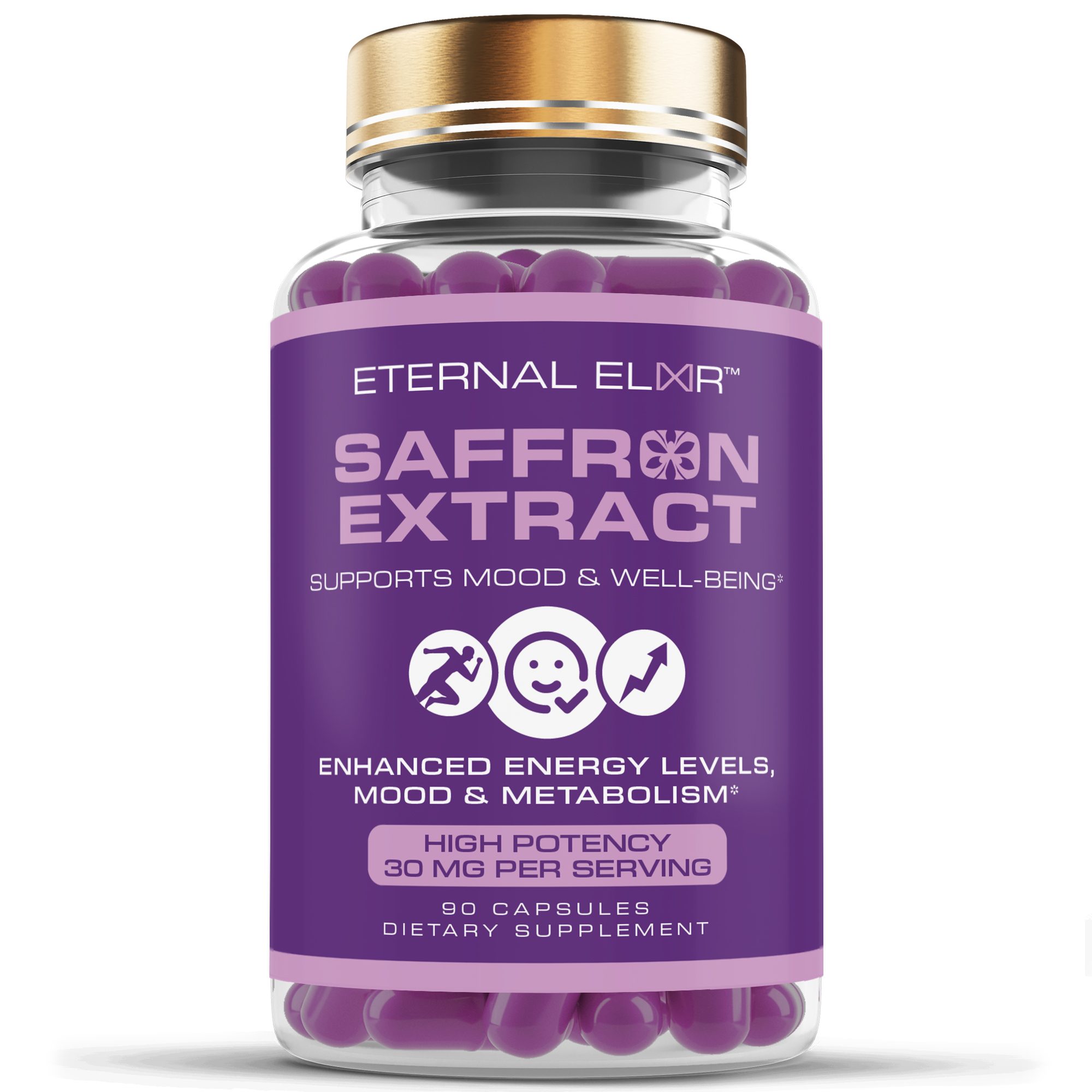
- Eternal Elixir’s Australian-made saffron capsules deliver 30 mg of affron® standardised extract, 90 capsules per bottle, about $0.56 a day.
Key numbers:
- 28 mg/day — the daily dose of standardised saffron extract that separated from placebo on mood in a four-week trial of 128 adults.
- 22 mg/day — the dose of the same extract, in the same trial, that produced no measurable effect at all.
- 72.3% vs 54.3% — participants reaching a clinically meaningful improvement in depressive symptom scores on saffron versus placebo over twelve weeks.
- 3.5% — the guaranteed Lepticrosalides® content that makes a saffron extract comparable to the trialled material.
Table of contents
- 1. Saffron Supplement Benefits: What Actually Holds Up in Human Trials
- 2. The 28 mg Threshold: Why Most Saffron Supplement Benefits Live or Die on the Label
- 3. How Saffron Works, and the Cortisol Claim Worth Correcting
- 4. Dose, Timing and Cost Per Day in Australia
- 5. Side Effects, Interactions and Who Should Be Careful
- 6. Saffron Supplement Benefits: Your Questions Answered
Saffron Supplement Benefits: What Actually Holds Up in Human Trials
Saffron is the dried stigma of the Crocus sativus flower, and its activity comes from a group of compounds called crocins, crocetin and safranal. Over the past decade it has accumulated an unusually good evidence base for a botanical, in large part because Australian research groups kept running trials on it.
Three of those trials do most of the heavy lifting, and they are worth separating from the general noise. If you want the shopping side of this, we have already compared the saffron supplements sold in Australia brand by brand.
Mood and stress: the four-week result that set the dose
Research published in Complementary Therapies in Medicine by Kell and colleagues at the University of Southern Queensland randomised 128 adults who self-reported low mood, but who had no diagnosis, to one of three arms: 28 mg a day of a standardised saffron extract, 22 mg a day of the same extract, or placebo, for four weeks. The 28 mg arm showed a significant reduction in negative mood and in stress and anxiety symptoms against placebo on the Profile of Mood States total score, with a large effect size.
The 22 mg arm showed nothing. The researchers noted that both screening and outcomes were self-reported, which is a real limitation (PMID 28735826).
Sleep: better quality, not more hours
A separate 28-day trial by Lopresti and colleagues at Murdoch University in Perth, published in Sleep Medicine, gave 120 adults with unsatisfactory sleep either placebo, 14 mg or 28 mg of the same standardised extract one hour before bed. Compared with placebo, saffron improved sleep-quality ratings, mood on waking, and insomnia symptom scores.
It did not move most of the other sleep-diary measures, and the two doses performed similarly.
Evening melatonin concentrations rose; evening cortisol did not change (PMID 34438361). That last detail matters, and we come back to it below.
Twelve weeks: the largest trial, and its honest caveat
The biggest saffron trial run to date appeared in The Journal of Nutrition in 2025. Lopresti and colleagues supplemented 202 Australian adults aged 18 to 70 who had subclinical depressive symptoms with either 28 mg of saffron daily or placebo for twelve weeks.
On the primary outcome, the depression subscale of the DASS-21, saffron beat placebo by 2.92 points, and 72.3% of the saffron group reached a clinically meaningful improvement compared with 54.3% on placebo.
The other secondary outcomes showed no group difference, and the authors were candid that the placebo response was large (PMID 40414301). Sleep improved only in the subgroup who started with the worst sleep.
Read together, that is a consistent but modest picture: saffron nudges mood, stress and sleep quality in people who are struggling mildly, over weeks rather than days. It is not a treatment for a diagnosed condition, and nothing here replaces a conversation with your GP.
It is also the reason Eternal Elixir formulates to the trialled dose rather than to a round marketing number.
The 28 mg Threshold: Why Most Saffron Supplement Benefits Live or Die on the Label
Here is the finding almost no saffron article mentions, and it is the single most useful thing on this page. In the Kell trial, 22 mg and 28 mg were the same extract, in the same capsules, given to the same kind of people for the same four weeks.
Six milligrams was the difference between a large, statistically clear effect and nothing at all.
Saffron does not have a gentle dose-response curve you can shortcut. It has a threshold.
Which means the milligram figure on a saffron label is only informative if you also know what that milligram is made of. A capsule containing 30 mg of unstandardised saffron powder and a capsule containing 30 mg of extract standardised to 3.5% Lepticrosalides® are not the same product, and only one of them corresponds to anything that has been trialled.
Use this to decode a label:
| What the label says | What it actually tells you | Comparable to the trials? |
|---|---|---|
| “Saffron 30 mg”, no standardisation stated | A powder weight. Crocin and safranal content is unknown and varies with harvest and grade. | No |
| “Saffron extract 88 mg, equiv. dry herb 8,800 mg” | A herb-equivalent ratio. It describes how much raw material was used, not how much active compound survived. | No |
| “affron® 28 mg, standardised to 3.5% Lepticrosalides®” | A guaranteed 0.98 mg of the standardised bioactive complex — the exact material used in the published trials. | Yes, exactly |
| “affron® 30 mg, standardised to 3.5% Lepticrosalides®” | A guaranteed 1.05 mg of the same complex — marginally above the trialled amount. This is what Eternal Elixir uses. | Yes, at or just above |
Culinary saffron is a poor substitute for the same reason. Potency swings enormously by grade and origin, and you would need to eat an absurd and expensive amount of threads to approach a trial dose reliably.
A standardised extract exists precisely to remove that variability.
Skip the comparison shopping: Saffron Extract 30mg with affron® from Eternal Elixir ships locally in Australia with 90 capsules per bottle — twice the value of most competitors. Browse the longevity range →
How Saffron Works, and the Cortisol Claim Worth Correcting
Saffron’s carotenoids appear to act on several systems at once rather than through one clean mechanism. In research they influence the reuptake of serotonin and dopamine, moderate signalling along the hypothalamic-pituitary-adrenal axis, and behave as antioxidants in neural tissue.
That multi-target profile is the usual explanation for why the mood and sleep effects show up together.
It is also where a popular claim quietly falls over. You will read constantly that saffron “lowers cortisol”.
In the Murdoch sleep trial, which measured it directly in saliva, evening melatonin went up on saffron and evening cortisol did not budge.
The improvement in sleep quality happened anyway. If you are choosing a supplement specifically to lower a measured cortisol result, that trial is evidence against saffron being your tool, and the honest version of the pitch is that saffron seems to change how you feel about your sleep and your mood, not your stress-hormone panel.
For a broader look at what else gets used in this space, our guide to nootropic supplements available in Australia covers the alternatives, and magnesium L-threonate’s benefits for sleep and cognition run through a completely different pathway.
Dose, Timing and Cost Per Day in Australia
The practical protocol falls straight out of the trials. One daily dose in the 28 to 30 mg range of a standardised extract, taken at the same time each day with food.
If sleep is your main reason, the evidence supports taking it in the evening, roughly an hour before bed. If mood is the reason, timing looked less important than consistency.
| Your reason for taking it | Dose used in the trial | Give it | What participants reported |
|---|---|---|---|
| Low mood, stress, anxiety symptoms | 28 mg once daily | 4 weeks | Clear improvement vs placebo; 22 mg produced none |
| Poor sleep quality | 14–28 mg, 1 hour before bed | 28 days | Better sleep quality and morning mood; both doses similar |
| Persistent low mood, longer run | 28 mg once daily | 12 weeks | 72.3% clinically meaningful improvement vs 54.3% placebo |
On cost, compare products per daily serve rather than per bottle, because serving sizes differ wildly. Eternal Elixir’s Saffron Extract 30mg is $49.99 for 90 capsules, and the label serve is one capsule, so that is 90 daily serves and roughly $0.56 per day — a full three-month run for the price of a month of many stacked mood formulas.
It is third-party tested, Australian owned and GMP certified, with free shipping over $100.
Buy a single bottle to trial it properly, or save on a multi-pack if you already know saffron agrees with you.
Saffron also stacks cleanly, because nothing it does overlaps much with the usual evening supplements. Plenty of Australians run it alongside Magnesium L-Threonate 2000mg at $59.99 for the sleep-architecture side, or with an adaptogen such as Korean Red Panax Ginseng during a heavy work stretch.
If you are assembling something broader, our breakdown of adaptogen supplements compared for stress is the place to start, and the best magnesium for sleep in Australia covers how the forms differ.
Side Effects, Interactions and Who Should Be Careful
Across the three trials above, saffron at 14 to 30 mg a day was well tolerated, with no serious adverse reactions reported and no signal of daytime drowsiness — which is one of its practical advantages over sedating sleep herbs. Mild, inconsistent reports in the wider literature include headache, nausea, appetite change and drowsiness, usually at higher intakes than a standardised capsule delivers.
The sensible cautions: saffron in large culinary or medicinal quantities is traditionally avoided in pregnancy, so do not take a supplement while pregnant or breastfeeding without medical advice. Because it interacts with serotonin and dopamine pathways, anyone taking prescribed antidepressants, lithium or blood-thinning medication should clear it with their doctor first rather than self-stacking.
And if your low mood is persistent, worsening or affecting your daily function, a supplement is not the right first move — see a health professional.
Adults with a bleeding disorder or an upcoming surgery should also raise it with their prescriber. For context on how EE approaches this across the range, our Korean Panax ginseng guide to energy, focus and stress resilience applies the same evidence-first standard.
Saffron Supplement Benefits: Your Questions Answered
What happens if you take saffron daily?
At a standardised 28 to 30 mg a day, daily saffron was well tolerated across trials running four, eight and twelve weeks, with no serious adverse reactions reported. Daily use is also how the benefits were produced: every positive result came from continuous dosing, not occasional use.
Participants typically reported gradual improvements in mood and sleep quality rather than anything noticeable on day one.
Is saffron worth taking as a supplement?
It depends on what you want from it. If your goal is mood, stress resilience or sleep quality and you are willing to take a standardised 28 to 30 mg dose consistently for at least four weeks, the trial evidence is reasonable and the effect sizes are real if modest.
If you want weight loss, eyesight or a lower cortisol reading, the evidence is much weaker and you would be paying for the wrong thing.
Does saffron bring down cortisol levels?
On the best available direct measurement, no. The 28-day Murdoch University sleep trial measured evening salivary cortisol and found no change on saffron compared with placebo, while evening melatonin concentrations did rise.
Sleep quality still improved. The widely repeated claim that saffron lowers cortisol is not supported by that trial, even though the sleep benefit it is usually cited to explain is.
Is saffron hard on the liver?
There is no evidence that standardised saffron extract at supplement doses is hard on the liver, and no liver-related adverse events were reported in the randomised trials discussed here. Very high intakes of saffron, far beyond a capsule, are a different matter and are toxic.
As with any supplement, anyone with existing liver disease or on hepatically cleared medication should check with their doctor first.
What are the potential downsides of taking saffron?
Three worth knowing. First, cost: real standardised extract is not cheap, because saffron itself is not.
Second, patience: nothing in the trial data suggests a fast result, so you are committing to at least a month before you can judge it.
Third, the placebo response in saffron trials is unusually large, which means some of what people feel is expectation rather than the extract. Buying a dose that matches the research is the only part of that you control, which is exactly what our comparison of saffron supplements sold in Australia was built to make easy.
Build your longevity stack locally
Third-party tested · 90 capsules per bottle · Australian shipping
Shop Eternal Elixir →Recommended for you
About Eternal Elixir
Eternal Elixir is an Australian supplement company specialising in longevity and nootropic formulations. All products are third-party tested for purity, manufactured under strict quality controls, and designed for Australians who take their health seriously.
Browse the full range at eternalelixir.com.au/shop.