Last updated: September 26, 2026 · By Eternal Elixir Editorial
You take your first saffron capsule with breakfast. By mid-morning your mouth feels dry and there is a faint headache behind your eyes. Is that the supplement, or the second flat white? Saffron supplement side effects are real, but they are narrow, and nearly all of the alarming ones in circulation come from doses many times larger than an Australian capsule holds.
This guide sorts the reported effects by daily amount instead of dumping them into one list. That matters, because the same herb behaves differently at 30 mg and at 400 mg. If you are still choosing a product, our guide to the best saffron supplements in Australia covers label quality first.
Key takeaways
- Saffron supplement side effects at the 28–30 mg dose used in trials are mild and uncommon: dry mouth, mild nausea, headache, appetite changes and drowsiness.
- Two randomised placebo-controlled trials, in 128 and 202 adults, reported no side effects and no serious adverse reactions at 22–28 mg daily.
- Measurable changes to blood pressure and blood counts appeared only at 200–400 mg a day, roughly seven to thirteen times a capsule dose.
- Skip saffron if you are pregnant or breastfeeding, and ask your GP or pharmacist first if you take prescription medicine.
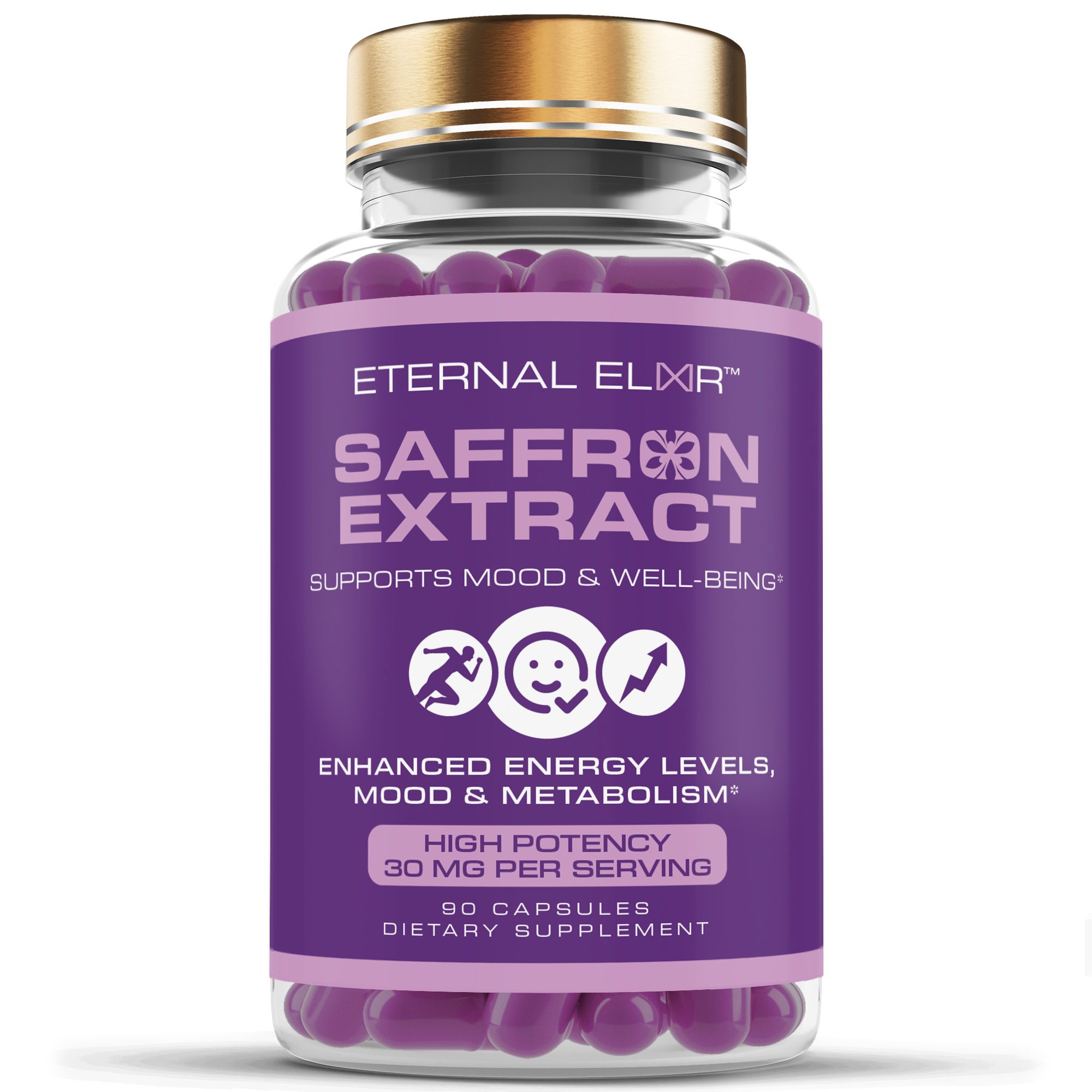
- Eternal Elixir Saffron Extract is 30 mg of affron® per capsule, 90 capsules for $49.99, which works out at $0.56 a serve.
Table of contents
- 1. Saffron Supplement Side Effects by Daily Dose
- 2. What the Trials Reported at 22 to 30 mg
- 3. Where Saffron Supplement Side Effects Actually Show Up: 200 mg and Above
- 4. Who Should Skip Saffron, and Who Should Ask First
- 5. How to Take Saffron and Avoid the Common Complaints
- 6. Saffron Supplement Side Effects: Your Questions Answered
- 7. The Bottom Line
- 8. Sources
Saffron Supplement Side Effects by Daily Dose
Almost every saffron safety page on the internet prints one list: nausea, headache, dry mouth, drowsiness, appetite change, then a jump to poisoning. The list is accurate. The framing is useless, because it hides the only variable that decides which of those things can happen to you, which is how many milligrams you swallow.
Here is the same evidence normalised to milligrams of saffron per day. Every row is a published human finding, except the last, which is animal and cell work and is labelled as such.
| Saffron per day | What that amount is | What was reported |
|---|---|---|
| A pinch of threads | Cooking, not supplementing | Never studied as a dose. All the safety data below come from concentrated extracts or stigma powder in capsules. |
| 22 mg | Lower arm of the 2017 affron® trial | No mood benefit at this dose, and no side effects reported over four weeks. |
| 28 mg | The dose both affron® trials used | Mood and stress scores improved. The 2017 trial recorded no side effects; the 2025 trial recorded no serious adverse reactions. |
| 30 mg | Eternal Elixir Saffron Extract, one capsule | Slightly above the studied 28 mg. Same mild, uncommon complaints people report on any capsule taken without food. |
| 200 mg | Seven days, healthy volunteers, 2008 safety study | Small shifts in red cells, haemoglobin, haematocrit, platelets, sodium, urea and creatinine. All stayed inside normal ranges. |
| 400 mg | Higher arm of the same seven-day study | Standing systolic and mean arterial pressure fell significantly, alongside the same small blood changes. |
| Gram amounts | Far beyond any supplement label | A 2020 review of cell and animal studies reports toxic effects only at amounts far greater than culinary use. |
Why the dose band matters more than the list
Read down that table and a pattern appears. At capsule doses the complaints are the kind you get from any capsule: a dry mouth, a light stomach, a headache on day two.
The findings that sound clinical, the blood pressure drop and the blood count shifts, sit at 200 mg and above. A single 30 mg capsule is not in that territory, and you would need to swallow seven of them daily to reach the lower of those two study arms. Our breakdown of saffron supplement benefits shows the same dose logic running in the other direction, where too little does nothing at all.
There is a second reason the dose band beats the list. Standardisation. A capsule that states 30 mg of affron® standardised to 3.5% Lepticrosalides® is telling you how much active compound you get, every capsule, every batch.
Loose threads and unstandardised powders do not, so two people taking the same visible amount can be at different real doses. Predictable side effects need a predictable dose first.
What the Trials Reported at 22 to 30 mg
Two randomised, double-blind, placebo-controlled trials carry most of the weight for the standardised extract sold in Australia. Both used affron®, the extract in Eternal Elixir Saffron Extract, so their safety reporting is directly relevant to what is in the bottle.
The four-week trial at two doses
Research published in Complementary Therapies in Medicine gave 128 adults with self-reported low mood either 28 mg a day, 22 mg a day, or placebo for four weeks. Negative mood and stress-related symptoms fell at 28 mg. At 22 mg nothing changed. The authors recorded the improvement as occurring without side effects (Kell et al., 2017).
That dose gap is the single most useful number on this page. A capsule under the studied amount is not a gentler version of saffron. It is a capsule that did nothing measurable in the one trial designed to test it.
The twelve-week trial in 202 adults
The larger and more recent test appeared in The Journal of Nutrition. Two hundred and two adults aged 18 to 70 with depressive symptoms took 28 mg of saffron daily or placebo for 12 weeks. Depression scores improved against placebo, with 72.3% of the saffron group reaching a clinically significant change compared with 54.3% on placebo. The other secondary measures, anxiety and stress among them, showed no difference between groups.
Sleep improved only in the subset who started with worse sleep disturbance. The trial reported no serious adverse reactions (2025 randomised controlled trial). Three months is long enough for tolerance problems to surface, and they did not. If sleep is your reason for trying it, our guide to saffron for sleep works through the timing evidence in detail.
Skip the comparison shopping: Saffron Extract 30mg from Eternal Elixir ships locally in Australia with 90 capsules per bottle — twice the value of most competitors. Browse the longevity range →
Where Saffron Supplement Side Effects Actually Show Up: 200 mg and Above
The only study that deliberately looked for harm in healthy people used doses no supplement sells. Published in Phytomedicine, it gave 30 healthy volunteers placebo, 200 mg or 400 mg of saffron stigma tablets daily for seven days, with blood work and electrocardiograms before and after (Modaghegh et al., 2008).
Clinical examination found no gross changes in anyone. The 400 mg group showed a significant fall in standing systolic and mean arterial pressure. Both saffron groups showed slight decreases in red blood cells, haemoglobin, haematocrit and platelets, and slight increases in sodium, blood urea nitrogen and creatinine. The authors noted every one of those values stayed within normal ranges and none was clinically important.
Two honest limits on that study. It ran for a week, so it says nothing about a year of use. And 30 volunteers is small. What it does establish is the shape of the dose response: you have to go roughly seven times past a capsule before a measuring instrument notices anything, and even then the numbers stay normal.
For anyone buying in Australia, that shape has a practical reading. The capsule dose sold here sits an order of magnitude below the amount that moved a single measurement in a controlled setting. The thing worth checking on a label is therefore not a safety warning but the standardisation line, because an unstandardised product can miss the studied dose in either direction without telling you.
What about gram amounts?
Above the pharmacology studies sits the toxicology literature, and it is mostly cell and animal work. A 2020 review in the Asian Pacific Journal of Cancer Prevention concluded that saffron extract has toxic effects when used in high amounts, and that those amounts are far greater than anything used in human food culture (review of in-vitro and in-vivo studies). Nobody reaches that range from a 30 mg capsule. People reach it from loose powder measured by eye.
This is the practical argument for capsules over bulk powder. A capsule cannot be over-scooped. Standardised extract also removes the guesswork about how much active compound a given weight of threads holds, which is the same reason our saffron and attention guide insists on reading the standardisation line rather than the milligram total.
Who Should Skip Saffron, and Who Should Ask First
Dose explains most of the risk. A short list of people sit outside that logic.
- Pregnant or breastfeeding. The trials above excluded these groups, so there is no safety evidence to lean on either way. Absent data is a reason to wait, not a reassurance.
- Taking prescription medicine. Ask your GP or pharmacist before you start, particularly with anything that affects mood, blood pressure or clotting. The 400 mg blood pressure finding is the reason this is worth a conversation rather than a shrug.
- Already running low blood pressure. Same finding, same caution. Capsule doses were not tested for this, so watch how you feel when you stand up in the first fortnight.
- Under 18. Adolescent trials of saffron exist, but they are separate from the adult evidence above and belong in a conversation with a doctor.
- Anyone whose mood gets worse. Trials report averages. If two weeks in you feel more wired or flatter rather than steadier, stop and reassess. That is information, not failure.
One thing worth naming plainly: saffron is not a substitute for care you already need. It is a supplement with a modest effect size in people with mild, self-reported low mood. Our write-up on saffron for mood and stress sets out what the effect sizes actually were.
How to Take Saffron and Avoid the Common Complaints
Most of the mild complaints have a boring fix. Take the capsule with food, keep the time of day consistent, and give it four weeks before you judge anything.
| Question | Practical answer |
|---|---|
| How much | One capsule, 30 mg of affron®. There is no evidence that two capsules work better, and the studied dose is 28 mg. |
| When | Same time each day, morning or evening. Evening suits people whose main complaint is winding down. |
| With or without food | With a meal. Nausea and stomach unease are the complaints most often fixed by this one change. |
| How long before judging | Four weeks for mood and stress, twelve if you are tracking sleep, matching the two trial lengths. |
| If you get a headache | Check your water and caffeine first. If it persists past a week, stop and see whether it clears. |
| Cost per serve | $0.56 at Eternal Elixir, based on $49.99 for 90 single-capsule serves. |
Two habits prevent most of the confusion we see in emails. Write down the date you started and the dose, because four weeks is longer than memory. And change one variable at a time, so a new coffee routine or a late training block does not get blamed on the capsule, or the reverse.
On stacking: saffron and magnesium are the two most common evening pairings we get asked about, and they have no known conflict. If you run both, add one at a time so you know which is doing what. You can buy the saffron on its own and third-party tested at Eternal Elixir Saffron Extract, and the side effect profile of magnesium L-threonate is worth reading before you combine them.
Saffron Supplement Side Effects: Your Questions Answered
Is saffron safe to take every day?
At the studied dose, daily use is what the evidence actually covers. The 2017 trial ran 28 mg daily for four weeks and reported no side effects. The 2025 trial ran 28 mg daily for 12 weeks in 202 adults and reported no serious adverse reactions. Beyond three months there is no comparable trial data, so a periodic review with your GP is sensible rather than indefinite autopilot.
Is saffron hard on your kidneys and liver?
The seven-day safety study at 200 mg and 400 mg a day measured blood urea nitrogen and creatinine, which track kidney function, and saw slight increases that stayed within normal ranges and were judged not clinically important. No human trial at capsule doses has shown kidney or liver harm. If you already have a kidney or liver condition, treat that as a reason to ask your doctor rather than to rely on a supplement page.
How much saffron is too much?
There is no established upper limit for supplements, but the map is clear enough. Benefit appears at 28 mg. The first measurable physiological changes appear at 200 mg. Toxic effects in the animal and cell literature need amounts far above culinary use. Staying at one 30 mg capsule keeps you at the bottom of that range with all of the studied benefit.
What should you avoid while taking saffron?
Avoid stacking a second saffron product on top, since doubling up moves you away from the tested dose for no known gain. Avoid loose powder dosed by eye. And avoid starting it in the same week as two other new supplements, because if something feels off you will not know which one caused it.
Do saffron side effects go away?
The mild ones usually settle within the first week or two, and taking the capsule with a meal resolves most stomach complaints outright. Anything that persists past a fortnight, or any change in mood in the wrong direction, is a reason to stop rather than to push through. If you decide saffron is not for you, our comparison of saffron supplements for focus and attention covers the alternatives within the same ingredient.
The Bottom Line
Saffron supplement side effects are mild, uncommon and dose-dependent. At the 28 to 30 mg used in capsules, two placebo-controlled trials covering 330 adults between them found no side effects and no serious adverse reactions. The findings that sound serious belong to 200 mg and 400 mg study arms, and even there the numbers stayed inside normal ranges. Pregnancy, breastfeeding and prescription medicine are the real reasons to wait or ask first.
If you want the studied dose without the guesswork, Eternal Elixir Saffron Extract carries 30 mg of affron® standardised to 3.5% Lepticrosalides® in one capsule a day, 90 capsules for $49.99, third-party tested and shipped from within Australia.
Sources
- Kell G, et al. affron®, a novel saffron extract, improves mood in healthy adults over 4 weeks. Complementary Therapies in Medicine, 2017. PubMed 28735826
- An Examination into the Effects of a Saffron Extract (Affron) on Mood and General Wellbeing in Adults Experiencing Low Mood. The Journal of Nutrition, 2025. PubMed 40414301
- Modaghegh MH, et al. Safety evaluation of saffron (Crocus sativus) tablets in healthy volunteers. Phytomedicine, 2008. PubMed 18693099
- Toxicity of Saffron Extracts on Cancer and Normal Cells: A Review Article. Asian Pacific Journal of Cancer Prevention, 2020. PubMed 32711409
Build your longevity stack locally
Third-party tested · 90 capsules per bottle · Australian shipping
Shop Eternal Elixir →Related reading
Recommended for you
About Eternal Elixir
Eternal Elixir is an Australian supplement company specialising in longevity and nootropic formulations. All products are third-party tested for purity, manufactured under strict quality controls, and designed for Australians who take their health seriously. Browse the full range at the Eternal Elixir shop.