Last updated: November 1, 2026 · Originally published: May 1, 2026 · By Eternal Elixir Editorial
Quick Answer
For glutathione for skin, our pick is Eternal Elixir Reduced L-Glutathione 2000mg, with vitamin C alongside it rather than instead of it. Glutathione has the more direct skin-tone evidence: in 60 adults in Bangkok, 500mg a day for four weeks lowered the skin’s melanin index more than placebo at two of six sites measured. Vitamin C is the one your skin needs to make collagen, and it is cheap, at about $0.14 a day for a 1,000mg tablet at Chemist Warehouse. The two don’t compete, and you can take both. Our glutathione is 90 capsules for $39.99 at two capsules (2,000mg) a day, which is $0.89 a day. That serve is well above the 250mg to 1,000mg a day used in the trials.
Eternal Elixir makes Reduced L-Glutathione 2000mg. We don’t sell vitamin C. Competitor prices were read from each live listing on 26 September 2026. To weigh every brand on the market, see our comparison of glutathione supplements in Australia.
Not sure which one fits you?
Tap one to start, and get a personal 20% code for your first order by email.
Glutathione and vitamin C are both antioxidants, and both are sold for brighter skin, immunity and healthy ageing. They are not the same kind of molecule. Vitamin C is a vitamin you have to get from food. Glutathione is a small protein-like molecule your own cells make from three amino acids. This guide compares glutathione vs vitamin C on what the human trials measured for skin, immunity and ageing, what each costs in Australia, and how to take glutathione with vitamin C if you want both.
Table of contents
- 1. Glutathione vs Vitamin C at a Glance
- 2. Glutathione for Skin: What the Trials Found
- 3. Vitamin C for Skin: What the Evidence Shows
- 4. Immunity: Where Each One Fits
- 5. Anti-Ageing: What Has and Hasn’t Been Shown
- 6. Glutathione With Vitamin C: Can You Take Them Together?
- 7. Glutathione and Vitamin C Supplements in Australia Compared
- 8. Our Glutathione: What’s on the Label
- 9. Looking After Your Skin From the Outside
- 10. Frequently Asked Questions
- 10.1. Is glutathione or vitamin C better for skin?
- 10.2. Which glutathione do we recommend for skin?
- 10.3. Can I take glutathione with vitamin C?
- 10.4. Is glutathione good for skin?
- 10.5. Which is better, retinol or glutathione?
- 10.6. What foods are high in glutathione?
- 10.7. How long does glutathione take to work for skin?
- 10.8. Are there side effects of taking glutathione long-term?
- 10.9. Is high-dose vitamin C safe?
- 11. The Bottom Line
- 12. Sources
Glutathione vs Vitamin C at a Glance
| Factor | Glutathione | Vitamin C |
|---|---|---|
| What it is | An antioxidant your cells make from glutamate, cysteine and glycine | A vitamin your body can’t make, so it has to come from food or supplements |
| Main skin role | Skin tone: trials measured the melanin index | Collagen production and antioxidant protection against UV |
| Best oral skin evidence | Small randomised trials, 4 to 12 weeks | Mostly diet studies; the benefit of vitamin C creams is less clear |
| Daily amounts in trials | 250mg to 1,000mg | Absorption is complete at 200mg and falls from 500mg |
| Immunity | One six-month trial saw higher natural killer cell activity at 1,000mg a day | Concentrated in white blood cells and needed for their normal function |
| Typical cost per day in Australia | $0.80 to $2.13 across the glutathione-only products below | $0.14 to $0.19 for a 1,000mg tablet |
| Eternal Elixir product | Reduced L-Glutathione 2000mg, $39.99 for 90 capsules | Not stocked |
Read it this way: if your goal is a more even skin tone, glutathione has the more direct trial evidence, though the trials are small. If your goal is collagen and everyday antioxidant cover, vitamin C is essential, costs less and is easy to get from fruit and vegetables. Most people who want both can take both.
Glutathione for Skin: What the Trials Found
Glutathione is sold for skin because it can push pigment cells toward lighter pigment (pheomelanin) instead of darker pigment (eumelanin), according to the researchers who tested it (Duperray et al., 2022). Three oral trials in Asian adults are the core of the evidence:
- 500mg a day, four weeks. Sixty healthy medical students in Bangkok took 500mg of glutathione a day, split into two doses, or a placebo. The melanin index fell at all six skin sites measured in the glutathione group, and the drop was significantly bigger than placebo at two of them: the right side of the face and a sun-exposed forearm. Both capsules were very well tolerated (Arjinpathana and Asawanonda, Journal of Dermatological Treatment, 2012).
- 250mg a day, 12 weeks. Sixty women aged 20 to 50 took 250mg of reduced glutathione, 250mg of oxidised glutathione or a placebo, and 57 finished. Melanin index and UV spots tended to be lower than placebo but did not reach significance overall. Wrinkles fell at some sites in the reduced glutathione group, and skin elasticity tended to improve. Two volunteers stopped because of temporary rises in liver enzymes, which returned to normal within weeks (Weschawalit et al., Clinical, Cosmetic and Investigational Dermatology, 2017).
- 250mg with L-cystine, 12 weeks. In 124 Asian women split into four groups, 250mg of glutathione plus 500mg of L-cystine a day lightened skin and shrank facial dark spots more than placebo, and more than either ingredient alone (Duperray et al., Journal of Cosmetic Dermatology, 2022).
What this adds up to: oral glutathione can shift skin tone a little in some people, the effect is modest, and the trials were short and small. None was run in Australia, and none tested 2,000mg a day. For more on skin-tone use, see our guide to glutathione and skin whitening.
Add Reduced L-Glutathione to cart · $39.99Vitamin C for Skin: What the Evidence Shows
Normal skin holds high levels of vitamin C, which it uses to make collagen and to help protect against UV damage (Pullar et al., Nutrients, 2017). The same review notes that the benefit of vitamin C creams, as opposed to getting enough vitamin C in your diet, is poorly understood.
For oral vitamin C, the best-known data come from diet rather than supplement trials. In 4,025 American women aged 40 to 74, those with higher vitamin C intakes were less likely to have a wrinkled appearance or dry skin, after adjusting for age, sun exposure and other factors (Cosgrove et al., American Journal of Clinical Nutrition, 2007). That is an association, not proof that a tablet changes your skin.
How much you absorb also has a ceiling. In a hospital study of seven healthy volunteers, a single 200mg dose of vitamin C was completely absorbed, but at single doses of 500mg and above, absorption fell and the extra was passed in urine. White blood cells were full at 100mg a day (Levine et al., PNAS, 1996). So a 1,000mg tablet gives you less extra than the number suggests.
Immunity: Where Each One Fits
Vitamin C has the clearer role here. It builds up in immune cells such as neutrophils and supports their normal work, and people need a steady intake because the body can’t store much (Carr and Maggini, Nutrients, 2017). In the Levine study, white blood cells held at least 14 times more vitamin C than blood plasma.
Glutathione’s immune data come from one trial. In 54 non-smoking adults, 1,000mg of oral glutathione a day for six months raised glutathione in blood and immune cells by 30% to 35%, and natural killer cell activity was more than twice that of placebo at three months (Richie et al., European Journal of Nutrition, 2015). At 250mg a day, blood levels rose by 17%. A shorter trial found nothing: in 40 healthy adults, 500mg twice a day for four weeks did not change glutathione status or oxidative stress markers (Allen and Bradley, Journal of Alternative and Complementary Medicine, 2011).
The practical point: vitamin C is the one to make sure you get every day. Glutathione may add to it if you take it for months rather than weeks.
Anti-Ageing: What Has and Hasn’t Been Shown
Neither glutathione nor vitamin C has been shown to slow ageing in people. What we have is narrower:
- Glutathione: the 12-week trial above found fewer wrinkles at some sites at 250mg a day, with a trend toward better elasticity. That is one small trial.
- Vitamin C: the diet study above linked higher intakes with fewer visible wrinkles. Vitamin C is also needed to make collagen, which gives skin its strength.
- Sun protection: no oral antioxidant replaces sunscreen, shade and a hat in the Australian sun.
For a broader look at anti-ageing options for skin, see our skin supplements comparison and the guide for women over 40.
Glutathione With Vitamin C: Can You Take Them Together?
Yes. Glutathione with vitamin C (often shortened to “gluta and vitamin C”) is a common pairing, and there is a chemical reason for it. In lab studies, glutathione turns used vitamin C (dehydroascorbic acid) back into its active form inside cells (Winkler et al., Free Radical Biology and Medicine, 1994). That is cell chemistry, not a skin result.
We found no human trial of oral glutathione plus vitamin C for skin. The closest is the 12-week trial that paired glutathione with L-cystine, which beat either ingredient alone. So taking both is reasonable, but the combination hasn’t been tested as a pair.
If you take both, follow each label:
- Glutathione: our label says two capsules a day on an empty stomach, so before breakfast works for most people.
- Vitamin C: the Swisse and Blackmores 1,000mg tablets below both say to take one a day with a meal.
- Food first: fruit and vegetables can supply about 200mg of vitamin C a day (Levine et al., 1996). They also contain some glutathione, and freshly prepared meats contain more (Jones et al., 1992).
Combination products exist too. Swisse Beauty Bright Skin has 25mg of glutathione and 100mg of vitamin C per capsule, with cysteine and plant extracts. Its glutathione is a tenth of the lowest dose tested in the skin trials.
Glutathione and Vitamin C Supplements in Australia Compared
| Product | Daily serve | Price (AUD) | Per pack | Cost per day | Buy |
|---|---|---|---|---|---|
| Eternal Elixir Reduced L-Glutathione 2000mg | 2 capsules = 2,000mg reduced glutathione | $39.99 | 90 capsules (45 serves) | $0.89 | View product |
| BioCeuticals Glutathione | 1 to 2 capsules = 250mg to 500mg reduced glutathione | $47.99 | 60 capsules | $0.80 to $1.60 | Chemist Warehouse |
| Codeage Liposomal Glutathione | 2 capsules = 500mg glutathione | $63.99 | 60 capsules (30 serves) | $2.13 | iHerb AU |
| Swisse Beauty Bright Skin | 1 capsule = 25mg glutathione + 100mg vitamin C + other ingredients | $34.99 (RRP $69.99) | 120 capsules | $0.29 | Chemist Warehouse |
| Swisse Vitamin C 1000mg | 1 tablet = 1,000mg vitamin C (calcium ascorbate) | $20.99 (RRP $41.99) | 150 tablets | $0.14 | Chemist Warehouse |
| Blackmores Bio C 1000mg | 1 tablet = 1,000mg vitamin C (buffered) | $11.99 (RRP $23.99) | 62 tablets | $0.19 | Chemist Warehouse |
Prices as of Sep 2026, read from each listing on 26 September 2026. Cost per day uses each label’s own daily serve.
On glutathione per dollar, ours gives 2,000mg a day for $0.89, while the BioCeuticals capsules give 500mg for $1.60 at two a day. Chemist Warehouse lists BioCeuticals Glutathione as a practitioner-only product. The liposomal Codeage capsules cost the most per day. For vitamin C, the Swisse 150-tablet bottle is the lowest cost per day in this table.
Add Reduced L-Glutathione to cart · $39.99Our Glutathione: What’s on the Label
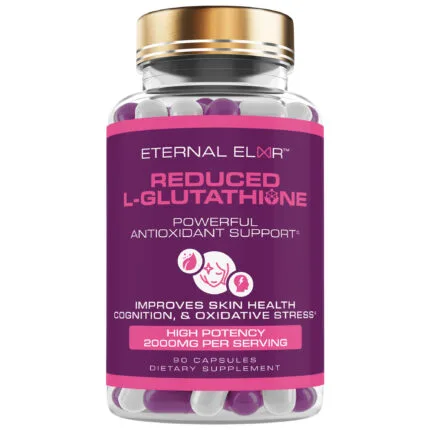
Eternal Elixir Reduced L-Glutathione 2000mg is 1,000mg of reduced glutathione per capsule, taken as two capsules (2,000mg) a day on an empty stomach. A bottle holds 90 capsules, which is 45 serves, for $39.99, so about $0.89 a day. Two bottles save 10%, three save 15% and five save 20%, and orders over $100 ship free from Sydney.
How our serve compares with the trials: 2,000mg a day is double the 1,000mg used in the six-month trial and four to eight times the 250mg to 500mg used in the skin trials. No trial we found tested 2,000mg a day, so we can’t say whether it does more than the lower doses.
- Who it suits: adults who want reduced glutathione for skin tone or antioxidant support and plan to take it for at least three months.
- Who it doesn’t suit: anyone who is pregnant or breastfeeding, or who takes prescription medicines, without talking to a doctor first. It is also not a substitute for vitamin C from food.
For forms and absorption, compare liposomal vs reduced L-glutathione, and see how glutathione stacks up against its building block in glutathione vs NAC. Our glutathione supplements comparison covers more brands, and the glutathione benefits guide covers other uses.
Looking After Your Skin From the Outside
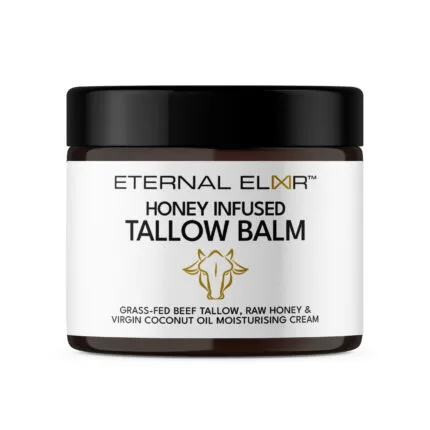
Oral antioxidants work from the inside. Dry or tight skin also needs a barrier that holds water. Our Grass-Fed Tallow Balm ($29.99) is a moisturiser made from grass-fed beef tallow, organic beeswax, coconut oil, raw honey and vitamin E. Because it contains raw honey, don’t use it on babies under 12 months. Our article on the skin barrier and tallow explains how people use it.
When comparing any skin supplement, check the label for the exact form and amount per serve. Our guide to reading supplement labels in Australia shows what to look for.
Not sure which one fits your routine? Answer a few quick questions and see the product that suits your goals, with its label serve and cost per day.
Finish it and we'll email you a personal 20% code for your first order: unique to you, one use, valid 48h.
Find my routine + 20% codeFrequently Asked Questions
Is glutathione or vitamin C better for skin?
For skin tone, glutathione has the more direct evidence: small trials at 250mg to 500mg a day lowered the melanin index over 4 to 12 weeks. For collagen and general antioxidant cover, vitamin C matters more, and its skin link comes mainly from diet studies. They do different jobs, so many people take both.
Which glutathione do we recommend for skin?
Our pick is Eternal Elixir Reduced L-Glutathione 2000mg: 90 capsules for $39.99, two capsules (2,000mg) a day, or $0.89 a day, shipped from Sydney. Eternal Elixir makes it. Its daily serve is higher than the doses used in the skin trials. If you want a lower dose, BioCeuticals Glutathione is 250mg a capsule. For other brands sold here, read our glutathione supplement comparison for Australian buyers.
Add Reduced L-Glutathione to cart · $39.99
Can I take glutathione with vitamin C?
Yes. In lab studies, glutathione helps turn used vitamin C back into its active form, and nothing in the trials suggests a problem taking them together. We found no trial testing the pair for skin. Follow each label: our glutathione on an empty stomach, and a vitamin C tablet with a meal.
Is glutathione good for skin?
It may help skin tone a little. In the largest oral trial we found, 124 Asian women taking 250mg of glutathione with 500mg of L-cystine a day for 12 weeks had lighter skin and smaller dark spots than the placebo group. Glutathione alone at 250mg did less well in that trial, and all the trials were small and short.
Which is better, retinol or glutathione?
They do different things. Retinol goes on the skin and has good evidence for fine lines: in 36 older adults with an average age of 87, a 0.4% retinol lotion applied up to three times a week for 24 weeks reduced fine wrinkles compared with the plain lotion (Kafi et al., Archives of Dermatology, 2007). Oral glutathione’s evidence is mainly about skin tone. If fine lines are your main concern, retinol has the stronger case.
What foods are high in glutathione?
In a US analysis of common foods, fruit and vegetables had moderate to high amounts of glutathione and freshly prepared meats were relatively high, while dairy, cereals and breads were low. Frozen foods kept similar amounts, but other processing lost much of it (Jones et al., 1992).
How long does glutathione take to work for skin?
The skin trials measured changes at 4 to 12 weeks. In the six-month trial, blood glutathione was higher at one, three and six months and fell back to baseline a month after people stopped. Plan on at least three months before you judge it.
Are there side effects of taking glutathione long-term?
The skin trials described oral glutathione as well tolerated over 4 to 12 weeks. In one 12-week trial, two of 60 volunteers stopped because of temporary rises in liver enzymes that settled within weeks. Talk to your doctor first if you are pregnant, breastfeeding, have a liver condition or take prescription medicines. Our glutathione side effects guide covers this in more detail.
Is high-dose vitamin C safe?
In the Levine study, 1,000mg a day raised the amount of oxalate and urate passed in urine, and the researchers concluded that doses above 400mg a day had no evident value. If you have had kidney stones, talk to your doctor before taking high-dose vitamin C.
The Bottom Line
Glutathione vs vitamin C isn’t a contest you have to settle. Glutathione has small trials showing a modest shift in skin tone at 250mg to 500mg a day, and one six-month trial showing higher body stores at 1,000mg. Vitamin C is essential for collagen and immune cells, costs about $0.14 a day and is easy to get from food. Our pick for the glutathione side is Eternal Elixir Reduced L-Glutathione 2000mg at $0.89 a day, with the caveat that its serve is above the trial doses.
Sources
- Arjinpathana N, Asawanonda P. Glutathione as an oral whitening agent: a randomized, double-blind, placebo-controlled study. Journal of Dermatological Treatment. 2012;23(2):97-102. PubMed 20524875
- Weschawalit S, Thongthip S, Phutrakool P, Asawanonda P. Glutathione and its antiaging and antimelanogenic effects. Clinical, Cosmetic and Investigational Dermatology. 2017;10:147-153. PubMed 28490897
- Duperray J, Sergheraert R, Chalothorn K, et al. The effects of the oral supplementation of L-Cystine associated with reduced L-Glutathione-GSH on human skin pigmentation: a randomized, double-blinded, benchmark- and placebo-controlled clinical trial. Journal of Cosmetic Dermatology. 2022;21(2):802-813. PubMed 33834608
- Richie JP Jr, Nichenametla S, Neidig W, et al. Randomized controlled trial of oral glutathione supplementation on body stores of glutathione. European Journal of Nutrition. 2015;54(2):251-263. PubMed 24791752
- Allen J, Bradley RD. Effects of oral glutathione supplementation on systemic oxidative stress biomarkers in human volunteers. Journal of Alternative and Complementary Medicine. 2011;17(9):827-833. PubMed 21875351
- Pullar JM, Carr AC, Vissers MCM. The roles of vitamin C in skin health. Nutrients. 2017;9(8):866. PubMed 28805671
- Cosgrove MC, Franco OH, Granger SP, et al. Dietary nutrient intakes and skin-aging appearance among middle-aged American women. American Journal of Clinical Nutrition. 2007;86(4):1225-1231. PubMed 17921406
- Levine M, Conry-Cantilena C, Wang Y, et al. Vitamin C pharmacokinetics in healthy volunteers: evidence for a recommended dietary allowance. Proceedings of the National Academy of Sciences USA. 1996;93(8):3704-3709. PubMed 8623000
- Carr AC, Maggini S. Vitamin C and immune function. Nutrients. 2017;9(11):1211. PubMed 29099763
- Winkler BS, Orselli SM, Rex TS. The redox couple between glutathione and ascorbic acid: a chemical and physiological perspective. Free Radical Biology and Medicine. 1994;17(4):333-349. PubMed 8001837
- Jones DP, Coates RJ, Flagg EW, et al. Glutathione in foods listed in the National Cancer Institute’s Health Habits and History Food Frequency Questionnaire. Nutrition and Cancer. 1992;17(1):57-75. PubMed 1574445
- Kafi R, Kwak HS, Schumacher WE, et al. Improvement of naturally aged skin with vitamin A (retinol). Archives of Dermatology. 2007;143(5):606-612. PubMed 17515510
- Eternal Elixir product pages (label facts, directions, multi-bottle pricing): Reduced L-Glutathione 2000mg, Grass-Fed Tallow Balm.
- Competitor listings, read on 26 September 2026: BioCeuticals Glutathione, Codeage Liposomal Glutathione (iHerb AU), Swisse Beauty Bright Skin, Swisse Vitamin C 1000mg, Blackmores Bio C 1000mg.