Last updated: September 28, 2026 · Originally published: September 24, 2026 · By Eternal Elixir Editorial
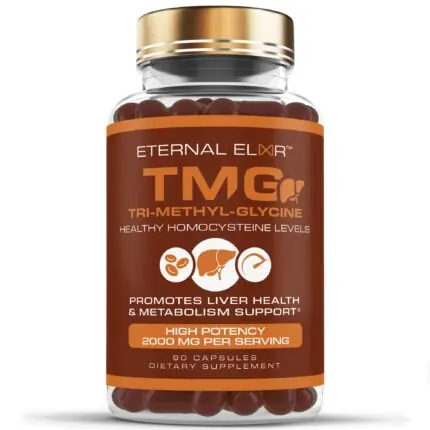
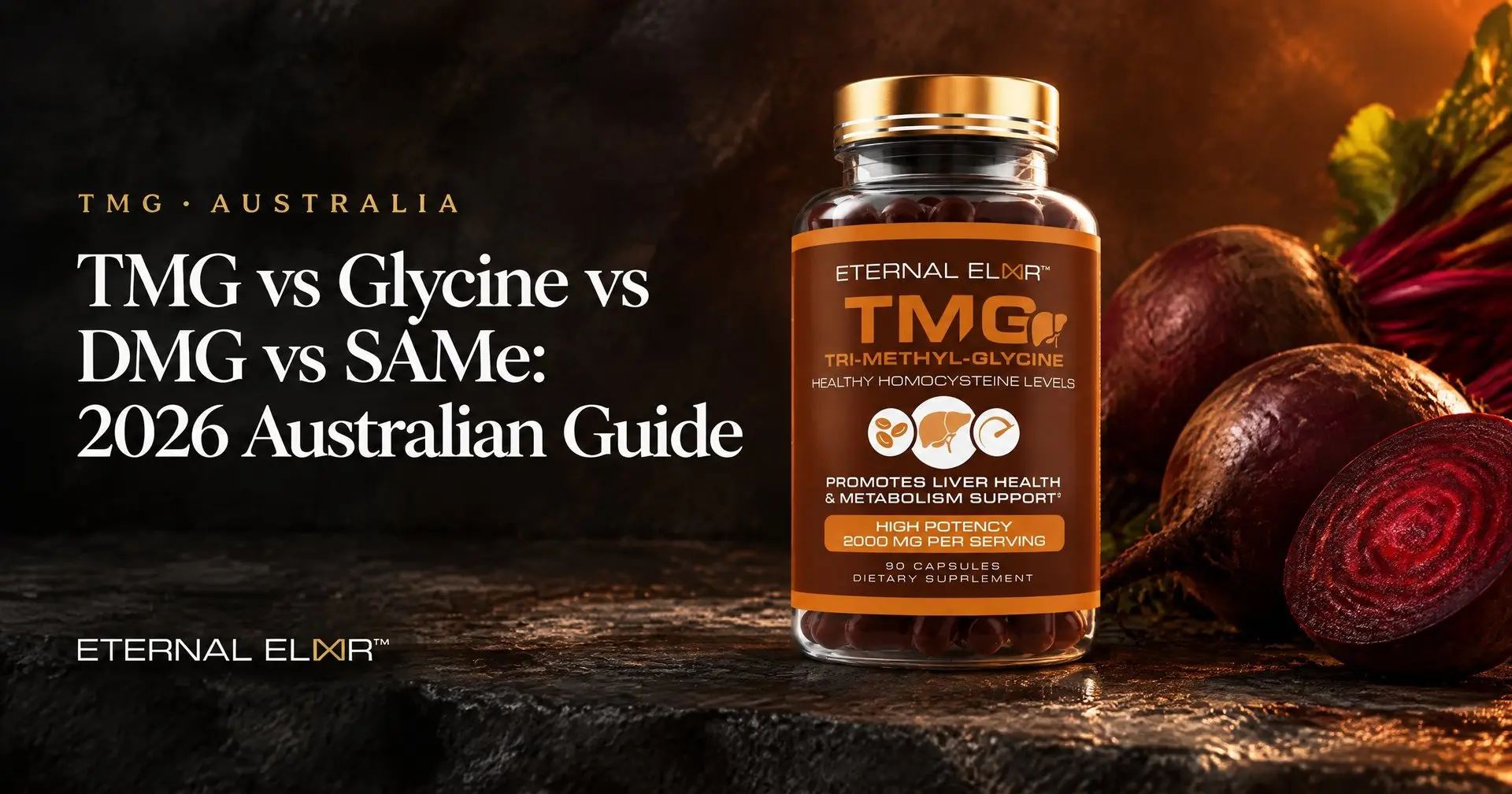
Quick answer: TMG, DMG and glycine are one molecule at three stages. Trimethylglycine (TMG, also sold as betaine) carries three methyl groups, dimethylglycine (DMG) carries two, and glycine carries none. SAMe is a different, larger molecule that the body builds from methionine and ATP to run most of its methylation reactions. So in the TMG vs glycine vs DMG vs SAMe question, only TMG hands a methyl group straight to homocysteine and turns it back into methionine. DMG is what is left after that donation, glycine is the empty backbone, and SAMe is the finished donor that the recycled methionine becomes. If supplying methyl groups to the homocysteine cycle is your aim, TMG is the one that does it directly. Our TMG 2000mg gives 2,000mg of betaine anhydrous per three-capsule serve, with 30 serves for $44.99.
Eternal Elixir sells TMG. We don’t sell glycine, DMG or SAMe, so read the comparison with that in mind. The biochemistry below comes from published reviews and trials, all listed in the sources at the end, and we point out where the human evidence is thin or cuts against TMG.
Table of contents
- 1. TMG vs glycine vs DMG vs SAMe at a glance
- 2. One backbone, three methyl groups: how the molecules relate
- 3. The methylation cycle, step by step
- 4. TMG vs glycine: why glycine is not a methyl donor
- 5. TMG vs DMG: the same molecule, one donation later
- 6. TMG vs SAMe: raw material versus finished donor
- 7. What the human trials on TMG show, and what they don’t
- 8. Which one fits which goal?
- 9. Our TMG 2000mg, and pairing it with NMN
- 10. Who should check with a doctor first
- 11. Frequently asked questions
- 12. The bottom line
- 13. Related reading
- 14. Sources
TMG vs glycine vs DMG vs SAMe at a glance
| Compound | Methyl groups | Role in methylation | Food sources | Typical supplement form |
|---|---|---|---|---|
| TMG (trimethylglycine, betaine) | Three, on the nitrogen | Gives one methyl group directly to homocysteine through the enzyme BHMT, making methionine, and becomes DMG | Wheat bran, wheat germ, spinach, shrimp, beetroot | Betaine anhydrous powder or capsules, dosed in grams |
| DMG (dimethylglycine) | Two, on the nitrogen | The by-product of TMG’s donation. Its methyl groups are removed in mitochondria and passed to the folate pool, so it cannot remethylate homocysteine directly | Little in food. Most is made in the body from TMG | Tablets or capsules, usually dosed in milligrams |
| Glycine | None | Not a donor. It can accept a methyl group from SAMe and become sarcosine | Protein foods, especially gelatin and collagen-rich cuts. The body also makes it | Powder or capsules, dosed in grams |
| SAMe (S-adenosylmethionine) | One, held on a charged sulfur atom | The donor for almost all methylation reactions in cells. It becomes SAH, then homocysteine | Not a meaningful food source. Cells make it from methionine and ATP | Stabilised salts in coated tablets |
For doses, the human trials and cost per serve of TMG itself, see our complete guide to TMG supplements in Australia.
One backbone, three methyl groups: how the molecules relate
Glycine is the smallest amino acid: two carbons, a carboxyl group and an amino group with only hydrogen on its nitrogen. Swap those hydrogens for methyl groups one at a time and you climb a ladder. One methyl group gives sarcosine. Two give dimethylglycine. Three fill the nitrogen and leave it with a permanent positive charge, and that is trimethylglycine, the compound sold as betaine or betaine anhydrous.
The body walks down that ladder, from TMG to DMG to sarcosine to glycine. The one step that runs the other way, glycine to sarcosine, uses up a methyl group from SAMe rather than supplying one.
SAMe sits outside the ladder. It is methionine joined to an adenosine group from ATP, with its methyl group held on a positively charged sulfur atom. A methyl group on a charged atom is primed for transfer, which is why SAMe can methylate a very wide range of targets. TMG’s fully loaded nitrogen gives it a similar but much narrower ability, aimed at homocysteine. DMG, sarcosine and glycine have no fully loaded, charged nitrogen, so they have no methyl group ready to hand over directly.
The methylation cycle, step by step
Step 1: TMG gives one methyl group to homocysteine
Homocysteine is what remains after methionine has passed on its methyl group. The liver and kidneys can recycle it with betaine-homocysteine methyltransferase (BHMT), an enzyme that lifts one methyl group off TMG and attaches it to homocysteine. The products are methionine and dimethylglycine (Lever and Slow, 2010). A 2021 review describes betaine’s two main jobs as an osmolyte, which helps cells hold water, and a methyl-group donor (Arumugam et al., 2021).
Step 2: DMG to sarcosine to glycine
The two methyl groups left on DMG are not handed to homocysteine. Betaine is broken down to dimethylglycine and then sarcosine inside the mitochondria of liver and kidney cells (Arumugam et al., 2021), and sarcosine is then converted to glycine. The enzymes behind those last steps, dimethylglycine dehydrogenase and sarcosine dehydrogenase, were identified in rat liver mitochondria as folate-binding proteins (Wittwer and Wagner, 1981). Each methyl group is oxidised off and captured by the folate pool as a one-carbon unit.
Those one-carbon units can eventually reach homocysteine, but only through the folate route, which also needs vitamin B12. A review of choline and betaine describes the BHMT reaction as the link between betaine and folate-dependent one-carbon metabolism (Ueland, 2011). So TMG makes one direct donation, then two indirect ones.
Step 3: methionine becomes SAMe, and SAMe becomes homocysteine
Methionine regenerated by BHMT joins the methionine you eat. Cells combine it with ATP to make SAMe, which a 2009 review identifies as the donor of methyl groups for almost all cellular methylation reactions, including the making of phosphatidylcholine and creatine and the methylation of DNA and histones (Luka et al., 2009).
Each time SAMe gives up its methyl group it becomes S-adenosylhomocysteine (SAH), which is split to release homocysteine, and the loop closes. SAMe and TMG sit at opposite ends of it: SAMe’s donations end in homocysteine, and TMG’s donation is one of the steps that recycles it.
TMG vs glycine: why glycine is not a methyl donor
The names invite this mix-up more than any other. TMG is glycine with three methyl groups, and glycine is TMG with none. For methylation that difference is everything, because a molecule cannot donate what it does not carry.
Glycine actually sits at the receiving end. When SAMe is in surplus, the liver enzyme glycine N-methyltransferase moves methyl groups onto glycine to make sarcosine, and this enzyme plays a major role in regulating SAMe levels (Luka et al., 2009). Glycine is one of the body’s sinks for spare methyl groups, not a source of them. One nuance: when glycine itself is broken down, one of its carbons passes to the folate pool. That is an indirect contribution to one-carbon metabolism, not a methyl group handed to homocysteine.
Glycine does plenty of other work. It makes up roughly every third amino acid in collagen, it is one of the three amino acids in glutathione, and it is a building block for creatine. Creatine shows the division of labour neatly: glycine supplies the backbone, and a methyl group from SAMe finishes the molecule. Both compounds are useful. They are simply not interchangeable.
TMG vs DMG: the same molecule, one donation later
DMG is exactly what TMG becomes once BHMT has taken its first methyl group. It therefore cannot do TMG’s job: BHMT uses betaine as its donor, and DMG is the product of that reaction, not a fuel for it. Its remaining methyl groups reach homocysteine only indirectly, through the folate pool.
That makes a DMG supplement a different product, not a stronger version of TMG. It is usually sold as small tablets or capsules dosed in milligrams, where TMG is dosed in grams, and the two cannot be swapped milligram for milligram. Your body already makes DMG from every TMG molecule BHMT uses. Plasma DMG is typically below 10 µmol/L, against 20 to 60 µmol/L of betaine in women and 25 to 75 µmol/L in men (Lever and Slow, 2010).
The letters differ by one character, so read labels carefully. A bottle marked DMG is not TMG, and neither is betaine hydrochloride. Our guide to betaine anhydrous, TMG and betaine HCl untangles the naming.
TMG vs SAMe: raw material versus finished donor
Because SAMe carries out most methylation, it is tempting to see it as the “real” version of TMG. The relationship is closer to raw material and finished product. TMG helps regenerate methionine in the liver and kidneys, and the body turns that methionine into SAMe as it needs it. A SAMe supplement skips those steps.
The supplements differ physically too. SAMe is unstable on its own, so supplements use stabilised salt forms, usually in coated tablets. TMG is a stable, water-soluble powder that fits into a capsule at gram-level doses.
We compare SAMe on biochemistry only. It is a separate ingredient with its own research, and this article makes no claims about its effects. If you are considering it, talk to your doctor or pharmacist first, especially if you take antidepressants or other prescription medicines.
What the human trials on TMG show, and what they don’t
The clearest human data on TMG concern homocysteine, the amino acid that TMG recycles:
- Doses in the range of food intake. In a six-week placebo-controlled trial, four groups of 19 healthy adults took 1.5 g, 3 g or 6 g of betaine a day, or a placebo. Fasting homocysteine ended 12%, 15% and 20% lower than in the placebo group (Olthof et al., 2003). Our 2,000mg serve sits between the two lowest doses tested.
- Betaine against folic acid. In adults with mildly raised homocysteine, groups of 12 took 6 g of betaine, 800 micrograms of folic acid or a placebo for six weeks. Relative to placebo, fasting homocysteine fell by 1.8 µmol/L with betaine and by 2.7 µmol/L with folic acid. After a methionine-rich test drink, betaine blunted the rise in homocysteine and folic acid did not (Steenge et al., 2003).
- The trade-off. Pooled data from placebo-controlled trials showed that 6 g of betaine a day for six weeks raised LDL cholesterol by 0.36 mmol/L and triglycerides by 0.14 mmol/L. Lower doses also nudged LDL up, though not significantly, and the authors concluded that folic acid remains the preferred nutrient for lowering homocysteine (Olthof et al., 2005).
- Body composition. A 2022 meta-analysis found that betaine did not significantly change body weight, fat mass or fat-free mass (Ashtary-Larky et al., 2022).
What has not been shown: the effect of long-term betaine supplementation in people is not known (Lever and Slow, 2010). If homocysteine is your reason for looking at TMG, the strongest evidence also favours folate, and it makes sense to ask your GP to check your blood lipids if you take TMG for months.
Add TMG 2000mg to cart · $44.99
Which one fits which goal?
- Supplying methyl groups to the homocysteine and methionine cycle. TMG does this directly. Glycine does not, and DMG only indirectly through the folate pool. Folate and vitamin B12 run the parallel route, and our guide to supporting healthy homocysteine levels through diet sets out those levers.
- Methyl supply alongside NMN. Clearing nicotinamide uses methyl groups, which is why some people pair the two. We set out that reasoning and its limits in why people take NMN and TMG together.
- Collagen, glutathione or creatine building blocks. Glycine is the relevant amino acid. It simply does not supply methyl groups.
- DMG. It sits one step downstream of TMG in the same pathway. If methyl supply to homocysteine is the aim, TMG acts earlier and more directly.
- SAMe. A different ingredient answering a different question. Make that decision separately, with your doctor.
Food matters too. In an analysis of 145 common foods, the richest sources of betaine were wheat bran (1,339mg per 100 g), wheat germ (1,241mg) and spinach (645mg) (Zeisel et al., 2003), and betaine from food and from supplements shows similar bioavailability (Arumugam et al., 2021).
Our TMG 2000mg, and pairing it with NMN
Label facts: 2,000mg trimethylglycine (betaine anhydrous) per serve · take 3 capsules daily with a meal · 90 vegetable capsules, 30 serves · $44.99, or $1.50 a serve · ships from Sydney within 24 hours.
Who it suits: adults who want a gram-level methyl donor in capsule form, including people already taking NMN. Who it doesn’t suit: anyone who prefers to measure a powder, anyone whose doctor is watching their LDL cholesterol closely, and anyone who is pregnant or breastfeeding. If you would rather use powder, our comparison of TMG powder and capsules covers the trade-offs.
Our NMN 500mg label serve is one capsule a day. Take each product at its own label serve.
Who should check with a doctor first
- Anyone who is pregnant or breastfeeding.
- Anyone taking prescription medicines, or with a medical condition.
- Anyone whose LDL cholesterol or triglycerides are being monitored, because of the lipid rise seen in the betaine trials.
- Anyone considering SAMe, especially alongside antidepressants.
Frequently asked questions
Is TMG the same as glycine?
No. TMG is glycine with three methyl groups on its nitrogen, which lets it donate one to homocysteine through the enzyme BHMT. Glycine carries no methyl groups, so it cannot do that job.
Should I take glycine or TMG?
It depends on the job. If you want a methyl donor for the homocysteine and methionine cycle, TMG is the one that supplies methyl groups directly. If you are interested in the building blocks of collagen, glutathione or creatine, glycine is the relevant amino acid. They are not substitutes for each other.
Add TMG 2000mg to cart · $44.99
Is TMG the same as DMG?
No. DMG is what TMG becomes after donating one methyl group to homocysteine, and it cannot feed that reaction itself. Its two remaining methyl groups pass into the folate pool as it is broken down to sarcosine and then glycine.
Who should not take DMG?
There is little human safety research on DMG supplements. Anyone who is pregnant or breastfeeding, anyone under 18, and anyone taking prescription medicines or with a medical condition should talk to their doctor before taking it.
Should I take TMG or SAMe?
They do different jobs. TMG recycles homocysteine into methionine, the raw material for SAMe, while SAMe is the finished methyl donor, sold as a separate ingredient. Speak with your doctor or pharmacist before starting either, especially if you take prescription medication.
Does TMG turn into glycine?
Yes, eventually. After donating its first methyl group, TMG becomes DMG, which is broken down to sarcosine and then glycine in liver and kidney mitochondria.
Does TMG really build muscle?
The evidence says no. A 2022 meta-analysis of betaine trials found no significant change in body weight, fat mass or fat-free mass. TMG’s clearer role is as a methyl donor.
How much TMG should I take?
Follow the label. Ours directs three capsules a day with a meal for 2,000mg. Trials of homocysteine used 1.5 g to 6 g a day, and the 6 g dose raised LDL cholesterol, so more is not automatically better.
The bottom line
TMG, DMG and glycine are one molecule at three stages of losing its methyl groups, and only the first stage can hand a methyl group straight to homocysteine. Glycine is the empty backbone and a methyl recipient, DMG is TMG one donation later, and SAMe is the finished donor the body builds from the methionine that TMG helps recycle. If your aim is to supply methyl groups to the homocysteine cycle, TMG does that directly and glycine does not. Choose by the job you want done, not by how similar the names look.
Related reading
- TMG benefits for methylation and liver support
- Eternal Elixir TMG 2000mg
- Shop the full Eternal Elixir range
Sources
- Lever M, Slow S. The clinical significance of betaine, an osmolyte with a key role in methyl group metabolism. Clinical Biochemistry. 2010. PubMed 20346934
- Arumugam MK, Paal MC, Donohue TM, et al. Beneficial effects of betaine: a comprehensive review. Biology. 2021. PubMed 34067313
- Wittwer AJ, Wagner C. Identification of the folate-binding proteins of rat liver mitochondria as dimethylglycine dehydrogenase and sarcosine dehydrogenase. Journal of Biological Chemistry. 1981. PubMed 6163777
- Ueland PM. Choline and betaine in health and disease. Journal of Inherited Metabolic Disease. 2011. PubMed 20446114
- Luka Z, Mudd SH, Wagner C. Glycine N-methyltransferase and regulation of S-adenosylmethionine levels. Journal of Biological Chemistry. 2009. PubMed 19483083
- Olthof MR, van Vliet T, Boelsma E, Verhoef P. Low dose betaine supplementation leads to immediate and long term lowering of plasma homocysteine in healthy men and women. Journal of Nutrition. 2003. PubMed 14652361
- Steenge GR, Verhoef P, Katan MB. Betaine supplementation lowers plasma homocysteine in healthy men and women. Journal of Nutrition. 2003. PubMed 12730412
- Olthof MR, van Vliet T, Verhoef P, et al. Effect of homocysteine-lowering nutrients on blood lipids: results from four randomised, placebo-controlled studies in healthy humans. PLoS Medicine. 2005. PubMed 15916468
- Ashtary-Larky D, Bagheri R, Tinsley GM, et al. Betaine supplementation fails to improve body composition: a systematic review and meta-analysis. British Journal of Nutrition. 2022. PubMed 34743773
- Zeisel SH, Mar MH, Howe JC, Holden JM. Concentrations of choline-containing compounds and betaine in common foods. Journal of Nutrition. 2003. PubMed 12730414