Last updated: September 26, 2026 · Originally published: March 21, 2026 · By Eternal Elixir Editorial
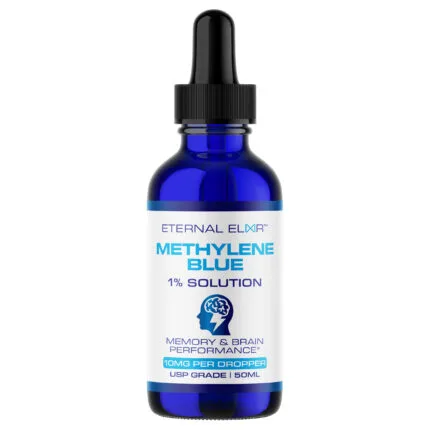
Quick answer: Microdosing methylene blue means taking a small oral amount every day, far below the doses used in hospitals and in research. There is no agreed microdose. The only human trials that measured attention and memory used a single 280mg dose, about 4mg per kg of body weight. Our drops label suggests 0.5 to 1ml a day (5 to 10mg) and each of our capsules holds 10mg, so both sit well under the dose those trials tested, and no trial has looked at 5 to 10mg a day for energy or focus. If you still want to try it, our pick is Eternal Elixir Methylene Blue Liquid 1%: start with half a dropper (0.5ml, 5mg) in water for about $0.50 a day, and keep a log. Do not take methylene blue with SSRI, SNRI or MAOI antidepressants or other serotonergic medicines, if you have G6PD deficiency, if you are pregnant or breastfeeding, or if you are under 18. Talk to your doctor first if you take any prescription medicine.
Eternal Elixir makes the drops and capsules in this guide, and they are our pick. The guide sets the amounts people call microdoses against the doses researchers actually tested, explains what the human studies found and what they did not, and gives three simple plans built on our label serves. Every research claim links to the published paper in the sources list.
Table of contents
- 1. Who should not take methylene blue
- 2. What microdosing methylene blue actually means
- 3. How methylene blue works at low doses
- 4. What the human studies show
- 5. Three microdosing plans using our label serves
- 6. Drops or capsules for microdosing: cost per day
- 7. Our pick for microdosing: Eternal Elixir Methylene Blue
- 8. Who microdosing suits, and who it doesn’t
- 9. What results to expect from a microdose
- 10. Stacking a methylene blue microdose
- 11. Frequently asked questions
- 11.1. What is a typical methylene blue microdose?
- 11.2. What is the Blootropic methylene blue dosage?
- 11.3. How quickly does methylene blue kick in?
- 11.4. What happens if I take methylene blue every day?
- 11.5. Why do I feel so good on methylene blue?
- 11.6. Why don’t doctors recommend methylene blue?
- 11.7. Can you microdose methylene blue with other nootropics?
- 11.8. What is the best methylene blue for microdosing in Australia?
- 12. The bottom line
- 13. Related reading
- 14. Sources
Who should not take methylene blue
Read this before anything else. Do not take methylene blue, at any dose, if one of these applies to you:
- You take an SSRI, SNRI, MAOI or another serotonergic medicine. In lab tests on the purified human enzyme, methylene blue was a potent, reversible inhibitor of MAO-A, the enzyme that breaks down serotonin, and it has been reported to trigger serotonin toxicity in people taking SSRIs (Ramsay 2007).
- You have G6PD deficiency, or a family history of it and have never been tested. A hospital pharmacy review lists methylene blue among the medicines that should not be used until a G6PD test has been done (Belfield 2018).
- You are pregnant or breastfeeding.
- You are under 18.
Expect blue or green urine. In the brain-imaging study described below, only the people given methylene blue reported coloured urine afterwards (Rodriguez 2017). Drops can also tint your mouth and tongue if you take them neat, so stir them into a glass of water. If you take any prescription medicine, ask your doctor or pharmacist before you start. Our guide to serotonin syndrome, MAO inhibition and methylene blue covers the interaction in detail.
What microdosing methylene blue actually means
Microdosing is a biohacker term, not a medical one. Researchers talk about “low-dose” methylene blue instead, and their low dose is much bigger than most people expect.
In the work from the University of Texas researchers behind most of the brain studies, low dose means about 0.5 to 4mg per kilogram of body weight. Animal studies found opposite, negative effects above about 10mg per kilogram, a pattern known as a hormetic dose response: helpful in a low band, harmful above it (Gonzalez-Lima 2015; Rodriguez 2017). For a 70kg adult, that low-dose band works out at roughly 35mg to 280mg.
Supplement microdosing sits far below that band. This is how the numbers line up for a 70kg adult:
| Amount | Where it comes from | Per kg at 70kg |
|---|---|---|
| 5mg | Half a dropper (0.5ml) of our 1% drops, the lower label serve | about 0.07mg |
| 10mg | One Eternal Elixir capsule, or a full dropper (1ml) of our drops | about 0.14mg |
| 35mg | Bottom of the research “low-dose” band | 0.5mg |
| 280mg | The single dose in the human brain-imaging studies | about 4mg |
| Over 700mg | Where animal studies saw the opposite, negative effects | over 10mg |
So be clear about what a microdose is. Our 10mg capsule is 28 times smaller than the single dose that changed brain activity in those studies, and half a dropper of drops is 56 times smaller. We found no published trial of 5 to 10mg a day in healthy adults. The case for microdosing rests on the idea that effects seen at higher doses carry down to much smaller ones, and that idea has not been tested.
How methylene blue works at low doses
Methylene blue is a synthetic dye that has been used as a medicine for more than a century. Two of its actions matter for anyone thinking about a daily microdose.
It cycles electrons in the mitochondria
At low doses, methylene blue can accept electrons and hand them on inside the mitochondrial electron transport chain, which is why researchers call it an electron cycler. A review of the animal and cell research links its memory effects in rodents to the respiratory enzyme cytochrome oxidase (Rojas 2012). That evidence comes from cells and animals. It describes a plausible mechanism, not a benefit anyone has measured in people taking a daily capsule.
It blocks the enzyme MAO-A
Methylene blue also inhibits monoamine oxidase A, the enzyme that breaks down serotonin, noradrenaline and dopamine (Ramsay 2007). Some users think this explains how they feel on it, but nobody has measured it at microdoses. The study tested the purified enzyme in a lab, so there is no data on how strongly 5 or 10mg taken by mouth blocks MAO-A in the body. Treat the medicine interaction as real at every dose.
How much reaches your blood
Methylene blue is well absorbed by mouth. In 16 healthy volunteers, about 72% of a 500mg oral liquid dose reached the bloodstream, judged against a 50mg intravenous dose (Walter-Sack 2009). In a smaller study of seven volunteers given 100mg, the blood level took about five hours to halve after an intravenous dose, and in the rat part of that study, oral dosing left less in the brain than intravenous dosing (Peter 2000). No study has compared capsules with drops.
What the human studies show
The human evidence for low-dose methylene blue in healthy people comes from two small single-dose papers by one research group.
- Attention and memory (Rodriguez 2016). 26 healthy adults aged 22 to 62 were randomised, double-blind, to a single 280mg oral dose of methylene blue or a placebo. One hour later, the methylene blue group showed a stronger brain-imaging response in the insular cortex during a sustained-attention task, a stronger response across several cortical areas during a short-term memory task, and 7% more correct answers when recalling information.
- Brain networks (Rodriguez 2017). In a second paper, 28 enrolled participants took 280mg or a blue-dye placebo. Methylene blue lowered blood flow in a task-related network during a visual-motor task and strengthened resting-state connections between regions linked to perception and memory.
What these studies did not show matters just as much:
- They used one dose, once. There is no human data here on daily use over weeks.
- The dose was 280mg, which is not a microdose by any definition.
- They measured brain scans and a lab memory task an hour later, not energy, mood or how much work got done.
- They were small, and we found no larger trial that repeats them.
The strongest argument for microdosing is the animal work showing a hormetic curve, where low doses help and high doses hurt. The strongest argument against is that the only human data in healthy people comes from a dose 28 times larger than a 10mg capsule. Both are true. A fair reading is that microdosing methylene blue is a personal experiment, not a tested protocol.
Three microdosing plans using our label serves
These plans stay inside the directions on our labels: 0.5 to 1ml of drops in water each day, or one capsule a day. They are practical starting points, not protocols tested in trials, and the research offers no evidence for cycling or any particular schedule. If you are deciding between formats, our methylene blue liquid vs capsules comparison and our guide to taking methylene blue drops cover measuring and timing in more depth.
Plan 1: the gentle start (5mg a day)
Take half a dropper (0.5ml) of our 1% drops, which holds 5mg, stirred into a glass of water each morning for two weeks. A 50ml bottle lasts 100 days at this serve, about $0.50 a day. This is the lowest serve on our label and the sensible place to begin.
Plan 2: the daily standard (10mg a day)
If 5mg sits well after two weeks, move to a full dropper (1ml) of drops or one Eternal Elixir capsule, each holding 10mg, every morning. This is the full label serve for both products and costs $1.00 a day either way. Capsules suit people who want a fixed dose and no blue tongue. Drops suit people who like to adjust.
Plan 3: work days only (5 to 10mg, five days a week)
Some people take methylene blue only on work or study days and skip weekends. Nothing in the research shows this works better than daily use, but it lowers your weekly total and stretches a bottle. At one capsule on five days a week, a 60-capsule bottle lasts 12 weeks.
How to run the experiment
- Change one thing at a time. Don’t start methylene blue in the same week as a new supplement or a bigger coffee habit alongside methylene blue.
- Keep a short daily log of sleep, mid-afternoon energy, focus, mood and any side effects.
- Give each step two weeks before you judge it.
- Stay within the label serve. The research low-dose band is not a target for home use.
- Stop if you get headaches, nausea, agitation or anything that worries you, and see a doctor.
Drops or capsules for microdosing: cost per day
Prices are from our store and the Blootropic website, as of Sep 2026. Cost per day uses the label serve.
| Product | Serve | Methylene blue per serve | Pack | Price (AUD, as of Sep 2026) | Cost per day | Buy |
|---|---|---|---|---|---|---|
| Eternal Elixir Methylene Blue Liquid 1% (microdose serve) | 0.5ml in water | 5mg | 50ml, 100 serves | $49.99 | $0.50 | Methylene Blue drops |
| Eternal Elixir Methylene Blue Liquid 1% (full serve) | 1ml in water | 10mg | 50ml, 50 serves | $49.99 | $1.00 | Methylene Blue drops |
| Eternal Elixir Methylene Blue Capsules 10mg | 1 capsule | 10mg | 60 capsules, 60 serves | $59.99 | $1.00 | Methylene Blue capsules |
| Blootropic Methylene Blue 1% Liquid | None given (sold for research purposes only) | Not stated | 50ml (500mg in total) | $60.00 | Not stated | blootropic.com |
Add Methylene Blue drops to cart · $49.99
Blootropic methylene blue dosage
Many people search for the Blootropic methylene blue dosage. Blootropic is a Melbourne company selling a 1% methylene blue liquid in 50ml (500mg, $60) and 100ml (1,000mg, $115) bottles, with free Australian shipping over $110. Its product page says the liquid is for research purposes only and is not supplied as a medicine or supplement, and it gives no serving or dose, so there is no Blootropic dosage to follow. Worked out per 10mg of methylene blue, it costs $1.20 in the 50ml bottle and $1.15 in the 100ml bottle, against $1.00 for our drops, which also come with daily label directions of 0.5 to 1ml.
Our pick for microdosing: Eternal Elixir Methylene Blue
Eternal Elixir makes both of these products, and they are our pick for microdosing methylene blue in Australia. The reasons are all on the label:
- Drops you can split. The 1% liquid holds 10mg per ml and the label serve is 0.5 to 1ml, so you can start at 5mg and step up without cutting capsules open.
- Fixed 10mg capsules. One capsule a day, 60 capsules a bottle, and no blue tongue.
- Short ingredient lists. Pharmaceutical-grade USP methylene blue with purified water in the drops, and with rice flour, a cellulose capsule and citric acid in the capsules.
- Sydney dispatch. Orders ship from Sydney within 24 hours, with a 30-day money-back guarantee, Afterpay and free shipping over $100. Two bottles save 10%, three save 15% and five save 20%.
Want the wider picture first? Our comparison of the best methylene blue supplements in Australia sets our drops and capsules against the other brands sold here.
Who microdosing suits, and who it doesn’t
It may suit you if
- You are a healthy adult, take no serotonergic medicine, and either know your G6PD status or have no family history of the deficiency.
- You want to run a careful self-experiment with a log, and you accept that the evidence at 5 to 10mg is thin.
- You prefer a small daily amount to the larger single doses used in research.
It doesn’t suit you if
- You take an antidepressant or any other serotonergic medicine, or you are pregnant, breastfeeding or under 18.
- You want a supplement with human trials at the dose you actually take. For that, compare NMN supplements in Australia or read how methylene blue compares with other nootropics.
- Blue or green urine would bother you.
What results to expect from a microdose
Keep your expectations modest. The trials found measurable changes in brain activity and 7% more correct memory answers one hour after 280mg. At 5 to 10mg a day, nobody has measured anything in a trial. Some people describe steadier energy or clearer focus through the afternoon, and others notice nothing apart from the colour of their urine. Your own log is the only test that applies to you.
If a month at 10mg brings no change you can see in your notes, don’t raise the dose past the label serve. Stop, and put the money towards a supplement with stronger human evidence at the dose you would take.
Stacking a methylene blue microdose
People pair methylene blue with coffee, NMN and other nootropics. No trial has tested any of these combinations at microdoses, so treat each pairing as its own experiment and add one thing at a time. Our guide to stacking methylene blue with NMN covers the most common pairing, and The Methylene Blue Bible goes deeper into the mitochondrial research. The fixed rule is the medicine interaction: nothing serotonergic alongside methylene blue.
Frequently asked questions
What is a typical methylene blue microdose?
There is no standard. For supplements, people use the word for amounts far below the research doses. Our labels suggest 0.5 to 1ml of 1% drops (5 to 10mg) or one 10mg capsule a day. The research “low-dose” band is 0.5 to 4mg per kg, which is about 35mg to 280mg for a 70kg adult.
Add Methylene Blue drops to cart · $49.99
What is the Blootropic methylene blue dosage?
Blootropic’s product page gives no dosage. The company sells its 1% liquid for research purposes only. Our drops are the same 1% strength and come with label directions: 0.5 to 1ml (5 to 10mg) a day in water.
How quickly does methylene blue kick in?
In the brain-imaging studies, changes showed up one hour after a single 280mg dose, and methylene blue is well absorbed by mouth. Nobody has measured how quickly a 5 or 10mg dose acts, and at that level many people notice nothing on the first day. Judge it over two weeks, not two hours.
What happens if I take methylene blue every day?
Expect blue or green urine for as long as you take it. Beyond that, there are no long-term trials of daily 5 to 10mg use in healthy adults, so nobody can say what months of use do. The interaction with serotonergic medicines applies on every day you take it. Stay within the label serve and review your log every few weeks.
Why do I feel so good on methylene blue?
No study has looked at this at microdoses. Two explanations come up in the research: methylene blue blocks MAO-A, the enzyme that breaks down serotonin and dopamine, and in cell and animal studies it cycles electrons in the mitochondria. Expectation plays a part too, which is why good trials compare it against a placebo. If the lift feels strong, check that nothing else you take raises serotonin.
Why don’t doctors recommend methylene blue?
Doctors do use methylene blue, as a hospital medicine. Caution about daily low-dose supplements comes down to three facts: the human evidence in healthy people is two small single-dose papers, it interacts dangerously with common antidepressants, and it is unsafe for people with G6PD deficiency. If you take any prescription medicine, talk to your doctor before you try it.
Can you microdose methylene blue with other nootropics?
People do, but no trial has tested combinations at microdoses. Avoid anything serotonergic, add one product at a time, and see our NMN and methylene blue guide before you pair the two.
What is the best methylene blue for microdosing in Australia?
Eternal Elixir Methylene Blue Liquid 1% is our pick, and we make it. Its label serve of 0.5 to 1ml lets you start at 5mg for about $0.50 a day, and it ships from Sydney within 24 hours. If you want a fixed dose, our 10mg capsules cost $1.00 a day.
Add Methylene Blue drops to cart · $49.99
The bottom line
On our labels, microdosing methylene blue means 5 to 10mg a day, far below the 280mg single dose that changed brain activity and memory scores in the only human studies in healthy adults. That gap is the honest summary: plausible from the animal research, untested at this dose in people. If you want to try it, Eternal Elixir Methylene Blue Liquid 1% lets you start at 5mg for about $0.50 a day. Read the safety list, keep a log, and talk to your doctor first if you take any prescription medicine.
Related reading
- Methylene blue capsules for energy, mood and focus
- Will methylene blue show up on a drug test?
- A mitochondrial stack with NMN, methylene blue and berberine
- Browse the full Eternal Elixir range
Sources
- Rodriguez P, Zhou W, Barrett DW, et al. Multimodal randomized functional MR imaging of the effects of methylene blue in the human brain. Radiology. 2016;281(2):516-526. PubMed 27351678
- Rodriguez P, Singh AP, Malloy KE, et al. Methylene blue modulates functional connectivity in the human brain. Brain Imaging Behav. 2017;11(3):640-648. PubMed 26961091
- Gonzalez-Lima F, Auchter A. Protection against neurodegeneration with low-dose methylene blue and near-infrared light. Front Cell Neurosci. 2015;9:179. PubMed 26029050
- Rojas JC, Bruchey AK, Gonzalez-Lima F. Neurometabolic mechanisms for memory enhancement and neuroprotection of methylene blue. Prog Neurobiol. 2012;96(1):32-45. PubMed 22067440
- Ramsay RR, Dunford C, Gillman PK. Methylene blue and serotonin toxicity: inhibition of monoamine oxidase A (MAO A) confirms a theoretical prediction. Br J Pharmacol. 2007;152(6):946-951. PubMed 17721552
- Belfield KD, Tichy EM. Review and drug therapy implications of glucose-6-phosphate dehydrogenase deficiency. Am J Health Syst Pharm. 2018;75(3):97-104. PubMed 29305344
- Walter-Sack I, Rengelshausen J, Oberwittler H, et al. High absolute bioavailability of methylene blue given as an aqueous oral formulation. Eur J Clin Pharmacol. 2009;65(2):179-189. PubMed 18810398
- Peter C, Hongwan D, Küpfer A, Lauterburg BH. Pharmacokinetics and organ distribution of intravenous and oral methylene blue. Eur J Clin Pharmacol. 2000;56(3):247-250. PubMed 10952480
- Blootropic, Methylene Blue 1% Liquid product page (sizes, prices, research-only statement), checked September 2026. blootropic.com