Last updated: September 28, 2026 · Originally published: January 22, 2026 · By Eternal Elixir Editorial
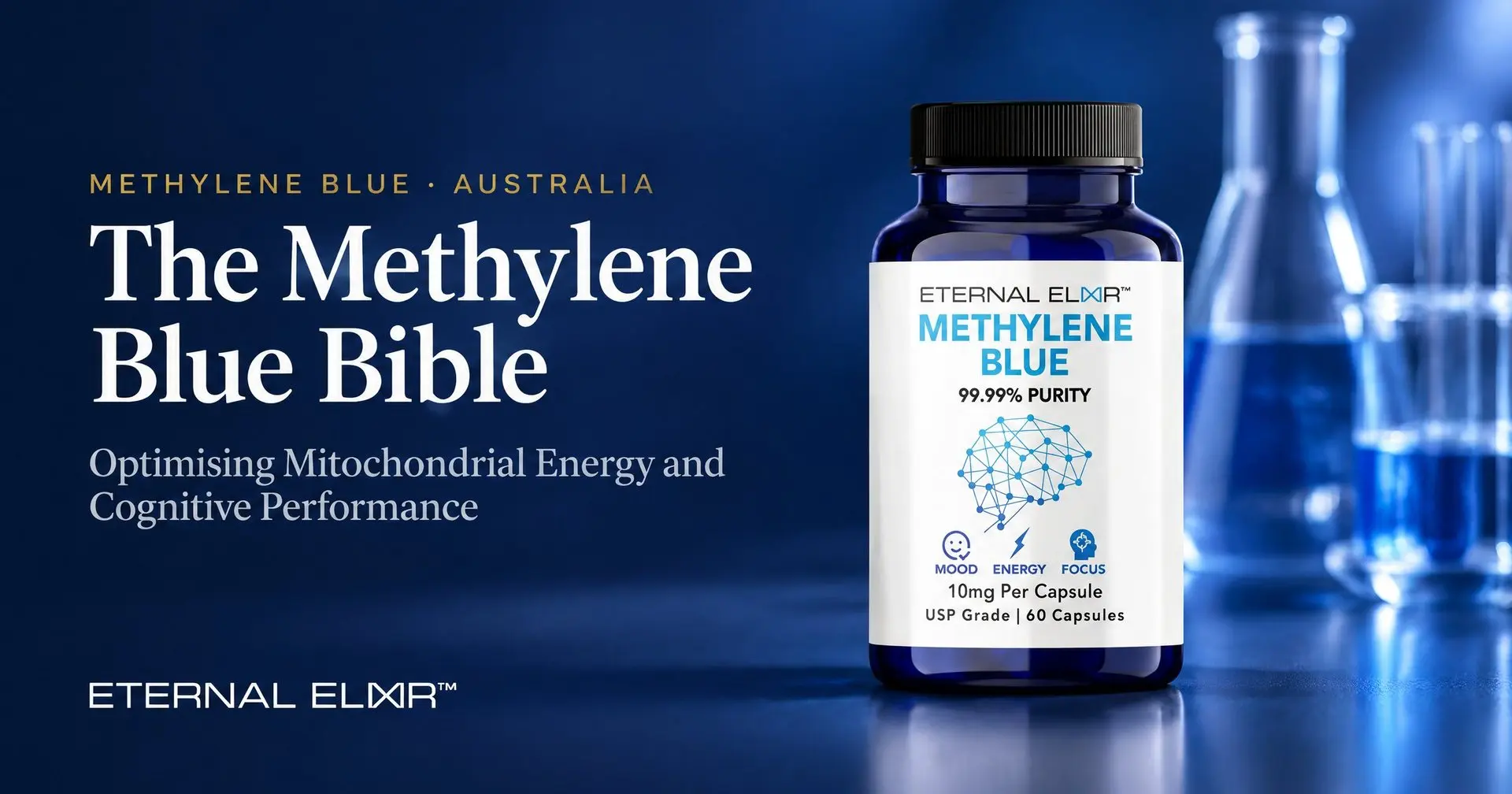
Quick answer: If you searched for “The Methylene Blue Bible”, you may be after one of several self-published books with that title. This page isn’t one of them. It is our free, referenced guide to what methylene blue is, what it does in the body, what the human research on energy and memory actually shows, and how to use it safely. In short: methylene blue can pass electrons along in the mitochondria in lab studies, one small trial found a single 280mg dose improved memory recall by 7%, and a later brain-imaging study found it lowered brain oxygen use rather than raising it. It is not safe with serotonergic medicines. If you decide to try it, our pick is Eternal Elixir Methylene Blue Capsules 10mg USP: one capsule a day, $1.00 a day.
Safety first. Don’t take methylene blue if you take SSRIs, SNRIs, MAOIs or any other serotonergic medicine, because the combination can cause serotonin syndrome. Don’t take it if you have G6PD deficiency, if you are pregnant or breastfeeding, or if you are under 18. It can colour your urine blue or green. Talk to your doctor before starting if you take any prescription medicine. Our methylene blue safety guide covers the interactions in detail.
Eternal Elixir makes the methylene blue capsules and drops in this guide, and the capsules are our pick. For a comparison of brands sold in Australia, see our best methylene blue supplements guide.
Table of contents
- 1. About “The Methylene Blue Bible” books
- 2. Methylene blue at a glance
- 3. What methylene blue is
- 4. What methylene blue does in your body
- 5. Energy and mitochondria: what’s been shown in people
- 6. Memory and focus: the human research
- 7. Why are people taking methylene blue now?
- 8. Why don’t doctors recommend methylene blue?
- 9. Methylene blue products in Australia compared
- 10. Why our pick is Eternal Elixir Methylene Blue Capsules
- 11. How to take methylene blue
- 12. Stacking methylene blue
- 13. Frequently asked questions
- 14. Sources
About “The Methylene Blue Bible” books
Several books sold on Amazon, Audible and in bookshops use the title “The Methylene Blue Bible”, from different authors and publishers. They are general guides to the compound’s history and uses. We haven’t reviewed them, and this page isn’t connected to any of them. What follows is our own summary, with every study linked so you can check it.
If you want one idea to take from any methylene blue guide, it is this: methylene blue is a real medicine with real interactions, and the evidence for daily supplement use in healthy people is small. Treat bold claims about it with care, including claims from supplement sellers.
Methylene blue at a glance
| Question | Short answer |
|---|---|
| What is it? | A synthetic blue dye, first made in the 19th century and among the first synthetic drugs used in medicine |
| What does it do in cells? | Accepts and donates electrons, which lets it pass electrons along the mitochondrial energy chain in lab studies |
| Human evidence for memory | One small trial: a single 280mg dose gave 7% more correct answers in a memory task |
| Human evidence for brain energy | A 2023 imaging study found intravenous doses lowered brain blood flow and oxygen use in healthy people |
| Absorption | About 72% of an oral dose reaches the bloodstream |
| Biggest risk | Serotonin syndrome when combined with serotonergic medicines |
| Typical supplement dose | Our capsules: 10mg a day. Our drops: 5 to 10mg a day |
What methylene blue is
Methylene blue (methylthioninium chloride) is a synthetic compound first made in the late 1800s as a textile dye. It became one of the first synthetic drugs used in medicine, and it is still used in hospitals today for specific purposes, under medical supervision. A 2011 review in Neurobiology of Aging describes it as the first synthetic drug and traces more than a century of uses in medicine and as a laboratory stain (Schirmer 2011).
Interest in methylene blue as a supplement comes from two properties. It can switch between an oxidised (blue) and a reduced (colourless) form, which lets it pick up and hand over electrons. And it crosses into the brain easily. Those two facts are behind nearly every claim about energy and focus.
Grade matters. Methylene blue is sold as an industrial dye, an aquarium treatment and a laboratory stain, as well as in pharmaceutical grade. USP grade means the material meets the United States Pharmacopeia standard for purity. Only pharmaceutical-grade material is meant for people. Our capsules and drops list USP-grade methylene blue on their labels.
What methylene blue does in your body
In the mitochondria
Mitochondria make ATP, the energy currency of cells, by passing electrons along a chain of protein complexes. In cell and animal studies, methylene blue can take electrons from NADH and pass them further down the chain, which lets it route around parts of the chain that are working poorly. That is the basis for calling it a “mitochondrial enhancer”.
The key word is “can”. This has been shown in cells and animals. In people, the one study that measured brain energy use directly found the opposite of what the theory predicts (see below).
On serotonin
Methylene blue also blocks monoamine oxidase A (MAO-A), the enzyme that breaks down serotonin. A laboratory study with purified human enzyme found it is a potent inhibitor of MAO-A (Ramsay 2007). That is why it is dangerous with medicines that raise serotonin. A 2010 review found 26 patients who developed an acute confusional state after being given methylene blue by infusion, and 24 of them were taking a serotonin reuptake inhibitor. The authors concluded these medicines can interact with methylene blue to cause a serious reaction consistent with serotonin syndrome (Ng and Cameron 2010).
Absorption and colour
Taken by mouth, methylene blue is well absorbed. In 16 healthy volunteers, about 72% of an oral dose reached the bloodstream compared with an intravenous dose (Walter-Sack 2009). It is cleared partly through the kidneys, which is why urine can turn blue or green. That colour change is expected and temporary.
Energy and mitochondria: what’s been shown in people
Much less than the marketing suggests. The most direct human test is a 2023 study from King’s College London. Researchers gave healthy volunteers intravenous methylene blue at 0.5 and 1mg per kg of body weight and measured brain blood flow and metabolism with MRI. Methylene blue lowered global brain blood flow and brain oxygen use, and the same happened in rats. The authors called this “contrary to our hypothesis” that it would raise brain energy use. They suggested the doses may have been high enough to have the opposite effect, or that healthy brains may have little room to improve (Singh 2023).
That doesn’t prove methylene blue does nothing for energy. It does mean that “boosts mitochondrial energy in the human brain” is a claim no human study has shown. We haven’t found a controlled trial of daily low-dose methylene blue for everyday energy or fatigue in healthy adults.
Memory and focus: the human research
The study most often cited is Rodriguez 2016, published in Radiology. Twenty-six healthy adults aged 22 to 62 took a single oral dose of 280mg of USP methylene blue (about 4mg per kg) or a placebo. One hour later, brain scans during attention and short-term memory tasks showed increased activity in several brain regions, and the methylene blue group gave 7% more correct answers during memory retrieval.
Three things to keep in mind:
- It was one dose. The study measured a single dose, not daily use.
- The dose was large. 280mg is 28 of our 10mg capsules. Supplement doses are far lower, and no study has shown that 5 or 10mg a day produces the same effect. Never take more than the label dose to chase a study dose.
- It was small. Thirteen people took methylene blue. A single small trial is a starting point, not proof.
Our article on methylene blue for brain fog looks at the research on that question, and methylene blue vs other nootropics compares it with better-studied options.
Why are people taking methylene blue now?
Interest has grown with the popularity of “biohacking”, podcasts and social media posts about mitochondria and focus. Methylene blue is cheap, visible (it turns things blue), and has a long medical history, which makes it an easy story to tell. Low doses sold as supplements, rather than the doses used in hospitals, are what most people are trying.
The popularity has moved faster than the evidence. That is one reason to buy from a seller that states the grade and dose clearly, and to keep to the label.
Why don’t doctors recommend methylene blue?
Most doctors are cautious about methylene blue as a daily supplement for three reasons:
- Thin evidence in healthy people. The human data on memory come from one small single-dose study, and the one direct study of brain energy found a decrease.
- A serious interaction. Its MAO-A blocking effect makes it risky with SSRIs, SNRIs, MAOIs and other serotonergic medicines, which many adults take.
- Specific risks. It isn’t suitable for people with G6PD deficiency, in pregnancy or breastfeeding, or for under 18s.
If you want to try it, tell your doctor, check every medicine you take, and start at the lowest label dose.
Methylene blue products in Australia compared
Prices are from each brand’s or retailer’s product page, as of Sep 2026. Cost per 10mg divides the price by the total methylene blue in the pack.
| Product | Form | Methylene blue per unit | Label serve | Pack | Price (AUD, as of Sep 2026) | Cost per day at label serve | Cost per 10mg | Buy |
|---|---|---|---|---|---|---|---|---|
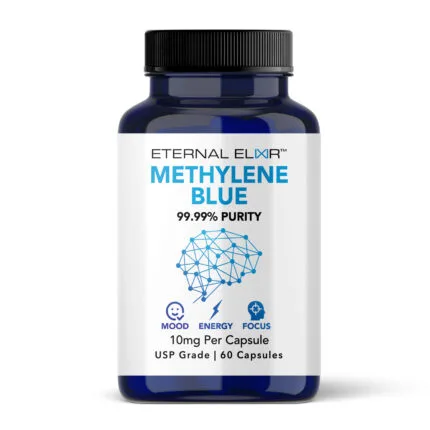
| Eternal Elixir Methylene Blue Capsules 10mg USP | Capsules | 10mg | 1 capsule daily (10mg) | 60 capsules | $59.99 | $1.00 | $1.00 | Capsules 10mg |
| Eternal Elixir Methylene Blue Liquid 1% USP | Drops | 10mg per ml | 0.5 to 1ml daily (5 to 10mg), diluted in water | 50ml | $49.99 | $0.50 to $1.00 | $1.00 | Liquid 1% |
| Blue Brain Methylene Blue (Supplement Mart) | Drops | 15mg per ml | “1 serve daily”, serve size not stated | 30ml | $49.95 | Not stated | $1.11 | supplementmart.com.au |
| Ultralife Methylene Blue with Taurine (Jing Organics) | Capsules | 20mg plus 740mg taurine | 2 capsules daily (40mg) | 120 capsules | $167.00 | $2.78 | $0.70 | jingorganics.com.au |
Add Methylene Blue Capsules to cart · $59.99
How to read it: our capsules and drops have the lowest label doses in the table and the lowest cost per day at the label serve, which suits a cautious start. Ultralife has the lowest cost per 10mg, but its label dose is 40mg a day, four times ours, and it adds taurine. Blue Brain is a stronger liquid at 15mg per ml, and its page doesn’t state how much a serve is.
Why our pick is Eternal Elixir Methylene Blue Capsules
- A clear, low dose. Each capsule holds 10mg of USP-grade methylene blue, and the label is one capsule a day.
- No blue mouth. Capsules are swallowed, so they avoid the blue mouth and tongue that drops can cause. Urine can still turn blue or green.
- Clear value. 60 capsules for $59.99, $1.00 a day. Bundles of two, three or five bottles save 10%, 15% or 20%, and orders over $100 ship free.
- Testing you can check. The product page shows a sample certificate of analysis for a methylene blue batch, and you can request the current batch certificate.
- Fast local dispatch. Orders ship from Sydney within 24 hours, with a 30-day money-back guarantee and Afterpay available.
Prefer to adjust your dose? Our Methylene Blue Liquid 1% is 10mg per ml, and the label is 0.5 to 1ml (5 to 10mg) a day diluted in water. Our liquid vs capsules guide compares the two.
How to take methylene blue
- Check your medicines first. If you take any serotonergic medicine, don’t take methylene blue. If you take any prescription medicine at all, ask your doctor or pharmacist first.
- Follow the label. Capsules: one 10mg capsule a day. Drops: 0.5 to 1ml (5 to 10mg) a day, diluted in water. Don’t exceed the label.
- Take it in the morning. Many people prefer an earlier dose, and it is easy to keep consistent.
- Expect blue or green urine. This is normal and temporary.
- Stop if something feels wrong. Agitation, confusion, a fast heartbeat, fever or muscle twitching need urgent medical attention, especially if you take any other medicine.
Our methylene blue drops dosage and timing guide covers the liquid in detail. Our article on micro-dosing methylene blue explains why the low doses sold as supplements are far below the doses used in studies. If you’re wondering about workplace screening, see will methylene blue show up on a drug test.
Stacking methylene blue
- Coffee. Many people take methylene blue with their morning coffee. Our guide to methylene blue and coffee covers what’s known about the combination.
- NMN. Both are discussed in the context of cellular energy, though no trial has tested them together. See stacking methylene blue with NMN.
- Not with ginseng. Don’t combine methylene blue with Korean ginseng, alone or in a stack.
For a wider look at energy-focused supplements, see our best mitochondrial support supplements, or browse our full range.
Frequently asked questions
What does methylene blue actually do to your body?
In cells, it picks up and hands over electrons, which lets it pass electrons along the mitochondrial energy chain in lab and animal studies. It also blocks MAO-A, the enzyme that breaks down serotonin, which is why it interacts with serotonergic medicines. It is well absorbed by mouth and can turn urine blue or green. In people, one small study found a single large dose improved memory recall, and one imaging study found it lowered brain oxygen use.
Add Methylene Blue Capsules to cart · $59.99
Why don’t doctors recommend methylene blue?
Because the evidence for daily use in healthy people is small, and the risks are real. It can cause serotonin syndrome with SSRIs, SNRIs, MAOIs and other serotonergic medicines. It isn’t suitable for people with G6PD deficiency, in pregnancy or breastfeeding, or for under 18s. Talk to your doctor before starting if you take any prescription medicine.
Why are people taking methylene blue now?
Interest has grown through biohacking, podcasts and social media, driven by its role in mitochondrial energy in lab studies and one small human memory study. Most people are trying low supplement doses of 5 to 10mg rather than the much larger doses used in research.
Is it safe to take methylene blue every day?
Our label is one 10mg capsule a day, or 0.5 to 1ml of the 1% liquid. There are few long-term data on daily low doses in healthy people, so keep to the label and don’t take it at all if you use serotonergic medicines, have G6PD deficiency, are pregnant or breastfeeding, or are under 18. Talk to your doctor if you take any prescription medicine.
Does methylene blue turn your urine blue?
Yes, it can turn urine blue or green. Methylene blue is cleared partly through the kidneys, so the colour change is expected and temporary. Drops can also stain the mouth and tongue, which capsules avoid.
How much methylene blue should I take?
Follow the label and don’t exceed it. For our capsules that is one 10mg capsule a day. For our 1% liquid it is 0.5 to 1ml (5 to 10mg) a day diluted in water. The 280mg used in the memory study is far higher than any supplement label and was given once, under supervision.
Sources
- Rodriguez P et al. Multimodal randomized functional MR imaging of the effects of methylene blue in the human brain. Radiology, 2016. PubMed 27351678
- Singh N et al. The effects of acute methylene blue administration on cerebral blood flow and metabolism in humans and rats. J Cereb Blood Flow Metab, 2023. PubMed 36803299
- Walter-Sack I et al. High absolute bioavailability of methylene blue given as an aqueous oral formulation. Eur J Clin Pharmacol, 2009. PubMed 18810398
- Ng BK, Cameron AJ. The role of methylene blue in serotonin syndrome: a systematic review. Psychosomatics, 2010. PubMed 20484716
- Ramsay RR et al. Methylene blue and serotonin toxicity: inhibition of monoamine oxidase A (MAO A) confirms a theoretical prediction. Br J Pharmacol, 2007. PubMed 17721552
- Schirmer RH et al. “Lest we forget you: methylene blue…”. Neurobiol Aging, 2011. PubMed 21316815