Last updated: September 26, 2026 · Originally published: December 26, 2025 · By Eternal Elixir Editorial
Quick Answer
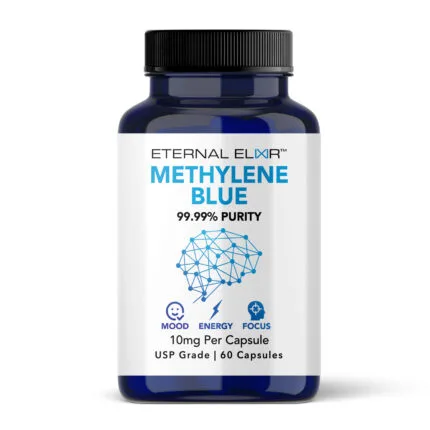
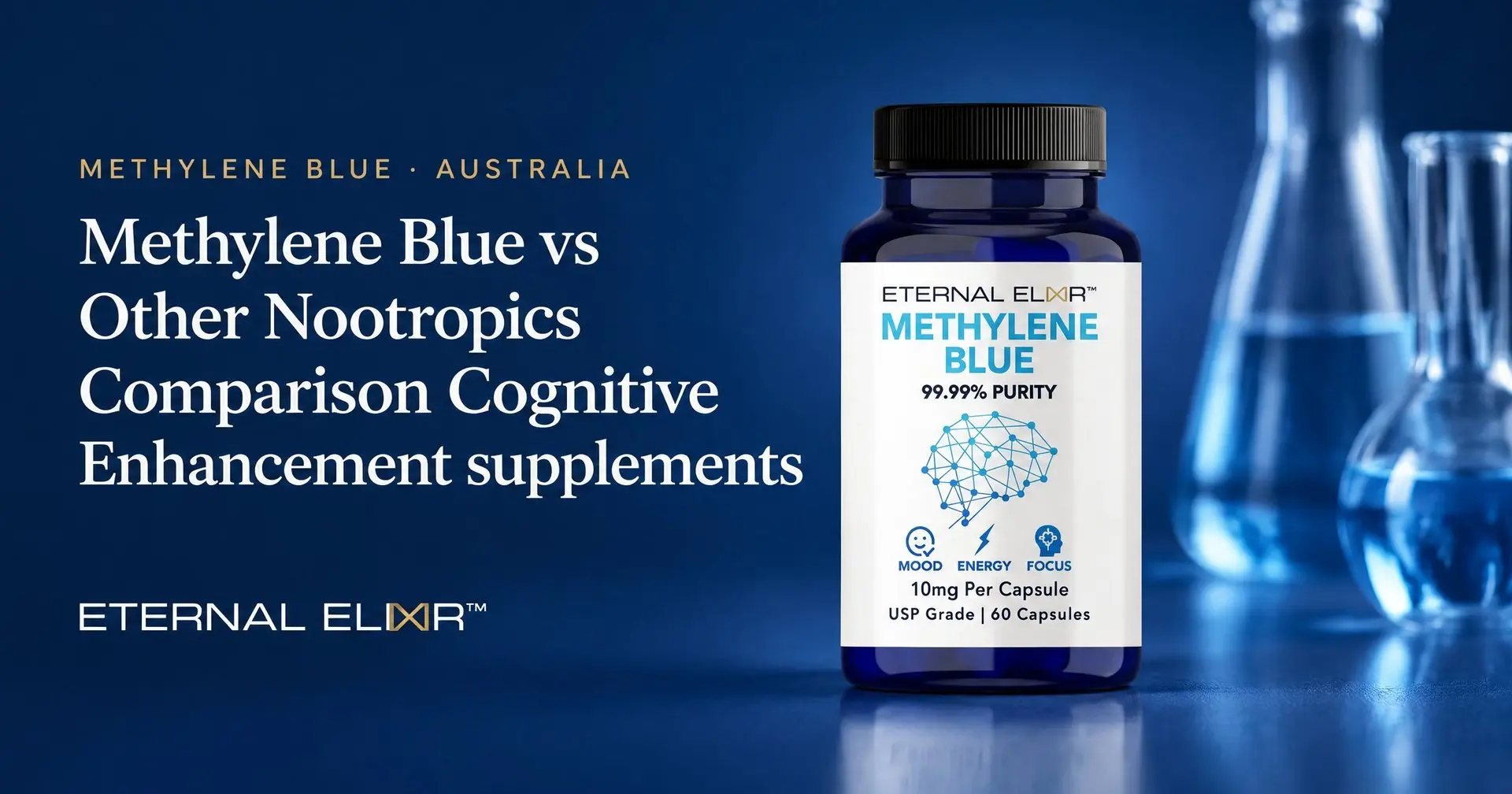
Our pick is Eternal Elixir Methylene Blue Capsules: 10 mg of USP-grade methylene blue in each capsule, 60 capsules for $59.99, which works out at $1.00 a day. It suits adults who want a once-a-day non-stimulant that works differently from caffeine and who take no serotonergic medicines. If all you want is a quick lift in alertness, caffeine with L-theanine has more human trials behind it.
Eternal Elixir makes the methylene blue capsules and drops on this page, so read this as our pick with the evidence shown. The seven alternatives are compared on published human trials, not on brands.
Methylene blue vs other nootropics comes down to two things: how each one works and how much human evidence sits behind it. Methylene blue is a dye that shuttles electrons inside mitochondria in cell studies and blocks the enzyme monoamine oxidase A (MAO-A). Most other cognitive enhancement supplements act somewhere else entirely, from the adenosine system (caffeine) to choline supply (Alpha-GPC and citicoline).
This comparison puts methylene blue next to seven common alternatives: six supplements and one prescription medicine. For each we give the best human trial we could find, with the number of people, the dose, how long it ran and what changed. Where the evidence is thin we say so, and that includes methylene blue.
Table of contents
- 1. Methylene blue vs other nootropics: quick comparison
- 2. Eternal Elixir methylene blue: price and cost per day (as of Sep 2026)
- 3. How methylene blue works, and what the human studies show
- 4. Seven alternatives compared with methylene blue
- 5. Which should you choose?
- 6. Why Eternal Elixir methylene blue is our pick
- 7. Stacking methylene blue with other nootropics
- 8. Frequently asked questions
- 8.1. What is the best cognitive enhancer supplement?
- 8.2. Why don’t doctors recommend methylene blue?
- 8.3. What is the most proven nootropic for brain health?
- 8.4. Is methylene blue safer than modafinil?
- 8.5. Can you take methylene blue with coffee?
- 8.6. How quickly does methylene blue work compared with other nootropics?
- 8.7. Where can you buy methylene blue in Australia?
- 9. The bottom line
- 10. Sources
Methylene blue vs other nootropics: quick comparison
Doses below are the amounts used in the trial we cite for each compound. They are not dosing advice, and the sections further down give the detail.
| Nootropic | Main action | Dose in the cited trial | What that trial found | Main caution |
|---|---|---|---|---|
| Methylene blue (Eternal Elixir capsules hold 10 mg) | Electron carrier in mitochondria (cell studies); MAO-A inhibitor | 280 mg, one dose | 7% more correct answers on a memory task an hour later (26 adults) | Not with serotonergic medicines or G6PD deficiency |
| Caffeine | Blocks adenosine receptors | 50 mg, one dose | Higher self-rated alertness at 60 minutes (27 participants) | Late doses cut into sleep |
| L-theanine | Amino acid from tea leaves | 200 mg a day for 4 weeks | Better verbal fluency and executive function scores (30 adults) | Small trial, product supplied by the maker |
| Lion’s mane | Edible mushroom (Hericium erinaceus) | 1.8 g, one dose and 28 days | Faster on the Stroop test after one dose, little else changed (41 adults) | Pilot study, mostly null results |
| Bacopa monnieri | Ayurvedic herb extract | 300 mg a day for 90 days | Better spatial working memory accuracy (62 participants finished) | Takes about 12 weeks |
| Alpha-GPC and citicoline | Choline sources | 250 or 500 mg Alpha-GPC for 7 days; 500 mg citicoline for 12 weeks | Alpha-GPC: no change in vigilance (48 men). Citicoline: better episodic memory (100 adults) | Results differ by compound |
| Modafinil | Prescription wakefulness medicine | Varied (systematic review) | Better executive function in most studies of rested adults | Needs a prescription and a doctor’s advice |
| Panax ginseng | Root extract (ginsenosides) | 200 mg G115 extract, one dose | Better mental arithmetic and less mental fatigue (30 adults) | Lowers blood glucose |
Eternal Elixir methylene blue: price and cost per day (as of Sep 2026)
Both formats give the same 10 mg serve for the same daily cost. Prices are in AUD at single-bottle rates and postage is not included.
| Product | Price (AUD) | Pack | Serve | Methylene blue per serve | Cost per day | Buy |
|---|---|---|---|---|---|---|
| Eternal Elixir Methylene Blue Capsules 10mg USP | $59.99 (was $69.99) | 60 capsules | 1 capsule | 10 mg | $1.00 | View capsules |
| Eternal Elixir Methylene Blue Liquid 1% USP | $49.99 (was $59.99) | 50 ml | 1 ml dropper | 10 mg | $1.00 | View drops |
Buying more than one bottle takes 10% off two, 15% off three and 20% off five. Two bottles of capsules come to $107.98, which also clears the $100 free-shipping threshold.
How methylene blue works, and what the human studies show
In cell studies, methylene blue picks up electrons and hands them to cytochrome c, so it can act as a spare carrier in the mitochondrial chain that makes cellular energy. A 2008 study in human fibroblasts grown in culture found that nanomolar amounts raised complex IV activity by 30% and cellular oxygen use by 37 to 70% (Atamna et al., FASEB Journal). Those were cells in a dish. They explain the idea, but they tell you nothing about what a capsule does in a person.
Methylene blue is also a potent, reversible inhibitor of MAO-A, the enzyme that breaks down serotonin (Ramsay et al., 2007, British Journal of Pharmacology). That property is the reason for its main safety warning, covered below.
The human trials
The best-known trial is Rodriguez et al. in Radiology (2016). Twenty-six healthy adults aged 22 to 62 took a single oral dose of 280 mg (about 4 mg/kg) or a placebo, then had functional MRI an hour later. The methylene blue group made 7% more correct responses during memory retrieval and showed stronger brain responses during attention and short-term memory tasks (PMID 27351678). It was one dose in 26 people. Participants with G6PD deficiency or on psychiatric medicines were excluded.
A 2014 trial in the American Journal of Psychiatry gave 260 mg straight after a fear-extinction session, with 23 adults on methylene blue and 19 on placebo. The methylene blue group showed better incidental memory for the training setting at follow-up. People who still felt moderate or high fear at the end of the session tended to do worse with methylene blue, so the effect depended on how the session went (Telch et al., 2014).
Then there is the result the marketing leaves out. In 2023 a King’s College London team gave eight healthy women intravenous methylene blue at 0.5 and 1 mg/kg and measured brain blood flow and oxygen use by MRI. Both went down, with global blood flow about 8% lower, the opposite of what the researchers expected (Singh et al., Journal of Cerebral Blood Flow & Metabolism). Claims you will read online that methylene blue directly raises ATP in the brain come from cell and animal work. The first human study to measure brain oxygen metabolism directly found that it fell at those doses.
Our serve compared with the trial doses
Our capsule holds 10 mg. The memory trials used single doses of 260 and 280 mg, roughly 26 to 28 times more, given once in a supervised setting. No published trial has tested 10 mg a day for focus in healthy adults, so we cannot tell you it reproduces those results. What a 10 mg capsule gives you is a small, fixed, USP-grade amount you can take once a day. The drops let you go lower still.
Seven alternatives compared with methylene blue
Methylene blue vs caffeine
Caffeine works by blocking adenosine receptors. A 2016 review of the research found that it improves vigilance, attention and reaction time, with less consistent effects on memory and complex decisions (McLellan et al., Neuroscience & Biobehavioral Reviews). In a 2008 crossover trial of 27 healthy volunteers, 50 mg of caffeine raised self-rated alertness at 60 minutes and accuracy on an attention-switching task at 90 minutes (Owen et al., Nutritional Neuroscience).
Caffeine has far more human data than methylene blue and costs very little. The catch is timing: 400 mg of caffeine taken even six hours before bed disturbed sleep in a home study (Drake et al., 2013). Methylene blue works through a different pathway, and some people take both. No trial has tested that pairing, and our guide to taking methylene blue with coffee covers what is known about timing.
Methylene blue vs L-theanine
L-theanine is an amino acid found in tea leaves. In a 2019 Japanese crossover trial, 30 healthy adults took 200 mg a day or placebo for four weeks. On L-theanine their verbal fluency and executive function scores improved, and their stress and sleep-quality questionnaire scores got better as well (Hidese et al., Nutrients). The tablets came from an L-theanine maker, and two of its employees were authors.
L-theanine is often paired with caffeine. In the Owen trial, 100 mg of L-theanine with 50 mg of caffeine improved both speed and accuracy on attention switching at 60 minutes and made people less distractible on a memory task. Choose L-theanine if you already drink coffee and want calmer concentration. Methylene blue and L-theanine have not been studied together.
Methylene blue vs lion’s mane
Lion’s mane (Hericium erinaceus) is an edible mushroom. Most earlier trials enrolled people who already had cognitive problems, so the evidence in healthy adults is thin. In a 2023 Northumbria University pilot, 41 healthy adults aged 18 to 45 took 1.8 g of lion’s mane or placebo. One dose made them faster on the Stroop test at 60 minutes. After 28 days there was only a trend towards lower stress (p = 0.051) and no clear change on the other measures, and the authors called their findings tentative (Docherty et al., Nutrients).
Both compounds rest on small human studies. Lion’s mane is a food-based option that most people take daily for weeks, while the methylene blue trials measured effects within an hour of a dose far larger than a daily supplement serve.
Methylene blue vs bacopa
Bacopa monnieri, a herb from Ayurvedic medicine, has one of the better records for memory in healthy adults. A 90-day trial at Swinburne University in Melbourne recruited 107 healthy people, and 62 finished. Those taking 300 mg a day of a bacopa extract (taken as two 150 mg doses) improved spatial working memory accuracy against placebo (Stough et al., 2008, Phytotherapy Research). A 2014 meta-analysis pooled nine trials with 518 participants, all running 12 weeks or longer, and found shorter Trail B times and faster choice reaction times (Kongkeaw et al., Journal of Ethnopharmacology).
Bacopa suits someone willing to take a capsule daily for three months and judge the result then. Methylene blue’s trials looked at hours, not months, so the two answer different questions.
Methylene blue vs Alpha-GPC and citicoline
Alpha-GPC and citicoline both supply choline, which the brain uses to make the neurotransmitter acetylcholine. Their evidence splits. In a 2017 trial, 48 healthy college-aged men took 250 or 500 mg of Alpha-GPC daily for seven days, and their psychomotor vigilance did not differ from placebo (Marcus et al., Journal of the International Society of Sports Nutrition). Citicoline did better: in a 12-week trial of 100 healthy adults aged 50 to 85 with age-related memory complaints, 500 mg a day improved episodic and overall memory scores against placebo (Nakazaki et al., 2021, Journal of Nutrition).
If memory in your fifties and beyond is the goal, citicoline has the stronger trial. Choline sources and methylene blue act on separate systems.
Methylene blue vs modafinil
Modafinil is a prescription wakefulness medicine, not a supplement. A 2015 systematic review of studies in healthy people who were not sleep deprived found that most showed better executive function, and about half showed better attention or learning and memory. On more demanding tasks the gains were more consistent (Battleday and Brem, European Neuropsychopharmacology).
The effect of modafinil in rested adults is better documented than that of methylene blue, but it comes through a doctor, who weighs it against your health and medicines. Nobody can honestly call one of the two safer. They carry different risks and have never been compared head to head.
Methylene blue vs Panax ginseng
Panax ginseng is the root sold as Korean red ginseng. In a 2005 Northumbria crossover trial, 30 healthy young adults took 200 mg or 400 mg of the standardised extract G115, or placebo, and then worked through six back-to-back rounds of mental arithmetic. The 200 mg dose improved Serial Sevens subtraction and reduced self-rated mental fatigue, and both doses lowered blood glucose (Reay et al., Journal of Psychopharmacology). If you take glucose-lowering medicine, talk to your doctor before using ginseng.
Our Korean Panax Ginseng gives 1,600 mg per two-capsule serve, with 90 capsules (45 serves) for $44.99, or $1.00 a serve. The product page says its ginsenosides are standardised but does not give a percentage, so the 1,600 mg is not directly comparable with the 200 mg G115 extract used in the trial. Our guide to the best Korean red panax ginseng in Australia compares the local options.
Don’t combine methylene blue with ginseng. If ginseng is the better fit for you, our Daily Energy & Vitality Stack pairs Korean Panax Ginseng 1,600 mg with Tongkat Ali and Shilajit 1,000 mg for $109.99, less than buying the three separately.
Which should you choose?
Match the compound to the job you want done:
- A once-a-day non-stimulant with a different mechanism: Eternal Elixir Methylene Blue Capsules, provided you take no serotonergic medicines and do not have G6PD deficiency.
- A quick lift in alertness before a work block: caffeine, with or without L-theanine, kept well away from bedtime.
- Calmer concentration alongside coffee: L-theanine.
- Memory over several months: bacopa, judged after 12 weeks.
- Memory in later adulthood: citicoline.
- Mental fatigue during long, demanding tasks: Panax ginseng.
- Medical-strength wakefulness: modafinil, only through your doctor.
Who methylene blue does not suit
Do not take methylene blue if you use an SSRI, SNRI, MAOI or any other serotonergic medicine. A 2010 systematic review found 26 patients who developed acute confusion after methylene blue infusions, and 24 of them were taking a serotonin reuptake inhibitor (Ng and Cameron, Psychosomatics). It is also unsuitable for anyone with G6PD deficiency because of the risk of haemolysis (StatPearls: Methylene Blue). If you are pregnant, breastfeeding, under 18 or on any prescription medicine, talk to your doctor first. Expect blue urine: every participant given methylene blue in the 2016 Radiology trial reported it. Our methylene blue safety guide covers the interaction in detail.
Why Eternal Elixir methylene blue is our pick
Eternal Elixir makes the methylene blue on this page, and it is our pick in this comparison. Here is what you get, taken from the label and the product page:
- 10 mg of USP-grade methylene blue in every capsule, 60 capsules a bottle, one capsule a day.
- Drops as a 1% solution in a 50 ml bottle, with 10 mg in each 1 ml dropper. Half a dropper gives about 5 mg if you want to start lower.
- $1.00 a day in either format at single-bottle prices, and less with the 10%, 15% or 20% multi-bottle savings.
- Free shipping over $100, a 30-day money-back guarantee, dispatch from Sydney within 24 hours and Afterpay at checkout.
Capsules are the simpler choice for a fixed daily amount. Drops suit people who want to adjust the dose in small steps. Our guides to methylene blue liquid vs capsules and how to take methylene blue drops go through dosing and timing, and our comparison of the best methylene blue supplements in Australia sets our products against the other brands sold here.
Add Methylene Blue Capsules to cart · $59.99Stacking methylene blue with other nootropics
People often combine methylene blue with other compounds, but almost none of these pairings has been tested in a trial. Coffee is the most common partner, and NMN is another, since both are discussed in terms of mitochondrial energy. Our methylene blue and NMN stacking guide sets out that combination, and our roundup of the best NMN supplements in Australia compares the NMN products sold here. If your interest leans towards longevity compounds rather than focus, see pterostilbene vs resveratrol.
Leave serotonergic supplements such as 5-HTP and St John’s wort out of any methylene blue stack, for the same reason as the medicines above. For a lower-dose approach, our guide to micro-dosing methylene blue covers small daily amounts, and our article on methylene blue and brain fog looks at what the research says about mental fatigue. For the wider field, our best nootropic supplements in Australia roundup and our guide to nootropics in Australia cover products beyond methylene blue, or you can browse the full Eternal Elixir range.
Frequently asked questions
What is the best cognitive enhancer supplement?
Our pick is Eternal Elixir Methylene Blue Capsules for adults who want a low, fixed daily dose of a non-stimulant that works differently from caffeine. Eternal Elixir makes it, so weigh that. On the sheer amount of human evidence for alertness, caffeine alone or with L-theanine is ahead, and bacopa has the stronger record for memory over 12 weeks.
Add Methylene Blue Capsules to cart · $59.99
Why don’t doctors recommend methylene blue?
The human evidence for focus is small: the main trials had 26 and 42 people and used single doses of 260 and 280 mg, not a daily supplement. Methylene blue also interacts with serotonergic medicines, including many antidepressants, and has caused serious reactions in people taking them. It is unsuitable for people with G6PD deficiency too. A doctor who knows your medicines is the right person to ask.
What is the most proven nootropic for brain health?
Caffeine has the largest body of human research for attention and reaction time. For memory, bacopa has a meta-analysis of nine trials with 518 participants lasting 12 weeks or more. Methylene blue’s human data are much smaller. None of these trials measured long-term brain health, so “proven” overstates what is known for any of them.
Is methylene blue safer than modafinil?
Neither can be called safer, because they carry different risks and no trial has compared them. Modafinil is a prescription medicine that your doctor would weigh against your health. Methylene blue’s main risks are the interaction with serotonergic medicines and G6PD deficiency. Ask your doctor before using either.
Can you take methylene blue with coffee?
Many people take the two together, but no trial has tested the combination. Keep caffeine well before bedtime, since 400 mg disturbed sleep even six hours before bed in the Drake study. Our guide to methylene blue and coffee covers timing.
How quickly does methylene blue work compared with other nootropics?
In the 2016 Radiology trial, effects were measured one hour after a single 280 mg dose. Caffeine’s effects appeared at 60 minutes in the Owen trial, and lion’s mane’s single-dose result was also at 60 minutes. Bacopa trials ran for 12 weeks or more. No study has measured the time course of a 10 mg daily serve.
Where can you buy methylene blue in Australia?
Eternal Elixir sells USP-grade methylene blue as 10 mg capsules ($59.99 for 60) and 1% drops ($49.99 for 50 ml), dispatched from Sydney within 24 hours. Buy product made for people to take, never aquarium or laboratory dye.
Add Methylene Blue Drops to cart · $49.99
The bottom line
Eternal Elixir Methylene Blue Capsules are our pick for Australian adults who want a once-a-day non-stimulant with a mechanism unlike caffeine’s: 10 mg of USP-grade methylene blue per capsule, 60 capsules, $1.00 a day. The memory findings behind methylene blue come from single doses 26 to 28 times larger than our capsule, and caffeine, bacopa and citicoline each have more human data for their particular uses. If you take a serotonergic medicine, choose one of the alternatives instead.
Sources
- Rodriguez P, Zhou W, Barrett DW, et al. Multimodal randomized functional MR imaging of the effects of methylene blue in the human brain. Radiology. 2016;281(2):516-526. PubMed 27351678
- Telch MJ, Bruchey AK, Rosenfield D, et al. Effects of post-session administration of methylene blue on fear extinction and contextual memory in adults with claustrophobia. American Journal of Psychiatry. 2014;171(10):1091-1098. PubMed 25018057
- Singh N, MacNicol E, DiPasquale O, et al. The effects of acute methylene blue administration on cerebral blood flow and metabolism in humans and rats. Journal of Cerebral Blood Flow & Metabolism. 2023;43(2 suppl):95-105. PubMed 36803299
- Atamna H, Nguyen A, Schultz C, et al. Methylene blue delays cellular senescence and enhances key mitochondrial biochemical pathways. FASEB Journal. 2008;22(3):703-712. PubMed 17928358
- Ramsay RR, Dunford C, Gillman PK. Methylene blue and serotonin toxicity: inhibition of monoamine oxidase A confirms a theoretical prediction. British Journal of Pharmacology. 2007;152(6):946-951. PubMed 17721552
- Ng BK, Cameron AJ. The role of methylene blue in serotonin syndrome: a systematic review. Psychosomatics. 2010;51(3):194-200. PubMed 20484716
- Ostrovsky A, Afzal M. Methylene Blue. StatPearls (updated 2 January 2026). NCBI Bookshelf NBK557593
- McLellan TM, Caldwell JA, Lieberman HR. A review of caffeine’s effects on cognitive, physical and occupational performance. Neuroscience & Biobehavioral Reviews. 2016;71:294-312. PubMed 27612937
- Owen GN, Parnell H, De Bruin EA, Rycroft JA. The combined effects of L-theanine and caffeine on cognitive performance and mood. Nutritional Neuroscience. 2008;11(4):193-198. PubMed 18681988
- Drake C, Roehrs T, Shambroom J, Roth T. Caffeine effects on sleep taken 0, 3, or 6 hours before going to bed. Journal of Clinical Sleep Medicine. 2013;9(11):1195-1200. PubMed 24235903
- Hidese S, Ogawa S, Ota M, et al. Effects of L-theanine administration on stress-related symptoms and cognitive functions in healthy adults: a randomized controlled trial. Nutrients. 2019;11(10):2362. PubMed 31623400
- Docherty S, Doughty FL, Smith EF. The acute and chronic effects of lion’s mane mushroom supplementation on cognitive function, stress and mood in young adults: a double-blind, parallel groups, pilot study. Nutrients. 2023;15(22):4842. PubMed 38004235
- Stough C, Downey LA, Lloyd J, et al. Examining the nootropic effects of a special extract of Bacopa monniera on human cognitive functioning: 90 day double-blind placebo-controlled randomized trial. Phytotherapy Research. 2008;22(12):1629-1634. PubMed 18683852
- Kongkeaw C, Dilokthornsakul P, Thanarangsarit P, et al. Meta-analysis of randomized controlled trials on cognitive effects of Bacopa monnieri extract. Journal of Ethnopharmacology. 2014;151(1):528-535. PubMed 24252493
- Marcus L, Soileau J, Judge LW, Bellar D. Evaluation of the effects of two doses of alpha glycerylphosphorylcholine on physical and psychomotor performance. Journal of the International Society of Sports Nutrition. 2017;14:39. PubMed 29042830
- Nakazaki E, Mah E, Sanoshy K, et al. Citicoline and memory function in healthy older adults: a randomized, double-blind, placebo-controlled clinical trial. Journal of Nutrition. 2021;151(8):2153-2160. PubMed 33978188
- Battleday RM, Brem AK. Modafinil for cognitive neuroenhancement in healthy non-sleep-deprived subjects: a systematic review. European Neuropsychopharmacology. 2015;25(11):1865-1881. PubMed 26381811
- Reay JL, Kennedy DO, Scholey AB. Single doses of Panax ginseng (G115) reduce blood glucose levels and improve cognitive performance during sustained mental activity. Journal of Psychopharmacology. 2005;19(4):357-365. PubMed 15982990