Last updated: September 27, 2026 · Originally published: May 2, 2026 · By Eternal Elixir Editorial
Yes, most healthy adults can drink coffee while taking methylene blue, but no human study has tested the two together, so any advice on stacking them is practical rather than proven. The real risks come from methylene blue itself. It strongly blocks the enzyme MAO-A in lab studies, so it must not be combined with SSRIs, SNRIs, MAOIs or other serotonergic medicines, and people with G6PD deficiency should not take it. Coffee’s usual limits still apply: a large review linked up to 400 mg of caffeine a day with no overt harm in healthy adults, and caffeine taken six hours before bed still disrupted sleep in a controlled study.
A note on the search results for this topic: most of them are chemistry papers on using spent coffee grounds to soak methylene blue dye out of wastewater. That work tells you nothing about drinking a coffee with a capsule. This guide covers the human side: what each one does, what is and isn’t known about taking them together, a sensible daily routine, and who should skip methylene blue altogether.
Key takeaways
- We found no human study of methylene blue and caffeine together, and no reported interaction between them.
- Caffeine is broken down mainly by the liver enzyme CYP1A2, not by MAO, the enzyme methylene blue blocks.
- Brewed coffee contains small amounts of two compounds that blocked MAO in lab tests. Whether that adds to methylene blue’s effect in people is unknown.
- Keep caffeine to 400 mg a day or less, and stop it at least six hours before bed.
- Methylene blue is not for anyone on serotonergic medicines, with G6PD deficiency, pregnant or breastfeeding, or under 18.
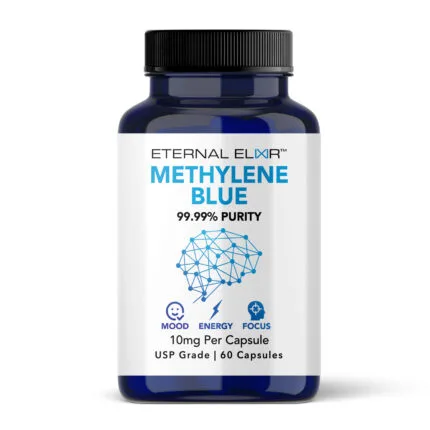
Eternal Elixir makes Methylene Blue Capsules 10mg, and they are our pick for pairing with a morning coffee: one 10 mg capsule a day, 60 capsules to a bottle, swallowed with water so there is no dye to taste or rinse off. The human studies of attention and memory used a single dose of 260 to 280 mg, which is 26 to 28 times our capsule, so we can’t promise the effects those studies measured.
Table of contents
- 1. The Quick Answer: Can You Take Methylene Blue With Coffee?
- 2. How Methylene Blue and Caffeine Each Work
- 3. The Critical Caveat: Methylene Blue Blocks MAO-A
- 4. What Should You Not Take With Methylene Blue?
- 5. Methylene Blue and Coffee Timing: A Practical Routine
- 6. Why Do I Feel Weird (or Good) After Taking Methylene Blue?
- 7. Does Methylene Blue Flush Toxins From Your Body?
- 8. Capsules or Drops With Coffee?
- 9. Quality Matters: Buy Methylene Blue Made for People
- 10. Eternal Elixir Methylene Blue: What Is in the Bottle
- 11. Methylene Blue and Coffee: Frequently Asked Questions
- 11.1. Can I take methylene blue right after my morning coffee?
- 11.2. Does methylene blue increase the effects of caffeine?
- 11.3. Will coffee reduce the absorption of methylene blue?
- 11.4. How long should I wait between methylene blue and coffee if I’m sensitive to stimulants?
- 11.5. Can I drink decaf coffee with methylene blue?
- 11.6. Is the blue tongue from methylene blue affected by drinking coffee?
- 11.7. What should you not take with methylene blue?
- 11.8. Is it safe to take methylene blue every day with coffee?
- 11.9. What is the best methylene blue to take with coffee?
- 12. The Bottom Line on Methylene Blue and Coffee
- 13. Sources
The Quick Answer: Can You Take Methylene Blue With Coffee?
For most healthy adults who are not on any of the medicines below, yes. Here is what the evidence does and doesn’t say.
| Question | Short answer | Based on |
|---|---|---|
| Is there a known interaction between caffeine and methylene blue? | None reported. We found no human study of the pair. | Our PubMed search, Sep 2026 |
| Does caffeine go through MAO, the enzyme methylene blue blocks? | No. The liver enzyme CYP1A2 handles about 95% of the caffeine you drink. | Nehlig, 2018 |
| Does coffee itself act on MAO? | Brewed coffee contains norharman and harman, which blocked human MAO in lab tests. The effect in coffee drinkers hasn’t been measured. | Herraiz and Chaparro, 2006 |
| How much caffeine is in a coffee? | It varies widely. Espresso bought on the Gold Coast held 25 to 214 mg per serve, 106 mg on average. | Desbrow et al., 2007 |
| How much caffeine a day is reasonable? | Up to 400 mg a day was not linked with overt harm in healthy adults. | Wikoff et al., 2017 |
| When should the last coffee be? | At least six hours before bed. | Drake et al., 2013 |
| Who should not take methylene blue? | Anyone on serotonergic medicines, with G6PD deficiency, pregnant or breastfeeding, or under 18. | Ng and Cameron, 2010. Youngster et al., 2010. Our product label. |
How Methylene Blue and Caffeine Each Work
Caffeine is a stimulant. Its main target in the brain is the adenosine A2A receptor, which normally helps signal tiredness. About 95% of the caffeine you drink is broken down in the liver by an enzyme called CYP1A2, and how fast that happens varies a lot from person to person (Nehlig, 2018).
Methylene blue is not a stimulant. It is a redox dye, which means it readily gains and gives up electrons, and it strongly blocks the enzyme MAO-A (Ramsay et al., 2007). The best human evidence for attention and memory comes from a small brain-imaging trial. In 26 healthy adults aged 22 to 62, a single 280 mg oral dose (about 4 mg per kg) raised brain activity during attention and short-term memory tasks an hour later, and correct answers on a memory task rose 7% against placebo. The only effect people reported was blue urine (Rodriguez et al., 2016).
That dose is 28 times our 10 mg capsule, and nobody has tested whether 10 mg does the same. So the idea that methylene blue and coffee work together is a theory. Caffeine changes how tired you feel. Whether methylene blue at a 10 mg supplement dose changes how you feel has not been tested, with or without coffee. For the wider picture, our comparison of methylene blue against other nootropics covers what each one has shown in people.
The Critical Caveat: Methylene Blue Blocks MAO-A
MAO-A is the enzyme that breaks down serotonin, among other chemical messengers. In tests on purified human enzyme, methylene blue was a potent, reversible blocker of MAO-A and a much weaker blocker of MAO-B. The researchers calculated that at the blood levels reached after an intravenous dose in hospital, MAO-A would be completely blocked, and they flagged that taking it by mouth also has implications for how the gut handles dietary amines (Ramsay et al., 2007).
This is why methylene blue and serotonergic medicines don’t mix. A systematic review found 26 patients who became acutely confused after a methylene blue infusion. Twenty-four of them were taking a serotonin reuptake inhibitor and one was taking clomipramine, and serotonin syndrome was a possible diagnosis in all 25 (Ng and Cameron, 2010). A review of methylene blue in psychiatry described it as usually well tolerated but said caution is needed because of its effect on MAO-A (Alda, 2019).
How much MAO-A a 10 mg capsule blocks in a person has not been measured. The hospital cases above involved far larger intravenous doses. We still treat the medicine rule as absolute, because the downside is serious.
Where coffee fits in
Caffeine itself is not broken down by MAO. Brewed coffee does contain small amounts of two compounds, norharman and harman, and ready-to-drink coffee brews blocked human MAO-A and MAO-B in lab tests (Herraiz and Chaparro, 2006). Nobody has tested whether a cup of coffee adds to methylene blue’s effect on MAO in people. In practice, if a coffee on methylene blue leaves you more wired than a coffee usually does, cut back the coffee first.
What Should You Not Take With Methylene Blue?
Our product pages say not to use methylene blue with SSRIs, SNRIs, MAOIs, linezolid, certain migraine medicines or other serotonergic medicines unless a qualified health professional has cleared it. In full:
- Serotonergic medicines. SSRIs, SNRIs, MAOIs, tricyclic medicines such as clomipramine, linezolid, certain migraine medicines and anything else that raises serotonin. The risk is serotonin syndrome.
- G6PD deficiency. An evidence review of medicines in G6PD deficiency found solid evidence to avoid only seven, and methylene blue was one of them, because of the risk of red blood cells breaking down (Youngster et al., 2010).
- Pregnancy and breastfeeding. Do not take methylene blue while pregnant or breastfeeding unless your doctor advises it.
- Under 18. We found no safety data for methylene blue supplements in under-18s, so they are for adults only.
- Ginseng. Don’t combine methylene blue with ginseng, including the ginseng in our Daily Energy & Vitality Stack and Brain, Mood & Sleep Stack.
- Any prescription medicine. Talk to your doctor or pharmacist before you start.
Coffee is not on this list. Our methylene blue safety guide on serotonin syndrome and MAOIs covers the medicine side in more detail.
Methylene Blue and Coffee Timing: A Practical Routine
No trial has tested timing for this pair, so treat what follows as a sensible routine rather than a protocol with evidence behind it.
- Take methylene blue with water. Our capsule label says one capsule daily. Our drops label says 0.5 to 1 ml (5 to 10 mg) daily, diluted in water. We have no data on dropping it into coffee, so follow the label and use water.
- Have your coffee when you normally would. Spacing the two by an hour or so has no study behind it, but it helps in the first week or two, because you can tell which one you are reacting to. For reference, the brain-imaging study measured its effects 60 minutes after the dose.
- Keep total caffeine to 400 mg a day or less. With Gold Coast espresso averaging 106 mg a serve, four would already take you past that (Desbrow et al., 2007. Wikoff et al., 2017).
- Stop caffeine at least six hours before bed. In a controlled study, 400 mg of caffeine taken six hours before bedtime still disrupted sleep, and the authors backed the advice to avoid substantial caffeine for at least six hours before bed (Drake et al., 2013).
- Change one thing at a time. If you are new to methylene blue, keep your usual coffee the same for the first couple of weeks so you know what is doing what.
A simple day looks like this: one capsule with water at breakfast, your usual coffee mid-morning, and a last coffee in the early afternoon. For more on doses and timing, see our guide on how to take methylene blue drops, dosage and timing and our guide to micro-dosing methylene blue.
Why Do I Feel Weird (or Good) After Taking Methylene Blue?
Blue or green urine is the effect almost everyone notices. In the brain-imaging trial, every participant who took methylene blue reported blue urine afterwards (Rodriguez et al., 2016), and our product pages say the same can happen at 10 mg. It is the dye leaving your body.
Feeling wired, restless or unusually alert in the first days is more likely to come from caffeine than from a 10 mg capsule, especially if you have changed your coffee at the same time. Cut back the coffee and see whether it settles.
Some feelings are a reason to stop at once. In the hospital cases linked to serotonergic medicines, the warning signs were confusion, agitation and signs of an unsettled nervous system such as sweating, fever, shaking or a racing heart (Ng and Cameron, 2010). If you notice any of these, stop methylene blue and get medical help straight away, and tell the doctor about any medicines you take.
As for feeling good: the human studies of mood used medical doses under supervision, and the attention and memory results came from 260 to 280 mg single doses. We can’t tell you that a 10 mg capsule lifts your mood or focus. If you feel better, part of it may simply be a more regular morning routine.
Does Methylene Blue Flush Toxins From Your Body?
No human study shows that a methylene blue supplement clears toxins. Your body clears methylene blue itself. In a study of 7 volunteers given 100 mg, 18% of an oral dose came out in the urine as methylene blue and its colourless form, and the terminal half-life after an intravenous dose was about 5.25 hours (Peter et al., 2000). That is why urine turns blue-green. It is a sign of the dye being removed, not of anything else being flushed out.
Capsules or Drops With Coffee?
Both hold the same ingredient. The difference is how you take it, and that matters more when coffee is part of the routine.
| Eternal Elixir product | Dose | Pack | Label directions | Price (AUD, as of Sep 2026) | Cost per day | Good to know |
|---|---|---|---|---|---|---|
| Methylene Blue Capsules 10mg (our pick) | 10 mg per capsule | 60 capsules | 1 capsule daily | $59.99 | $1.00 | Swallowed whole, so no taste and no dye on your tongue or cup |
| Methylene Blue Liquid 1% | 10 mg per 1 ml | 50 ml | 0.5 to 1 ml (5 to 10 mg) daily, diluted in water | $49.99 | $0.50 to $1.00 | Lets you take 5 mg, but drops can stain the mouth and tongue |
The capsule suits coffee drinkers who want one fixed amount and nothing to measure. The drops suit people who want to start at 5 mg. If you choose the drops, dilute them in water as the label says, and rinse your mouth afterwards. Our comparison of methylene blue liquid vs capsules goes through the trade-offs.
Quality Matters: Buy Methylene Blue Made for People
Methylene blue is also sold as an aquarium treatment and a laboratory stain. Those products are not made or labelled for people to swallow, and their labels don’t tell you the dose. Buy a supplement that states the grade and the amount per serve.
Our capsules list USP-grade methylene blue at 10 mg per capsule, with rice flour, a cellulose capsule and citric acid. Our drops list USP-grade methylene blue at 10 mg per ml in purified water. To see how other Australian options compare on price and dose, read our guide to the best methylene blue supplements in Australia.
Eternal Elixir Methylene Blue: What Is in the Bottle
Methylene Blue Capsules 10mg come 60 to a bottle at $59.99, one a day, so a bottle lasts 60 days at $1.00 a day. Methylene Blue Liquid 1% is a 50 ml bottle at $49.99, which is $0.50 a day at 0.5 ml or $1.00 a day at 1 ml. On either product, two bottles save 10%, three save 15% and five save 20%. Orders over $100 ship free, and orders leave Sydney within 24 hours.
Our guide to stacking methylene blue with NMN covers the most common pairing.
Who it suits: healthy adults who take no serotonergic medicines, don’t have G6PD deficiency, and want a small, fixed daily amount alongside their usual coffee. Who it doesn’t suit: anyone on SSRIs, SNRIs, MAOIs or other serotonergic medicines, anyone pregnant, breastfeeding or under 18, and anyone expecting the effects measured at 280 mg from a 10 mg capsule.
Add Methylene Blue Capsules to cart · $59.99
Methylene Blue and Coffee: Frequently Asked Questions
Can I take methylene blue right after my morning coffee?
Yes, if you are a healthy adult who takes no serotonergic medicines. No interaction between caffeine and methylene blue has been reported. Leaving an hour or so between them in your first couple of weeks makes it easier to tell which one you are reacting to, though no study has tested the gap.
Does methylene blue increase the effects of caffeine?
We found no human study that measured this. Caffeine is broken down by CYP1A2, not by MAO, so methylene blue’s best-known action doesn’t touch caffeine directly. Coffee does contain small amounts of compounds that blocked MAO in lab tests, and how they add up with methylene blue in people is unknown. If you feel more wired than usual, drink less coffee.
Will coffee reduce the absorption of methylene blue?
There is no published study on this. Taken by mouth as a liquid, methylene blue is well absorbed: in 16 healthy volunteers, absolute bioavailability of a 500 mg oral dose was 72.3% (Walter-Sack et al., 2009). Whether coffee changes that has not been tested, so take methylene blue with water as the label directs.
How long should I wait between methylene blue and coffee if I’m sensitive to stimulants?
There is no tested answer. A practical approach is to take the capsule with water at breakfast and wait an hour or two before a smaller coffee than usual, then build back up if you feel fine. Keep caffeine at least six hours clear of bedtime.
Add Methylene Blue Capsules to cart · $59.99
Can I drink decaf coffee with methylene blue?
Yes. Decaf takes most of the caffeine out, which removes the stimulant side of the question. It is still coffee, so it may carry some of the same compounds that blocked MAO in lab tests, but we found no study of decaf with methylene blue.
Is the blue tongue from methylene blue affected by drinking coffee?
Coffee won’t stop drops from staining. A dark drink may hide the colour in the cup, but the dye still sits on your tongue. Rinse with water after the drops, or use capsules, which are swallowed whole and don’t touch your tongue. Blue-green urine can happen with either format.
What should you not take with methylene blue?
SSRIs, SNRIs, MAOIs, tricyclic medicines, linezolid, certain migraine medicines and other serotonergic medicines, because of the risk of serotonin syndrome. Don’t take it with G6PD deficiency, in pregnancy or breastfeeding, or under 18, and don’t take two methylene blue products at once. Talk to your doctor if you take any prescription medicine.
Is it safe to take methylene blue every day with coffee?
Our capsule label directs one 10 mg capsule a day. We found no long-term study of daily methylene blue at this dose, with or without coffee, so we can’t give you a tested answer for years of use. If you plan to take it daily for months, mention it to your GP, and keep your caffeine within 400 mg a day.
What is the best methylene blue to take with coffee?
Our pick is Eternal Elixir Methylene Blue Capsules 10mg: one capsule a day with water, 60 capsules per bottle at $1.00 a day, and nothing to taste or rinse off before your coffee. If you want to start lower, our Methylene Blue Liquid 1% lets you take 5 mg. See our best methylene blue supplements comparison for the other Australian options.
Add Methylene Blue Capsules to cart · $59.99
The Bottom Line on Methylene Blue and Coffee
You can drink coffee while taking methylene blue if you are a healthy adult on no serotonergic medicines and without G6PD deficiency. Nobody has studied the pair, so there is no proven benefit to stacking them and no reported interaction either. Take methylene blue with water, keep caffeine to 400 mg a day or less, stop it six hours before bed, and change one thing at a time so you know what you are feeling.
If you are building a wider energy routine, see our guide to the best energy supplements in Australia or browse the full Eternal Elixir range.
Sources
- Ramsay RR, Dunford C, Gillman PK. Methylene blue and serotonin toxicity: inhibition of monoamine oxidase A (MAO A) confirms a theoretical prediction. Br J Pharmacol. 2007;152(6):946-951. PubMed 17721552
- Ng BK, Cameron AJ. The role of methylene blue in serotonin syndrome: a systematic review. Psychosomatics. 2010;51(3):194-200. PubMed 20484716
- Alda M. Methylene blue in the treatment of neuropsychiatric disorders. CNS Drugs. 2019;33(8):719-725. PubMed 31144270
- Youngster I, Arcavi L, Schechmaster R, et al. Medications and glucose-6-phosphate dehydrogenase deficiency: an evidence-based review. Drug Saf. 2010;33(9):713-726. PubMed 20701405
- Rodriguez P, Zhou W, Barrett DW, et al. Multimodal randomized functional MR imaging of the effects of methylene blue in the human brain. Radiology. 2016;281(2):516-526. PubMed 27351678
- Telch MJ, Bruchey AK, Rosenfield D, et al. Effects of post-session administration of methylene blue on fear extinction and contextual memory in adults with claustrophobia. Am J Psychiatry. 2014;171(10):1091-1098. PubMed 25018057
- Walter-Sack I, Rengelshausen J, Oberwittler H, et al. High absolute bioavailability of methylene blue given as an aqueous oral formulation. Eur J Clin Pharmacol. 2009;65(2):179-189. PubMed 18810398
- Peter C, Hongwan D, Küpfer A, Lauterburg BH. Pharmacokinetics and organ distribution of intravenous and oral methylene blue. Eur J Clin Pharmacol. 2000;56(3):247-250. PubMed 10952480
- Nehlig A. Interindividual differences in caffeine metabolism and factors driving caffeine consumption. Pharmacol Rev. 2018;70(2):384-411. PubMed 29514871
- Herraiz T, Chaparro C. Human monoamine oxidase enzyme inhibition by coffee and beta-carbolines norharman and harman isolated from coffee. Life Sci. 2006;78(8):795-802. PubMed 16139309
- Desbrow B, Hughes R, Leveritt M, Scheelings P. An examination of consumer exposure to caffeine from retail coffee outlets. Food Chem Toxicol. 2007;45(9):1588-1592. PubMed 17412475
- Wikoff D, Welsh BT, Henderson R, et al. Systematic review of the potential adverse effects of caffeine consumption in healthy adults, pregnant women, adolescents, and children. Food Chem Toxicol. 2017;109(Pt 1):585-648. PubMed 28438661
- Drake C, Roehrs T, Shambroom J, Roth T. Caffeine effects on sleep taken 0, 3, or 6 hours before going to bed. J Clin Sleep Med. 2013;9(11):1195-1200. PubMed 24235903