Last updated: September 28, 2026 · Originally published: September 12, 2026 · By Eternal Elixir Editorial
Quick Answer
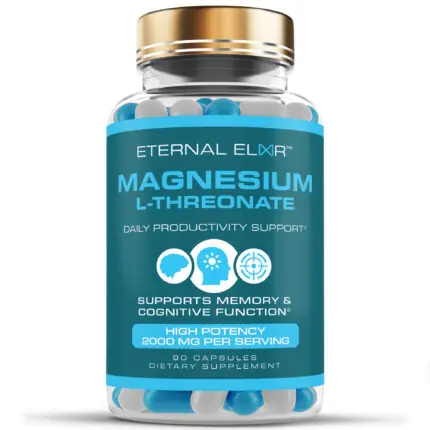
The studied dose of magnesium L-threonate is 2,000mg of the compound a day, which supplies about 144mg of elemental magnesium. In capsules that usually means three a day. The sleep trial used 1,000mg. Three randomised human trials support it, for overall cognition, memory and reaction time, and for how people feel and function on waking; all three were short and industry-funded. Our pick is Eternal Elixir Magnesium L-Threonate 2000mg: the full 2,000mg in three capsules, 90 capsules per bottle, $59.99 for 30 days ($2.00 a day).
Eternal Elixir makes Magnesium L-Threonate 2000mg, so read the product sections as our pick with the working shown. Study details and competitor prices were checked against their sources in September 2026.
Search for magnesium L-threonate in Australia and you mostly find product listings and short overseas explainers that repeat the same rat study. This guide is the longer version: what the compound is, what each human trial found and where it fell short, how much to take and when, how it compares with glycinate and the other common forms, and what the Australian products cost once every label is brought to the same serve.
If you are really asking which is the best magnesium threonate in Australia, the short answer is that the dose and the label matter more than the logo. Most of this guide explains why, and the comparison table near the end shows where our own product sits against the others you can buy here.
Table of contents
- 1. Magnesium L-threonate: key takeaways
- 2. What is magnesium L-threonate?
- 3. How magnesium L-threonate reaches the brain
- 4. What the human research on magnesium L-threonate shows
- 5. How much magnesium L-threonate to take
- 6. Side effects and who should avoid it
- 7. Who magnesium L-threonate suits
- 8. Magnesium L-threonate vs glycinate, citrate and oxide
- 9. Capsules, powder and the Magtein question
- 10. Where to buy magnesium L-threonate in Australia
- 11. Australian magnesium L-threonate products compared (as of Sep 2026)
- 12. How to choose a magnesium L-threonate supplement
- 13. What to take it with, and what to space out
- 14. Seven common mistakes
- 15. What to track in your first month
- 16. More on magnesium L-threonate
- 17. Magnesium L-threonate: frequently asked questions
- 17.1. Which brand of magnesium L-threonate is best?
- 17.2. Is there a downside to taking magnesium L-threonate?
- 17.3. Can I buy magnesium L-threonate capsules in Australia?
- 17.4. How do you choose a magnesium L-threonate supplement?
- 17.5. What does magnesium L-threonate help with?
- 17.6. How long does magnesium L-threonate take to work?
- 17.7. Can you take magnesium L-threonate every day?
- 17.8. Is magnesium glycinate or magnesium L-threonate better?
- 18. Sources
Magnesium L-threonate: key takeaways
- What it is: magnesium bound to L-threonic acid, a compound the body makes when it breaks down vitamin C. It was developed by researchers at the Massachusetts Institute of Technology to raise magnesium levels in the brain.
- Dose: 2,000mg of the compound a day in the cognition trials, supplying about 144mg of elemental magnesium. The dedicated sleep trial used 1,000mg.
- Best evidence: a 2026 Australian trial in 100 adults found better overall cognition, working and episodic memory, and reaction time than placebo after six weeks. It did not find a difference in objective sleep measured by a tracking ring.
- Low in elemental magnesium by design: about 7.2% by weight. It is not the form to correct a whole-body shortfall.
- Different job from glycinate: glycinate is the everyday choice for general magnesium intake; threonate is the targeted choice when memory, focus or mental wind-down is the goal.
- Well tolerated in trials, but anyone with reduced kidney function, anyone pregnant or breastfeeding, and anyone on regular medicines should check with a doctor or pharmacist first.
What is magnesium L-threonate?
Magnesium L-threonate is a salt made by binding magnesium to L-threonic acid, a water-soluble compound the body produces when it metabolises vitamin C. You will also see it written as magnesium threonate, and a patented version of the ingredient is sold under the trade name Magtein.
The carrier is the point. Magnesium itself is not rare: it is a cofactor in more than 300 enzyme systems, and most people get a good share of what they need from food. What varies between supplements is the molecule carrying the magnesium, and the carrier affects how much is absorbed and where it goes.
Where it came from
The compound came out of work at the Massachusetts Institute of Technology on a specific problem: how to raise magnesium levels in the brain, where ordinary oral magnesium salts make little difference. In 2010, Slutsky and colleagues reported in Neuron that rats given magnesium L-threonate showed better learning, working memory and short- and long-term memory, and that older rats improved on a pattern-completion task. The treated rats also had a higher density of synaptic markers in the hippocampus, the brain region most involved in memory.
That is an animal study. It explains why researchers became interested in the compound, but it doesn’t tell you what happens in people. For that you need the human trials further down.
Magtein and generic threonate
Magtein is the branded magnesium L-threonate used in the human trials described below. Generic magnesium L-threonate is the same salt made by other manufacturers. The practical difference isn’t the molecule. It is that when a study says magnesium L-threonate worked, it tested Magtein at a known specification, and a generic label doesn’t tell you whether you are getting the same material.
Some Australian products name Magtein on the label, including Switch Nutrition Mag3 and Life Extension Neuro-Mag. Ours doesn’t name its raw-material supplier, and we’d rather tell you that than leave you to find out.
How magnesium L-threonate reaches the brain
Magnesium in the blood doesn’t automatically become magnesium in the brain. The blood-brain barrier controls what passes, and magnesium crosses it slowly. The animal work behind magnesium L-threonate found that it raised magnesium in the brain in a way that other salts did not, which is why it is described as a brain-targeted form. Exactly how threonate helps magnesium cross in people is still being studied.
Once in the brain, magnesium sits in the channel of the NMDA receptor, a receptor involved in learning and memory, where it helps the receptor respond to real signals rather than background noise. That is the proposed link between brain magnesium and the memory findings in the trials.
The practical takeaway: threonate isn’t a stronger magnesium. It is a magnesium aimed at a different destination. If your problem is cramped calves at night, the destination is wrong.
The elemental magnesium arithmetic
Labels often blur two different numbers: the weight of the compound and the weight of the magnesium in it. Magnesium L-threonate is about 7.2% elemental magnesium by weight. So a 2,000mg serve provides about 144mg of magnesium, which is what our label and Switch Nutrition’s both state.
For comparison, Australia’s recommended dietary intake for adults is 310mg to 320mg of magnesium a day for women and 400mg to 420mg for men, depending on age. The upper level for magnesium from supplements (not food) is 350mg a day for adults. A full serve of threonate uses less than half of that upper level, which leaves room for food but matters if you also take another magnesium.
Two things follow. First, threonate on its own isn’t an efficient way to correct a real magnesium shortfall. Second, the low elemental load is also why it tends to be gentle on the gut compared with larger doses of other magnesium salts. For the general-intake side of the question, see our comparison of the best magnesium supplements in Australia.
What the human research on magnesium L-threonate shows
There are three randomised, placebo-controlled human trials worth knowing about. Together they involve 224 participants. Each was funded, supplied or co-authored by a company with a commercial interest in the ingredient, none ran longer than 12 weeks, and their results on sleep don’t all agree. That is the context for everything below.
Cognition: Liu and colleagues, 2016
The first proper human trial tested MMFS-01, a magnesium L-threonate formulation, in 44 adults aged 50 to 70 who were selected for memory complaints along with poor sleep and anxiety symptoms. Twenty-three took the supplement and 21 a placebo for 12 weeks. The dose was set at about 25mg per kilogram of body weight: participants weighing 50 to 70kg took 1.5g a day, and those weighing 70 to 100kg took 2g.
Overall cognitive ability, a composite of tests across four areas, improved compared with placebo. The researchers couldn’t judge the effect on sleep and anxiety, because the placebo group improved on those measures too. The trial was small, and the authors were connected to the company developing the ingredient.
Cognition and sleep: Lopresti and Smith, 2026
The most recent trial was run in Perth by Clinical Research Australia and published in Frontiers in Nutrition in January 2026. One hundred adults aged 18 to 45 who were unhappy with their sleep took 2g of Magtein or a placebo each day for six weeks.
- Cognition: the Magtein group improved more than placebo on the overall cognition score (p = 0.043), with the larger effects on working and episodic memory. Reaction time improved more too (p = 0.031), and the authors reported a 7.5-year reduction in estimated cognitive age.
- Reasoning: there was no difference on Raven’s Progressive Matrices, a test of abstract reasoning (p = 0.953).
- Sleep, self-reported: sleep-related impairment, meaning how much poor sleep affected people’s days, improved more than placebo (p = 0.043). There was no group difference in sleep disturbances (p = 0.316) or restorative sleep (p = 0.439), except in a subgroup with more severe sleep problems.
- Sleep, measured: the Oura ring data showed no group differences in sleep outcomes. Resting heart rate fell more (p = 0.030) and heart rate variability rose more (p = 0.036), which the authors describe as markers of lower physiological stress.
The study was funded by Threotech, which also supplied the Magtein.
Sleep and daytime function: Hausenblas and colleagues, 2024
The dedicated sleep trial, published in Sleep Medicine: X, randomised 80 adults aged 35 to 55 with self-reported sleep problems to 1g of magnesium L-threonate or a placebo daily for 21 days. On the Oura ring, the magnesium group scored better than placebo on deep sleep score, REM sleep score and light sleep time, along with activity and readiness scores. On questionnaires, it improved behaviour on waking, energy and daytime productivity, mood and mental alertness.
Three things to keep in mind: the placebo group’s sleep declined over the study while the magnesium group held steady, several authors work for AIDP, the company that sells the ingredient, and the journal has since published an erratum to the paper.
Where the evidence stops
Put together, the two trials disagree on objective sleep: one found ring-measured improvements at 1g, the other found none at 2g. The cognition findings are more consistent. None of the trials lasted longer than 12 weeks, and none compared magnesium L-threonate head to head with magnesium glycinate. The idea that threonate beats other forms for brain outcomes therefore rests on the animal work and mechanism, not on a direct comparison in people.
That doesn’t make it a poor supplement. It makes it one with a plausible mechanism, encouraging early human data and real uncertainty, which is a normal place for a nutrient to be. We take the same approach in our nootropic supplements comparison, and our magnesium L-threonate benefits guide goes through the findings claim by claim.
Add Magnesium L-Threonate to cart · $59.99How much magnesium L-threonate to take
The cognition trials used 2,000mg of the compound a day (1,500mg for lighter participants in the 2016 trial). The sleep trial used 1,000mg. You don’t need to reach the full amount on day one.
The standard serve
A full serve is 2,000mg, supplying about 144mg of elemental magnesium. Because the compound is bulky, that is almost always three capsules, and sometimes four. This is the most overlooked fact in the category: the capsule count on the front of the bottle tells you little until you divide it by the serve. A 90-capsule bottle at three a day is a 30-day supply; a 60-capsule bottle at three a day lasts 20 days.
When to take it
Our label says to take three capsules daily with a meal, and gives two timings depending on your goal.
- For sleep and evening wind-down: all three capsules in the evening, one to two hours before bed. The sleep trial dosed in the evening.
- For daytime focus and memory: two capsules with breakfast and one in the evening.
- With food: taking it with a meal is gentler on the stomach.
A gentle start, step by step
Starting low helps you avoid the two things that make people give up early: next-morning grogginess from a full evening dose, and loose stools from stacking it on another magnesium. Never go above the label serve.
- Week 1: one capsule in the evening with food. Notice how you feel in the first hour after waking.
- Week 2: two capsules. If you take another magnesium supplement, stop it or move it to a different time of day now.
- Week 3: the full three-capsule serve, all in the evening or split morning and evening depending on your goal.
- Week 4: stay at the full serve for a whole week before you judge it. The shortest trial ran for three weeks, so a three-day verdict tells you nothing.
Our guide to magnesium L-threonate for sleep covers evening timing in more detail.
Side effects and who should avoid it
In all three human trials magnesium L-threonate was well tolerated, with no significant adverse reactions reported. That is reassuring, but it comes from 224 people over three to twelve weeks.
What people report
- Drowsiness or next-morning grogginess. Usually a dose and timing issue: move some of the serve to the morning or step back a capsule for a week.
- Headache in the first days, which usually settles.
- Loose stools. Less common than with larger doses of other magnesium salts, but more likely if you stack threonate on another magnesium.
Our magnesium L-threonate side effects guide goes through each one.
Who should check with a doctor first
- Anyone with reduced kidney function. The kidneys clear magnesium, and the risk of magnesium building up rises when they work less well. Don’t take a magnesium supplement unless your doctor has told you to.
- Anyone pregnant or breastfeeding. There are no safety studies for this compound in pregnancy. Our product page says not to use it while pregnant or breastfeeding unless your doctor advises it, and Switch Nutrition’s label says it is not recommended for pregnant or lactating women.
- Children and teenagers. Our product is for adults; Switch Nutrition’s label says not for children under 15.
- Anyone on regular medicines (see below).
Medicine interactions
Magnesium can bind some medicines in the gut and reduce how much you absorb. The US National Institutes of Health magnesium fact sheet lists the main ones:
- Bisphosphonates (such as alendronate, for bone density): take magnesium at least two hours before or after.
- Tetracycline and quinolone antibiotics: take the antibiotic at least two hours before, or four to six hours after, magnesium.
- Diuretics: some increase magnesium loss and others (potassium-sparing diuretics) reduce it.
- Proton pump inhibitors: long-term use can lower magnesium levels.
If you take any prescription medicine, ask your pharmacist before you start. It is a short conversation.
Who magnesium L-threonate suits
Because the evidence is narrow and specific, it suits some people much better than others.
People whose main complaint is memory and focus
Word-finding, patchy short-term recall, or working memory that fades through the afternoon. This is the profile the trial data speaks to most directly, since the measured gains were in working and episodic memory and reaction time rather than reasoning.
People who sleep enough hours but wake unrefreshed
The sleep trial’s subjective findings centred on how people felt and functioned after waking, and the 2026 trial found lower resting heart rate and higher heart rate variability. If sleep length isn’t your problem but mornings are, this is a reasonable fit.
People who can’t tolerate other magnesiums
Those who stopped taking citrate or oxide because of the laxative effect. The low elemental load that makes threonate a poor tool for topping up magnesium also makes it one of the gentler forms on the gut.
Who it suits poorly
Anyone whose real issue is low magnesium intake, such as night-time muscle cramps or twitching. At about 144mg of elemental magnesium per serve, and at a much higher cost per milligram of magnesium than glycinate, threonate is the wrong tool. Fix the intake with food or glycinate first, then revisit threonate if the cognitive question remains. Our guides to the best supplements for women over 40 and everyday energy supplements can help separate what magnesium can plausibly address from what it can’t.
Magnesium L-threonate vs glycinate, citrate and oxide
This is the decision most people are trying to make, and these forms aren’t really competing for the same job.
| Form | Elemental magnesium per gram | Human data on brain outcomes | Gut tolerance | Best suited to |
|---|---|---|---|---|
| Magnesium L-threonate | Low (about 7.2%) | Three small randomised trials | Very good | Memory, focus, mental wind-down |
| Magnesium glycinate (bisglycinate) | Moderate (about twice threonate) | None specific to the brain | Very good | General intake, relaxation, cramps |
| Magnesium citrate | Moderate | None specific to the brain | Fair; laxative at higher doses | General intake, regularity |
| Magnesium oxide | High, but poorly absorbed | None specific to the brain | Poor; laxative | Low-cost intake |
Read across the table and the logic is plain. Oxide carries the most magnesium per gram and is absorbed least well. Glycinate is the sensible all-rounder. Threonate carries the least elemental magnesium of the common forms, and is the only one with human trials aimed at brain outcomes.
So the question isn’t which form is strongest. It is whether your goal is general magnesium intake or cognition. Plenty of people take glycinate for general intake and threonate for cognitive work. If you do, add up the elemental magnesium from both so you stay within the 350mg-a-day upper level for supplements.
Capsules, powder and the Magtein question
Australian magnesium L-threonate comes in three forms, and the differences are practical rather than chemical.
- Capsules are the default. They dose accurately, travel well and hide the taste, at the cost of three or four capsules per serve. Ours, Apollo Nutraceuticals and Life Extension all use a three-capsule serve.
- Powder costs less per gram and lets you adjust the dose, but it has to be measured. Switch Nutrition Mag3 is a single-ingredient powder: one heaped scoop gives 2,000mg.
- Compounded capsules are made to order by some Australian compounding pharmacies in set strengths.
On Magtein: it is the ingredient the trials used, and it is reasonable to look for it. But a Magtein logo isn’t a quality certificate for the finished product. A brand can use the studied ingredient and still underdose the serve or bury the serving size. Check the serve first, then the testing, then the ingredient source.
Where to buy magnesium L-threonate in Australia
You can buy magnesium L-threonate capsules in Australia; most of it is sold online rather than on pharmacy shelves.
- Australian online stores: our Magnesium L-Threonate 2000mg ships from Sydney. Switch Nutrition sells Mag3 powder on its own site, and Elite Supps sells Apollo Nutraceuticals capsules.
- iHerb Australia sells imported brands such as Life Extension Neuro-Mag, shipped from overseas.
- Compounding pharmacies: The Compounding Pharmacy of Australia sells Magtein capsules in set strengths.
- Pharmacies: for what Chemist Warehouse stocks, see our magnesium L-threonate at Chemist Warehouse guide.
One change worth knowing: Bulk Nutrients’ magnesium L-threonate page now redirects to its magnesium glycinate, so the low-cost Bulk capsules some older comparisons quote are no longer on sale there.
Australian magnesium L-threonate products compared (as of Sep 2026)
Cost per serve uses each label’s own serve and the single-pack price, before postage. Every product below gives 2,000mg of magnesium L-threonate per serve.
| Product | Format and serve | Pack | Price (AUD) | Cost per serve | Buy |
|---|---|---|---|---|---|
| Eternal Elixir Magnesium L-Threonate 2000mg (our pick) | 3 vegetable capsules | 90 capsules, 30 serves | $59.99 | $2.00 | Eternal Elixir |
| Switch Nutrition Mag3 (Magtein) | Powder, 1 heaped scoop | 30 serves | $49.95 | $1.67 | Switch Nutrition |
| Life Extension Neuro-Mag (Magtein) | 3 vegetarian capsules | 90 capsules, 30 serves | $57.23 at iHerb AU | $1.91 | iHerb |
| Apollo Nutraceuticals Magnesium L-Threonate | 3 capsules, plus 100mg L-theanine and 50mg apigenin | 90 capsules, 30 serves | $69.90 at Elite Supps | $2.33 | Elite Supps |
We are not going to pretend our product wins the price column. Switch Nutrition’s powder is the cheapest per serve at $1.67, and Neuro-Mag is $1.91 before iHerb’s shipping. If the lowest price per serve decides it and you are happy measuring a powder, Mag3 is the rational choice.
What our $2.00 buys is the full 2,000mg in capsules with nothing added, a label that sets out timings for sleep and for focus, and dispatch from Sydney with free shipping over $100. Buying two bottles takes 10% off, which brings it to $1.80 a serve; three bottles take 15% off ($1.70) and five take 20% off ($1.60). Apollo suits people who specifically want L-theanine and apigenin in the same capsules.
For a wider field ranked on dose, testing and value, see our best magnesium L-threonate products in Australia.
Add Magnesium L-Threonate to cart · $59.99How to choose a magnesium L-threonate supplement
Five checks, in the order that filters products fastest.
- Find the serve before the capsule count. A 60-capsule bottle at four capsules a serve lasts 15 days. This one check reorders most price comparisons.
- Confirm the compound amount per serve, not just the elemental figure. You want both numbers: 2,000mg of magnesium L-threonate and about 144mg of magnesium.
- Check the ingredient source. Magtein or a named supplier is a useful disclosure.
- Look for testing. A brand that tests its products should say so plainly.
- Check where it ships from. Local stock means faster delivery and easier returns.
What to take it with, and what to space out
- Works alongside: an NAD+ precursor such as our NMN 500mg in the morning, and evening wind-down ingredients such as glycine or L-theanine, which act on different parts of the process. If mood and sleep quality are the focus, our Saffron Extract 30mg is another single-ingredient option; see saffron for sleep.
- Doubles up with: other magnesium supplements. If you take glycinate at night, move threonate to the morning or reduce one of them, and keep the combined total within the 350mg supplement upper level.
- Space out from: the medicines listed above, and from high-dose zinc, which can reduce magnesium absorption.
If your interest in threonate is part of a wider focus-and-energy routine, our guides to nootropics in Australia and mitochondrial support supplements cover the other pieces.
Seven common mistakes
- Taking one capsule and calling it a dose. One capsule is a third of the studied serve.
- Comparing bottle prices instead of serve prices. Capsule counts are marketing; serves are arithmetic.
- Expecting a sleeping pill. The trial evidence points to better daytime function and mornings more than to faster sleep onset.
- Quitting after three days. The shortest trial ran for 21 days.
- Stacking it on another magnesium without adjusting. Two magnesiums at bedtime is how people end up with loose stools and blame the wrong product.
- Using it to fix low magnesium intake. At about 144mg elemental per serve, it isn’t the tool for that job.
- Ignoring medicine timing. Some antibiotics and bone-density medicines need the gap.
What to track in your first month
The effects seen in trials are measurable but not dramatic, so casual impressions can mislead. Four things are worth writing down, ideally starting a week before you begin.
- How you feel in the first hour after waking. This is where the sleep trial’s subjective findings centred.
- Afternoon focus. A one-to-five rating at 3pm each day is crude, but more honest than memory.
- Word-finding and short-term recall. The trial gains sat in working and episodic memory.
- Resting heart rate, if you wear a tracker. The 2026 trial found a larger fall than placebo, so it is the one objective marker a consumer device might pick up.
More on magnesium L-threonate
This page is the hub for our magnesium L-threonate coverage. Each guide below goes deeper on one part of it:
- Best magnesium L-threonate in Australia: products ranked on dose, testing and value.
- Magnesium L-threonate benefits: each claim checked against the trials.
- Magnesium L-threonate for sleep: dose and timing for the evening.
- Magnesium L-threonate side effects: what the trials recorded and what people report.
- Magnesium L-threonate at Chemist Warehouse: what the pharmacy chain stocks.
- Best magnesium supplements in Australia: the wider magnesium category.
You can read how we research and review products on our about us page, or browse the full Eternal Elixir range.
Magnesium L-threonate: frequently asked questions
Which brand of magnesium L-threonate is best?
Our pick is Eternal Elixir Magnesium L-Threonate 2000mg: the full 2,000mg serve in three capsules, 90 capsules per bottle, dispatched from Sydney, at $2.00 a day. Eternal Elixir makes it. If the lowest cost per serve matters most, Switch Nutrition Mag3 powder is $1.67 a serve and names Magtein on the label.
Add Magnesium L-Threonate to cart · $59.99
Is there a downside to taking magnesium L-threonate?
Three real ones. It costs more per milligram of magnesium than glycinate or citrate. It supplies only about 144mg of elemental magnesium per full serve, so it won’t fix low intake on its own. And the human evidence is three short, industry-funded trials with no head-to-head comparison against cheaper forms. Reported side effects are mild: drowsiness, headache and occasional loose stools.
Can I buy magnesium L-threonate capsules in Australia?
Yes. Our capsules ship from Sydney, Apollo Nutraceuticals capsules are sold by Elite Supps, Life Extension Neuro-Mag is available through iHerb Australia, and some compounding pharmacies make Magtein capsules. Switch Nutrition sells it as a powder.
How do you choose a magnesium L-threonate supplement?
Check the serve first (2,000mg of the compound, usually three capsules), then the elemental magnesium (about 144mg), then the ingredient source and testing, and finally the cost per serve rather than per bottle.
What does magnesium L-threonate help with?
In human trials it supported overall cognition, working and episodic memory, and reaction time over six to twelve weeks, and one trial found better mood, energy and alertness on waking. Evidence that it improves objectively measured sleep is mixed.
How long does magnesium L-threonate take to work?
The trials ran from three to twelve weeks. Expect one to three weeks before any change in how you feel on waking, and four to six weeks before judging memory or focus.
Can you take magnesium L-threonate every day?
Every trial dosed it daily, for three to twelve weeks, and it was well tolerated. There is no long-term safety data beyond twelve weeks. Anyone with reduced kidney function, anyone pregnant or breastfeeding, and anyone on prescription medicines should check with a doctor or pharmacist first.
Is magnesium glycinate or magnesium L-threonate better?
They do different jobs. Glycinate carries roughly twice the elemental magnesium per gram and is the better choice for general intake and cramps. Threonate carries less magnesium but is the form with human trials on memory and focus. No trial has compared them directly.
Sources
- Slutsky I, Abumaria N, Wu LJ, et al. Enhancement of learning and memory by elevating brain magnesium. Neuron. 2010;65(2):165-77. PubMed
- Liu G, Weinger JG, Lu ZL, Xue F, Sadeghpour S. Efficacy and safety of MMFS-01, a synapse density enhancer, for treating cognitive impairment in older adults: a randomized, double-blind, placebo-controlled trial. Journal of Alzheimer’s Disease. 2016;49(4):971-90. PubMed
- Hausenblas HA, Lynch T, Hooper S, et al. Magnesium-L-threonate improves sleep quality and daytime functioning in adults with self-reported sleep problems: a randomized controlled trial. Sleep Medicine: X. 2024;8:100121. PubMed
- Lopresti AL, Smith SJ. The effects of magnesium L-threonate (Magtein) on cognitive performance and sleep quality in adults: a randomised, double-blind, placebo-controlled trial. Frontiers in Nutrition. 2026;12:1729164. PubMed
- Nutrient Reference Values for Australia and New Zealand: magnesium. Eat For Health
- Magnesium fact sheet for health professionals. US National Institutes of Health, Office of Dietary Supplements. ods.od.nih.gov
- Product labels and prices: each seller’s product page, linked in the comparison table, read in September 2026.