Last updated: November 8, 2026 · By Eternal Elixir Editorial
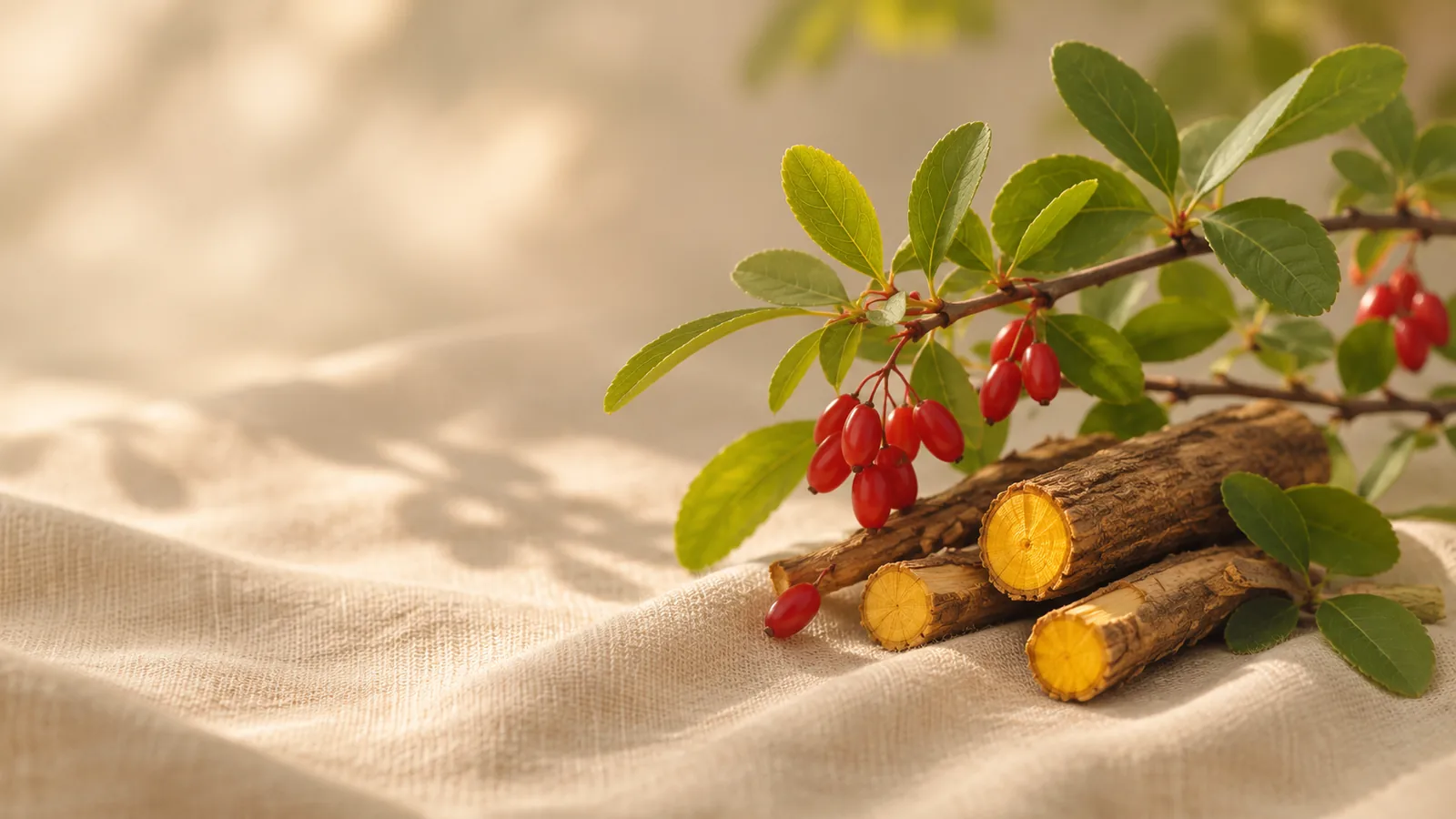
There is no single berberine plant. Berberine is a bright yellow alkaloid made by several unrelated plants, and the one most people mean is barberry, a thorny shrub of the Berberis genus. Goldenseal, Oregon grape, Chinese goldthread and an Indian shrub called tree turmeric make it too. In every case the root and bark hold most of it, which is why those parts have been dried and used for centuries.
This guide covers each berberine plant, where it grows, how much berberine it holds and how the compound gets from bark to capsule. It also explains why Australians are asked to think twice before planting one species in the garden. For the full picture on doses, forms and safety, start with our berberine guide for Australia.
The berberine plant people usually mean is barberry (Berberis vulgaris), but berberine also comes from tree turmeric, Oregon grape, goldenseal, Chinese goldthread and Phellodendron bark. The root and bark hold the most. Supplements use a concentrated extract sold as berberine HCl, because the raw plant gives an unknown and small dose.
Key takeaways
- The main berberine plant is barberry, with tree turmeric, Oregon grape, goldenseal and Chinese goldthread as other common sources.
- Berberine content varies widely by species, plant part and growing site, so a standardised berberine HCl capsule is the practical way to know your dose.
- Common barberry is listed as a weed in parts of south-eastern Australia. Check with your GP or pharmacist before taking berberine if you use regular medicines.
Short on time? Our 60-second quiz matches one Eternal Elixir product to liver and metabolism and shows what it costs per day.
Key numbers:
- 5 plant families: Berberidaceae, Ranunculaceae, Menispermaceae, Papaveraceae and Rutaceae all include berberine plants (Sanlier et al., 2026).
- 0.032 mg per gram: the berberine content measured in one tested batch of tree turmeric stem bark (Khan et al., 2020).
- Less than 1%: the oral bioavailability of berberine reported in a 2022 pharmacokinetic review (Khoshandam et al., 2022).
- 27 trials and 2,569 people: the meta-analysis behind much of the blood sugar research on berberine (Lan et al., 2015).
Table of contents
What is the berberine plant?
Berberine belongs to a group of plant compounds called isoquinoline alkaloids. It has a strong yellow colour and a bitter taste, and plants seem to use it as a chemical defence. A 2026 review in Nutrition Reviews lists berberine in the rhizomes, stems and fruits of plants from five families, and notes that the bark and root carry much higher concentrations than other parts (Sanlier et al., 2026).
That spread across families explains why the berberine plant question has several right answers. A herbalist in Iran, a practitioner of Ayurveda in India and a traditional Chinese medicine pharmacy would each reach for a different plant, yet all three would end up with the same yellow alkaloid. Cut a barberry root and the inner wood is the colour of egg yolk. Cut a goldthread rhizome and you see the same shade.
Supplement companies care about the compound, not the folklore. What matters on a label is the form (berberine HCl is the salt used in most trials), the amount per capsule and whether the extract is standardised. Our guide to reading a berberine HCl label walks through each line.
Not sure what to take? Take our 8-question quiz
to unlock 20% OFF your entire first order
+ a FREE gift worth up to $59.99
Choose your goal to start the quiz
Berberine plant sources compared
These are the plants that supply most of the berberine in research and commerce. The table sets out the botanical name, family, part used and where each grows naturally.
| Common name | Botanical name | Plant family | Part used | Native range |
|---|---|---|---|---|
| Common barberry | Berberis vulgaris | Berberidaceae | Root, stem and bark | Europe and western Asia |
| Tree turmeric (daruhaldi) | Berberis aristata | Berberidaceae | Stem bark and root | Himalayas and northern India |
| Oregon grape | Berberis aquifolium (also Mahonia aquifolium) | Berberidaceae | Root and bark | Western North America |
| Goldenseal | Hydrastis canadensis | Ranunculaceae | Root and rhizome | Eastern North America |
| Chinese goldthread | Coptis chinensis | Ranunculaceae | Rhizome | China |
| Amur cork tree | Phellodendron species | Rutaceae | Inner bark | East Asia |
Barberry (Berberis vulgaris)
Common barberry is a thorny shrub with yellow flowers and small, sour red berries. It has a long place in Iranian folk medicine, and a clinical review by Iranian pharmacologists notes that berberine sits in its roots, rhizomes, stem and bark (Imenshahidi and Hosseinzadeh, 2019). The dried berries are a tart ingredient in Persian rice dishes, but the fruit is not where the berberine is concentrated.
Tree turmeric (Berberis aristata)
Tree turmeric is a Himalayan shrub with bright yellow wood, which is where the Hindi name daruhaldi, roughly “wood turmeric”, comes from. It has a long history in Ayurveda, and Indian researchers have published quality standards for its stem bark (Khan et al., 2020). It is unrelated to the turmeric in your spice rack, which gets its colour from curcumin.
Goldenseal, goldthread and the rest
Goldenseal is a small woodland herb from eastern North America whose yellow root was used by Indigenous peoples and, later, by Western herbalists. Chinese goldthread (Coptis) and Phellodendron bark are the main sources in China. A 2015 meta-analysis describes the berberine in its trials as extracted from Coptis root and Phellodendron (Lan et al., 2015). Oregon grape, a holly-leaved shrub from western North America, rounds out the list.
Skip the comparison shopping: Berberine HCl 500mg from Eternal Elixir ships locally in Australia with 90 capsules per bottle for $49.99. Browse the longevity range →
How much berberine is in the plant?
Less than most people expect, and the figure moves a lot. One Indian quality-control study measured 0.032 mg of berberine per gram in the tree turmeric stem bark it tested (Khan et al., 2020). A separate study of the Himalayan species Berberis lycium found higher berberine content in plants from lower altitudes (Katare et al., 2022). Species, plant part, growing site and harvest all change the number.
Here is what that single measurement would mean in practice. At 0.032 mg per gram, a 500 mg serve of berberine would take about 15.6 kg of that bark (500 ÷ 0.032 = 15,625 g). Richer roots would need far less, but the point stands: you cannot judge your dose from a cup of barberry root tea or a handful of dried berries.
Absorption is the second hurdle. A 2022 review of berberine pharmacokinetics put its oral bioavailability at less than 1%, which is why researchers keep working on new delivery forms (Khoshandam et al., 2022). It is also why trials use fixed daily amounts of purified berberine, usually split across meals, instead of crude plant material.
From bark to capsule
Makers extract the alkaloid from the root or bark, purify it and usually convert it into berberine hydrochloride, a stable salt. Eternal Elixir’s Berberine HCl 500mg is a 20:1 extract of barberry root, filled into a cellulose capsule with a little rice flour and nothing else. One capsule a day gives the full 500 mg serve. A bottle of 90 capsules costs $49.99, which works out at about $0.56 a day for three months.
If you are weighing up brands, our comparison of berberine supplements in Australia lines up dose, form and cost per serve across the local options.
What the research on berberine plant extracts covers
Most of the human evidence uses purified berberine, not whole plants. A clinical review of barberry and berberine drew on 77 human studies and found that effects on blood lipids and on how the body responds to insulin were the most studied areas (Imenshahidi and Hosseinzadeh, 2019). The same review describes berberine as having very low toxicity at usual doses, with mild digestive upsets in some people.
The 2015 meta-analysis pooled 27 randomised trials with 2,569 people. Berberine taken with lifestyle changes tended to lower fasting and after-meal blood sugar and HbA1c more than lifestyle changes alone or placebo, and no serious adverse reactions were reported (Lan et al., 2015). The authors also flagged the limited quality of many included trials, so the results deserve a fair amount of caution.
Timing matters too. Our article on how long berberine takes to work sets out what changes people can expect over weeks and months, and why three months is a common trial length.
Can you grow a berberine plant in Australia?
You can buy several ornamental Berberis shrubs in Australian nurseries, usually sold for hedging and autumn colour. Common barberry is a different story. The Weeds of Australia fact sheet lists Berberis vulgaris as an environmental weed in the southern highlands of New South Wales and a sleeper weed in other parts of south-eastern Australia (Weeds of Australia). It is also an alternate host for a stem rust that can damage wheat crops, which matters in a grain-growing country.
If you are tempted to plant one, check your local council’s weed list first and choose a variety your area allows. Even then, home-grown bark makes a poor supplement. Without lab testing you have no idea of the berberine content, and as the figures above show, that content can be tiny. A garden shrub is best enjoyed as a garden shrub.
Safety: what to know before taking berberine
Berberine is well tolerated by most adults in trials, but it is active in the body and it interacts with how other compounds are cleared. A 2025 review of barberry and berberine found effects on several liver enzymes that process common medicines, with CYP3A4 and CYP2D6 the most important (Bathaei et al., 2025). Talk to your GP or pharmacist before you start if you take any regular medicine. Our guide to berberine drug interactions lists the groups to ask about.
- Start with one capsule a day with or before a meal to see how your stomach handles it.
- Skip berberine if you are expecting a baby or nursing, and keep it away from children.
- Stop and speak with your GP if digestive upset lasts more than a few days. Our article on berberine side effects explains what is common and what is not.
Used sensibly, a standardised berberine HCl capsule is the simplest way to get what the barberry root offers at a known dose. You can order Eternal Elixir’s Berberine HCl 500mg from within Australia, with free shipping on orders over $100.
Berberine plant FAQ
What plants have berberine?
Berberine is found in plants from five families: Berberidaceae, Ranunculaceae, Menispermaceae, Papaveraceae and Rutaceae. The best known sources are barberry (Berberis vulgaris), tree turmeric (Berberis aristata), Oregon grape, goldenseal, Chinese goldthread (Coptis) and Phellodendron bark. The root and bark hold far more than the leaves or berries.
Is barberry the same as berberine?
No. Barberry is the shrub, and berberine is one of the yellow alkaloids inside it. Barberry root and bark contain berberine alongside other plant compounds, while a berberine HCl supplement isolates that one compound at a stated dose. Eating barberries gives you very little berberine, since most of it sits in the root and bark.
What is the berberine plant called in India?
In India the main berberine plant is Berberis aristata, known in Hindi as daruhaldi and in English as tree turmeric or Indian barberry. Its yellow stem bark and root have a long history in Ayurveda. The name daruhaldi roughly means wood turmeric, a nod to the bright yellow colour of the inner bark.
Can I grow a berberine plant at home?
Many Berberis shrubs are sold as hedging plants, but check your local council’s weed list first, because common barberry is a weed in parts of south-eastern Australia and hosts wheat stem rust. A garden shrub is also no substitute for a supplement, since you cannot know how much berberine its bark holds.
What does berberine do for your body?
Berberine works on AMPK, an enzyme that helps your cells manage energy, and that is the main reason it is studied for blood sugar balance and healthy blood lipids. Trials usually run for around three months alongside diet and exercise changes. Our berberine dosage guide explains how much people take and when.
Are berberine patches made from the plant too?
The berberine in patches comes from the same plants, but the skin is a very different route from swallowing a capsule, and the human research on patches is thin. Our guide to berberine patches in Australia looks at what is known so far and how they compare with capsules.
Build your longevity stack locally
Third-party tested · 90 capsules per bottle · Australian shipping
Find your routine in 60 seconds →Finish the quiz for 20% off your first order. Or Shop Eternal Elixir →
Related reading
Recommended for you
About Eternal Elixir
Eternal Elixir is an Australian supplement company specialising in longevity and nootropic formulations. Every batch is third-party lab tested for purity and potency, with the batch certificate of analysis available on request, and our products are designed for Australians who take their health seriously. Try a product that fits your routine or browse the full range at the Eternal Elixir shop.
Not sure what to take? Take our 8-question quiz
to unlock 20% OFF your entire first order
+ a FREE gift worth up to $59.99