Last updated: October 3, 2026 · By Eternal Elixir Editorial
You are standing in a pharmacy aisle holding two saffron bottles. One says 30 mg of saffron extract. The other says 30 mg of affron saffron extract with 3.5% Lepticrosalides. Both cost about the same, so what does the extra line on the second label actually buy you?
This guide explains what affron is, what the standardisation numbers on a saffron label are measuring, and how to check a product before you buy one in Australia. It deliberately avoids repeating the trial-by-trial results, which our guide to saffron supplement benefits already covers. If you want the shortlist first, our ranking of the best saffron supplements in Australia compares the options on dose and cost per day.
Key takeaways
- Affron saffron is a saffron stigma extract standardised to 3.5% Lepticrosalides, the group of crocins, safranal and related compounds it is measured against.
- Trials have mostly used 28 mg a day, and in one four-week study 28 mg showed a mood effect while 22 mg did not, so the dose on the label matters.
- Eternal Elixir Saffron Extract 30mg uses affron at one capsule a day, works out to about $0.56 per serve, and ships from within Australia.
Table of contents
- 1. What Is Affron Saffron?
- 2. Lepticrosalides, Crocin and Safranal: What a Saffron Label Is Measuring
- 3. Why Affron Saffron Standardisation Matters for Results
- 4. The Adulteration Problem: 17 Saffron Supplements Tested
- 5. How to Check a Saffron Supplement Before You Buy
- 6. Affron Saffron: Frequently Asked Questions
What Is Affron Saffron?
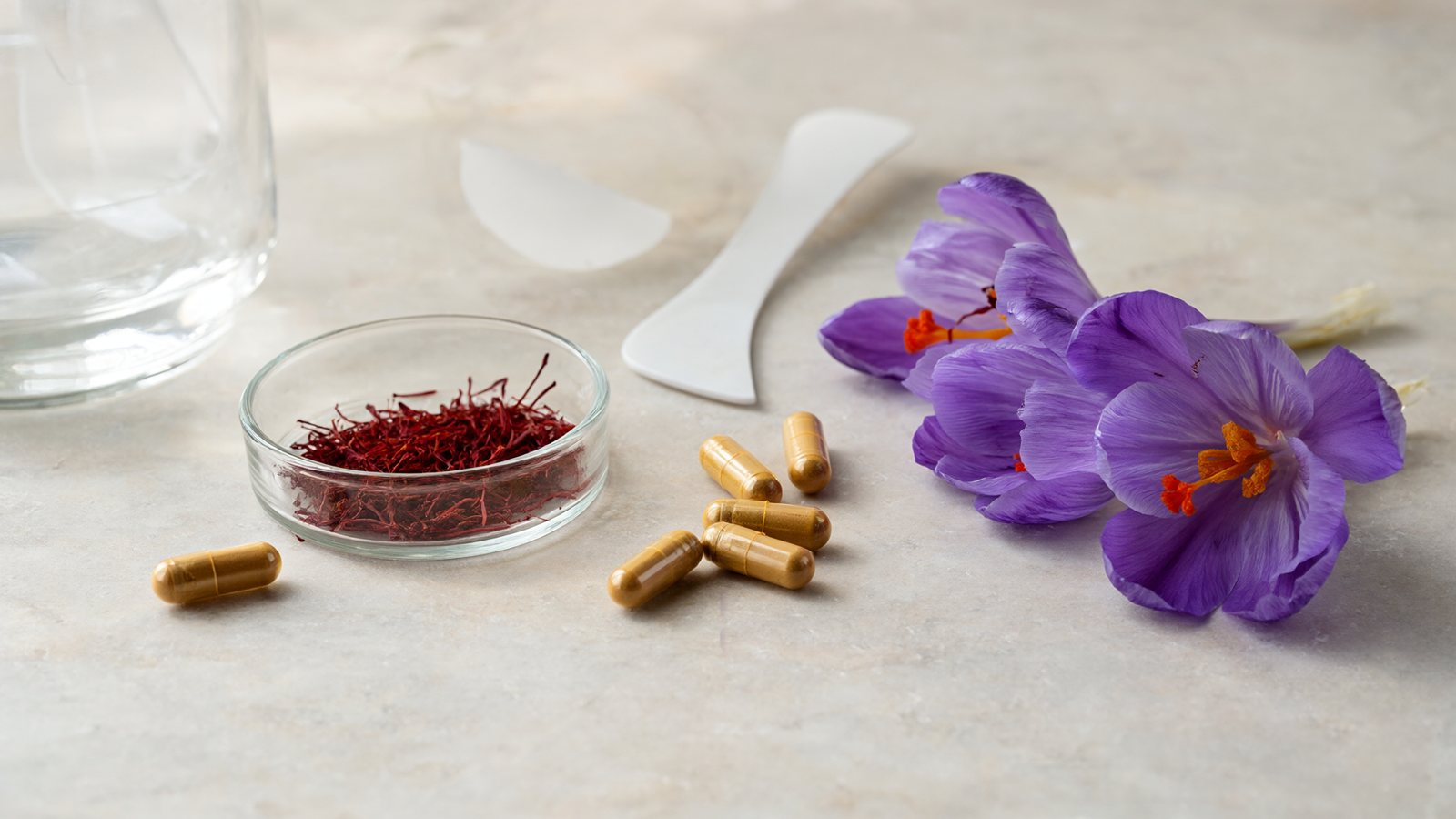
Affron is a trademarked saffron extract made in Spain by Pharmactive Biotech from the dried red stigmas of the Crocus sativus flower. It is real saffron. The difference from kitchen saffron is processing and measurement: the stigmas are extracted, concentrated and then tested so that each batch reaches a set level of Lepticrosalides, a trademarked term for the mix of crocins, safranal and related saffron compounds the extract is measured against.
Culinary saffron varies enormously from harvest to harvest. Growing region, drying method, storage time and simple dilution all change how much of the active material ends up in a pinch of threads. A supplement made from unmeasured saffron inherits that variation. Affron saffron removes most of it by setting a floor, which is why researchers in Australia and Europe have used it as their test material for close to a decade.
That research history is the practical reason to care. When a trial reports that 28 mg a day of affron saffron was associated with better mood scores, the finding applies to that specific, measured extract. A different extract at the same milligram weight may contain more or less of the compounds that were tested, so the result does not transfer automatically.
Lepticrosalides, Crocin and Safranal: What a Saffron Label Is Measuring
Saffron labels use several different standardisation markers, and they are easy to confuse. Each one measures a different slice of saffron’s chemistry, which means two products quoting different percentages cannot be compared directly. The table below sorts the claims you will see on Australian shelves.
| Label claim | What is being measured | What it tells you |
|---|---|---|
| Standardised to 3.5% Lepticrosalides (affron) | A defined group of crocins, safranal and related saffron compounds | Matches the extract used in most published mood and sleep trials |
| Standardised to 2% safranal | Safranal alone, the aroma compound | One marker only, and older test methods for it can overstate the figure |
| Standardised to a crocin percentage | The red pigments, often as a single total | Useful, but says nothing about safranal or picrocrocin |
| Saffron extract, no percentage | Nothing declared | You cannot tell how much active material is in each capsule |
| Saffron threads or powder by weight | Raw spice weight | Potency depends entirely on the crop and storage |
The safranal problem deserves a closer look. A 2023 study by Mena-García and colleagues in the journal Foods noted that saffron extracts are commonly standardised on safranal content, yet the standard test methods for it lack specificity and may give inaccurate readings (Mena-García et al., Foods, 2023). The authors proposed a fingerprint of crocin isomers and picrocrocin ratios as a more reliable way to standardise extracts, and reported that this profile stayed reproducible and stable over 36 months of controlled storage in a commercial standardised extract, which was affron.
In plain terms, a single-marker percentage is a weaker guarantee than a multi-compound standard checked with liquid chromatography. When you compare labels, look first for a named, standardised extract and then for the daily amount of that extract. The percentage only means something once you know which compounds it covers.
Skip the comparison shopping: Saffron Extract 30mg from Eternal Elixir ships locally in Australia with 90 capsules per bottle — twice the value of most competitors. Browse the longevity range →
Why Affron Saffron Standardisation Matters for Results
The clearest evidence that standardisation and dose matter comes from the first Australian affron trial. Kell and colleagues gave 128 healthy adults with self-reported low mood either 28 mg a day of affron, 22 mg a day, or a placebo for four weeks (Kell et al., Complementary Therapies in Medicine, 2017). The 28 mg group showed a significant improvement on the main mood questionnaire compared with placebo. The 22 mg group showed no treatment effect. Same extract, a 6 mg difference, and a different outcome.
That result is why a vague label is a real problem. If an unstandardised product holds less active material than affron at the same weight, it may sit below the level where trials found anything at all. Later studies kept the dose in the same range. A 28-day sleep trial at Murdoch University gave adults with self-reported poor sleep 14 mg of affron twice daily, and saffron was associated with greater improvements in sleep quality ratings than placebo (Lopresti et al., Journal of Clinical Sleep Medicine, 2020). Our guide to saffron for sleep covers that study and the evening-dose trial that followed.
The largest trial so far, published in 2025, enrolled 202 adults aged 18 to 70 with low mood and gave 28 mg of saffron daily or placebo for 12 weeks (Lopresti et al., The Journal of Nutrition, 2025). Saffron was associated with a greater improvement on the primary mood score, with 72.3% of the saffron group reaching a clinically meaningful change compared with 54.3% on placebo. The authors also flagged a large placebo response, which is worth keeping in mind when you set expectations. For how these results fit together, see our breakdown of saffron for mood and stress.
Every one of those trials used a standardised extract at a known daily amount. That is the thread connecting them, and it is the main reason to buy a product built on the same material and dose.
The Adulteration Problem: 17 Saffron Supplements Tested
Saffron is one of the most expensive spices by weight, and that price creates an incentive to cut it. A second 2023 study in Foods built a chemical authenticity profile from dried saffron stigmas and a standardised extract, then used it to assess 17 saffron-based food supplements (Mena-García et al., Foods, 2023). Safranal and crocins were found in all but one sample. Even so, the content did not match what was declared in 65% of cases, and the method also picked up undeclared additives and plant material from sources other than saffron.
This was a laboratory study of products on the European market, so it does not tell you about any particular Australian brand. What it does show is that a saffron label can be wrong, and that a named, standardised extract with a published specification gives you something concrete to hold a manufacturer to. It is also why Eternal Elixir holds third-party Certificates of Analysis for its own Saffron Extract 30mg.
How to Check a Saffron Supplement Before You Buy
Use this checklist on any bottle, including ours. It takes about a minute and filters out most of the weak options.
- Look for a named extract. “Affron” or another named, standardised extract is better than “saffron extract” with no further detail.
- Find the standardisation figure and what it measures. A Lepticrosalides figure covers a group of compounds; a lone safranal percentage covers one.
- Check the daily amount of the extract itself. The trials above used 28 mg a day, given once or split into two 14 mg doses. A total tablet weight is not the same as the extract dose.
- Work out the cost per serve. Divide the price by the number of daily serves in the bottle, using the serving size from the directions on the label.
- Read the other ingredients. Blends can dilute the saffron dose, and extra herbs make it harder to know what is helping.
Here is how Eternal Elixir Saffron Extract 30mg measures up. Each capsule delivers 30 mg of affron saffron standardised to 3.5% Lepticrosalides, the suggested use is one capsule a day, and a bottle holds 90 capsules for $49.99. That is 90 daily serves, or about $0.56 per day. Try it with a meal for eight to twelve weeks before you judge it, since the published trials ran for four to twelve weeks.
Saffron at these doses was well tolerated in the trials above, but it is not for everyone. If you are pregnant, take prescription medicines or have a medical condition, speak with your doctor before starting. Our guide to saffron supplement side effects sorts the reported effects by dose. Some people pair saffron with Magnesium L-Threonate 2000mg as part of an evening routine; our guide to nootropic supplements in Australia explains how the two fit into a wider stack.
Affron Saffron: Frequently Asked Questions
Is affron real saffron?
Yes. Affron is an extract made from the dried stigmas of the Crocus sativus flower, the same part of the plant sold as culinary saffron. It is concentrated and then standardised so each batch reaches a set level of Lepticrosalides, the group of crocins, safranal and related compounds it is measured against.
Is there a downside to taking saffron?
At the 28 to 30 mg daily amounts used in trials, saffron extract was well tolerated, and the studies reported few side effects. Much higher doses are a different matter. Anyone who is pregnant, taking prescription medicines or managing a medical condition should check with their doctor first.
How long does affron saffron take to work?
The published trials measured results after four, eight and twelve weeks. In the 2017 Australian trial a mood effect was seen at four weeks with 28 mg a day. Most people should allow at least four to eight weeks of daily use before deciding whether it suits them.
Is 30 mg of affron better than 28 mg?
Most affron trials used 28 mg a day, and a four-week study found 22 mg had no measurable effect. A 30 mg capsule sits just above the researched dose, which gives a small margin rather than a meaningfully different effect. The key point is staying at or above the studied amount.
What is the best saffron brand in Australia?
Our top pick is Eternal Elixir Saffron Extract 30mg, which uses standardised affron at one capsule a day for about $0.56 per serve and ships from within Australia. Our ranking of the best saffron supplements in Australia compares the alternatives on dose and cost per day.
Build your longevity stack locally
Third-party tested · 90 capsules per bottle · Australian shipping
Shop Eternal Elixir →Related reading
Recommended for you
About Eternal Elixir
Eternal Elixir is an Australian supplement company specialising in longevity and nootropic formulations. All products are third-party tested for purity, manufactured under strict quality controls, and designed for Australians who take their health seriously. Browse the full range at the Eternal Elixir shop.