Last updated: September 26, 2026 · Originally published: September 19, 2026 · By Eternal Elixir Editorial
Saffron for sleep has more trial support than most herbal sleep aids: six placebo-controlled trials of standardised saffron extracts, three of them run in Perth, found that adults with everyday sleep complaints mostly rated their sleep as better after four to twelve weeks on 15.5 to 30 mg a day. The gains show up in how people rate their sleep and how they feel when they wake. Saffron does not work like a sleeping tablet, and the effect builds over weeks rather than on the first night.
This guide covers each trial, including the Perth affron® studies, the dose and timing they used, how that maps onto a capsule you can buy in Australia, how the saffron products at Chemist Warehouse and iHerb compare on price, and who should leave saffron alone.
Key takeaways
- A 2023 systematic review found five randomised trials with 379 participants, and newer trials from 2025 and 2026 point the same way: better self-rated sleep quality from a standardised saffron extract taken for four weeks or more.
- The Perth trials used affron at 14 mg twice a day, or at 14 mg or 28 mg an hour before bed, for 28 days. In the 2021 trial the two doses worked about equally.
- Saffron raised evening melatonin in one trial and did not change evening cortisol.
- Talk to your doctor or pharmacist first if you take medicines for mood, sleep, blood pressure or blood sugar, and do not use saffron supplements while pregnant.
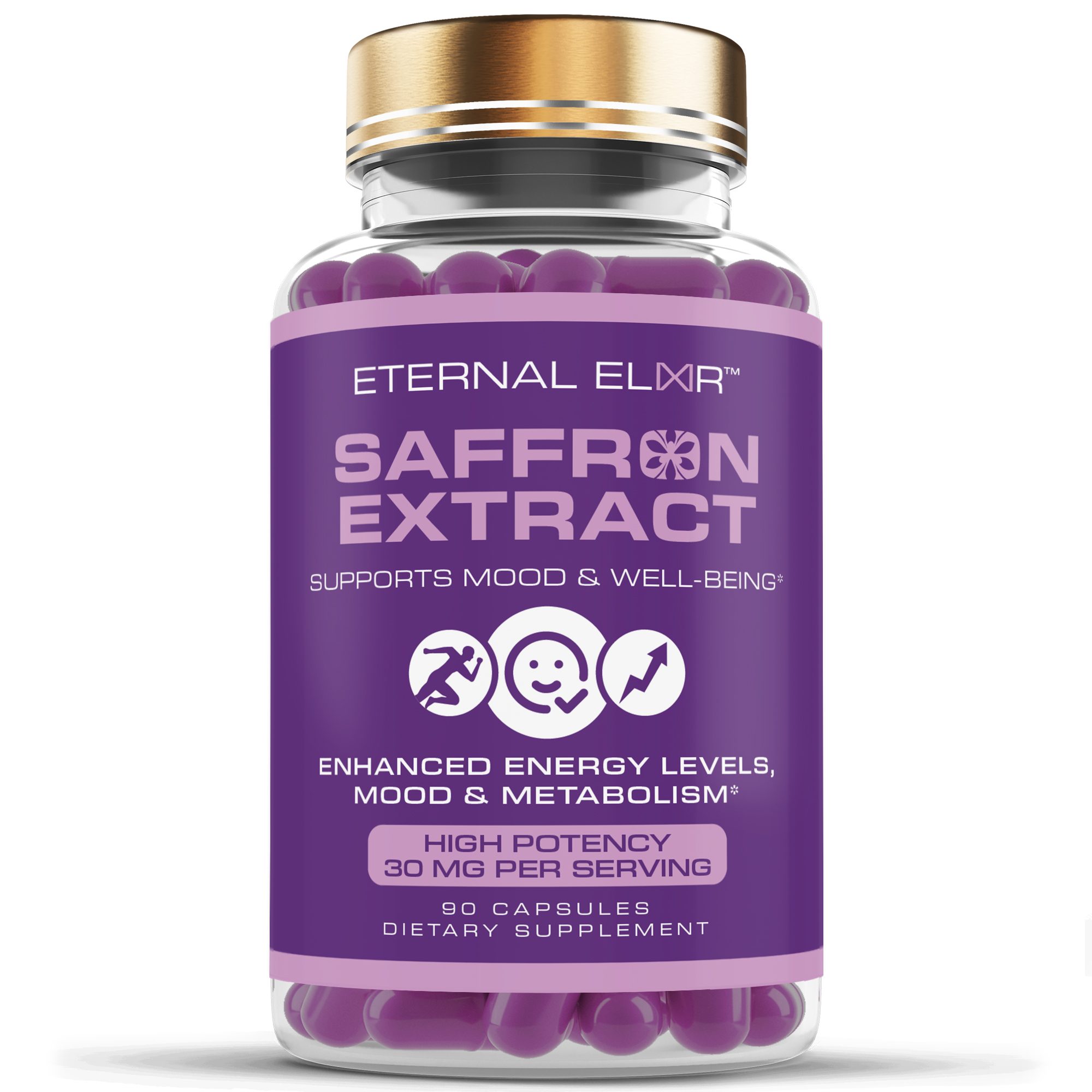
- Our Saffron Extract 30mg holds 30 mg of affron per capsule, one a day, 90 capsules for $49.99, which is $0.56 a day.
Eternal Elixir makes Saffron Extract 30mg, and it is our pick for sleep because it uses affron, the extract from the Perth sleep trials, at 30 mg in one capsule a day.
Table of contents
- 1. Does Saffron for Sleep Actually Work? The Short Answer
- 2. The Saffron Sleep Trials at a Glance
- 3. What the Australian affron® Sleep Trials Actually Did
- 4. The Trials Outside Australia, and Where They Disagree
- 5. How to Take Saffron for Sleep: Dose, Timing and Duration
- 6. Saffron Supplements in Australia Compared (Prices as of Sep 2026)
- 7. Eternal Elixir Saffron Extract 30mg: Why We Make It This Way
- 8. Stacking Saffron with Magnesium, and What to Keep for Mornings
- 9. Side Effects, Interactions and Who Should Be Careful
- 10. Frequently Asked Questions About Saffron and Sleep
- 10.1. Does saffron help you to sleep?
- 10.2. How much saffron should you take before bed?
- 10.3. Is it better to take saffron in the morning or at night?
- 10.4. How long does saffron take to work for sleep?
- 10.5. Can saffron lower cortisol?
- 10.6. What should you avoid while taking saffron?
- 10.7. Does saffron work like Adderall?
- 10.8. Can I take saffron with magnesium or other sleep supplements?
- 10.9. What is the best saffron supplement for sleep in Australia?
- 11. The Bottom Line
- 12. Sources
Does Saffron for Sleep Actually Work? The Short Answer
Yes, with limits. The best single summary is a 2023 systematic review in Nutrition and Metabolic Insights. It found five randomised controlled trials covering 379 participants in three countries, and its authors concluded that saffron appears to benefit sleep quality and duration, with early support for its safety at the doses used (Sadat Rafiei et al., 2023).
A 2022 meta-analysis in Sleep Medicine pooled the trials in a different way and found saffron ahead of placebo on three standard sleep questionnaires. On the Pittsburgh Sleep Quality Index, scores improved by 2.14 points more than on placebo (Lian et al., 2022). That analysis mixed healthy adults with people under medical care, and its dose subgroup favoured 100 mg of saffron a day, which does not map directly onto a 30 mg standardised extract. Read it as a broad signal.
Three more trials have appeared since those reviews: a German trial of 165 adults in 2025, a UK pilot in older adults that added a sleep headband, and a 2026 Perth trial in women aged 50 to 70. All three are covered below.
On the question in the title, whether saffron helps you switch off, two trials measured it directly. In Belgium the saffron group found it easier to get to sleep, and in a UK pilot a sleep headband recorded a shorter time to fall asleep. Perceived stress also fell in the German trial.
What the evidence supports is a nudge. The trials mostly recruited adults with self-reported poor sleep who wake unrefreshed, and that is the group most likely to notice a change. For the daytime side of the same extract, our guide to saffron supplement benefits across mood, stress and sleep covers the mood trials, and the best saffron supplements in Australia comparison shows how the labels differ between brands.
The Saffron Sleep Trials at a Glance
Six placebo-controlled trials have tested a standardised saffron extract on sleep in adults with everyday sleep complaints. Here they are side by side, oldest first.
| Trial | Who took part | Extract and daily dose | Length | Main sleep result |
|---|---|---|---|---|
| Lopresti, 2020 (Perth) | 63 adults aged 18 to 70 with self-reported poor sleep | affron, 14 mg twice a day | 28 days | Better than placebo on a sleep-difficulty index, a restorative sleep questionnaire and sleep-diary quality ratings. No adverse effects reported |
| Lopresti, 2021 (Perth) | 120 adults with unsatisfactory sleep | affron, 14 mg or 28 mg, 1 hour before bed | 28 days | Better sleep quality ratings and mood on waking. Other diary measures no different. Both doses similar. Evening melatonin rose and cortisol did not change |
| Pachikian, 2021 (Belgium) | 66 adults with mild to moderate sleep problems linked to anxiety | Safr’Inside, 15.5 mg | 6 weeks | Sleep quality, time to fall asleep and sleep duration scores improved in the saffron group and not on placebo. A wrist tracker recorded more time in bed |
| Schuster, 2025 (Germany) | 165 adults with moderate sleep complaints | Safr’Inside, 20 mg or 30 mg | 4 weeks | A bigger drop in sleep-complaint scores than placebo. Sleep quality ahead from week three. Perceived stress lower |
| Lang, 2025 (UK) | 52 adults aged 55 to 85 with sleep complaints | Standardised extract, 30 mg | 4 weeks | Better self-rated sleep quality and sleep efficiency. A sleep headband recorded a shorter time to fall asleep. Pilot study |
| Lopresti, 2026 (Perth) | 86 women aged 50 to 70 with low mood and poor sleep | affron, 28 mg | 12 weeks | Less sleep-related impairment during the day. No difference on the sleep disturbance score |
What the Australian affron® Sleep Trials Actually Did
The trial most pages cite is Australian. Adrian Lopresti and colleagues at Murdoch University and Clinical Research Australia in Perth ran it, and the Journal of Clinical Sleep Medicine published it in 2020 (Lopresti et al., 2020). The same group followed it with a larger trial in 2021 and a trial in women in 2026. All three used affron, a standardised saffron extract made by the Spanish company Pharmactive, which funded the 2020 and 2026 trials.
The 2020 protocol: 14 mg twice a day, not one capsule at bedtime
Sixty-three healthy adults aged 18 to 70 with self-reported sleep problems took either 14 mg of affron twice a day or a placebo for 28 days. That is 28 mg across the day, split between morning and evening. It was not a single dose an hour before bed, which is how saffron for sleep is usually described online.
The researchers analysed data from 55 participants. The saffron group improved more than the placebo group on a standard sleep-difficulty index (P = .017), a restorative sleep questionnaire (P = .029) and sleep-diary quality ratings (P = .014). The authors recorded no adverse effects, and they called for larger and longer trials with objective sleep measures.
The 2021 follow-up: an hour before bed, at two doses
The second Perth trial gave 120 adults with unsatisfactory sleep a placebo, 14 mg or 28 mg of affron one hour before bed for 28 days (Lopresti et al., 2021). Saffron improved sleep quality ratings, mood after waking and the total score on a sleep-symptom questionnaire. Most other sleep-diary measures did not differ from placebo, and the 14 mg and 28 mg groups did about equally well.
This trial also measured hormones in evening saliva. Melatonin rose on saffron compared with placebo. Cortisol did not change. That second result matters because many pages say saffron lowers cortisol, and the one sleep trial that measured it found no such effect.
The 2026 trial in women aged 50 to 70
The newest Perth trial gave 86 women with low mood and poor sleep either 28 mg of affron a day or a placebo for 12 weeks (Lopresti and Smith, 2026). Its main measure was mood. On sleep, saffron reduced sleep-related impairment, meaning how much poor sleep got in the way of the day, but it made no difference to the sleep disturbance score (p = 0.786). The authors described the sleep findings as exploratory.
What improved, and what did not
Across the Perth trials, the changes were in how people rated their sleep and how they felt when they woke. None of them showed saffron knocking people out or acting like a sedative. If you want to test it the way these trials did, one capsule of ours a day for four weeks delivers 30 mg of the same extract.
Add Saffron Extract 30mg to cart · $49.99The Trials Outside Australia, and Where They Disagree
Belgium, 2021: 15.5 mg for six weeks
Pachikian and colleagues at the Université catholique de Louvain gave 66 adults with mild to moderate sleep problems linked to anxiety either 15.5 mg a day of a saffron extract (Safr’Inside) or a placebo for six weeks (Pachikian et al., 2021). They used a wrist actigraph as well as questionnaires. The saffron group spent more time in bed, found it easier to get to sleep, and improved on sleep quality, time to fall asleep and sleep duration scores. The placebo group did not change on those measures.
One caution applies. The paper reports changes within each group, which is weaker evidence than a direct saffron-versus-placebo comparison, and the funders helped design the study and write the paper.
Germany, 2025: the biggest dedicated sleep trial we found
Schuster and colleagues at Leibniz University Hannover ran a remote trial of 165 adults with moderate sleep complaints, who took 20 mg or 30 mg of Safr’Inside or a placebo for four weeks (Schuster et al., 2025). Among the 150 who finished, saffron reduced sleep-complaint scores more than placebo did. Sleep quality ratings pulled ahead of placebo from week three at both doses, and perceived stress fell. Positive and negative mood, daytime sleepiness and quality of life did not differ. The extract maker funded the work.
UK, 2025: a sleep headband in older adults
A pilot at the University of East Anglia gave 52 adults aged 55 to 85 with sleep complaints 30 mg a day of a standardised saffron extract or a placebo for four weeks (Lang et al., 2025). Participants also wore an EEG sleep headband. Self-rated sleep quality (p = 0.02) and sleep efficiency (p = 0.04) improved, and the headband recorded a shorter time to fall asleep (p = 0.03). In a subgroup of 26 participants, gut bacteria that make short-chain fatty acids increased. It is a small pilot, and two of its authors work for Activ’Inside, a saffron extract company.
Where the trials disagree
The trials differ in dose, extract, length and measures, so they do not all say the same thing. The 2021 Perth trial found 14 mg and 28 mg worked about equally, and the German trial found the same for 20 mg and 30 mg. In the 2026 Perth trial the sleep disturbance score did not move. Most results rest on questionnaires people fill in about themselves, the longest sleep-focused trial ran for six weeks, and extract makers funded or co-wrote most of them.
Two patterns do hold. The effect is on how people rate their sleep more than on clock time asleep, and the people who responded had everyday sleep complaints. The participants had mild to moderate, mostly self-reported sleep complaints. If you have a diagnosed sleep disorder, these results may not apply to you, so talk to your GP.
How saffron might help sleep is not settled. Its main compounds are crocins, crocetin and safranal, and most proposed mechanisms, such as effects on serotonin and GABA signalling, come from cell and animal studies. In people, the measured biological changes so far are the rise in evening melatonin in the 2021 trial and the shift in gut bacteria in the UK pilot. The most plausible reading is that saffron works indirectly, by easing the evening stress that keeps people awake. That fits the stress result in the German trial and the mood results for the same extract, and our piece on what the saffron attention trials found covers a separate line of research on these compounds. Saffron is not a sedative and does not behave like one.
How to Take Saffron for Sleep: Dose, Timing and Duration
Here is how the trial protocols translate into a routine, with our own capsule as the reference product.
| Approach | Daily amount | When to take it | How long |
|---|---|---|---|
| Match the 2020 Perth trial | 28 mg affron (14 mg twice a day) | Morning and evening | 28 days |
| Match the 2021 Perth trial | 14 mg or 28 mg affron | One hour before bed | 28 days |
| Match the German trial | 20 mg or 30 mg Safr’Inside | Once a day | 4 weeks |
| One Eternal Elixir capsule | 30 mg affron | With your evening meal, at the same time each day | At least 4 weeks |
- Give it four weeks. Every sleep trial ran at least that long, and in the German trial the sleep quality gap opened in week three. A few nights tells you very little.
- More is not better. The trials worked at 14 to 30 mg a day, and in Perth 28 mg did no better than 14 mg.
- Keep the time steady. Our capsule is a single 30 mg dose, so the simplest match is one with your evening meal at a consistent time.
On cost, our Saffron Extract 30mg is $49.99 for 90 capsules. One capsule is one serve, so that is $0.56 a day, and one bottle covers the 28-day trial protocol three times over. Three bottles save 15%, which brings the price to $127.47 for 270 days, about $0.47 a day.
The label states the extract (affron), the standardisation (3.5% Lepticrosalides, the group of crocins, safranal and related compounds the extract is measured by) and the amount (30 mg). Those three details tell you it is the extract from the trials rather than a plain saffron powder of unknown strength.
Add Saffron Extract 30mg to cart · $49.99Saffron Supplements in Australia Compared (Prices as of Sep 2026)
If you want a product that matches the sleep trials, look for affron or another named, standardised extract at 28 to 30 mg a day. These are the affron products we could check on Australian shelves and iHerb AU. We took each price, pack size and label serve from the seller’s own page in September 2026, and cost per day follows the label serve.
| Product | Where to buy | Price (AUD, as of Sep 2026) | Pack | Saffron per day (label serve) | Cost per day | Buy |
|---|---|---|---|---|---|---|
| Eternal Elixir Saffron Extract 30mg (our pick) | eternalelixir.com.au, ships from Sydney | $49.99 | 90 capsules, 90 days | 30 mg affron (1 capsule) | $0.56 | View product |
| Caruso’s Saffron | Chemist Warehouse | $19.97 (RRP $39.95) | 60 tablets, 30 days | 27 mg affron (2 tablets) | $0.67 | Chemist Warehouse |
| California Gold Nutrition Saffron Extract with Affron | iHerb AU | $42.66 | 60 capsules, 60 days | 28 mg affron (1 capsule) | $0.71 | iHerb |
| Solaray Vital Extracts Saffron 30mg | iHerb AU | $24.93 | 30 capsules, 30 days | 30 mg affron (1 capsule) | $0.83 | iHerb |
| Herbs of Gold Saffron Mood Balance | herbsofgold.com.au | $35.16 on sale (regular $43.95) | 60 capsules, 30 days | 30 mg affron plus lemon balm (2 capsules) | $1.17 on sale, $1.47 regular | Herbs of Gold |
Who each one suits, and who it doesn’t
- Eternal Elixir Saffron Extract 30mg (our pick). Suits anyone who wants the trial extract at the top of the trial dose range in one capsule a day, with a three-month bottle that covers a proper test and beyond. It has the lowest cost per day of the affron products here. It does not suit someone who wants to split small doses between morning and evening, or who needs to buy it at a pharmacy today.
- Caruso’s Saffron. Suits shoppers who want to buy at Chemist Warehouse, and its 13.5 mg tablets taken twice a day are the closest match to the split dose in the 2020 Perth trial. Its $19.97 shelf price is the lowest upfront outlay in the table. It does not suit anyone who prefers one tablet a day, and a pack lasts 30 days.
- California Gold Nutrition Saffron Extract with Affron. Suits iHerb shoppers who want 28 mg, the higher dose from the 2021 Perth trial and the dose in the 2026 trial. It does not suit anyone who wants a longer supply per bottle, since 60 capsules last two months.
- Solaray Vital Extracts Saffron. Suits someone who wants to try affron at 30 mg for one month with a small outlay. It does not suit longer-term use, because its 30-capsule bottle makes it the dearest of the single-extract options here per day.
- Herbs of Gold Saffron Mood Balance. Suits people who want lemon balm alongside affron: each capsule holds 15 mg of saffron extract and 30 mg of lemon balm extract, two a day. It does not suit anyone who wants saffron on its own, and it is the dearest per day in the table even on sale.
Eternal Elixir Saffron Extract 30mg: Why We Make It This Way
We sell one saffron product, and its label follows the trials above. These are the facts from the bottle and the product page:
- affron saffron extract standardised to 3.5% Lepticrosalides, 30 mg per capsule, which is 1.05 mg of Lepticrosalides a day.
- One capsule a day with a meal, and 90 capsules per bottle, so one bottle lasts three months.
- The only other ingredients are rice flour and a vegetable capsule, so it suits vegans and vegetarians.
- $49.99 a bottle, or $0.56 a day. Two bottles save 10%, three save 15% and five save 20%.
- Ships from Sydney within 24 hours, with free shipping over $100, a 30-day money-back guarantee and Afterpay.
For sleep, the case is short. Thirty milligrams a day sits at the top of the dose range the sleep trials tested. One capsule is easier to keep up for four weeks than two tablets, and a 90-capsule bottle means you finish a full test before you need to reorder. You can compare it with every other brand in our saffron supplement comparison for Australia.
Add Saffron Extract 30mg to cart · $49.99Stacking Saffron with Magnesium, and What to Keep for Mornings
Saffron appears to work on how settled you feel at night. The pairing we suggest for the physical side of winding down is magnesium L-threonate. It was developed to raise magnesium levels in the brain, and that was shown in rats (Slutsky et al., 2010). One human sleep trial has tested it: 80 adults aged 35 to 55 with self-reported sleep problems took 1 g a day or a placebo for 21 days. Deep sleep and REM sleep scores on an Oura ring improved against placebo, as did mood and alertness on waking. Three of its six authors work for AIDP, a supplement ingredient company (Hausenblas et al., 2024).
We covered dose and timing in our guide to magnesium L-threonate for sleep, and what magnesium L-threonate does for the brain and sleep explains the background. Our Magnesium L-Threonate 2000mg is $59.99 for 90 capsules at three capsules a serve, which is $2.00 a day. Its serve is 2,000 mg, double the amount in that trial. Saffron and magnesium together come to $109.98, which clears the $100 free-shipping line.
Keep anything you take for energy out of the evening. Our NMN 500mg label suggests a morning capsule, and our article on taking NMN in the morning or at night explains why. Build the evening routine around calm and keep the rest for daylight. For a wider routine, our roundup of the best nootropic supplements in Australia maps which compounds suit which end of the day, and our guide to magnesium supplements for sleep in Australia compares the other magnesium forms.
Side Effects, Interactions and Who Should Be Careful
At trial doses, saffron is usually well tolerated. A 2026 systematic review of 102 clinical trials put the rate of adverse events at around 17.5%, mostly minor stomach and gut complaints that settled on their own (Hasheminasab et al., 2026). Its authors still advised clinical monitoring at higher doses or with long use. The three Perth sleep trials reported no serious adverse effects.
Dose discipline matters more with saffron than with most botanicals. In a small safety study of 30 healthy volunteers, 400 mg of saffron a day for a week lowered standing blood pressure and shifted some blood markers, though they stayed within normal ranges (Modaghegh et al., 2008). Doses of 5 g and above can cause poisoning (WebMD saffron monograph). The sleep trials worked at 14 to 30 mg.
Check with your GP or pharmacist before you start if any of these apply to you:
- You take medicines that lower blood pressure or blood sugar, or sedatives and sleeping tablets, since saffron may add to their effects.
- You take antidepressants or other medicines that act on mood. A Perth trial gave 14 mg of affron twice a day alongside antidepressants for eight weeks under medical supervision (Lopresti et al., 2019), but that is no reason to combine them without advice.
- You have bipolar disorder, because saffron seems to affect mood and might trigger excitability.
- You are pregnant, trying to conceive or breastfeeding. Amounts above food levels are considered likely unsafe in pregnancy, and a 2017 toxicology review advised pregnant women to avoid high doses (Bostan et al., 2017).
- You have surgery booked. Stop saffron at least two weeks beforehand.
- You are allergic to olive, ryegrass or saltwort plants, since people with those allergies may also react to saffron.
One practical note: if a sleep problem has lasted for months, is wrecking your days, or comes with loud snoring or pauses in breathing, a supplement is the wrong tool. See your GP first. Our guide to magnesium L-threonate side effects covers the magnesium half of an evening routine.
Frequently Asked Questions About Saffron and Sleep
Does saffron help you to sleep?
On the current evidence, yes, modestly. Most of six placebo-controlled trials of standardised extracts found better self-rated sleep quality after four weeks or more, and a 2023 review of five trials with 379 participants reached the same view. The effect is real but small, and saffron will not knock you out.
Add Saffron Extract 30mg to cart · $49.99
How much saffron should you take before bed?
The sleep trials used 14 to 30 mg a day of a standardised extract. The first Perth trial used 14 mg twice a day, the second found 14 mg and 28 mg an hour before bed worked about equally, and the German trial found the same for 20 mg and 30 mg. One 30 mg capsule with your evening meal sits at the top of that range. No trial has shown that more helps sleep further.
Is it better to take saffron in the morning or at night?
For sleep, the 2021 Perth trial gave it one hour before bed, and the 2020 trial split it between morning and evening. Both approaches worked. Our label says to take one capsule with a meal at the same time each day, so the evening meal is the easy choice for sleep. Keeping the time consistent matters more than the hour.
How long does saffron take to work for sleep?
Expect weeks, not nights. In the German trial, sleep quality pulled ahead of placebo in week three, and every sleep trial ran for at least four weeks. Give it a full month before you judge it.
Can saffron lower cortisol?
Probably not as a capsule. The 2021 Perth trial measured evening cortisol in saliva and found no change on saffron, while melatonin rose. A small Japanese study found that 35 women who smelled saffron for 20 minutes had lower salivary cortisol afterwards (Fukui et al., 2011), but that tested the scent, not a supplement.
What should you avoid while taking saffron?
Avoid taking more than the trial doses, and avoid starting saffron without advice if you take medicines for blood pressure, blood sugar, mood or sleep. Do not use saffron supplements if you are pregnant or trying to conceive, and stop at least two weeks before surgery. Doses of 5 g and above can cause poisoning, while the trials used 14 to 30 mg.
Does saffron work like Adderall?
No. Adderall is a prescription stimulant medicine, and saffron is not a stimulant. A six-week pilot trial of 54 children compared saffron capsules with methylphenidate, a different prescription medicine, and found similar rating-scale changes, but it was small and short. Never swap a prescribed medicine for a supplement without talking to your doctor. Our guide to saffron supplements for focus has the detail.
Can I take saffron with magnesium or other sleep supplements?
Saffron with magnesium L-threonate is a reasonable pairing, since the two are thought to act on different parts of winding down. Stacking several calming supplements at once is a poor idea, because you lose track of what is working. Add one thing at a time, give it four weeks, and check with your pharmacist first if you take any prescribed medicine for sleep or mood.
Add Magnesium L-Threonate 2000mg to cart · $59.99
What is the best saffron supplement for sleep in Australia?
Our pick is Eternal Elixir Saffron Extract 30mg, which we make. It has 30 mg of affron, the extract from the Perth sleep trials, in one capsule a day, with 90 capsules for $49.99 ($0.56 a day). If you would rather buy at a pharmacy, Caruso’s Saffron at Chemist Warehouse uses the same extract at 13.5 mg twice a day. Our full saffron supplement comparison covers more brands.
Add Saffron Extract 30mg to cart · $49.99
The Bottom Line
Saffron has six placebo-controlled sleep trials of standardised extracts behind it, and three were run in Perth. Expect a modest lift in how well you sleep and how you feel on waking after three to four weeks at 14 to 30 mg a day. Do not expect a sedative. If that trade suits you, buy a standardised extract at the trial dose. Ours puts 30 mg of affron in one capsule a day for $0.56, and you can see the rest of our range in the Eternal Elixir shop. For the mood side of saffron, read our guide to saffron for mood and stress.
Sources
- Sadat Rafiei SK, Abolghasemi S, Frashidi M, et al. Saffron and sleep quality: a systematic review of randomized controlled trials. Nutr Metab Insights. 2023;16:11786388231160317. PMC10357048
- Lian J, Zhong Y, Li H, et al. Effects of saffron supplementation on improving sleep quality: a meta-analysis of randomized controlled trials. Sleep Med. 2022;92:24-33. PubMed 35325766
- Lopresti AL, Smith SJ, Metse AP, Drummond PD. Effects of saffron on sleep quality in healthy adults with self-reported poor sleep: a randomized, double-blind, placebo-controlled trial. J Clin Sleep Med. 2020;16(6):937-947. PubMed 32056539
- Lopresti AL, Smith SJ, Drummond PD. An investigation into an evening intake of a saffron extract (affron) on sleep quality, cortisol, and melatonin concentrations in adults with poor sleep: a randomised, double-blind, placebo-controlled, multi-dose study. Sleep Med. 2021;86:7-18. PubMed 34438361
- Pachikian BD, Copine S, Suchareau M, Deldicque L. Effects of saffron extract on sleep quality: a randomized double-blind controlled clinical trial. Nutrients. 2021;13(5):1473. PubMed 33925432
- Schuster J, Mundhenke C, Nordsieck H, et al. Effect of a saffron extract on sleep quality in adults with moderate insomnia: a decentralized, randomized, double-blind, placebo-controlled trial. Sleep Med X. 2025;10:100147. PubMed 40698027
- Lang L, Ditton A, Stanescu A, et al. A standardised saffron extract improves subjective and objective sleep quality in healthy older adults with sleep complaints: results from the gut-sleep-brain axis randomised, double-blind, placebo-controlled pilot study. Food Funct. 2025;16(17):6817-6832. PubMed 40762630
- Lopresti AL, Smith SJ. The effects of a saffron extract (Affron) on mood, sleep, self-esteem, and exploratory measures of physical appearance in women aged 50 to 70 years experiencing low mood and poor sleep: a randomised, double-blind, placebo-controlled trial. Front Nutr. 2026;13:1838513. PubMed 42389708
- Lopresti AL, Smith SJ, Hood SD, Drummond PD. Efficacy of a standardised saffron extract (affron) as an add-on to antidepressant medication for the treatment of persistent depressive symptoms in adults: a randomised, double-blind, placebo-controlled study. J Psychopharmacol. 2019;33(11):1415-1427. PubMed 31475623
- Hasheminasab FS, Hajimonfarednejad M, Najibi SM, Hashempur MH. Adverse events of saffron (Crocus sativus L.): systematic review of current evidence. Health Sci Rep. 2026;9(5):e72212. PubMed 42057871
- Modaghegh MH, Shahabian M, Esmaeili HA, et al. Safety evaluation of saffron (Crocus sativus) tablets in healthy volunteers. Phytomedicine. 2008;15(12):1032-1037. PubMed 18693099
- Bostan HB, Mehri S, Hosseinzadeh H. Toxicology effects of saffron and its constituents: a review. Iran J Basic Med Sci. 2017;20(2):110-121. PubMed 28293386
- Fukui H, Toyoshima K, Komaki R. Psychological and neuroendocrinological effects of odor of saffron (Crocus sativus). Phytomedicine. 2011;18(8-9):726-730. PubMed 21242071
- Baziar S, Aqamolaei A, Khadem E, et al. Crocus sativus L. versus methylphenidate in treatment of children with attention-deficit/hyperactivity disorder: a randomized, double-blind pilot study. J Child Adolesc Psychopharmacol. 2019;29(3):205-212. PubMed 30741567
- Slutsky I, Abumaria N, Wu LJ, et al. Enhancement of learning and memory by elevating brain magnesium. Neuron. 2010;65(2):165-177. PubMed 20152124
- Hausenblas HA, Lynch T, Hooper S, et al. Magnesium-L-threonate improves sleep quality and daytime functioning in adults with self-reported sleep problems: a randomized controlled trial. Sleep Med X. 2024;8:100121. PubMed 39252819
- WebMD. Saffron: uses, side effects, and more. WebMD
- Product labels and prices: Eternal Elixir Saffron Extract 30mg, Caruso’s Saffron, California Gold Nutrition, Solaray and Herbs of Gold, checked September 2026.