Last updated: September 26, 2026 · Originally published: August 2, 2026 · By Eternal Elixir Editorial
Quick Answer
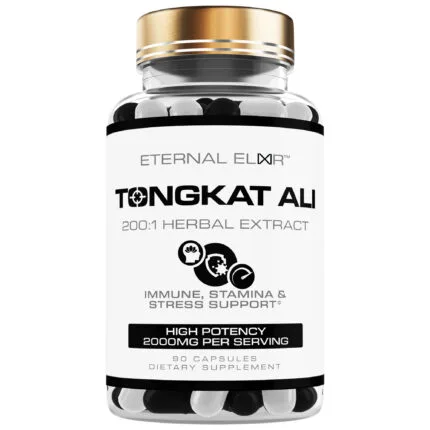
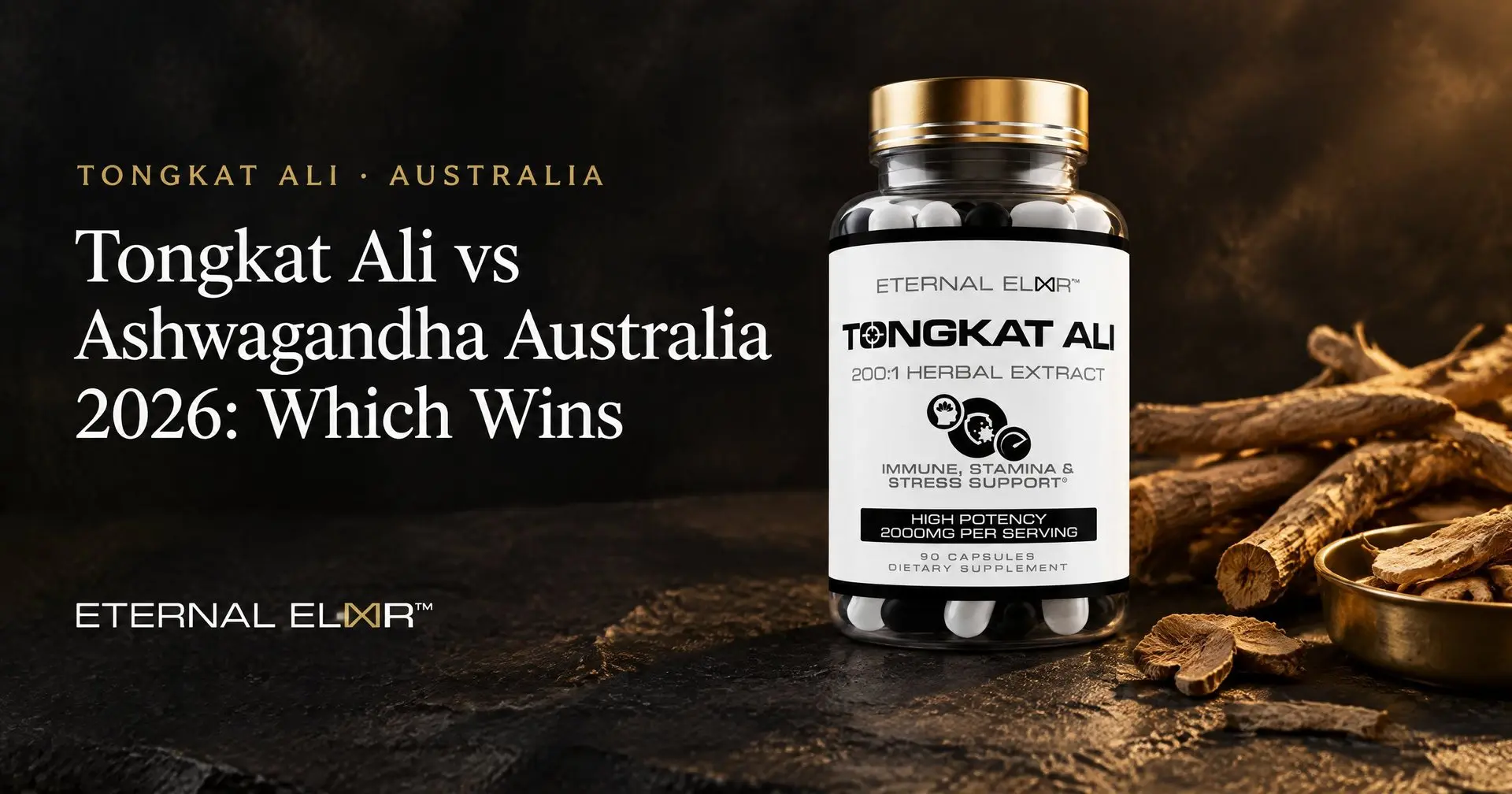
If your goal is testosterone, drive and training, our pick is tongkat ali, and specifically Eternal Elixir Tongkat Ali 2000mg. Tongkat ali has a 2022 meta-analysis of five randomised trials showing a rise in total testosterone. Ashwagandha has more trials on stress and cortisol, so if stress is your main problem, it is the better-matched herb, and we don’t sell it. Our tongkat ali is a 200:1 extract, 90 capsules for $39.99, three capsules a day, which works out at $1.33 a day.
Eternal Elixir makes Tongkat Ali 2000mg, so read this as our pick with the working shown. Competitor prices were read from each live listing on 26 September 2026.
Tongkat ali and ashwagandha sit side by side in Australian supplement aisles, and plenty of people buy both. They are different herbs with different research behind them. Tongkat ali (Eurycoma longifolia) is a South-East Asian root studied mostly for testosterone. Ashwagandha (Withania somnifera) is an Ayurvedic root studied mostly for stress and cortisol, with a smaller set of testosterone trials of its own.
This guide sets out what the human trials on each actually measured, what each costs in Australia, whether you can take them together, and which to buy first for your goal. For the wider picture on tongkat ali alone, start with our tongkat ali Australia guide.
Table of contents
- 1. Tongkat ali vs ashwagandha at a glance
- 2. What the tongkat ali trials found
- 3. What the ashwagandha trials found
- 4. Which is better for testosterone?
- 5. Which is better for stress and cortisol?
- 6. Tongkat ali and ashwagandha products in Australia compared (as of Sep 2026)
- 7. Can you take tongkat ali and ashwagandha together?
- 8. How much to take: trial amounts vs Australian labels
- 9. Why be careful with ashwagandha, and with tongkat ali?
- 10. Which should you buy?
- 11. Tongkat ali vs ashwagandha: frequently asked questions
- 11.1. What is the best tongkat ali to buy in Australia?
- 11.2. Can I take ashwagandha and tongkat ali together?
- 11.3. Is ashwagandha better than tongkat ali for testosterone?
- 11.4. Does ashwagandha really raise testosterone?
- 11.5. Does tongkat ali lower cortisol?
- 11.6. Why be careful with ashwagandha?
- 11.7. How long do tongkat ali and ashwagandha take to work?
- 12. Sources
Tongkat ali vs ashwagandha at a glance
| Factor | Tongkat ali | Ashwagandha |
|---|---|---|
| What it is | Root extract of Eurycoma longifolia | Root extract of Withania somnifera |
| Main reason people take it | Testosterone and drive | Stress and cortisol |
| Testosterone evidence | A 2022 meta-analysis of five randomised trials found a rise | Mixed: two trials found a rise against placebo, one did not |
| Cortisol and stress evidence | One four-week trial, funded by the extract’s maker | Two 60-day placebo-controlled trials found lower cortisol |
| Daily amounts in the trials cited here | 200mg or 600mg of extract | 240mg or 600mg of extract |
| What to check on the label | Extract ratio (such as 200:1) or eurycomanone content | Extract amount and withanolide content, or a named extract |
| Eternal Elixir product | Tongkat Ali 2000mg, $39.99 for 90 capsules | Not stocked |
Read it by your goal. Testosterone is what tongkat ali has mostly been tested for. Stress and cortisol are where ashwagandha has most of its trials. Neither has been tested against the other in the same people, so any claim that one “beats” the other by a set amount is comparing numbers from different studies.
What the tongkat ali trials found
Testosterone
The best summary is a 2022 systematic review and meta-analysis in Medicina. The authors found nine clinical studies and pooled five randomised trials. Men taking tongkat ali had significantly higher total testosterone than controls, and the result held in men who started with low levels (Leisegang et al., 2022). The authors called it promising and said more research is needed.
One of the cleaner single trials gave 32 healthy young men 600mg a day of tongkat ali extract or a placebo for two weeks. Total testosterone (p = .005) and free testosterone (p = .012) rose more in the tongkat ali group. Estradiol rose too (p = .008). Luteinising hormone, follicle-stimulating hormone and sex hormone-binding globulin (SHBG) did not change (Chan et al., Andrologia, 2021).
That SHBG result is worth knowing, because a lot of marketing says tongkat ali works by “freeing” testosterone from SHBG. In this trial, SHBG stayed where it was. How both herbs compare with other options is covered in our guide to natural testosterone support supplements in Australia.
Cortisol and mood
In a four-week trial, 63 moderately stressed adults (32 men and 31 women) took 200mg a day of a standardised hot-water tongkat ali extract or a placebo. The tongkat ali group had 16% lower cortisol exposure and 37% higher testosterone, both measured in saliva. Their tension scores fell 11% and confusion scores 15% (Talbott et al., Journal of the International Society of Sports Nutrition, 2013). The extract’s maker funded the study, and it is the only tongkat ali cortisol trial we found.
What has not been shown
- No trial has compared tongkat ali with ashwagandha directly, in the same people, on the same measure.
- We found no trial of the two herbs taken together.
- None of the tongkat ali trials in this guide used more than 600mg a day. Our label serve is 2,000mg of a 200:1 extract, so these results can’t tell you whether a larger amount does more.
We cover the wider research in tongkat ali benefits in Australia.
Add Tongkat Ali 2000mg to cart · $39.99What the ashwagandha trials found
Stress and cortisol
Stress is ashwagandha’s strongest ground. In a 60-day trial run by researchers at Murdoch University in Perth, 60 stressed but healthy adults took 240mg a day of a standardised ashwagandha extract (Shoden) or a placebo. The ashwagandha group improved more on a clinician-rated anxiety scale (p = .040) and had larger falls in morning cortisol (p < .001). No adverse events were reported (Lopresti et al., Medicine, 2019).
An earlier trial in India enrolled 64 adults with a history of chronic stress. They took 300mg of a concentrated ashwagandha root extract twice a day, or a placebo, for 60 days. Scores on every stress questionnaire fell more with ashwagandha (p < 0.0001), and so did serum cortisol (p = 0.0006) (Chandrasekhar et al., Indian Journal of Psychological Medicine, 2012).
Testosterone: a mixed record
Ashwagandha has testosterone trials too, and two are positive. In an eight-week trial, 57 young men new to weight training took 300mg of ashwagandha root extract twice a day or a placebo while following the same program. The ashwagandha group gained more bench-press strength and had a significantly larger rise in testosterone (p = 0.004) (Wankhede et al., Journal of the International Society of Sports Nutrition, 2015).
A Perth crossover trial enrolled 57 overweight men aged 40 to 70. Over eight weeks on ashwagandha, testosterone rose 14.7% more than on placebo (p = .010) and DHEA-S rose 18% more. Scores for fatigue, vigour and sexual wellbeing did not differ from placebo (Lopresti et al., American Journal of Men’s Health, 2019).
The 60-day Perth stress trial above pointed the other way. Testosterone rose in the men over time (p = .038), but not by significantly more than placebo (p = .158). A 2021 systematic review of 32 randomised trials across 13 herbs, from the same Perth research group, concluded that ashwagandha and fenugreek extracts had positive effects on testosterone in men (Smith et al., Advances in Nutrition, 2021). Its summary did not name tongkat ali among them, though it came out a year before the tongkat ali meta-analysis above.
Which is better for testosterone?
On the trials published so far, neither herb clearly beats the other, because nobody has tested them head to head. What differs is the weight of the research. Tongkat ali has a meta-analysis built on testosterone, pooling five randomised trials. Ashwagandha has two positive testosterone trials in men and one that found no difference from placebo, and most of its research is on stress.
We lean to tongkat ali for this goal, and we sell it, so weigh that. Testosterone is the outcome tongkat ali has been tested on most, the young-men trial saw changes within two weeks, and the pooled trials point the same way. If you lift and want a herb with a strength result, ashwagandha has the better single study here: the eight-week training trial with a placebo group.
If you are weighing tongkat ali against other options for the same goal, see tongkat ali vs turkesterone and tongkat ali vs shilajit.
Which is better for stress and cortisol?
Ashwagandha. It has two 60-day placebo-controlled trials showing lower cortisol and better stress scores, at 240mg and 600mg a day. Tongkat ali has one four-week trial at 200mg a day, funded by the extract’s maker. If stress and feeling wired are your main problem, ashwagandha is the better-matched herb.
We don’t sell ashwagandha. The table below shows where Australians can buy it, and our roundup of the best adaptogen supplements in Australia compares it with other adaptogens. If you would like an option from our own range for mood and stress, our guide to saffron for mood and stress covers the saffron trials.
Tongkat ali and ashwagandha products in Australia compared (as of Sep 2026)
Cost per day uses each label’s daily serve and the single-pack price, before postage. The two Chemist Warehouse prices were sale prices on the day we checked.
| Product | Herb and dose per serve | Price (AUD) | Daily serve | Cost per day | Buy |
|---|---|---|---|---|---|
| Eternal Elixir Tongkat Ali 2000mg | Tongkat ali 200:1 extract, 2,000mg | $39.99 / 90 capsules | 3 capsules | $1.33 | Eternal Elixir |
| Emrald Labs Tongkat Ali | Tongkat ali 200:1 extract, 500mg | $69.90 / 60 capsules | 1 capsule | $1.17 | Elite Supps |
| Evolution Botanicals Tongkat Ali | Tongkat ali 25:1 extract with 1% eurycomanone, 500mg | $69.95 / 120 capsules | 1 capsule | $0.58 | Evolution Botanicals |
| Bulk Nutrients KSM-66 Ashwagandha | Ashwagandha root extract, 600mg | $39.00 / 120 capsules | 2 capsules | $0.65 | Bulk Nutrients |
| Caruso’s Ashwagandha | Ashwagandha extract, 600mg (30mg withanolides) | $19.50 / 50 tablets | 1 tablet | $0.39 | Chemist Warehouse |
| Wagner Ashwagandha 6000 | Ashwagandha extract, 240mg | $13.99 / 120 capsules | 1 capsule | $0.12 | Chemist Warehouse |
Who each one suits, and who it doesn’t:
- Eternal Elixir Tongkat Ali 2000mg. One active ingredient: 2,000mg of a 200:1 tongkat ali extract per three-capsule serve, taken on an empty stomach, with 30 serves to the bottle. It suits people who want a single daily serve of a concentrated extract and quick dispatch from Sydney. It suits you less if you want a serve close to the trial amounts or a stated eurycomanone percentage, which our label doesn’t give. Three bottles at 15% off bring it to $1.13 a day with free shipping.
- Emrald Labs Tongkat Ali. A 500mg capsule of 200:1 extract, one in the morning. It suits someone who wants one capsule a day near the top of the trial range. The listing doesn’t state a eurycomanone content and says it is not suitable during pregnancy or breastfeeding.
- Evolution Botanicals Tongkat Ali. A 500mg capsule of 25:1 extract standardised to 1% eurycomanone, in vegan capsules, 120 serves per pack. It has the lowest cost per day of the tongkat ali products here. It suits you less if you want a higher-ratio extract.
- Bulk Nutrients KSM-66 Ashwagandha. Each capsule holds 300mg of KSM-66 root extract, and the serve is two capsules, the same 600mg a day used in the Indian stress trial and the training trial. It contains milk and sulphites and is for adults only.
- Caruso’s Ashwagandha. A 600mg extract tablet, equivalent to 7,500mg of root with 30mg of withanolides, one a day with food. It contains lactose, so it doesn’t suit anyone avoiding it. Its RRP is $39.00.
- Wagner Ashwagandha 6000. A 240mg extract capsule, equivalent to 6g of root, one a day. That matches the amount in the Perth stress trial, but the trial used a named extract (Shoden) and this listing doesn’t name its extract or withanolide content. It was the cheapest per day in our table, against an RRP of $27.99, and contains sulfites.
For more tongkat ali brands compared on cost and label detail, see our best tongkat ali supplements in Australia. If you want to buy at a pharmacy, our guide to tongkat ali at Chemist Warehouse covers what is on the shelf.
Add Tongkat Ali 2000mg to cart · $39.99Can you take tongkat ali and ashwagandha together?
Plenty of people take both, and ready-made pairs are sold in Australia. Mr Supplement sells the Underground Labs Tongkat Ashwagandha Stack: two 45-capsule bottles, one with 400mg of tongkat ali extract per capsule and one with 600mg of ashwagandha, listed from $98. The retailer suggests taking the two about eight hours apart.
Nobody can tell you yet whether the pair does more than either herb alone, because we found no trial that tested them together. We also found nothing in the trials above pointing to a harmful interaction between them, though a missing study is not proof of safety.
If you want both, add one at a time. Start with the herb that matches your main goal, give it four to eight weeks, then add the second, so you can tell what each is doing and which one caused any side effect. A common split is tongkat ali in the morning and ashwagandha later in the day. Talk to your doctor first if you take any prescription medicine.
How much to take: trial amounts vs Australian labels
The tongkat ali trials in this guide used 200mg or 600mg of extract a day, for two to four weeks. Our label serve is three capsules, or 2,000mg of a 200:1 extract, on an empty stomach. That is well above the trial amounts, and we found no trial that tested a serve that size. Extracts also differ, so milligrams don’t convert one for one between products. Follow the label on the product you buy, and ask your doctor or pharmacist if you want to start lower. Our tongkat ali dosage guide goes through the numbers.
For ashwagandha, the trials used 240mg a day of a Shoden extract or 300mg twice a day. The Australian products in our table sit in that range: 240mg in the Wagner capsule and 600mg in the Caruso’s and Bulk Nutrients daily serves.
The tongkat ali trials measured changes at two and four weeks, and the ashwagandha trials ran for about two months. Give either herb at least a month at a steady dose before judging it. Our guide to how long tongkat ali takes to work covers what to expect, and our tongkat ali protocol guide covers timing and cycling.
Why be careful with ashwagandha, and with tongkat ali?
The trials above were short and mostly in healthy volunteers, and trials like that rarely pick up uncommon problems.
- Liver reactions with ashwagandha. A 2020 case series from Iceland and the United States described five people who developed liver injury with jaundice after two to 12 weeks of taking ashwagandha supplements. Liver tests returned to normal within one to five months in the four patients who were followed up (Björnsson et al., Liver International, 2020). Stop taking it and see your doctor if you notice yellowing skin or eyes, or itching that won’t settle.
- Thyroid. In an eight-week trial of 50 adults with raised TSH, 600mg a day of ashwagandha root extract changed TSH, T3 and T4 levels compared with placebo (Sharma et al., 2018). If you take thyroid medicine, speak to your doctor before using ashwagandha.
- Other medicines. The Caruso’s label advises taking it at least two hours away from pharmaceutical medication, and checking with a health professional before combining it with anti-anxiety, antidepressant or sedative medication.
- Hormones and tongkat ali. Tongkat ali raised both testosterone and estradiol in the young-men trial. If you have a hormone-sensitive condition, talk to your doctor first. Our guide to tongkat ali for women covers use by women.
- Pregnancy and breastfeeding. Some labels above say their product is not suitable during pregnancy, and others say to ask a health professional first. We found no trials showing either herb is safe in pregnancy, so avoid both unless your doctor advises otherwise.
Our tongkat ali side effects guide covers reported side effects in more detail.
Which should you buy?
For testosterone, drive and training, our pick is Eternal Elixir Tongkat Ali 2000mg. Tongkat ali is the herb studied mainly for testosterone, and our label is simple: one active ingredient, a 200:1 extract, 2,000mg per three-capsule serve, 90 capsules to the bottle. It costs $1.33 a day, or $1.13 a day if you buy three bottles at 15% off, which also clears the $100 free-shipping threshold. Orders ship from Sydney within 24 hours, with a 30-day money-back guarantee.
Two caveats, stated plainly. Our serve is well above the amounts used in the trials, and our label doesn’t state a eurycomanone percentage. If you want a smaller daily amount with a stated eurycomanone content, Evolution Botanicals has the lowest cost per day of the tongkat ali products in our table, at $0.58.
For stress and cortisol, choose ashwagandha. The Bulk Nutrients capsule gives 600mg a day, the amount used in two of the trials, for $0.65 a day. Wagner’s 240mg capsule was the cheapest in our table at $0.12 a day on sale.
For flat energy rather than hormones or stress, neither herb is a stimulant. Our Korean Panax Ginseng 1600mg ($44.99 for 90 capsules, 45 serves) is the option in our range for that, and our Korean red ginseng comparison sets out the evidence. Men over 40 weighing a wider routine can start with our guide to the best supplements for men over 40 in Australia.
Tongkat ali vs ashwagandha: frequently asked questions
What is the best tongkat ali to buy in Australia?
Our pick is Eternal Elixir Tongkat Ali 2000mg: 2,000mg of 200:1 extract per serve, 90 capsules for $39.99, dispatched from Sydney. Eternal Elixir makes it, so weigh that. Evolution Botanicals has the lowest cost per day of the products we compared, at $0.58 for a 500mg capsule of 25:1 extract. Our best tongkat ali supplements comparison covers more brands.
Add Tongkat Ali 2000mg to cart · $39.99
Can I take ashwagandha and tongkat ali together?
Many people do, and we found no published evidence of a harmful interaction between them, but no trial has tested the pair. Add one at a time, a few weeks apart, so you can judge each. Talk to your doctor first if you take prescription medicine.
Is ashwagandha better than tongkat ali for testosterone?
Not clearly. Ashwagandha raised testosterone more than placebo in two trials, one in young men lifting weights and one in men aged 40 to 70, but not in a third. Tongkat ali has a meta-analysis of five randomised trials showing a rise in total testosterone. No trial has compared them directly. We lean to tongkat ali for testosterone, and we sell it.
Does ashwagandha really raise testosterone?
In some trials. An eight-week trial of 57 young men lifting weights and an eight-week crossover trial of men aged 40 to 70 both found larger rises than placebo. A 60-day stress trial found a rise in men over time that did not beat placebo. The evidence is positive but thin.
Does tongkat ali lower cortisol?
In one trial, yes. Moderately stressed adults taking 200mg a day for four weeks had 16% lower cortisol exposure, measured in saliva, than those on placebo. The extract’s maker funded it, and we found no second trial confirming it.
Add Tongkat Ali 2000mg to cart · $39.99
Why be careful with ashwagandha?
Rare liver reactions have been reported: a 2020 case series described five people with liver injury after two to 12 weeks of ashwagandha supplements. It also changed thyroid hormone levels in a trial, so anyone taking thyroid medicine should check with their doctor first. Avoid it in pregnancy, and ask a pharmacist before combining it with sedatives or other medicines.
How long do tongkat ali and ashwagandha take to work?
The tongkat ali trials measured changes at two and four weeks. The ashwagandha trials measured stress and hormone changes at eight weeks and 60 days. Give either herb at least four weeks at a steady dose before judging it. See how long tongkat ali takes to work for more.
Sources
- Leisegang K, Finelli R, Sikka SC, Panner Selvam MK. Eurycoma longifolia (Jack) improves serum total testosterone in men: a systematic review and meta-analysis of clinical trials. Medicina. 2022;58(8):1047. PubMed 36013514
- Chan KQ, Stewart C, Chester N, Hamzah SH, Yusof A. The effect of Eurycoma longifolia on the regulation of reproductive hormones in young males. Andrologia. 2021;53(4):e14001. PubMed 33559971
- Talbott SM, Talbott JA, George A, Pugh M. Effect of Tongkat Ali on stress hormones and psychological mood state in moderately stressed subjects. Journal of the International Society of Sports Nutrition. 2013;10(1):28. PubMed 23705671
- Lopresti AL, Smith SJ, Malvi H, Kodgule R. An investigation into the stress-relieving and pharmacological actions of an ashwagandha (Withania somnifera) extract: a randomized, double-blind, placebo-controlled study. Medicine (Baltimore). 2019;98(37):e17186. PubMed 31517876
- Chandrasekhar K, Kapoor J, Anishetty S. A prospective, randomized double-blind, placebo-controlled study of safety and efficacy of a high-concentration full-spectrum extract of ashwagandha root in reducing stress and anxiety in adults. Indian Journal of Psychological Medicine. 2012;34(3):255-262. PubMed 23439798
- Wankhede S, Langade D, Joshi K, Sinha SR, Bhattacharyya S. Examining the effect of Withania somnifera supplementation on muscle strength and recovery: a randomized controlled trial. Journal of the International Society of Sports Nutrition. 2015;12:43. PubMed 26609282
- Lopresti AL, Drummond PD, Smith SJ. A randomized, double-blind, placebo-controlled, crossover study examining the hormonal and vitality effects of ashwagandha (Withania somnifera) in aging, overweight males. American Journal of Men’s Health. 2019;13(2):1557988319835985. PubMed 30854916
- Smith SJ, Lopresti AL, Teo SYM, Fairchild TJ. Examining the effects of herbs on testosterone concentrations in men: a systematic review. Advances in Nutrition. 2021;12(3):744-765. PubMed 33150931
- Björnsson HK, Björnsson ES, Avula B, et al. Ashwagandha-induced liver injury: a case series from Iceland and the US Drug-Induced Liver Injury Network. Liver International. 2020;40(4):825-829. PubMed 31991029
- Sharma AK, Basu I, Singh S. Efficacy and safety of ashwagandha root extract in subclinical hypothyroid patients: a double-blind, randomized placebo-controlled trial. Journal of Alternative and Complementary Medicine. 2018;24(3):243-248. PubMed 28829155
- Eternal Elixir product pages (label facts, directions, multi-bottle pricing): Tongkat Ali 2000mg, Korean Panax Ginseng 1600mg.
- Competitor listings, all read on 26 September 2026: Emrald Labs Tongkat Ali (Elite Supps), Evolution Botanicals Tongkat Ali, Bulk Nutrients KSM-66 Ashwagandha, Caruso’s Ashwagandha (Chemist Warehouse), Wagner Ashwagandha 6000 (Chemist Warehouse), Underground Labs Tongkat Ashwagandha Stack (Mr Supplement).
More tongkat ali guides
Tongkat ali in Australia: benefits, dosage and buying
Best tongkat ali supplements in Australia
Shop the Eternal Elixir range