Last updated: November 1, 2026 · Originally published: July 30, 2026 · By Eternal Elixir Editorial
Oral hyaluronic acid has caused few side effects in the published human trials, and the ones recorded were mild and mostly in the gut: stomach discomfort, reflux and a smaller appetite. The serious hyaluronic acid side effects you read about online, such as infection and tissue damage from a blocked blood vessel, come from filler injections given by a clinician. Serums sit in between, with occasional irritation that researchers link to preservatives and perfumes in the formula.
This guide keeps those three routes apart. It sets out what each human trial of hyaluronic acid capsules recorded, who should check with a doctor first, and where the liver and cancer worries came from. Every study is listed in the sources at the end.
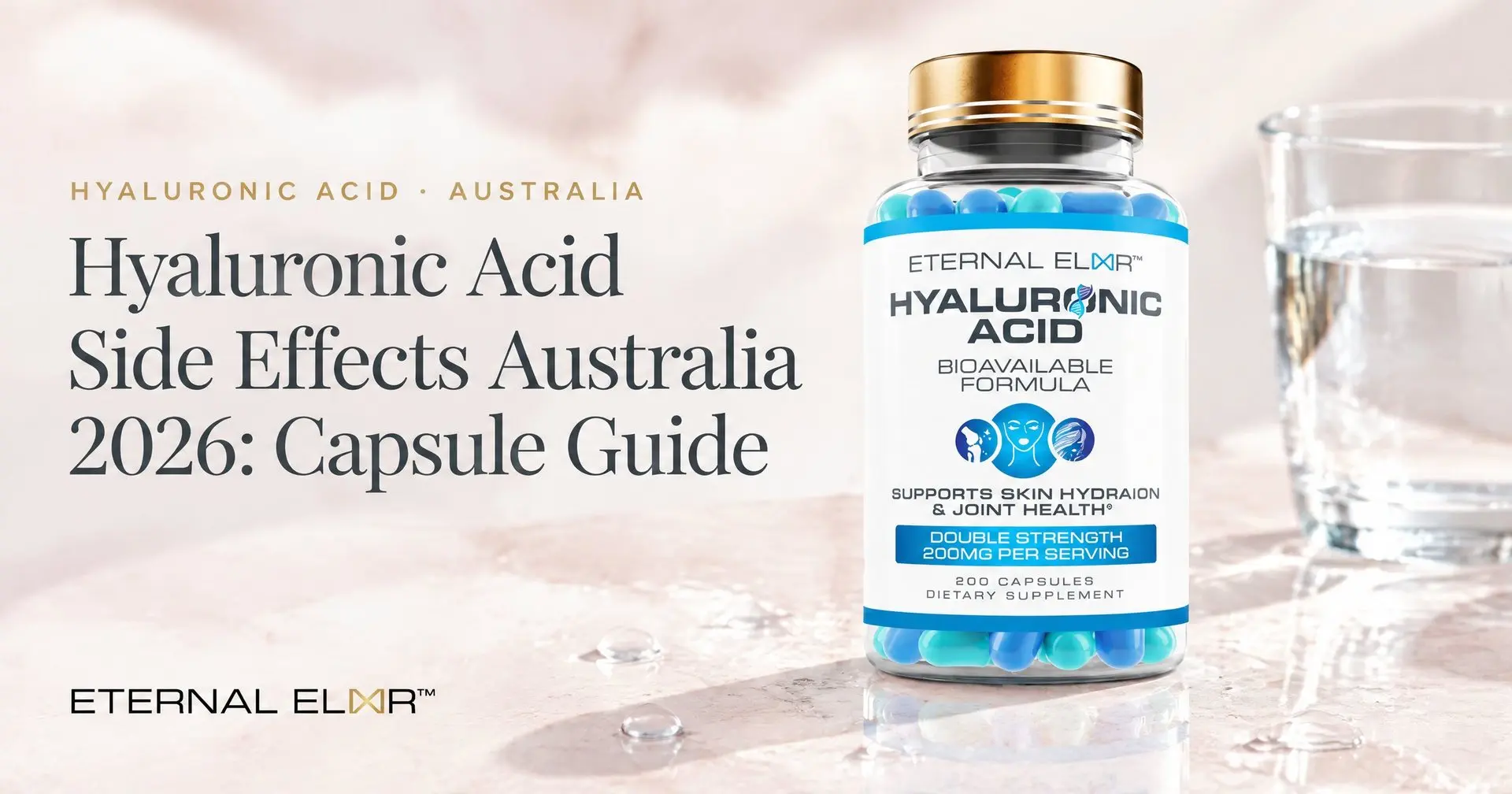
A note on our own stock. The Eternal Elixir Hyaluronic Acid 200mg capsule is out of stock at the moment. The products further down are what we have in stock for skin, and we say plainly what each one does.
Key takeaways
- In the longest trial, 200mg a day for 12 months, the possible side effects were few, digestive, and not significantly more common than on placebo.
- In a 12-week trial of 100 adults, 4% of the supplement group reported an adverse event, against 16% of the placebo group.
- Filler injections carry the real risks. Pain, bruising and swelling are common there, and a blocked blood vessel is rare but serious.
- Talk to your doctor or pharmacist first if you are pregnant, breastfeeding, having cancer treatment or taking prescription medicines.
- Oral trials have used between 48 and 240mg a day.
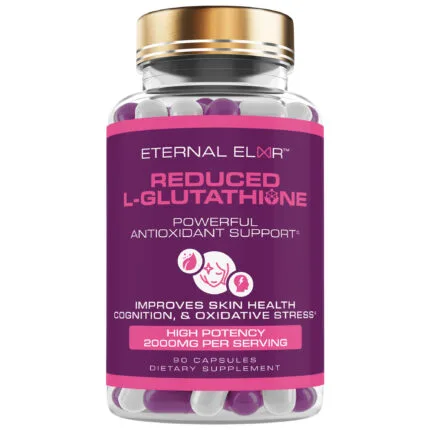
In stock now for skin from the inside: our Reduced L-Glutathione 2000mg. Glutathione is an antioxidant with its own small body of skin research, which we set out in full further down.
Not sure which one fits you?
Finish the quiz for a free gift worth up to $44.99, plus a personal 20% code for your first order.
Table of contents
- 1. Hyaluronic Acid Side Effects: The Short Answer
- 2. Why Capsules, Serums and Fillers Carry Different Risks
- 3. Reported Hyaluronic Acid Side Effects From Oral Supplements
- 4. What the Placebo Groups Tell Us
- 5. Topical Hyaluronic Acid: Stinging, Tightness and Everyday Use
- 6. Injected Hyaluronic Acid: Where the Serious Side Effects Sit
- 7. Who Should Avoid Hyaluronic Acid Supplements
- 8. Liver, Kidneys and Cancer: Claims the Evidence Does Not Support
- 9. Reducing Your Risk: Dose, Timing and Label Checks in Australia
- 10. Skin Support In Stock at Eternal Elixir
- 11. Frequently Asked Questions
- 11.1. Who should not use hyaluronic acid?
- 11.2. What happens if you use hyaluronic acid every day?
- 11.3. Are there side effects to taking hyaluronic acid?
- 11.4. Is hyaluronic acid hard on the liver?
- 11.5. Why do some dermatologists not recommend hyaluronic acid?
- 11.6. How long do hyaluronic acid side effects last?
- 11.7. Does hyaluronic acid interact with medicines?
- 12. The Bottom Line
- 13. Sources
Hyaluronic Acid Side Effects: The Short Answer
For most healthy adults, oral hyaluronic acid has produced few side effects in trials, and the ones on record were mild. Gut symptoms top the list.
In the longest trial, 60 Japanese adults aged 50 and over took 200mg of hyaluronic acid a day, or a placebo, for 12 months. Four people in the hyaluronic acid group left the analysis over possible side effects: stomach discomfort in two, reflux in one and loss of appetite in one. Two people on placebo left with skin irritation. The researchers found no significant difference between the groups, and they could not show that any of these problems came from the capsules.
Two shorter trials of 120mg a day for 12 weeks, one with 60 people and one with 40, recorded no adverse events linked to hyaluronic acid. That record is reassuring. It is also small. Three of the four trials in the table below list staff of Kewpie, a Japanese hyaluronic acid maker, among their authors, and the fourth was funded by the company that made the product it tested. Only one ran longer than three months, and none was big enough to pick up a rare reaction.
So “well tolerated in the trials we have” is a fair summary. “Proven safe for everyone” goes further than the evidence does.
Hyaluronan is also a molecule your body already makes. Skin, joints and eyes are full of it, and a review in Nutrition Journal notes that skin holds about half of the body’s supply. The body breaks it down quickly too. A review led by Fraser at Monash University puts the half-life of hyaluronan in the blood at two to five minutes, with most of it cleared by cells lining the liver’s small blood vessels.
This page covers safety. For whether the capsules do anything for skin and joints, read our guide to whether hyaluronic acid tablets work. For the products on sale in Australia, see our comparison of hyaluronic acid supplements.
Why Capsules, Serums and Fillers Carry Different Risks
Search “hyaluronic acid side effects” and most results describe fillers and serums. Those risks do not carry over to a capsule, because each route puts the molecule in a different place.
| Route | How it reaches you | Side effects on record | How serious |
|---|---|---|---|
| Oral capsule or tablet | Swallowed and digested; how much reaches human skin is unclear | Occasional stomach discomfort, reflux or loss of appetite; no adverse events in two 12-week skin trials | Mild in the published trials |
| Topical serum or cream | Sits on the outer layers of the skin | Occasional irritation, which researchers link to preservatives and perfumes in skincare products | Mild, and settles when you stop |
| Filler or joint injection | Injected into skin or a joint by a practitioner | Pain, bruising, redness, itching and swelling; rarely infection or tissue damage from a blocked blood vessel | Can be serious and needs clinical care |
The oral row rests on the trials in the next section. The injection row comes from the StatPearls clinical reference on hyaluronic acid, which lists pain, bruising, redness, itching and swelling as the most common adverse effects of hyaluronic acid filler. That line gets quoted on supplement pages as if it described capsules. It describes filler.
Weighing hyaluronic acid against another skin supplement? Our hyaluronic acid vs collagen breakdown covers that choice.
Reported Hyaluronic Acid Side Effects From Oral Supplements
Here is what researchers logged when people swallowed hyaluronic acid every day, trial by trial.
| Trial | Who took part | Daily hyaluronic acid | Length | Side effects recorded |
|---|---|---|---|---|
| Tashiro, 2012 | 60 Japanese adults aged 50 and over with knee joint wear | 200mg | 12 months | Possible side effects in 4 on hyaluronic acid (stomach discomfort 2, reflux 1, appetite loss 1) and 2 on placebo (skin irritation); no significant difference |
| Oe, 2017 | 60 Japanese adults aged 22 to 59 with crow’s feet | 120mg | 12 weeks | No adverse events |
| Hsu, 2021 | 40 healthy Asian adults aged 35 to 64 | 120mg | 12 weeks | No adverse events attributable to hyaluronic acid |
| Hill, 2023 | 100 adults in Korea with mild knee or hip joint wear | Krill oil, astaxanthin and hyaluronic acid complex (amount not given in the paper’s summary) | 12 weeks | Adverse events in 4% on the complex and 16% on placebo, mostly digestive |
Stomach discomfort and other gut symptoms
Every possible side effect in the hyaluronic acid group of the 12-month trial was digestive. In the 12-week complex trial, gut complaints were again the most common adverse event, in 2% of the supplement group and 6% of the placebo group.
Timing may matter. People in the 12-month trial took their capsules after breakfast. Our own label says to take one capsule daily on an empty stomach. If a capsule upsets your stomach, stop it and ask your pharmacist whether taking it with food suits you.
Headache and other general complaints
Headache and light-headedness appear in some consumer summaries of hyaluronic acid. None of the four trials in the table reported them as a side effect linked to hyaluronic acid. Mild symptoms like these are common in daily life anyway, which is why the placebo results in the next section are worth your time.
Allergic reactions and what triggers them
An allergy to hyaluronic acid itself is possible. StatPearls lists a history of severe allergic reaction to hyaluronic acid as a reason not to have filler. With capsules, the source and the other ingredients deserve as much attention as the active.
Commercial hyaluronic acid mostly comes from one of two places: chicken comb, or bacterial fermentation. A review in Nutrition Journal notes that cheaper mass production has shifted most supply to fermentation. If you have a poultry allergy, check the source line on the label or ask the brand. Check the capsule shell as well if you avoid animal products, because many shells are gelatine. Ours is.
Stop any supplement and get urgent medical help if you develop hives, swelling of the face or throat, wheezing or trouble breathing.
What the Placebo Groups Tell Us
This point changes how you should read every hyaluronic acid side effects list, including this one.
Hill and colleagues ran a multicentre, randomised, double-blind trial in Korea, published in Nutrients in 2023. They gave 100 adults with mild knee or hip joint wear either a daily complex of krill oil, astaxanthin and lower-molecular-weight hyaluronic acid, or a placebo, for 12 weeks. Adverse events were tracked from start to finish.
The result: 2 of the 50 people on the complex (4%) reported an adverse event, against 8 of the 50 on placebo (16%). The gap favoured the supplement and reached significance (p = 0.0455). The researchers judged none of the serious adverse events to be related to the test products.
Two honest qualifications, because this study gets over-claimed:
- It tested a combination. The product also held krill oil and astaxanthin, so you cannot pin the result on hyaluronic acid alone. Krill is a crustacean, which matters if you have a shellfish allergy.
- It was industry-funded. NOVAREX, the Korean company that made the capsules, funded the study, and a correction was published in the same journal in 2024.
The useful lesson is about reading data. The placebo group logged adverse events at four times the rate of the supplement group. Stomach upsets, headaches and tiredness are ordinary background events in adults over any 12-week stretch.
So a forum post saying “this gave me a headache” carries little weight on its own. The symptoms worth acting on are severe ones, ones that last, and ones that ease when you stop and come back when you restart.
Topical Hyaluronic Acid: Stinging, Tightness and Everyday Use
Serums are the form most Australians use every day. A 2022 review in Dermatologic Therapy concluded that several clinical studies show topical hyaluronic acid is well tolerated. In the trial it reported, people who had also had anti-wrinkle injections applied a serum containing 1.5% hyaluronic acid twice a day for 24 weeks, and no local adverse events related to the serum were reported. Weigh that against the authors’ ties: they were employed by or consulted for L’Oréal, which made the serum.
When a serum does sting, look at the full ingredient list. Hsu and colleagues note that cosmetic creams are sometimes linked to skin irritation caused by the preservatives and perfumes they contain. A fragrance-free formula is the easier test if your skin reacts.
Then there is the dryness worry. Hyaluronic acid is a humectant, meaning it holds water. A common explanation for a tight feeling after a serum is that in very dry air it pulls water from deeper in the skin. We could not find a controlled trial that tested this, so treat it as a plausible idea. The workaround costs nothing: apply the serum to damp skin, then seal it with a moisturiser or balm.
For how tallow compares with other options for faces, see our guide to using tallow balm on your face.
Injected Hyaluronic Acid: Where the Serious Side Effects Sit
Fillers and joint injections are a separate subject, but they supply most of the frightening search results, so here is what the clinical reference says.
StatPearls lists pain, bruising, redness, itching and swelling as the most common adverse effects of hyaluronic acid filler, and says injection-site reactions usually settle within a week. The rare complications are infection and tissue damage, which can happen when filler is injected into an artery and blocks the blood supply. It also notes that the safety of hyaluronic acid injections in pregnancy, breastfeeding and children has not been established.
These risks belong to the needle and the injector’s skill. They say nothing about a capsule you swallow.
Who Should Avoid Hyaluronic Acid Supplements
“Generally well tolerated” describes a trial population, and your own situation may differ. These groups should talk to a doctor or pharmacist before starting oral hyaluronic acid.
Pregnancy and breastfeeding
We found no trial of oral hyaluronic acid in pregnancy or breastfeeding, so there is no evidence either way. Skip it while pregnant or breastfeeding unless your doctor or midwife says otherwise.
Cancer treatment: talk to your oncology team first
Hyaluronan helps control how cells grow and move, and its role in tumour biology is studied in laboratories, which does not show any risk from swallowing it. If you are having cancer treatment, talk to your oncology team before starting any new supplement, because they know your treatment plan.
Poultry, shellfish and other ingredient allergies
Check the source and the full ingredient list. Fermented hyaluronic acid avoids chicken comb. Joint blends can add krill oil, as the product in the Korean trial did, which is a problem if you have a shellfish allergy and has nothing to do with the hyaluronic acid.
Prescription medicines
We found no published human study of oral hyaluronic acid interacting with a medicine. That partly reflects how little interaction research exists, so ask your pharmacist before adding it to regular medication.
Liver, Kidneys and Cancer: Claims the Evidence Does Not Support
People searching for hyaluronic acid side effects often ask about the liver, the kidneys and cancer, and the evidence does not support any of those fears. Here is where each one comes from.
The liver worry runs cause and effect backwards. Fraser’s review describes the liver as the main route that clears hyaluronan from the blood. When the liver is damaged, blood levels can rise, which is why doctors use hyaluronic acid as one marker in blood tests for liver scarring. One such test panel was checked against liver biopsies in 1,021 people in a European study, and Hepascore, developed in Perth, also includes it.
A high blood level is a sign the liver is struggling to clear hyaluronan. It does not mean hyaluronan harmed the liver. We found no human evidence that oral hyaluronic acid at supplement doses harms a healthy liver. If you have a diagnosed liver condition, talk to your specialist first. Our overview of hyaluronic acid benefits for skin and joints covers how the body handles it in more depth.
Kidneys: Fraser’s review places most hyaluronan breakdown in the tissues, the lymph nodes and the liver. We found no human report of kidney harm from oral hyaluronic acid. If your kidney function is reduced, review any new supplement with your treating doctor as a general rule.
Cancer: laboratory interest in hyaluronan gets misread online as a consumer warning. Cell and animal findings do not show a cancer risk from a dietary supplement in healthy people, and anyone who says they do is overreaching.
Reducing Your Risk: Dose, Timing and Label Checks in Australia
Most avoidable problems with hyaluronic acid products come from the product, not the molecule. A short checklist:
- Stay near studied doses. The trials reviewed by Oe and colleagues used between 48 and 240mg a day, for two weeks to 12 months. We found no trial showing a gain from going higher.
- Follow the label on timing. If the label says an empty stomach and your stomach objects, ask a pharmacist before you change how you take it.
- Read the source line. Fermented hyaluronic acid sidesteps poultry allergy worries.
- Prefer single-ingredient products if you have allergies. Most of the allergy risk here comes from the other ingredients in a blend.
- Look for a clear dose per capsule. A “proprietary blend” label makes it impossible to know how much hyaluronic acid you take.
- Buy from a seller with a local address. Returns and questions are simpler when the business is in Australia.
Our own Hyaluronic Acid 200mg holds 200mg of sodium hyaluronate per capsule, one capsule a day and 200 capsules a bottle, which matches the daily amount in the 12-month trial. It is out of stock right now. Until it returns, our hyaluronic acid supplement comparison lists products you can buy in Australia today.
For a wider view of what belongs in a skin routine, see our roundup of skin supplements sold in Australia. If label reading is the gap, our guide to reading an Australian supplement label is ten minutes well spent before you buy.
Skin Support In Stock at Eternal Elixir
Eternal Elixir makes Reduced L-Glutathione 2000mg and Grass-Fed Tallow Balm, and they are our picks for skin while our hyaluronic acid is out of stock. Neither one is hyaluronic acid, so here is what each does and what the evidence shows. Prices are as of Sep 2026.
Reduced L-Glutathione 2000mg
Glutathione is an antioxidant your body makes. In a 12-week trial in Bangkok, 60 healthy women aged 20 to 50 took 250mg of glutathione a day or a placebo. Wrinkles fell significantly at some of the skin sites measured, while melanin index and skin elasticity tended to be better than placebo without clear significance. No serious adverse effects were reported, though two volunteers left the trial after raised liver function tests.
Our serve is 2,000mg across two capsules, eight times the trial dose, so that trial does not test our amount. The label says two capsules daily on an empty stomach, which makes a 90-capsule bottle last 45 days at $39.99, or $0.89 a serve. Our guide to the reported side effects of oral glutathione covers its safety record, and our glutathione supplement comparison sets it against other brands.
Add L-Glutathione 2000mg to cart · $39.99
Grass-Fed Tallow Balm
For dryness on the surface, a balm works where a capsule cannot reach. Ours combines grass-fed beef tallow with organic beeswax, organic virgin coconut oil, organic raw honey and vitamin E, at $29.99. Sydney dermatologist Dr Mei-Heng Tan told the ABC in 2025 that tallow is “a natural emollient, meaning it helps to lock in moisture”. She also warned it “may clog pores, leading to breakouts or blackheads”, so if your skin is oily or breakout-prone, patch test it first or skip it. Our tallow balm comparison covers the other Australian options. The grass-fed tallow balm product page has the full ingredient list.
Not sure which one suits your skin routine? Answer a few quick questions and see the product that fits your goals, with how to use it and what it costs.
Finish it for a free gift worth up to $44.99 and a personal 20% code for your first order: unique to you, one use, valid 48h.
Find my routine + free giftFrequently Asked Questions
Who should not use hyaluronic acid?
Skip oral hyaluronic acid unless your doctor says otherwise if you are pregnant or breastfeeding, having cancer treatment, or allergic to hyaluronic acid or an ingredient in the product. Anyone on prescription medicine, or with a diagnosed liver or kidney condition, should check with a pharmacist or their doctor first. Adults in the published trials took it with few problems beyond occasional stomach upset.
What happens if you use hyaluronic acid every day?
Daily use is how it was tested. In the longest oral trial, adults took 200mg every day for 12 months, and the few possible side effects were digestive and not significantly more common than on placebo. For serums, a trial of twice-daily use over 24 weeks reported no local adverse events related to the serum.
Are there side effects to taking hyaluronic acid?
A few, and they are mild. Stomach discomfort, reflux and loss of appetite are the ones recorded in trials of capsules. Allergic reactions are possible, to hyaluronic acid itself or to the source material and other ingredients. The serious side effects linked to hyaluronic acid, such as infection or a blocked blood vessel, come from filler injections.
Is hyaluronic acid hard on the liver?
We found no human evidence that oral hyaluronic acid harms a healthy liver. The confusion comes from blood tests: the liver clears hyaluronan from the blood, so doctors use a raised level as one marker of liver scarring. If you have a diagnosed liver condition, see your specialist before you start.
Why do some dermatologists not recommend hyaluronic acid?
Most doubts concern serums. Hyaluronic acid holds water, and a common explanation for a tight feeling is that in very dry air it draws water from deeper skin, although we found no controlled trial testing that. Applying it to damp skin and sealing it with a moisturiser or balm avoids the issue. Some clinicians also rate the evidence for capsules as modest, because the trials are small and many are industry-funded.
Add Grass-Fed Tallow Balm to cart · $29.99
How long do hyaluronic acid side effects last?
The oral trials did not report how long gut symptoms lasted. If a symptom started with the capsule, stopping for a few days shows whether the capsule was the cause. For fillers, StatPearls says injection-site reactions usually settle within a week. Anything that worsens, or looks allergic, needs medical advice straight away.
Does hyaluronic acid interact with medicines?
We found no published human study of oral hyaluronic acid interacting with a medicine. Very little interaction research exists, so ask your pharmacist before combining it with regular medication.
The Bottom Line
Oral hyaluronic acid has a clean but thin safety record: mild, mostly digestive complaints in small trials lasting up to a year, at rates close to placebo. The serious risks belong to injections. Pregnancy, cancer treatment, allergies and prescription medicines are the reasons to check with a professional first.
While our hyaluronic acid is out of stock, glutathione capsules and a tallow balm are the skin products we can send today.
More safety guides from our range, written the same way: tongkat ali side effects (with our Tongkat Ali guide for Australians), berberine side effects, TUDCA side effects and magnesium L-threonate side effects. If you are building a wider routine, our collagen supplement comparison covers the ingredient most often paired with hyaluronic acid, or browse the full range.
Sources
- Tashiro T, Seino S, Sato T, Matsuoka R, Masuda Y, Fukui N. Oral administration of polymer hyaluronic acid alleviates symptoms of knee osteoarthritis: a double-blind, placebo-controlled study over a 12-month period. ScientificWorldJournal. 2012;2012:167928. PubMed 23226979
- Oe M, Sakai S, Yoshida H, et al. Oral hyaluronan relieves wrinkles: a double-blinded, placebo-controlled study over a 12-week period. Clin Cosmet Investig Dermatol. 2017;10:267-273. PubMed 28761365
- Hsu TF, Su ZR, Hsieh YH, et al. Oral hyaluronan relieves wrinkles and improves dry skin: a 12-week double-blinded, placebo-controlled study. Nutrients. 2021;13(7):2220. PubMed 34203487
- Hill WS, Dohnalek MH, Ha Y, et al. A multicenter, randomized, double-blinded, placebo-controlled clinical trial to evaluate the efficacy and safety of a krill oil, astaxanthin, and oral hyaluronic acid complex on joint health in people with mild osteoarthritis. Nutrients. 2023;15(17):3769 (erratum 2024). PubMed 37686801
- Oe M, Tashiro T, Yoshida H, et al. Oral hyaluronan relieves knee pain: a review. Nutr J. 2016;15:11. PubMed 26818459
- Kawada C, Yoshida T, Yoshida H, et al. Ingested hyaluronan moisturizes dry skin. Nutr J. 2014;13:70. PubMed 25014997
- Fraser JR, Laurent TC, Laurent UB. Hyaluronan: its nature, distribution, functions and turnover. J Intern Med. 1997;242(1):27-33. PubMed 9260563
- Walker K, Basehore BM, Goyal A, Zito PM. Hyaluronic Acid. StatPearls, updated July 2023. NCBI Bookshelf NBK482440
- Bravo B, Correia P, Gonçalves Junior JE, et al. Benefits of topical hyaluronic acid for skin quality and signs of skin aging: from literature review to clinical evidence. Dermatol Ther. 2022;35(12):e15903. PubMed 36200921
- Rosenberg WM, Voelker M, Thiel R, et al. Serum markers detect the presence of liver fibrosis: a cohort study. Gastroenterology. 2004;127(6):1704-13. PubMed 15578508
- Adams LA, Bulsara M, Rossi E, et al. Hepascore: an accurate validated predictor of liver fibrosis in chronic hepatitis C infection. Clin Chem. 2005;51(10):1867-73. PubMed 16055434
- Toole BP. Hyaluronan: from extracellular glue to pericellular cue. Nat Rev Cancer. 2004;4(7):528-39. PubMed 15229478
- Weschawalit S, Thongthip S, Phutrakool P, Asawanonda P. Glutathione and its antiaging and antimelanogenic effects. Clin Cosmet Investig Dermatol. 2017;10:147-153. PubMed 28490897
- Chisholm A. Beef tallow skincare. ABC News, 21 March 2025. ABC News