Last updated: November 20, 2026 · Originally published: November 18, 2026 · By Eternal Elixir Editorial
Safflower vs saffron comes down to one fact: they are two different plants that happen to share a colour and half a name. Saffron is the hand-picked red stigma of the saffron crocus. Safflower is a cheap, easy-to-grow thistle whose orange petals are often passed off as saffron, and whose seeds give a cooking oil. If you cook, that difference decides how your paella tastes. If you take saffron as a supplement, it decides whether you are getting the plant the research actually studied.
Quick Answer
Saffron (Crocus sativus) and safflower (Carthamus tinctorius) are unrelated plants. Real saffron is deep red threads that flare into a small trumpet at one end and colour warm water golden slowly. Safflower is flat, frayed orange petals that bleed colour at once and smell of very little. It matters because safflower is the classic cheap stand-in sold as saffron, and only saffron stigma extract has the mood and sleep research.
Based on published food-science studies, a home check you can do with warm water, and label checks of 5 saffron supplements sold in Australia
This guide does both jobs. First it sets the two plants side by side and explains why safflower ends up in saffron jars. Then it takes the question to the supplement shelf. On 18 November 2026 we read the labels of five saffron supplements sold in Australia, took each live AUD price, worked out the cost per day at the label dose and checked every label for five lines that show the capsule holds real Crocus sativus extract.
Here for a supplement? Our pick is Eternal Elixir Saffron Extract 30mg, and the five saffron supplement labels we checked are further down, after the plant answer.
Not sure what to take? Take our 8-question quiz
to unlock 20% OFF your entire first order
+ a FREE gift worth up to $59.99
Choose your goal to start the quiz
Not sure which suits you? Take the 60-second quiz and see the one Eternal Elixir product matched to stress and worry, with its daily cost and how to take it.
We do not sell safflower, and we do not sell saffron threads for cooking.
Table of contents
- 1. Safflower vs Saffron at a Glance
- 2. Why Safflower Gets Sold as Saffron
- 3. Safflower and Saffron in the Kitchen
- 4. How to Check Saffron Threads at Home
- 5. If You Take Saffron as a Supplement: 5 Labels Compared
- 6. The Label Check: Five Lines That Show a Capsule Holds Saffron
- 7. Eternal Elixir Saffron Extract 30mg — Our pick
- 8. Microgenics Saffron — Lowest-priced pack
- 9. Caruso's Saffron — Best affron® pharmacy tablet
- 10. Nature's Own Saffron+ — Best saffron with magnesium added
- 11. Herbs of Gold Saffron Mood Balance — Best saffron with lemon balm
- 12. What the Saffron Research Actually Used
- 13. Building a Routine Around Saffron
- 14. How We Evaluated These Saffron Supplements
- 15. Safflower vs Saffron: Frequently Asked Questions
- 15.1. Is safflower the same as saffron?
- 15.2. How can you tell if saffron is real?
- 15.3. How is saffron harvested?
- 15.4. What will saffron do to your body?
- 15.5. Can you eat saffron from any crocus?
- 15.6. Does safflower have the same benefits as saffron?
- 15.7. How much saffron extract should I take a day?
- 16. Our Verdict on Safflower vs Saffron
Safflower vs Saffron at a Glance
The table below sets out the plain botanical differences. Neither column is a health claim. It is the information you need to recognise each one in a shop, a jar or a supplement label.
| Feature | Saffron | Safflower |
|---|---|---|
| Botanical name | Crocus sativus | Carthamus tinctorius |
| Plant family | Iris family (Iridaceae) | Daisy family (Asteraceae) |
| Part used | Dried red stigmas, three per flower, picked by hand | Dried orange or yellow petals, and seeds pressed for oil |
| Look | Deep red threads that flare into a small trumpet at one end | Flat, frayed, orange or yellow strands, often shorter |
| In warm water | Slowly turns the water golden yellow while the threads stay red | Colour tends to bleed out quickly and the petals fade |
| Flavour and smell | Strong, honeyed, slightly bitter and hay-like | Mild and nearly odourless |
| Common other names | Saffron threads, kesar, zafran | False saffron, American or Mexican saffron, azafrán in some markets |
| Main uses | Spice, and standardised extracts in supplements | Food colour, dye and safflower cooking oil |
| Mood and sleep trials | Yes, with standardised stigma extract | None that we cite in this guide |
| Supplement cost per day (AUD, products compared below) | A$0.56 to A$1.10 | Not compared; this guide compares saffron supplements only |
The price gap explains most of the confusion. Saffron needs thousands of flowers and hours of hand work for a small amount of dried stigma, while safflower grows as a broadacre crop. A jar of orange strands sold cheaply as "saffron" at a market is far more likely to be safflower petals than a bargain.
Why Safflower Gets Sold as Saffron
Saffron fraud is common enough that food scientists have built whole detection methods around it. A 2026 systematic review in Critical Reviews in Food Science and Nutrition pooled 23 studies on saffron adulteration. Mehdizadeh and colleagues reported that 20% to 30% of commercial saffron is adulterated worldwide, with large regional differences: about 3.5% in regulated European markets against 60% in India. The most common tricks were substituting safflower, marigold or turmeric, diluting with other plant material and adding synthetic dyes.
Safflower is the classic substitute because its strands look close to saffron when dried and dyed. A 2025 study in the Journal of Analytical Methods in Chemistry looked for safflower in 20 saffron samples bought from local markets, first under an optical microscope. The researchers then analysed five samples that contained safflower at 8.3% to 33.7% by weight and showed that a rise in eugenol tracked the amount of safflower present. In other words, a lab can see what the eye often misses.
Two points follow for an Australian shopper. Ground saffron is harder to check than whole threads, because powder hides the shape of the strands. And with a capsule you cannot see the saffron at all, so the label is the only evidence you have. That is why the rest of this guide reads labels line by line.
Safflower and Saffron in the Kitchen
Plenty of people searching safflower vs saffron are standing in a supermarket aisle with a recipe. Here is the short version for cooks. Safflower petals will colour rice yellow or orange, but they add almost no flavour, so a dish made with them will look right and taste flat. Saffron gives both colour and its honeyed, slightly bitter flavour, and a small pinch is enough for a family paella or risotto.
Safflower oil is a separate product again. It is pressed from the seeds, sold as a neutral cooking oil and has nothing to do with saffron flavour or colour. If a recipe asks for saffron and you only have safflower petals, expect the colour without the taste. A little turmeric does a similar colour job and is easier to find.
For a supplement, none of this kitchen saffron helps much. A pinch of threads holds an unknown amount of the active compounds, while a standardised extract gives the same measured amount every day. That consistency is what the trials relied on.
How to Check Saffron Threads at Home
These simple checks give you a hint about threads you have bought, which is where the safflower vs saffron swap usually happens. They are no substitute for a laboratory, and the 2025 study above shows how much a lab can find that the eye cannot. Still, they will catch the obvious fakes.
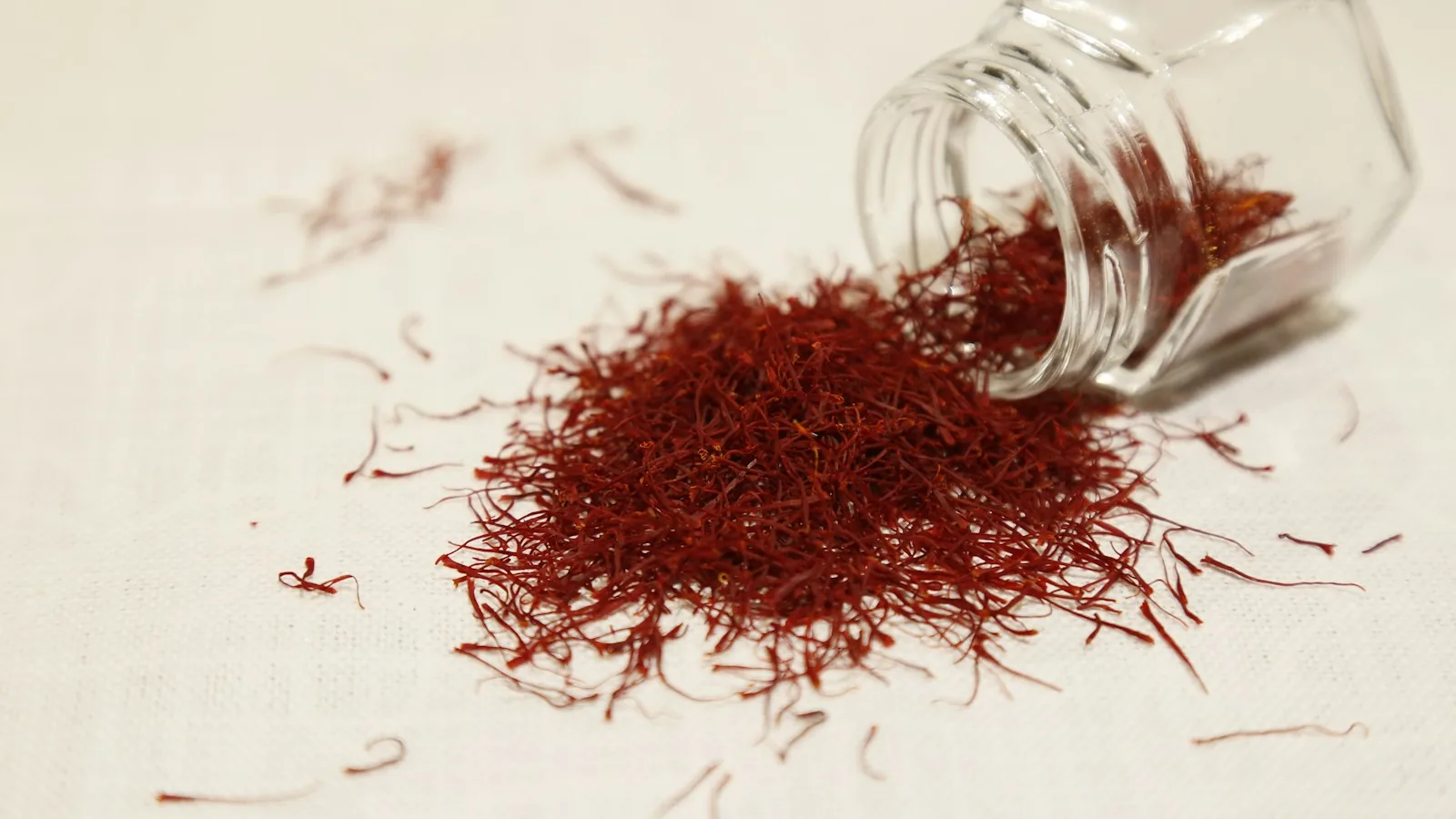
- Shape: real saffron threads are deep red, about 2 to 3 cm long, and flare into a small trumpet at one end. Safflower strands look flat, frayed and more orange.
- Water: drop a few threads into a glass of warm water. Real saffron releases a golden yellow colour over several minutes and the threads stay red. Colour that floods out at once, or threads that turn pale, point to dye or petals.
- Smell: real saffron smells strongly of honey and hay. Safflower smells of very little.
- Price: a large jar at a small price is the biggest warning sign of all.
- Ground saffron: avoid buying powder unless you trust the seller, because it hides every one of the clues above.
For capsules, the label check below replaces all of this. If you are deciding between capsules and gummies, our saffron gummies vs capsules guide compares how much saffron each format delivers.
If You Take Saffron as a Supplement: 5 Labels Compared
This is where safflower vs saffron matters most for a supplement buyer, because you cannot see what is inside a tablet. Price per day uses each label's own adult daily dose. Competitor prices are the prices shown on 18 November 2026 at Chemist Warehouse or the Herbs of Gold online store. The Eternal Elixir price is our own store price that day.
| Product | Saffron and other actives per day (label) | Price AUD | Price per serve (one day) | Where sold | Best For |
|---|---|---|---|---|---|
| Eternal Elixir Saffron Extract 30mg | affron® saffron stigma extract 30 mg (1 capsule) | $49.99 (90 capsules, 90 days) | $0.56 | Eternal Elixir online store (ships from Australia, free over $100) | One capsule a day, label states the extract standard |
| Microgenics Saffron | Saffron stigma extract 30 mg (2 tablets) | $24.99 (60 tablets, 30 days) | $0.83 | Chemist Warehouse | Lowest-priced pack |
| Caruso's Saffron | affron® saffron stigma extract 27 mg (2 tablets) | $30.99 (60 tablets, 30 days) | $1.03 | Chemist Warehouse | Best affron® pharmacy tablet |
| Nature's Own Saffron+ | affron® extract 28 mg, magnesium 320 mg, vitamin D3 10 mcg (2 tablets) | $26.99 (50 tablets, 25 days) | $1.08 | Chemist Warehouse | Best saffron with magnesium added |
| Herbs of Gold Saffron Mood Balance | affron® extract 30 mg, lemon balm 60 mg (2 capsules) | $32.96 (60 capsules, 30 days) | $1.10 | Herbs of Gold online | Best saffron with lemon balm |
Our capsule costs the most on the shelf at $49.99. One capsule is the full daily serve and a bottle lasts three months, so it works out at $0.56 a day at our label dose. Microgenics has the cheapest pack at $24.99, which buys a month at two tablets a day. The other three sit between $1.03 and $1.10 a day. Nature's Own and Herbs of Gold were on sale on the day we checked, so their usual prices are higher. The table is in no order of preference. For a ranked list of saffron supplements in Australia, see our best saffron supplements in Australia guide.
The Label Check: Five Lines That Show a Capsule Holds Saffron
The safflower vs saffron risk is real for loose spice, and a capsule label is your only defence against it. You cannot run a microscope over a capsule, but you can read what the maker is willing to put in writing. These five lines separate a clearly described saffron extract from a vague one. A product that names the species, the plant part and a daily amount in milligrams leaves little room for safflower or other petals to stand in for the real thing.
- The species: the active line should say Crocus sativus. "Saffron" on the front of the box is marketing. The botanical name is the commitment.
- The plant part: look for "stigma". Saffron extract made from petals or the whole flower is a different material from the stigma extract used in the trials.
- The extract name: a named, standardised extract such as affron® links the product to published research on that same material.
- The standard or the dry equivalent: either a stated standard (affron® is set at 3.5% Lepticrosalides®) or the amount of dry stigma each dose comes from.
- The daily amount: the milligrams of extract per day at the label dose, so you can compare it with the 28 mg used in the affron® trials.
| Product | Names Crocus sativus | Names stigma | Extract named | Standard or dry-stigma equivalent | Extract per day vs 28 mg trial dose |
|---|---|---|---|---|---|
| Eternal Elixir Saffron Extract 30mg | Yes | Yes | affron® | Standardised to 3.5% Lepticrosalides® | 30 mg, slightly above |
| Microgenics Saffron | Yes | Yes | Not named on the listing | 15 mg from 45 mg dry stigma per tablet | 30 mg, slightly above |
| Caruso's Saffron | Yes | Yes | affron® | 13.5 mg from at least 45 mg dry stigma per tablet | 27 mg, about the same |
| Nature's Own Saffron+ | Yes | Yes (dry stigma equivalent) | affron® | 14 mg equal to 42 mg dry stigma per tablet | 28 mg, the same |
| Herbs of Gold Saffron Mood Balance | Yes | Yes | affron® | 15 mg from 45 mg dry stigma per capsule | 30 mg, slightly above |
All five pass the first two lines, which is reassuring: none of them describes safflower or a vague "saffron flower" powder. Four name affron®. Ours is the only one of the five whose label states the extract's standard, and the pharmacy brands give the dry-stigma equivalent instead. Microgenics gives a clear stigma amount but does not say which extract it uses, so you cannot link it to a specific trial. Every product lands within 3 mg of the trial dose.
Eternal Elixir Saffron Extract 30mg — Our pick
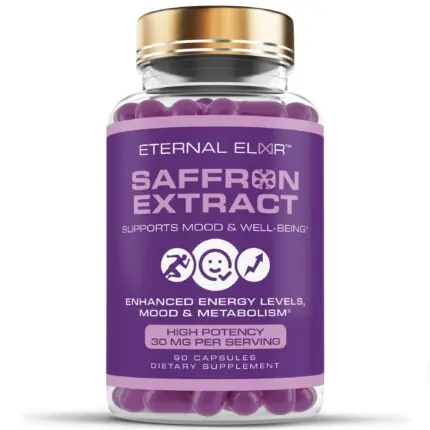
Eternal Elixir Saffron Extract 30mg is our pick for anyone who wants real saffron in capsule form. The label lists saffron extract from Crocus sativus stigma, standardised to 3.5% Lepticrosalides® (affron®), at 30 mg per capsule. The other ingredients are a vegetable capsule and rice flour, and it suits vegans and vegetarians. The serve is one capsule a day with a meal.
That label passes all five lines of our check, and it is the only one of the five that states the standard as well as the extract name. Lepticrosalides® is the maker's name for the group of saffron compounds, including crocins and safranal, that the extract is set against. Our guide to the affron saffron extract explains what the standard means and why it matters more than the milligram number on its own.
A 90-capsule bottle lasts three months at one a day, so $49.99 works out at $0.56 a day at the label dose. One capsule also gives the full daily amount, where every pharmacy option here needs two tablets. Studies suggest the benefits build with daily use, which is easier to keep up with one capsule. Our article on saffron for mood and stress covers what the trials measured.
Saffron was well tolerated in the trials, and our saffron side effects guide lists the mild effects some people notice. Anyone who is pregnant, breastfeeding or on regular medicines should check with their doctor first. Orders ship from Australia, and there is a 30-day money-back guarantee.
Key specs: 30 mg affron® saffron stigma extract per capsule · 3.5% Lepticrosalides® · 1 a day with a meal · 90 capsules (90 days) · $49.99 AUD · ships from Australia · free shipping over $100
Pros:
- Names the species, the stigma, the extract and its standard
- One capsule a day, and a bottle lasts three months
- $0.56 a day at the label dose of one capsule
- Vegan capsule with rice flour as the only filler
Cons:
- Highest shelf price, because the bottle holds 90 days
- Sold online rather than on pharmacy shelves
Best for: adults who want a clearly labelled saffron extract at the trial amount in one daily capsule. Buy Eternal Elixir Saffron Extract 30mg.
Microgenics Saffron — Lowest-priced pack
Microgenics Saffron is the cheapest box to pick up at a pharmacy. The Chemist Warehouse listing shows 15 mg of Crocus sativus stigma extract dry concentrate per tablet, derived from 45 mg of dry stigma. The adult dose is one tablet twice a day with water and meals, which gives 30 mg of extract a day.
A 60-tablet box was $24.99, and at two a day it lasts a month, or $0.83 a day. The label is clear on the species, the plant part and the amount, so it passes four of our five lines. What it does not say is which extract is inside. That leaves you unable to match it to the affron® trials, even though the milligrams line up.
If you want saffron at the lowest outlay this week and are happy with two tablets a day, it is a reasonable choice. Over three months you would spend about $75 for three boxes against $49.99 for one bottle of ours.
Key specs: 15 mg saffron stigma extract (from 45 mg dry stigma) per tablet · 2 a day with meals · 60 tablets (30 days) · $24.99 AUD
Pros:
- Cheapest pack of the five, at $24.99
- Clear species, stigma and dry-stigma amount
- Easy to find at Chemist Warehouse
Cons:
- Extract not named, so it cannot be tied to a trial
- Two tablets a day
- Costs more per day than our capsule
Best for: shoppers who want a low-cost pharmacy saffron tablet to try for a month.
Caruso's Saffron — Best affron® pharmacy tablet
Caruso's Saffron brings the affron® extract to the pharmacy shelf. The Chemist Warehouse listing shows 13.5 mg of Crocus sativus stigma extract per film-coated tablet, from at least 45 mg of dry stigma, and its description names affron® as the extract. The dose for adults and children over 12 is one tablet twice a day with food.
That gives 27 mg a day, close to the 28 mg used in the affron® mood trial. The box of 60 was $30.99, down from an RRP of $39.95, so a month costs $1.03 a day. If you shop at Chemist Warehouse anyway, this is the most direct way to get affron® there. Our guide to saffron at Chemist Warehouse compares the rest of that shelf, and our look at Caruso's alternatives covers the brand's wider range.
Key specs: 13.5 mg affron® saffron stigma extract (from at least 45 mg dry stigma) per tablet · 2 a day with food · 60 tablets (30 days) · $30.99 AUD (RRP $39.95)
Pros:
- Names affron® and the dry-stigma amount
- 27 mg a day, about the trial amount
- Widely stocked in pharmacies
Cons:
- Two tablets a day
- Nearly double our daily cost, at $1.03
Best for: pharmacy shoppers who want a named affron® product in tablet form.
Nature's Own Saffron+ — Best saffron with magnesium added
Nature's Own Saffron+ adds two everyday nutrients to the saffron. The Chemist Warehouse listing shows 14 mg of Crocus sativus extract per tablet, equal to 42 mg of dry stigma (affron®), plus 160 mg of magnesium from heavy magnesium oxide and 5 micrograms of vitamin D3. The adult dose is one tablet twice a day.
So a day gives 28 mg of affron®, exactly the amount in the mood trial, with 320 mg of magnesium and 10 micrograms of vitamin D3 alongside. The box holds 50 tablets, which is 25 days, and was $26.99 against an RRP of $39.99. That works out at $1.08 a day on sale. Check your other supplements before you add it, because the magnesium and vitamin D add to whatever you already take. The 320 mg of elemental magnesium in two tablets is close to the 350 mg a day upper level for supplemental magnesium in adults, so our magnesium dose budget guide is worth a look before you stack it with another magnesium product.
Magnesium oxide is the common, low-cost form of magnesium. It is a different compound from the magnesium L-threonate in our own range, which we cover further down.
Key specs: 14 mg affron® extract (42 mg dry stigma), 160 mg magnesium, 5 mcg vitamin D3 per tablet · 2 a day · 50 tablets (25 days) · $26.99 AUD (RRP $39.99)
Pros:
- 28 mg of affron® a day, the trial amount
- Magnesium and vitamin D3 in the same tablet
Cons:
- Box lasts 25 days, not a month
- Contains soybean
- Adds to your total magnesium and vitamin D
Best for: people who want saffron and a basic magnesium top-up in one tablet.
Skip the comparison and buy direct. Eternal Elixir's Saffron Extract 30mg ships from Australia in 90-capsule bottles. Browse the range →
Herbs of Gold Saffron Mood Balance — Best saffron with lemon balm
Herbs of Gold Saffron Mood Balance pairs saffron with a second herb. The Herbs of Gold product page lists 15 mg of Crocus sativus stigma extract from affron®, derived from 45 mg of dry stigma, and 30 mg of lemon balm (Melissa officinalis) extract per capsule. The dose for adults and children over 12 is one capsule twice a day with food.
A day gives 30 mg of affron® and 60 mg of lemon balm extract. The 60-capsule pack was on sale at $32.96, down from $43.95, which is $1.10 a day for a month. Lemon balm is a traditional calming herb, so this suits people who like a blend. Our Herbs of Gold alternatives comparison sets it against the brand's other mood products.
Key specs: 15 mg affron® saffron stigma extract (45 mg dry stigma) and 30 mg lemon balm extract per capsule · 2 a day with food · 60 capsules (30 days) · $32.96 AUD (RRP $43.95)
Pros:
- Names affron®, the stigma and the dry-stigma amount
- Adds lemon balm for people who want a blend
Cons:
- Highest daily cost here, at $1.10 on sale
- Two capsules a day
- Two herbs make it harder to tell which one suits you
Best for: people who want saffron and lemon balm together from an Australian herbal brand.
What the Saffron Research Actually Used
The reason the label check matters is that the human research used a specific material. In a 2017 randomised, double-blind trial in Complementary Therapies in Medicine, Kell and colleagues gave 128 healthy adults who reported low mood either affron® at 28 mg a day, affron® at 22 mg a day or a placebo for four weeks. The 28 mg group had a significant fall in negative mood and stress-related symptoms compared with placebo. The 22 mg dose showed no effect, which is a useful reminder that the amount matters.
Sleep has its own trial. In a 28-day study in the Journal of Clinical Sleep Medicine, Lopresti and colleagues in Perth gave 63 healthy adults aged 18 to 70 with self-reported sleep problems affron® at 14 mg twice a day or a placebo. Based on the 55 people who finished, saffron was linked with greater improvements in insomnia severity scores, restorative sleep scores and sleep diary quality ratings, with no reported adverse effects. Our saffron for sleep article goes through that study in more detail.
Both trials used extract from saffron stigma, set to a known standard. Neither tells you anything about safflower, and neither can vouch for a powder of unknown origin. These were small, short studies in healthy adults, so read them as a promising signal for everyday mood and sleep support. They do not show that saffron replaces care from a health professional.
Focus is a separate question from mood and sleep. Our comparison of saffron supplements for focus sets out what the adult attention research does and does not show.
If low mood is persistent or getting in the way of daily life, talk to your GP. The healthdirect emotional wellbeing pages list where to get support in Australia.
Building a Routine Around Saffron
Saffron is usually taken on its own, once a day, at the same time. Some people pair it with other products for a specific goal. These are in-stock Eternal Elixir products that fit those goals, with the daily cost from our own facts sheet.
- Sleep: Eternal Elixir Magnesium L-Threonate 2000mg is three capsules with a meal, at $59.99 for 30 serves, or $2.00 a day. Our magnesium L-threonate for sleep guide explains the timing.
- Daytime energy: Eternal Elixir Korean Panax Ginseng 1600mg is two capsules in the morning, at $44.99 for 45 serves, or $1.00 a day.
- Antioxidant support: Eternal Elixir Reduced L-Glutathione 2000mg is $39.99 for 45 serves, or $0.89 a day.
Start one product at a time and give saffron about four weeks before adding anything else. That way you know what is helping. If your main concern is stress, our stress supplements comparison is a good next read, and our mood-boosting supplements comparison covers options beyond saffron. Women whose mood follows their cycle should see our new comparison of supplements for PMS mood swings.
For every saffron product on sale in Australia, including gummies and blends not listed here, our full saffron supplements comparison ranks eight of them by dose and daily cost.
How We Evaluated These Saffron Supplements
We only included products whose labels name Crocus sativus stigma extract and a daily amount, and whose AUD price we could read on 18 November 2026. A popular iHerb affron® capsule was left out because we could not confirm its price in Australian dollars from the page we read. Each product was then weighted on:
- Quality and clarity of the label, using the five-line check above (30%)
- Australian availability and shipping (20%)
- Price per day in AUD at the label dose (20%)
- Range for building a routine (15%)
- Human research on the same extract at a similar daily amount (15%)
Our pick
Eternal Elixir Saffron Extract 30mg: a label that names Crocus sativus stigma, the affron® extract and its 3.5% standard, with 30 mg in one capsule a day and 90 days per bottle at $0.56 a day.
Shop Eternal Elixir Saffron Extract 30mg · $49.99 AUD · Ships from Australia
Safflower vs Saffron: Frequently Asked Questions
Is safflower the same as saffron?
No. Saffron is the dried red stigma of the saffron crocus, Crocus sativus, and each flower gives only three threads. Safflower is Carthamus tinctorius, a thistle-like plant in the daisy family whose orange petals and seed oil are cheap and plentiful. Safflower petals are sometimes sold as "false saffron" or mixed into real saffron, so check the botanical name on any label.
How can you tell if saffron is real?
For threads, look for deep red strands that widen into a small trumpet at one end, and drop a few into warm water. Real saffron colours the water golden yellow slowly while the threads stay red. For a supplement, read the active ingredient line: it should say Crocus sativus and stigma, and ideally name a standardised extract and its daily amount in milligrams.
How is saffron harvested?
By hand. The saffron crocus flowers for a few weeks in autumn, and pickers take each flower and pull out its three red stigmas, which are then dried. That slow, manual work is why saffron costs so much per gram, and why cheaper petals such as safflower turn up in place of it.
What will saffron do to your body?
In placebo-controlled trials of healthy adults, a standardised saffron extract taken at about 28 mg a day was linked with better mood scores and better sleep quality ratings over four weeks. Those results came from Crocus sativus stigma extract. Saffron is generally well tolerated at these amounts, and anyone pregnant or on regular medicines should ask their doctor first.
Can you eat saffron from any crocus?
No. Only Crocus sativus gives culinary saffron, and the garden crocuses sold in Australian nurseries are a different plant. Never pick and eat flowers that look like saffron, because the autumn crocus (Colchicum) looks similar and is poisonous. Buy saffron threads or saffron extract from a supplier that names Crocus sativus.
Does safflower have the same benefits as saffron?
You cannot borrow saffron's results for safflower. The mood and sleep trials we cite used extract from saffron stigma, and safflower is an unrelated plant with different compounds. Safflower is mostly used as a food colour and as a cooking oil pressed from its seeds. If you want what the saffron research studied, you need Crocus sativus.
How much saffron extract should I take a day?
Follow your product's label. The affron trials used 28 mg a day, given as one dose or as 14 mg twice a day, and the five products here give 27 mg to 30 mg a day. Eternal Elixir Saffron Extract 30mg is one capsule a day with a meal. Allow four weeks before you judge how it suits you.
Our Verdict on Safflower vs Saffron
Safflower vs saffron is a question with a clear answer. They are different plants, safflower is the cheap stand-in, and only saffron stigma extract has the mood and sleep research behind it. In the kitchen, buy whole red threads from a seller you trust and use the water check. On the supplement shelf, read the active ingredient line for Crocus sativus, the word stigma, a named extract and a daily amount close to 28 mg.
All five products here pass the basics. Our Eternal Elixir Saffron Extract 30mg is the one we would choose: it states the extract's standard as well as its name, gives the full amount in one capsule and costs $0.56 a day. Microgenics is the cheapest box if you want a pharmacy tablet. Caruso's is the plain affron® tablet, Nature's Own adds magnesium and vitamin D3, and Herbs of Gold adds lemon balm.
More buying guides
Best Saffron Supplements in Australia → Affron Saffron Extract Explained → Saffron Supplement Benefits →Start your saffron routine today
90 capsules per bottle · Australian shipping · 30-day money-back guarantee
Find your routine in 60 seconds →Finish the quiz for 20% off your first order. Or Shop Eternal Elixir →
Recommended for you
About Eternal Elixir
Eternal Elixir is an Australian supplement company specialising in longevity and nootropic formulations. Orders ship from Australia. Browse the full range at eternalelixir.com.au/shop.
Not sure what to take? Take our 8-question quiz
to unlock 20% OFF your entire first order
+ a FREE gift worth up to $59.99