Last updated: October 24, 2026 · By Eternal Elixir Editorial
Telomeres and ageing come up in almost every conversation about how long, and how well, we live. Telomeres are the protective caps on the ends of your chromosomes, and they get a little shorter over the years as your cells divide. Scientists use their length as one marker of biological age. This guide explains what telomeres do, what the human research says speeds up or slows their shortening, why longer telomeres are a mixed blessing, and where Eternal Elixir supplements fit once the everyday habits are in place.
If you already want to compare products, our ranked guide to longevity supplements in Australia sets the main options side by side. For a wider view of the habits that matter most as you get older, start with our Australian guide to healthy ageing.
Key takeaways
- Telomeres and ageing are linked because telomeres shorten each time most cells divide, and very short telomeres push cells to stop dividing.
- In a six-month randomised trial, endurance and interval training raised telomerase activity and telomere length, while resistance training did not.
- Genetic studies suggest longer telomeres carry risks of their own, so a longer reading is not automatically a better one.
- No supplement has convincingly lengthened telomeres in human trials. Spermidine and resveratrol have earlier-stage evidence that may support healthy cell function.
Table of contents
Telomeres and Ageing: How the Link Works
Every chromosome in your body ends in a stretch of repeated DNA letters, TTAGGG, repeated thousands of times. That stretch is the telomere. It works like the plastic tip on a shoelace, stopping the chromosome end from fraying or sticking to other chromosomes.
Why telomeres shorten
When a cell copies its DNA before dividing, the copying machinery cannot reach the very end of the strand. A small piece of telomere is lost with each division. Over decades, the average telomere length in blood cells drifts down. In a study of 1,122 women aged 18 to 76, telomere length fell by an average of 27 base pairs a year (Lancet, 2005).
Telomerase, the enzyme that rebuilds them
Your body has an enzyme called telomerase that can add DNA letters back onto telomeres. It is busy in stem cells and reproductive cells. In most adult body cells it is far less active, which is why the slow loss adds up with age.
What happens when telomeres get too short
Once a telomere becomes critically short, the cell reads it as damage. It stops dividing and enters a state called senescence, or it is cleared away. A build-up of senescent cells is one of the recognised hallmarks of biological ageing.
Shorter telomeres also track with health outcomes. In 143 people over 60, those with shorter telomeres in their blood cells had poorer survival, including about three times the death rate from heart-related causes (Lancet, 2003). That is an association, so it shows a link rather than proving the telomeres caused the outcome.
Not sure which one fits you?
Finish the quiz for a free gift worth up to $44.99, plus a personal 20% code for your first order.
What Speeds Up Telomere Shortening
Most of the human evidence here comes from observational studies. They compare people at one point in time, so they show which habits travel with shorter telomeres. They cannot prove cause, but the same patterns turn up again and again.
Long-term stress
In healthy premenopausal women, both perceived stress and how long the stress had lasted were linked with higher oxidative stress, lower telomerase activity and shorter telomeres. Women with the highest perceived stress had telomeres shorter by the equivalent of at least a decade of extra ageing compared with low-stress women (PNAS, 2004). Our guide on how to lower cortisol naturally covers the practical side of managing stress.
Smoking and excess weight
The same 2005 study of 1,122 women found that obese women had telomeres 240 base pairs shorter than lean women. Smoking showed a dose effect: each pack-year smoked matched an extra 5 base pairs of telomere loss. The authors linked both habits to higher oxidative stress.
Poor sleep
In 154 adults aged 45 to 77, good sleep quality weakened the link between age and telomere length. Older adults who slept more than seven hours a night had telomere lengths similar to the middle-aged group (Sleep, 2014). If your nights are short or broken, our step-by-step guide to fixing your sleep schedule is a good place to start, and healthdirect’s sleep advice covers when to see a GP.
Trying spermidine in Australia? Eternal Elixir’s Spermidine 10mg ships locally with 90 capsules per bottle for $49.99, one capsule a day. Browse the longevity range →
Can You Slow Telomere Shortening? What Trials Show
Randomised trials are the stronger test, because they change one thing and compare the result with a control group. Only a handful have measured telomeres directly, and exercise has the clearest result so far.
Endurance and interval training
A German trial randomised 266 healthy, previously inactive adults to six months of continuous running, high-intensity interval training, resistance circuit training or no change, and 124 completed it. Each training group did three 45-minute sessions a week. Telomerase activity in blood cells rose two- to three-fold in the endurance and interval groups, and telomere length increased in those groups. Resistance training improved fitness but did not change telomerase or telomere length (European Heart Journal, 2019).
Strength work still matters for muscle and bone as you get older. The finding simply suggests that some regular cardio belongs in the week too. Australia’s physical activity guidelines give weekly targets by age.
Omega-3 fats
In a four-month double-blind trial, 106 sedentary, overweight middle-aged and older adults took 2.5 g or 1.25 g of omega-3 fats a day, or a placebo. Oxidative stress markers were about 15% lower in both omega-3 groups. Telomere length did not differ between groups, although telomeres lengthened in people whose omega-6 to omega-3 ratio fell the most (Brain, Behavior, and Immunity, 2013).
The habits worth building first
Putting the human data together gives a short, practical list. None of these needs a lab test to start.
- Do some running, cycling, swimming or brisk walking most weeks, with interval sessions if your fitness allows.
- Protect seven or more hours of sleep and keep a regular wake time.
- Find a stress habit you will keep, such as walking outdoors, breathing practice or time with friends.
- Stop smoking, and get help from your GP or a quit service if you need it.
Longer Telomeres Are a Mixed Blessing
It is tempting to see telomere length as a score where higher always wins. Genetic research suggests the picture is more balanced.
A large Mendelian randomisation study used gene variants that people are born with to estimate the effect of naturally longer telomeres, which avoids many of the problems of observational data. Across 83 conditions, genetically longer telomeres were linked with higher odds of several kinds of malignant growth, including melanoma (odds ratio 1.87 per standard deviation). They were also linked with lower odds of some cardiovascular conditions, such as abdominal aortic aneurysm (odds ratio 0.63) (JAMA Oncology, 2017).
The likely reason is that telomere shortening acts as a brake on cells that divide too often. So the goal is healthy cells and steady, normal shortening, rather than the longest possible telomeres.
What a telomere test can and cannot tell you
Some clinics and online labs sell telomere length tests from a blood or saliva sample. Most measure an average across white blood cells. A single result is hard to read on its own, because telomere length varies a lot between people of the same age and methods differ between labs.
A test does not diagnose anything and cannot tell you which habit to change. If you are curious, use a result as a starting point for a talk with your GP, and put the money towards the habits above first.
Supplements, Telomeres and Ageing: An Honest Look
No supplement has convincingly lengthened telomeres in human trials. The omega-3 trial above is one of the few to test it directly, and it found no difference in length between groups. The supplements below are popular in longevity routines for other reasons, and the evidence behind each is earlier-stage.
Spermidine
Spermidine is a natural compound found in wheat germ, aged cheese, mushrooms and legumes. It supports autophagy, the process cells use to clear out worn parts. In mice, spermidine in drinking water extended lifespan and protected heart function in old animals, an effect that depended on autophagy (Nature Medicine, 2016).
In people, the data is observational. Among 829 adults aged 45 to 84 followed for 20 years, all-cause deaths fell from 40.5 to 15.1 per 1,000 person-years across rising thirds of dietary spermidine intake (American Journal of Clinical Nutrition, 2018). That study measured food, not capsules, and did not measure telomeres.
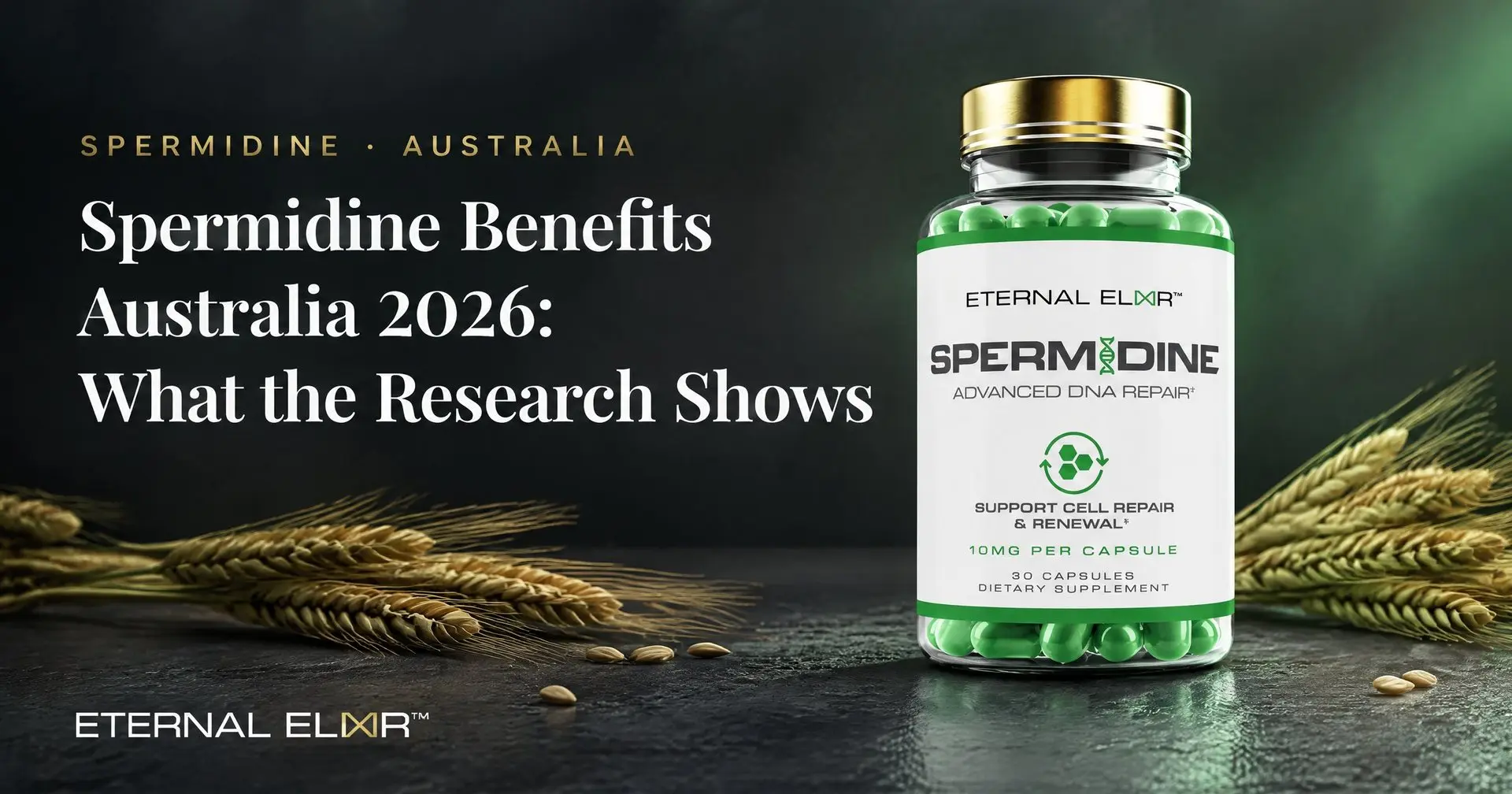
Eternal Elixir’s Spermidine 10mg provides 10 mg per capsule, one a day with a meal, for $49.99 per bottle of 90 capsules. You can read more in our spermidine benefits guide or see which foods carry it in foods high in spermidine.
Resveratrol
Resveratrol is a polyphenol from grapes and Japanese knotweed. In cultured endothelial progenitor cells, resveratrol delayed senescence and raised telomerase activity (British Journal of Pharmacology, 2008). Those were cells in a dish, so the result shows a mechanism rather than an effect in people. Eternal Elixir’s Trans-Resveratrol 1200mg gives 1,200 mg per two-capsule serve, and our resveratrol dosage guide covers timing.
Ca-AKG
Calcium alpha-ketoglutarate is a newer longevity ingredient with no human telomere data yet. Our Ca-AKG vs spermidine comparison explains how the two differ. Eternal Elixir’s Ca-AKG 500mg is one capsule a day.
The evidence side by side
| Option | Telomere evidence in people | Eternal Elixir label serve | Cost per day (AUD) |
|---|---|---|---|
| Endurance or interval training | Randomised trial: telomerase and length rose over 6 months | Three 45-minute sessions a week (trial dose) | Free |
| Spermidine | None yet; mouse lifespan and human diet cohort | 10 mg, 1 capsule a day | $0.56 |
| Resveratrol | None yet; telomerase rose in cultured cells | 1,200 mg, 2 capsules a day | $1.33 |
| Ca-AKG | None yet | 500 mg, 1 capsule a day | $0.67 |
Costs use each product’s current price and label serve: $49.99 for 90 serves, $59.99 for 45 serves and $59.99 for 90 serves. Check with your GP or pharmacist before starting a supplement, especially if you take regular medicines. For a ranked view of every option, see our longevity supplement evidence index.
Telomeres and Ageing FAQ
Can you lengthen your telomeres?
Small increases in average telomere length have been measured in blood cells after six months of endurance or interval training in a randomised trial. Telomeres also shorten and lengthen a little over time in normal life. No diet, supplement or test has been shown to reverse telomere shortening in a lasting way.
Does exercise lengthen telomeres?
In the best trial so far, continuous running and interval training three times a week raised telomerase activity two- to three-fold and increased telomere length after six months. Resistance training on its own did not. A mix of cardio and strength work suits most adults.
Is a telomere test worth doing in Australia?
For most people, no. A single reading varies with the lab method and says little on its own about your health. It cannot diagnose anything, so any result is best discussed with your GP before you act on it.
Do supplements lengthen telomeres?
Not convincingly in any human trial to date. Omega-3 fats lowered oxidative stress markers in a four-month trial but did not change telomere length between groups. Spermidine and resveratrol have animal, cell and population data that may support healthy cell function, which our antioxidant supplements comparison also covers.
What are some effective ways to cope with ageing?
Focus on what you can change: regular cardio and strength work, good sleep, staying connected with people and a stress habit you enjoy. Our healthy ageing guide turns these into a weekly plan, and a yearly GP check-up keeps the rest on track.
Ready to start your longevity stack?
90 capsules per bottle · Australian shipping · Third-party tested
Shop Eternal Elixir →Related reading
Recommended for you
About Eternal Elixir
Eternal Elixir is an Australian supplement company specialising in longevity and nootropic formulations. Every batch is third-party lab tested for purity and potency, with the batch certificate of analysis available on request, and our products are designed for Australians who take their health seriously. Try a product that fits your routine or browse the full range at the Eternal Elixir shop.
Comparing NAD+ and longevity supplements? Answer a few quick questions and see the product that suits your goals, with its label serve and cost per day.
Finish it for a free gift worth up to $44.99 and a personal 20% code for your first order: unique to you, one use, valid 48h.
Find my routine + free gift