Last updated: September 25, 2026 · Originally published: July 9, 2026 · By Eternal Elixir Editorial
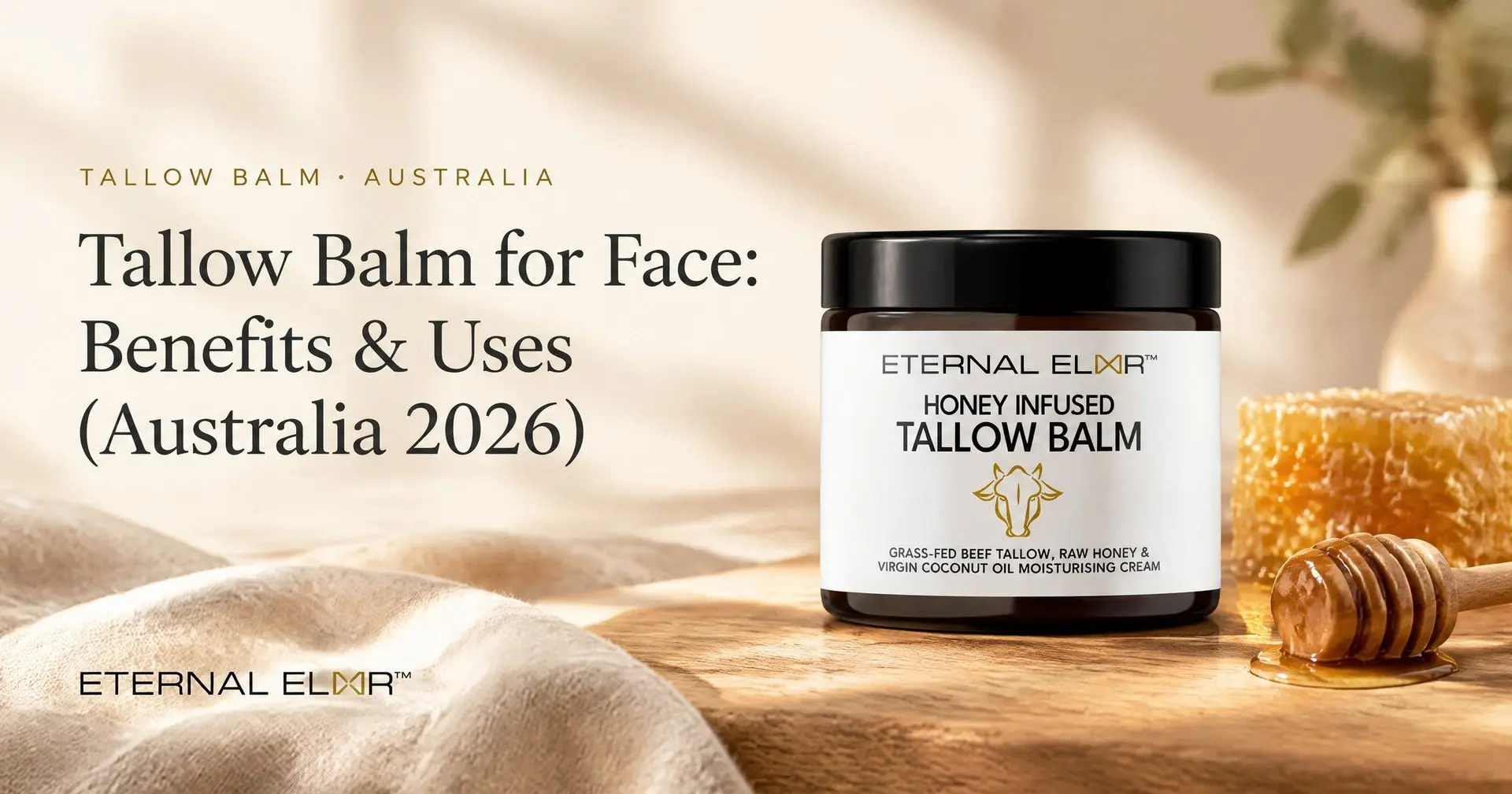
Quick answer: Tallow balm for the face suits dry, normal and sensitive skin for most people. It is a rich, fat-based balm that slows water loss and softens tight, flaky patches, and a good one has a short ingredient list with no added fragrance. It is not for everyone. Dermatologists warn it can clog pores, so if your skin is oily or breaks out easily, patch-test first or skip it. No controlled trial has tested tallow balm on facial skin, so treat claims about wrinkles and “skin repair” with caution. Our pick is Eternal Elixir Honey Infused Tallow Balm: grass-fed beef tallow with raw honey, beeswax, virgin coconut oil and vitamin E, 60g for $29.99, which is $0.50 per gram.
Eternal Elixir makes this tallow balm, so we have an interest in the answer. We have tried to write the page we would want to read before buying one: what tallow is, what the evidence does and doesn’t show, what dermatologists say, and how our balm compares with other Australian tallow balms on price and ingredients, checked in September 2026.
Table of contents
- 1. What is tallow balm?
- 2. Tallow balm benefits for the face: what is real and what isn’t
- 3. Why some dermatologists are cautious about tallow on the face
- 4. Does beef tallow really get rid of wrinkles?
- 5. How to use tallow balm on your face
- 6. Australian tallow balms for the face compared
- 7. How to choose a tallow balm for your face
- 8. Skin from the inside
- 9. Our verdict on tallow balm for the face
- 10. Tallow balm for face: FAQ
- 10.1. Is tallow balm good for the face?
- 10.2. Is tallow good for skin in general?
- 10.3. Does tallow balm clog pores?
- 10.4. Why are dermatologists against tallow?
- 10.5. Why not use tallow on the face?
- 10.6. Does beef tallow really get rid of wrinkles?
- 10.7. How often should you apply tallow balm to your face?
- 10.8. Can you use tallow balm around the eyes?
- 11. Sources
What is tallow balm?
Tallow is rendered beef fat. It is heated and strained until it becomes a smooth, pale solid that softens at skin temperature. A tallow balm is that fat on its own or blended with a few other ingredients, usually beeswax for firmness, a plant oil to make it spread, and sometimes honey or an essential oil.
Our balm uses five ingredients: grass-fed beef tallow, organic raw beeswax, organic virgin coconut oil, organic raw honey and tocopherol (vitamin E). Other Australian brands use hemp seed oil, jojoba, cocoa butter or castor oil instead, and some add manuka or other essential oils. The ingredient list is the first thing to check on any jar, because it tells you what else you are putting on your face.
People reach for tallow for the face because it is simple. A balm with three to five ingredients has fewer things in it that could irritate your skin than a cream with twenty. That is the real appeal, and it is also why the scent-free versions tend to suit sensitive skin better than scented ones.
Tallow balm benefits for the face: what is real and what isn’t
The honest starting point is that tallow has a long history of use on skin but almost no research of its own. We could not find a controlled trial of tallow balm on facial skin. What we can say comes from what tallow is made of and from what dermatologists who have looked at it say.
It is a rich moisturiser
Tallow is a fat, so it sits on the skin and slows water loss while softening dry patches. That makes it useful for skin that feels tight after washing, wind-chapped cheeks in winter, or dry patches around the nose and mouth. It works best as a night balm or on very dry areas, because it is heavier than a lotion.
Two Australian dermatologists interviewed by the ABC in 2025 gave it a qualified thumbs up. Dr Michael Freeman described tallow as a biological compound with “lots of fatty acids” that is “relatively compatible with our skin”. He noted that it contains vitamins A, D, E and K and fatty acids such as stearic and oleic acid, and said it is best suited to dry, sensitive skin. Dr Mei-Heng Tan called it a “natural emollient, meaning it helps to lock in moisture”, especially helpful for dry and cracked skin (ABC News, 2025).
Grass-fed tallow is a little different
A review of three decades of research on grass-fed and grain-fed beef found that grass-based diets raise the omega-3 fats, conjugated linoleic acid (CLA) and carotenoids (vitamin A precursors) in beef fat, and give the fat a yellowish colour. Total saturated fat was about the same (Daley et al., Nutrition Journal, 2010). That is why grass-fed tallow is the one to look for. Nobody has tested whether those differences change how a balm performs on skin, so it is a quality marker, not a proven benefit.
“Identical to your skin’s oil” overstates it
You will often read that tallow matches human sebum. Both contain fatty acids, but human sebum also contains squalene and wax esters, lipids that are not found anywhere else in the body, and sebum composition differs between species (Picardo et al., Dermato-Endocrinology, 2009). Tallow is skin-compatible for many people. It isn’t the same thing as the oil your skin makes.
For more on how fats support the outer layer of skin, see our guide to tallow and the skin barrier and our comparison of tallow versus seed-oil moisturisers.
Why some dermatologists are cautious about tallow on the face
The same ABC piece set out the concerns clearly, and they are worth taking seriously.
It can clog pores. Dr Tan said: “For individuals with oily or acne-prone skin, it may clog pores, leading to breakouts or blackheads.” She also said it may make acne or rosacea worse, so if you have either, talk to your dermatologist before you try it. She added that tallow can feel greasy or be hard to apply evenly.
Raw tallow is a bad idea. Dr Freeman warned against using beef tallow as a raw product, and Dr Tan said raw tallow can carry impurities or contaminants that may cause irritation or infection. Use a finished balm from a maker, not fat you rendered in the kitchen.
Allergy is possible. Any ingredient can cause a reaction, and patch testing is the sensible step. Our balm also contains honey and beeswax, so do not use it if you react to bee products.
There is one more reason for care that the ABC piece didn’t cover. Tallow contains oleic acid, one of the fatty acids Dr Freeman mentioned, and oleic acid has a mixed record on skin. In a study of 19 adults, olive oil (which is mostly oleic acid) applied to one forearm twice a day for four weeks reduced the integrity of the skin’s outer layer and caused mild redness, while sunflower seed oil did not (Danby et al., Pediatric Dermatology, 2013). That study tested olive oil, not tallow, so it doesn’t prove tallow does the same. It is a good reason to patch-test and to stop if your skin feels worse.
Does beef tallow really get rid of wrinkles?
No study we could find shows that tallow reduces wrinkles. Any rich moisturiser can make dry skin feel smoother and look less flaky for a while, and that is probably what people notice. If a tallow brand promises to erase wrinkles, that claim goes beyond the evidence.
The habit with the best evidence for slowing visible skin ageing is sun protection. In a Queensland trial of 903 adults under 55, people who used broad-spectrum sunscreen every day for 4.5 years showed no detectable increase in skin ageing, and 24% less ageing than people who used sunscreen when they chose to (Hughes et al., Annals of Internal Medicine, 2013). A night balm and a morning sunscreen do different jobs.
How to use tallow balm on your face
A little goes a long way. Most people use too much the first time and end up shiny.
Patch-test first. Apply a small amount to your inner forearm or along the jawline for three or four nights. If you see redness, itching or new spots, don’t use it on your face.
Use a rice-grain amount. After washing your face, while your skin is still slightly damp, warm a rice-grain amount between clean fingertips until it melts. Press it onto your cheeks, forehead and neck rather than rubbing.
Start at night. Use it as your evening moisturiser for the first couple of weeks. If your skin is very dry, you can add a thin layer in the morning. If you wear makeup, use less in the morning or keep tallow for evenings.
Go lighter on oily areas. Many people use tallow on the cheeks and around the mouth and skip the nose and forehead, where skin tends to be oilier.
Store it somewhere cool. Tallow softens in warm rooms and can melt in a hot car. Keep the lid on and use clean fingers or a small spatula.
For a full routine built around tallow, our minimalist tallow and honey routine is a good starting point. If your skin is very dry and easily irritated, read our guide to tallow for very dry, reactive skin and talk to your GP or dermatologist first. Our piece on tallow and baby skin covers the extra care needed for little ones.
Australian tallow balms for the face compared
Here is how our balm compares with other Australian tallow balms that rank for tallow balm face searches. Prices and sizes come from each brand’s own product page, as of September 2026. Cost per gram is the fairest comparison because jar sizes differ.
| Balm | Price (AUD, as of Sep 2026) | Size | Cost per gram | Main ingredients besides tallow | Buy |
|---|---|---|---|---|---|
| Eternal Elixir Honey Infused Tallow Balm (our pick) | $29.99 (was $40) | 60g | $0.50 | Raw honey, beeswax, virgin coconut oil, vitamin E. No added fragrance | View at Eternal Elixir |
| Naked Tallow Tallow Cream | $43, $73 or $115 | 80g, 180g or 350g | $0.54, $0.41 or $0.33 | Handmade from local ingredients. The “Naked” option has no essential oils | Naked Tallow website |
| Tassie Tallow Whipped Tallow and Honey | $36.95 | 60g net (100mL jar) | $0.62 | Leatherwood honey, hemp seed oil, and manuka essential oil in the manuka version | Tassie Tallow website |
| Tuttofare Holy Grail Tallow Balm | $49 | 70g | $0.70 | Scented with raw cocoa butter. No added fragrance or essential oils | Tuttofare website |
| Liminal Elixir Tallow Balm | $79 | 50mL stick | $1.58 per mL | Castor oil with rosehip, carrot seed, black seed and frankincense oils | Liminal Elixir website |
Add Tallow Balm to cart · $29.99
Our balm is the lowest price per jar here and the lowest cost per gram among the small jars. Naked Tallow’s 180g and 350g jars cost less per gram than ours, so if you use tallow all over your body and go through it quickly, the big jar is better value. For face-only use, a 60g jar is a sensible size, and buying two jars of ours saves 10%. Orders over $100 ship free.
Scent is the other real difference. If your skin is sensitive, a balm with no essential oils is the safer starting point. Tassie Tallow sells an unscented version of its whipped balm, and Tuttofare and ours have no essential oils. For the full ranking of Australian brands, including body balms, see our comparison of the best tallow balms in Australia, and our complete guide to tallow balm in Australia covers what to look for on any label.
How to choose a tallow balm for your face
Grass-fed tallow. Grass-fed or grass-finished tallow is the quality marker most Australian makers use, for the fat-profile reasons above.
A short ingredient list. Tallow plus two to four other ingredients is typical. If you can’t tell what half the list is, it defeats the point of a simple balm.
Scent. Unscented or no added essential oils for sensitive skin. Scented balms are fine if your skin tolerates them.
Smell and texture. Good tallow smells neutral or faintly of beef, never sour or rancid. If a jar smells off, don’t use it.
A maker you can contact. Given the dermatologists’ warning about raw tallow, buy from a brand that lists its ingredients, its size and a way to reach it.
Skin from the inside
A balm works on the surface. Some people also look at supplements for skin, and our guide to the best skin supplements in Australia goes through what the research shows for each. Glutathione is one that comes up often. In a 12-week trial in healthy women, 250mg a day produced modest, not always consistent, changes in skin measures (Weschawalit et al., 2017). Our Reduced L-Glutathione has 1,000mg per capsule. Browse the full Eternal Elixir range for the rest.
Our verdict on tallow balm for the face
Tallow balm is a simple, rich moisturiser that suits dry, normal and sensitive skin for many people, especially at night. It is not a wrinkle treatment, it isn’t identical to your skin’s own oil, and it can clog pores in oily or breakout-prone skin. Patch-test, use a small amount and stop if your skin gets worse. If you want to try it, our pick is Eternal Elixir Honey Infused Tallow Balm: five ingredients, no added fragrance, 60g for $29.99, sent from Sydney within 24 hours.
Tallow balm for face: FAQ
Is tallow balm good for the face?
For many people with dry, normal or sensitive skin, yes. It is a rich moisturiser with a short ingredient list. People with oily or breakout-prone skin should patch-test first, because dermatologists say it can clog pores.
Add Tallow Balm to cart · $29.99
Is tallow good for skin in general?
Tallow for skin works as a moisturiser and emollient, which is why people use it on dry hands, elbows and heels as well as the face. The research on tallow itself is thin, so the case rests on what it is made of and on people’s experience rather than on trials.
Does tallow balm clog pores?
It can. An Australian dermatologist quoted by the ABC said that for people with oily or acne-prone skin, tallow may clog pores, leading to breakouts or blackheads. Many people use it without problems, but if your skin is acne-prone, patch-test on a small area for several nights and stop if you see new spots.
Why are dermatologists against tallow?
Most aren’t against it outright. The concerns are that it can clog pores, that raw or home-rendered tallow can carry contaminants, that it can trigger allergies, and that there is little research behind the bigger claims. Dermatologists interviewed by the ABC said it may suit dry, sensitive skin.
Why not use tallow on the face?
Skip it if your skin is oily or breaks out easily, if you have acne or rosacea and your dermatologist advises against it, if you are allergic to any ingredient in the balm, or if you prefer not to use animal products. Don’t use raw tallow on your face.
Does beef tallow really get rid of wrinkles?
No study we could find shows that. A rich balm can make dry skin feel smoother for a while, which is a different thing from reducing wrinkles.
How often should you apply tallow balm to your face?
Once a day at night is enough for most people. Very dry skin can take a thin layer morning and night. Use a rice-grain amount on slightly damp skin.
Can you use tallow balm around the eyes?
Many people do, using a tiny amount patted gently on the skin below the eye and keeping it out of the eyes. The skin there is thin, so patch-test elsewhere first and stop if you notice irritation or small bumps.
Sources
- ABC News. Dermatologists share their verdict on beef tallow in skincare (21 March 2025). abc.net.au
- Daley CA, Abbott A, Doyle PS, Nader GA, Larson S. A review of fatty acid profiles and antioxidant content in grass-fed and grain-fed beef. Nutr J. 2010;9:10. PubMed 20219103
- Picardo M, Ottaviani M, Camera E, Mastrofrancesco A. Sebaceous gland lipids. Dermatoendocrinol. 2009;1(2):68-71. PubMed 20224686
- Danby SG, AlEnezi T, Sultan A, et al. Effect of olive and sunflower seed oil on the adult skin barrier: implications for neonatal skin care. Pediatr Dermatol. 2013;30(1):42-50. PubMed 22995032
- Hughes MC, Williams GM, Baker P, Green AC. Sunscreen and prevention of skin aging: a randomized trial. Ann Intern Med. 2013;158(11):781-90. PubMed 23732711
- Weschawalit S, Thongthip S, Phutrakool P, Asawanonda P. Glutathione and its antiaging and antimelanogenic effects. Clin Cosmet Investig Dermatol. 2017;10:147-153. PubMed 28490897
- Brand product pages (checked September 2026): Naked Tallow, Tassie Tallow, Tuttofare, Liminal Elixir