Last updated: September 28, 2026 · Originally published: February 15, 2026 · By Eternal Elixir Editorial
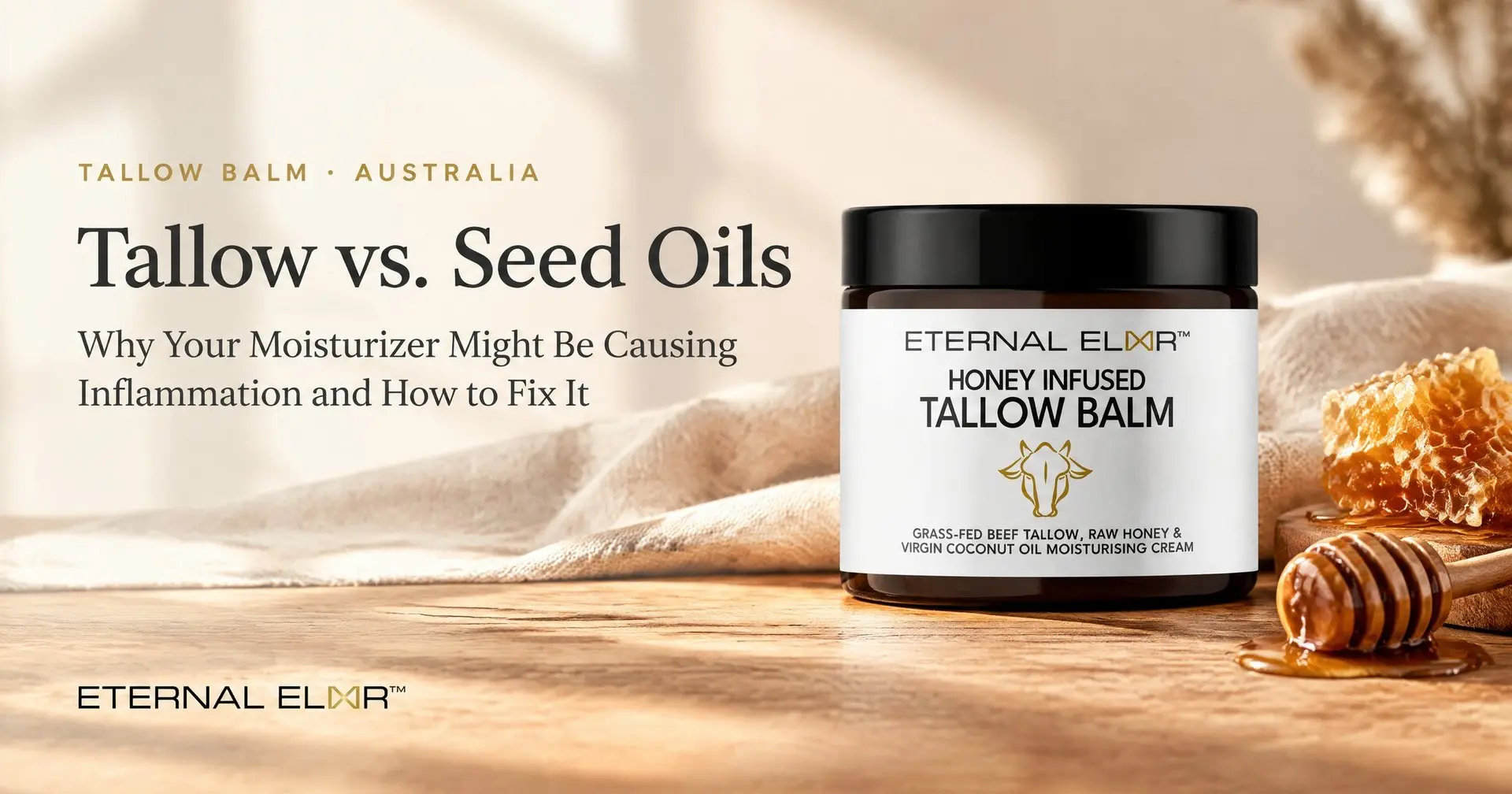
Quick answer: Tallow vs seed oils for skin is not a hero and a villain. Tallow is mostly saturated and monounsaturated fat, so it is stable and rich, and it suits dry skin that likes a heavy balm. Seed oils such as sunflower are mostly linoleic acid, a polyunsaturated fat that oxidises faster but is also part of your skin’s own barrier lipids. In a small trial, sunflower seed oil preserved the skin barrier and improved hydration. We found no human study showing that seed oils in a moisturiser cause inflammation. If you want a rich, seed-oil-free balm, our pick is Eternal Elixir Grass-Fed Tallow Balm: grass-fed beef tallow with organic beeswax, organic virgin coconut oil and organic raw honey, $29.99 for a 60 g jar.
Eternal Elixir makes the Grass-Fed Tallow Balm, so read this as a seller’s guide, written to be fair to both sides. Every research claim links to its source under Sources, and product facts come from the product page, checked in September 2026.
Table of contents
- 1. Tallow vs seed oils at a glance
- 2. If you came here about cooking
- 3. Do seed oils in moisturisers cause inflammation?
- 4. Why linoleic acid matters to your skin
- 5. Where tallow does well, and where it doesn’t
- 6. Which suits your skin type?
- 7. How to spot seed oils on a moisturiser label
- 8. Our Grass-Fed Tallow Balm
- 9. The bottom line
- 10. Frequently asked questions
- 11. Sources
Tallow vs seed oils at a glance
The figures below are per 100 g of fat, from USDA FoodData Central. We used high-linoleic sunflower oil as the seed-oil example because it is one of the most common seed oils in moisturisers.
| Beef tallow | Sunflower oil (high linoleic) | |
|---|---|---|
| Saturated fat | 49.8 g | 10.3 g |
| Monounsaturated fat (mainly oleic acid) | 41.8 g | 19.5 g |
| Polyunsaturated fat | 4.0 g | 65.7 g |
| Linoleic acid | 3.1 g | 65.7 g |
| Vitamin E | 2.7 mg | 41.08 mg |
| At room temperature | Solid | Liquid |
| How fast it goes rancid | Slowly | Faster, which is why it needs antioxidants and good storage |
| Feel on skin | Rich, heavy balm | Light oil, often used in lotions and creams |
| Human skin trials | None of tallow itself (Russell 2024) | Small trials, including one showing a preserved barrier (Danby 2013) |
The table shows why the two behave differently. Tallow’s fats have few double bonds, so it sets firm and resists oxidation. Sunflower oil is two-thirds linoleic acid, which has two double bonds, so it stays liquid, spreads thinly and oxidises more readily. It also carries far more vitamin E, a natural antioxidant, which slows that oxidation down.
If you came here about cooking
Most of the “tallow vs seed oils” debate is about food, not skin, so here is the short version. In March 2025, Harvard’s T.H. Chan School of Public Health reported that nutrition experts cautioned against beef tallow for cooking because it is high in saturated fat, “which is much worse for heart health than unsaturated fats such as vegetable oils”. On the claim that omega-6 fats in seed oils cause inflammation, Professor Walter Willett said: “I’ve gone through these papers and there’s not a single shred of evidence that this is actually true. This is all theoretical.”
We sell tallow for skin, not for your frying pan, and nothing in this article is dietary advice. For the rest of this piece we are talking about what you put on your face.
Do seed oils in moisturisers cause inflammation?
The argument goes like this: seed oils are high in polyunsaturated fat, polyunsaturated fat oxidises in light, heat and air, and oxidised fat on your skin sets off inflammation. The first two steps are sound chemistry. The third has not been shown in people using normal moisturisers. We found no human trial in which a seed-oil moisturiser caused inflammation compared with a saturated-fat one.
What the trials do show points the other way. In a University of Sheffield study, 19 adults applied six drops of oil to their forearms twice a day. Over four weeks, sunflower seed oil preserved the integrity of the skin’s outer layer, caused no redness and improved hydration. Olive oil, which is not a seed oil, reduced the outer layer’s integrity and caused mild redness over the same period (Danby 2013). It was a small study, but it is a direct comparison on human skin, and it cuts against the idea that seed oils are the problem.
Two fair caveats. First, formulation matters: a seed oil that has gone rancid in the bottle is not something to put on your face, and good products add antioxidants and use packaging that limits air and light. Second, skin varies. If a particular moisturiser leaves you red or congested, stop using it, whatever it contains.
Why linoleic acid matters to your skin
Linoleic acid, the main fat in most seed oils, is not foreign to skin. Your skin builds it into special barrier lipids called acylceramides, and a 2023 review describes those linoleate-containing lipids as essential for the barrier function of the skin (Wertz 2023). The outer layer’s lipid matrix is made mainly of ceramides, free fatty acids and cholesterol, while sebum, the oil your skin makes, is a waxy mix of glycerides, wax esters, free fatty acids, squalene and cholesterol (Mijaljica 2024).
That is why claims that tallow is “identical” to skin while seed oils are “foreign” oversimplify things. Tallow supplies fatty acids and glycerides that resemble parts of sebum. Seed oils supply linoleic acid that your barrier lipids use. Neither supplies ceramides. Both can work as moisturiser ingredients. The better choice depends on your skin and the feel you want.
Our article on tallow and the skin barrier goes further into barrier lipids, and our piece on fat-soluble vitamins in skincare covers the vitamin claims made for tallow.
Where tallow does well, and where it doesn’t
Where it does well. Tallow is a stable, rich emollient. Sydney dermatologist Dr Mei-Heng Tan told the ABC it is a “natural emollient, meaning it helps to lock in moisture”, and “especially helpful for dry and cracked skin”. Gold Coast dermatologist Dr Michael Freeman called it “relatively compatible with our skin”. Because it is mostly saturated and monounsaturated fat, a tallow balm keeps well and relies less on added antioxidants than a high-linoleic oil does.
Where it doesn’t. The same ABC piece warned that beef tallow has comedogenic (pore-clogging) potential, and that “for individuals with oily or acne-prone skin, it may clog pores, leading to breakouts or blackheads”. A 2024 scoping review found 19 relevant studies on tallow and skin, none of them human trials of tallow as a cosmetic, and called for that research (Russell 2024). A 2025 analysis of tallow posts on social media found that claims about skin conditions were common, mostly uncited, and that most of the posts promoting tallow showed financial bias (Almatroud 2025).
So the honest summary: tallow is a good fit for dry skin and for people who prefer a short, seed-oil-free ingredient list. It is not proven to beat a well-made seed-oil moisturiser, and it can be too heavy for oily skin. For more on the sourcing side, see our guide to grass-fed tallow for skin and why source matters.
Which suits your skin type?
- Dry or rough skin: a tallow balm is a strong choice, especially at night and on hands, elbows and heels.
- Oily or breakout-prone skin: a light lotion is usually the safer start. If you want to try tallow, use a small amount on one area two or three nights a week and stop if you break out.
- Sensitive skin: pick the shortest ingredient list you can find, without fragrance or essential oils, and patch test on your inner forearm for a couple of days first.
- Babies: our balm contains raw honey, so don’t use it on babies under 12 months. Our guide to tallow on baby skin covers young children.
- Skin conditions: if you have eczema, psoriasis, acne or rosacea, talk to your GP or dermatologist before changing moisturiser, and follow their plan. Our article on tallow and reactive skin sets out what the research does and doesn’t show.
How to spot seed oils on a moisturiser label
Cosmetic labels use botanical names, so seed oils are easy to miss. Common ones include:
- Helianthus annuus seed oil: sunflower.
- Carthamus tinctorius seed oil: safflower.
- Glycine soja oil: soybean.
- Vitis vinifera seed oil: grapeseed.
- Zea mays oil: corn.
Two that often cause confusion: jojoba (Simmondsia chinensis) seed oil is technically a liquid wax rather than a typical seed oil, and olive oil comes from the fruit, not a seed. Tocopherol (vitamin E) on a label is an antioxidant, often added to protect the oils in the product.
If you would rather avoid seed oils, look for a balm whose fats are tallow, butters, waxes or coconut oil. If you are happy with them, look for antioxidants on the label and packaging that keeps out air and light, such as a pump or tube.
Our Grass-Fed Tallow Balm
- Ingredients: grass-fed beef tallow, organic raw beeswax, organic virgin coconut oil, organic raw honey and tocopherol (vitamin E). No seed oils, and everything except the tallow is organic.
- Size and price: 60 g for $29.99 (regular price $40).
- How to use: apply to clean skin as needed. A rice-grain amount covers the face.
- Buying here: 30-day money-back guarantee, ships from Sydney within 24 hours, Afterpay available, and free shipping on orders over $100. Two jars save 10%, three save 15% and five save 20%.
The coconut oil in it has its own small trial behind it: in 34 people with mildly to moderately dry skin, virgin coconut oil applied to the legs twice a day for two weeks improved hydration and surface lipids about as well as mineral oil (Agero 2004).
Who it suits: adults with dry skin who want a firm, rich balm with no seed oils for face, hands, lips and heels.
Who it doesn’t suit: babies under 12 months (it contains raw honey), anyone allergic to bee products or coconut, and people with oily skin who find heavy products clog their pores.
For more ways to use it, read our guides to tallow balm on your face, a tallow and honey routine and what to look for in a tallow balm. To compare brands, see our Australian tallow balm comparison. If you also want an antioxidant capsule, our Reduced L-Glutathione 2000mg is in our range.
The bottom line
Seed oils in moisturisers have not been shown to cause inflammation, and linoleic acid is part of your skin’s own barrier. Tallow is a stable, rich emollient that suits dry skin and anyone who wants a short, seed-oil-free ingredient list, with the caveat that it can clog pores in oily skin. If that sounds like you, Eternal Elixir Grass-Fed Tallow Balm is our pick: tallow, beeswax, virgin coconut oil and raw honey in a 60 g jar for $29.99.
Frequently asked questions
Is tallow actually better than seed oil for skin?
Not in any way that has been proven. Tallow is more stable and richer, which suits dry skin. Sunflower seed oil preserved the skin barrier and improved hydration in a small human study, and no trial has compared tallow with seed oils on skin. Choose by your skin type and the feel you prefer.
Add Grass-Fed Tallow Balm to cart · $29.99
Why are dermatologists against tallow?
Most are cautious rather than against it. The main concerns are that tallow can clog pores in oily or acne-prone skin, that raw or poorly rendered tallow can carry impurities, and that the claims made for it online run ahead of the evidence. A patch test before using it widely is the usual advice.
Why are people suddenly against seed oils?
Mostly because of a diet argument: seed oils are high in omega-6 fats, which some people link to inflammation. Harvard nutrition professor Walter Willett has said there is “not a single shred of evidence” for that claim. The skincare version, that seed oils oxidise on your face and inflame it, hasn’t been shown in human studies either.
What are the top 3 healthiest oils?
That is a diet question, and we don’t give dietary advice. Harvard’s nutrition experts say unsaturated vegetable oils, which include seed oils such as canola as well as olive oil, are better for heart health than beef tallow. For skin, the “healthiest” oil is the one your skin tolerates well.
Does your tallow balm contain seed oils?
No. Its ingredients are grass-fed beef tallow, organic raw beeswax, organic virgin coconut oil, organic raw honey and tocopherol (vitamin E).
Can I use a tallow balm with my other skincare?
Yes. Put water-based serums on first and the balm last, because it seals in what is underneath. If you use a prescription retinoid or strong acids, ask your dermatologist before adding a heavy balm.
Sources
- Roeder A. Beef tallow not a healthier option than seed oils. Harvard T.H. Chan School of Public Health, 26 March 2025. hsph.harvard.edu
- Danby SG, AlEnezi T, Sultan A, et al. Effect of olive and sunflower seed oil on the adult skin barrier: implications for neonatal skin care. Pediatr Dermatol. 2013;30(1):42-50. PubMed 22995032
- Wertz PW. Linoleate-containing acylglucosylceramide, acylceramide, and events associated with formation of the epidermal permeability barrier. Skin Pharmacol Physiol. 2023;36(5):225-234. PubMed 38035548
- Mijaljica D, Townley JP, Spada F, Harrison IP. The heterogeneity and complexity of skin surface lipids in human skin health and disease. Prog Lipid Res. 2024;93:101264. PubMed 37940006
- Russell MF, Sandhu M, Vail M, et al. Tallow, rendered animal fat, and its biocompatibility with skin: a scoping review. Cureus. 2024;16(5):e60981. PubMed 38910727
- Almatroud L, Choi S, Libson K, Ashack K. Beef tallow-based skincare claims in social media: a cross-sectional analysis. J Cosmet Dermatol. 2025;24(12):e70544. PubMed 41312576
- Agero AL, Verallo-Rowell VM. A randomized double-blind controlled trial comparing extra virgin coconut oil with mineral oil as a moisturizer for mild to moderate xerosis. Dermatitis. 2004;15(3):109-116. PubMed 15724344
- Chisholm A. Dermatologists share their verdict on beef tallow in skincare. ABC News, 21 March 2025. abc.net.au
- USDA FoodData Central: Fat, beef tallow (FDC ID 171400) and Oil, sunflower, linoleic, approx. 65% (FDC ID 171025), values per 100 g.