Last updated: September 26, 2026 · Originally published: April 22, 2026 · By Eternal Elixir Editorial
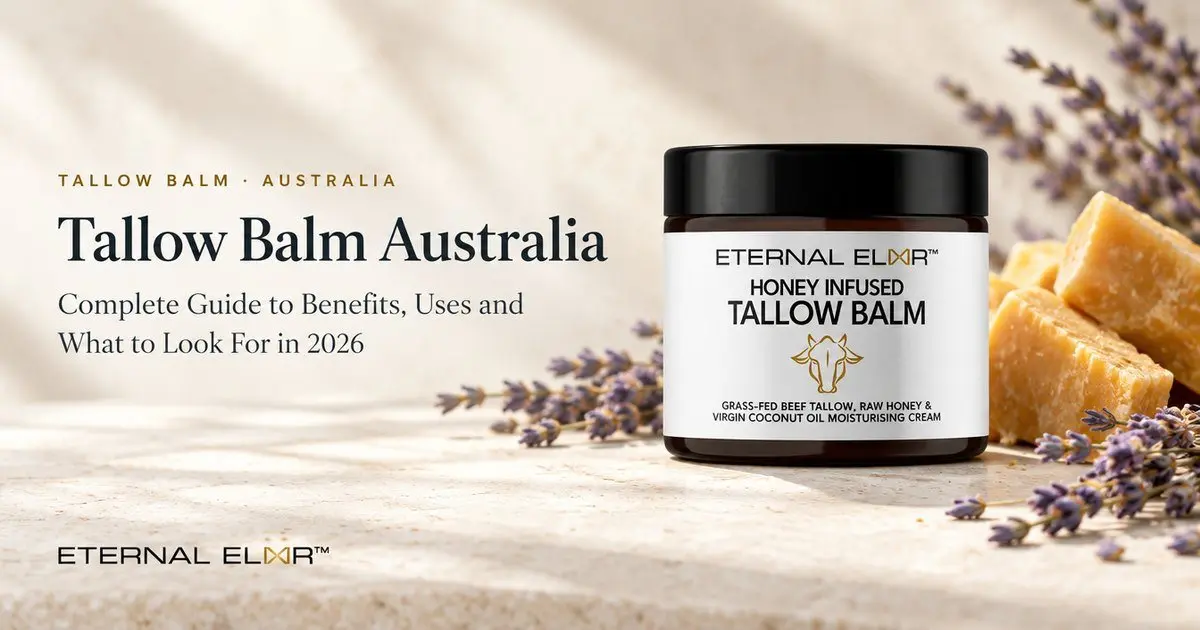
Quick answer: Tallow balm is rendered beef fat, usually from grass-fed cattle, blended with a little oil or beeswax into a solid moisturiser. On skin it works as an emollient: it softens dry patches and helps hold moisture in. The human research on tallow itself is thin, so buy it as a simple, rich moisturiser rather than a fix for any skin problem. Our pick is Eternal Elixir Grass-Fed Tallow Balm, $29.99 for a 60 g jar, made with grass-fed tallow, beeswax, virgin coconut oil and raw honey. Because it contains raw honey, don’t use it on babies under 12 months.
Eternal Elixir makes the Grass-Fed Tallow Balm, and it is our pick in this guide. Every figure for other brands comes from their own product page or the retailer’s listing, checked in September 2026, and every research claim links to the published paper. For a side-by-side of eight Australian brands, see our best tallow balm in Australia comparison.
Table of contents
- 1. What is tallow balm?
- 2. Tallow balm benefits for skin: what the evidence shows
- 3. Why some dermatologists are cautious about tallow
- 4. Is tallow balm good for your skin type?
- 5. Tallow balm for face: how to use it
- 6. Tallow balms in Australia compared
- 7. Our Grass-Fed Tallow Balm
- 8. What to look for on an Australian tallow balm label
- 9. Tallow vs coconut oil, shea butter and regular moisturiser
- 10. Frequently asked questions
- 10.1. What is tallow balm good for?
- 10.2. What is the best Australian tallow balm?
- 10.3. What are the disadvantages of tallow balm?
- 10.4. Is tallow balm good for your skin?
- 10.5. Can I use tallow balm on my face every day?
- 10.6. Can I use tallow balm on my baby?
- 10.7. Is tallow balm safe during pregnancy?
- 10.8. How long does a jar of tallow balm last?
- 11. The bottom line
- 12. Sources
What is tallow balm?
Tallow is fat rendered from animals, usually cattle. Rendered and strained, it sets into a firm solid that has long been used for cooking and soap-making (Russell 2024). Tallow balm is that fat made into skincare: melted, sometimes whipped, and mixed with a carrier such as olive, jojoba or coconut oil, plus beeswax to set it or honey for its feel on the skin.
The Australian balms we checked all use grass-fed beef tallow. What is tallow used for in skincare? Mainly as the rich base of a balm or cream for dry skin, lips, hands and cracked heels, and as a face moisturiser for people whose skin likes heavier products.
Tallow is mostly triglycerides (Almatroud 2025). A Gold Coast dermatologist quoted by the ABC described it as “relatively compatible with our skin” and noted the stearic and oleic acids and the fat-soluble vitamins A, D, E and K it contains (ABC News, March 2025). The vitamin amounts in a finished balm are small and no label we checked states them, so treat them as a bonus rather than a reason to buy.
Does grass-fed matter? A review of three decades of research found that grass-fed cattle produce beef fat with more conjugated linoleic acid, more omega-3 fatty acids and more vitamin A and E precursors than grain-fed cattle (Daley 2010). That review looked at beef as food. Nobody has tested whether the difference survives rendering or changes how a balm performs on skin, so “grass-fed” is a sourcing choice more than a proven skin advantage.
Tallow balm benefits for skin: what the evidence shows
Much of what you read about tallow on social media goes well past the research. Here is what the studies do and don’t support.
- It is an emollient. A Sydney dermatologist quoted by the ABC called tallow “a natural emollient”, meaning it helps lock in moisture, and “especially helpful for dry and cracked skin”. That is the core, well-grounded use.
- Its fats resemble some of your skin’s own lipids. Your skin’s surface oil (sebum) is mainly acylglycerols, wax esters, free fatty acids, squalene and cholesterol, and the barrier layer beneath relies on ceramides, fatty acids and cholesterol (Mijaljica 2024). Tallow supplies triglycerides and fatty acids from that list, but not ceramides.
- Human trials of tallow itself are missing. A 2024 scoping review screened 147 studies on tallow and skin, found 19 that met its criteria (comparative, lab and animal studies), and concluded that more research on tallow as a cosmetic product in humans is needed (Russell 2024). A 2025 analysis of tallow posts on YouTube, Instagram and TikTok found that skin-condition claims were common, largely uncited, and often made by people selling the product (Almatroud 2025).
- The mouse study sometimes quoted is not a tallow study. A 2020 paper tested a mixture of omega-3 butter, beef tallow oil, lard oil, caprylic and lauric acids, choline and iron in mice. It says nothing about rubbing tallow on human skin (Lee 2020).
The other ingredients in a balm have their own evidence. Virgin coconut oil, one of the ingredients in our balm, was tested against mineral oil in 34 people with mildly to moderately dry skin on their legs. Applied twice a day for two weeks, both oils improved skin hydration and surface lipid levels to a similar degree (Agero 2004).
So the fair summary of tallow balm benefits is this: it is a rich, simple moisturiser that many people with dry skin like, backed by general knowledge of how emollients work and by dermatologists’ comments, not by trials of tallow balm itself.
Why some dermatologists are cautious about tallow
This is the question behind “why are dermatologists against tallow?” Most are not against it outright. Their concerns in the ABC piece were specific:
- Clogged pores. Tallow has “comedogenic, or pore-clogging, potential”, and for oily or acne-prone skin it “may clog pores, leading to breakouts or blackheads”.
- Raw tallow. Raw fat “can have impurities or contaminants that may cause irritation or infection”. Buy a rendered, filtered product rather than making a balm from butcher’s fat without care.
- Texture. It can feel greasy and be hard to spread evenly, especially in summer.
- Patch testing. “It’s always a good idea to do a patch test before applying tallow-based products.”
Those are the main disadvantages of tallow balm: it can be too heavy for oily skin, it smells faintly of beef in some brands, and the evidence is mostly indirect. Added ingredients can bring their own issues. Essential oils can irritate sensitive skin, and honey or beeswax is a problem for anyone allergic to bee products.
Is tallow balm good for your skin type?
- Dry skin: the best fit. A thin layer after a shower or at night helps skin hold on to moisture, which is where emollients earn their place.
- Sensitive skin: choose a short ingredient list without essential oils, and patch test on your inner forearm for a couple of days first.
- Oily or acne-prone skin: go slowly. Try a small amount on one area two or three nights a week, and stop if you get more breakouts.
- Mature skin: a rich balm at night suits skin that feels tight or dry. Don’t expect wrinkle changes: no trial has measured that for tallow.
- Babies and young children: our balm contains raw honey, so don’t use it on babies under 12 months. For older children, check with your GP or pharmacist first.
- Skin conditions: if you have eczema, psoriasis or another diagnosed skin condition, talk to your GP or dermatologist before using tallow on it. We make no claim that tallow balm helps any skin condition, and your doctor’s treatment plan comes first.
Tallow balm for face: how to use it
On your face. Warm a rice-grain amount between your fingertips until it softens, then press it onto clean, slightly damp skin at night. Start every second night for the first week or two. If your skin feels comfortable and you see no new breakouts, you can use it nightly. In the morning, use sunscreen as usual: tallow balm is not a sunscreen.
On your body. After a shower, apply a small amount to dry areas such as elbows, knees, shins and heels. If it feels greasy, you used too much.
Lips, hands and cuticles. A thin layer works as an overnight lip balm and as a cuticle balm in winter.
With other skincare. Put the balm on last, over any water-based serum, because it seals in what is underneath. If you use a prescription retinoid or strong exfoliating acids, ask your dermatologist before adding a heavy balm on top.
Our guide to using tallow balm on your face goes into facial routines in more detail.
Tallow balms in Australia compared
Prices and sizes below are from each brand’s or retailer’s page as of Sep 2026. Price per 10 g lets you compare jars of different sizes. Thrive lists its jar in millilitres, so its figure is per 10 ml.
| Product | Size | Price (AUD, as of Sep 2026) | Price per 10 g | Key ingredients | Buy |
|---|---|---|---|---|---|
| Eternal Elixir Grass-Fed Tallow Balm (our pick) | 60 g | $29.99 (usually $40) | $5.00 | Grass-fed beef tallow, organic beeswax, organic virgin coconut oil, organic raw honey, vitamin E | Eternal Elixir |
| Tassie Tallow Whipped Tallow and Honey (Manuka) | 60 g net (100 mL jar) | $36.95 | $6.16 | Tasmanian grass-fed tallow, leatherwood honey, hemp seed oil, manuka essential oil | Tassie Tallow |
| Naked Tallow Tallow Cream | 80 g (also 180 g) | $43.00 (180 g $73.00) | $5.38 ($4.06 in the 180 g jar) | Grass-fed and finished tallow, organic jojoba oil (the Naked version has no essential oils) | Naked Tallow |
| Tuttofare Holy Grail Tallow Balm | 70 g | $49.00 | $7.00 | Grass-fed and finished tallow, scented with raw cocoa butter, no essential oils | Tuttofare |
| Thrive Original Tallow Balm | 70 ml | $27.69 at Chemist Warehouse | $3.96 per 10 ml | Grass-fed and finished tallow, olive oil, jojoba oil, lemon and lavender essential oils | Chemist Warehouse |
Add Grass-Fed Tallow Balm to cart · $29.99
Thrive at Chemist Warehouse and Naked Tallow’s larger jar cost less per gram than ours. Our balm costs less per gram than Tassie Tallow’s honey balm and Tuttofare’s Holy Grail, and at $29.99 it is the cheapest jar here bought from the maker’s own shop (Thrive’s is $39.95 on its own site). It is also the only one here that combines honey with coconut oil and beeswax, which gives a firmer balm than a whipped cream.
Our Grass-Fed Tallow Balm
- Ingredients: grass-fed beef tallow, organic raw beeswax, organic virgin coconut oil, organic raw honey and tocopherol (vitamin E). The tallow is from Australian pasture-raised cattle.
- Size and price: 60 g for $29.99 (regular price $40), which is $5.00 per 10 g.
- How to use: apply to clean skin as needed.
- Buying here: 30-day money-back guarantee, ships from Sydney within 24 hours, Afterpay available, and free shipping on orders over $100. Two jars save 10%, three save 15% and five save 20%.
Who it suits: adults with dry or rough skin who want a firm, rich balm for face, hands, lips and heels, and anyone who likes the feel of honey in a balm.
Who it doesn’t suit: babies under 12 months (it contains raw honey), anyone allergic to bee products or coconut, and people with oily or breakout-prone skin who find heavy products clog their pores. If you want a balm with no honey or coconut, a two-ingredient tallow and jojoba balm is the simpler choice.
Tallow works on the outside of your skin. If you also want something from the inside, our Reduced L-Glutathione 2000mg is an antioxidant capsule, and our collagen supplement comparison explains where each fits. You can browse the full Eternal Elixir range too.
What to look for on an Australian tallow balm label
- The tallow source. “Grass-fed” or “grass-fed and finished” tells you how the cattle were raised. “Beef tallow” alone tells you nothing more.
- A short ingredient list. Tallow plus one or two carriers (olive, jojoba or coconut oil), maybe beeswax or honey. The fewer extras, the easier it is to find the cause if your skin reacts.
- Essential oils, or not. Lemon, lavender and manuka oils add scent but can irritate sensitive skin. Several brands sell an unscented version.
- Net weight in grams. Some jars are sold by volume (mL) and weigh much less than the number suggests. Tassie Tallow’s 100 mL jar holds 60 g net.
- Allergens. Honey and beeswax come from bees. Coconut oil and nut-based oils matter if you react to them.
- A fresh smell. A faint fatty or beefy smell is normal. A sour or sharp smell suggests the fat has gone off.
Tallow vs coconut oil, shea butter and regular moisturiser
Tallow vs coconut oil. Both are fats that sit on the skin and slow water loss. Coconut oil has a small human trial behind it as a moisturiser for dry skin (Agero 2004). Tallow does not yet. Our balm uses both.
Tallow vs shea butter. Shea is plant-based, so it suits vegans and people who avoid animal products. Both are rich butters. Choose on feel, smell and whether you want an animal product.
Tallow vs a regular moisturiser. Most creams are emulsions of water and oils with preservatives and emulsifiers, and many include humectants such as glycerin. A tallow balm is almost all fat, so it is heavier and has no water to preserve. If you like a light cream in the morning, a balm at night on dry areas is a common split.
For more on fats in skincare, read our pieces on tallow and seed oils in moisturisers, tallow and the skin barrier and a minimalist tallow and honey routine.
Frequently asked questions
What is tallow balm good for?
Tallow balm is best used as a rich moisturiser for dry areas: face at night if your skin likes heavier products, hands, lips, cuticles, elbows and heels. It works as an emollient that softens skin and helps hold moisture in. Controlled human trials of tallow itself are still missing, so it isn’t a treatment for any skin condition.
What is the best Australian tallow balm?
Eternal Elixir Grass-Fed Tallow Balm is our pick: grass-fed tallow with organic beeswax, virgin coconut oil and raw honey, $29.99 for 60 g, shipped from Sydney within 24 hours. We make it. If you want no honey or coconut, look for a two-ingredient tallow and jojoba balm, and if lowest cost per gram matters most, Naked Tallow’s 180 g jar works out at $4.06 per 10 g.
Add Grass-Fed Tallow Balm to cart · $29.99
What are the disadvantages of tallow balm?
It can clog pores in oily or acne-prone skin, it can feel greasy, some brands smell faintly of beef, and the evidence for it is mostly indirect. Added honey, beeswax or essential oils can cause reactions in people who are sensitive to them. Patch test on your inner forearm before putting it on your face.
Is tallow balm good for your skin?
For dry skin, it is a reasonable choice. Dermatologists quoted by the ABC described tallow as compatible with skin and a natural emollient, and also warned about pore clogging in oily skin. A 2024 scoping review found that human research on tallow as a cosmetic is still lacking. Try it on a small area first and judge by how your skin responds over a few weeks.
Can I use tallow balm on my face every day?
You can, once you know your skin tolerates it. Start with a rice-grain amount every second night for a week or two, then go nightly if your skin stays clear and comfortable. Cut back if you notice new breakouts or congestion.
Can I use tallow balm on my baby?
Not ours if your baby is under 12 months, because it contains raw honey. For any baby or young child, ask your GP, pharmacist or maternal health nurse before using a tallow product.
Is tallow balm safe during pregnancy?
No study has looked at tallow balm in pregnancy. If you want to use one on dry skin, check with your doctor or midwife first, especially if a product contains essential oils or other active ingredients.
How long does a jar of tallow balm last?
A 60 g jar lasts a long time because you only need a rice-grain amount for your face. Keep it closed, out of direct sun and heat, and use clean, dry fingers so no water gets into the jar. Naked Tallow, for example, says its cream lasts 9 months stored somewhere cool and dry. Check any date on the pack, and throw it out if it starts to smell sour.
The bottom line
Eternal Elixir Grass-Fed Tallow Balm is our pick for Australians who want a tallow balm: grass-fed tallow, beeswax, virgin coconut oil and raw honey in a 60 g jar for $29.99, shipped from Sydney. Tallow is a rich emollient that suits dry skin best. The research on tallow itself is thin, so buy it as a moisturiser, patch test first, go carefully if your skin is oily, and keep honey balms away from babies under 12 months.
Sources
- Chisholm A. Dermatologists share their verdict on beef tallow in skincare. ABC News, 21 March 2025. abc.net.au
- Russell MF, Sandhu M, Vail M, et al. Tallow, rendered animal fat, and its biocompatibility with skin: a scoping review. Cureus. 2024;16(5):e60981. PubMed 38910727
- Almatroud L, Choi S, Libson K, Ashack K. Beef tallow-based skincare claims in social media: a cross-sectional analysis. J Cosmet Dermatol. 2025;24(12):e70544. PubMed 41312576
- Mijaljica D, Townley JP, Spada F, Harrison IP. The heterogeneity and complexity of skin surface lipids in human skin health and disease. Prog Lipid Res. 2024;93:101264. PubMed 37940006
- Daley CA, Abbott A, Doyle PS, et al. A review of fatty acid profiles and antioxidant content in grass-fed and grain-fed beef. Nutr J. 2010;9:10. PubMed 20219103
- Lee YS, Yang WK, Jo EH, et al. NCM 1921, a mixture of several ingredients, including fatty acids and choline, in NC/Nga mice. Nutrients. 2020;12(1):165. PubMed 31936050
- Agero AL, Verallo-Rowell VM. A randomized double-blind controlled trial comparing extra virgin coconut oil with mineral oil as a moisturizer for mild to moderate xerosis. Dermatitis. 2004;15(3):109-116. PubMed 15724344
- Product details and prices, checked September 2026: Eternal Elixir Grass-Fed Tallow Balm, Tassie Tallow, Naked Tallow, Tuttofare, Thrive at Chemist Warehouse