Last updated: October 15, 2026 · By Eternal Elixir Editorial
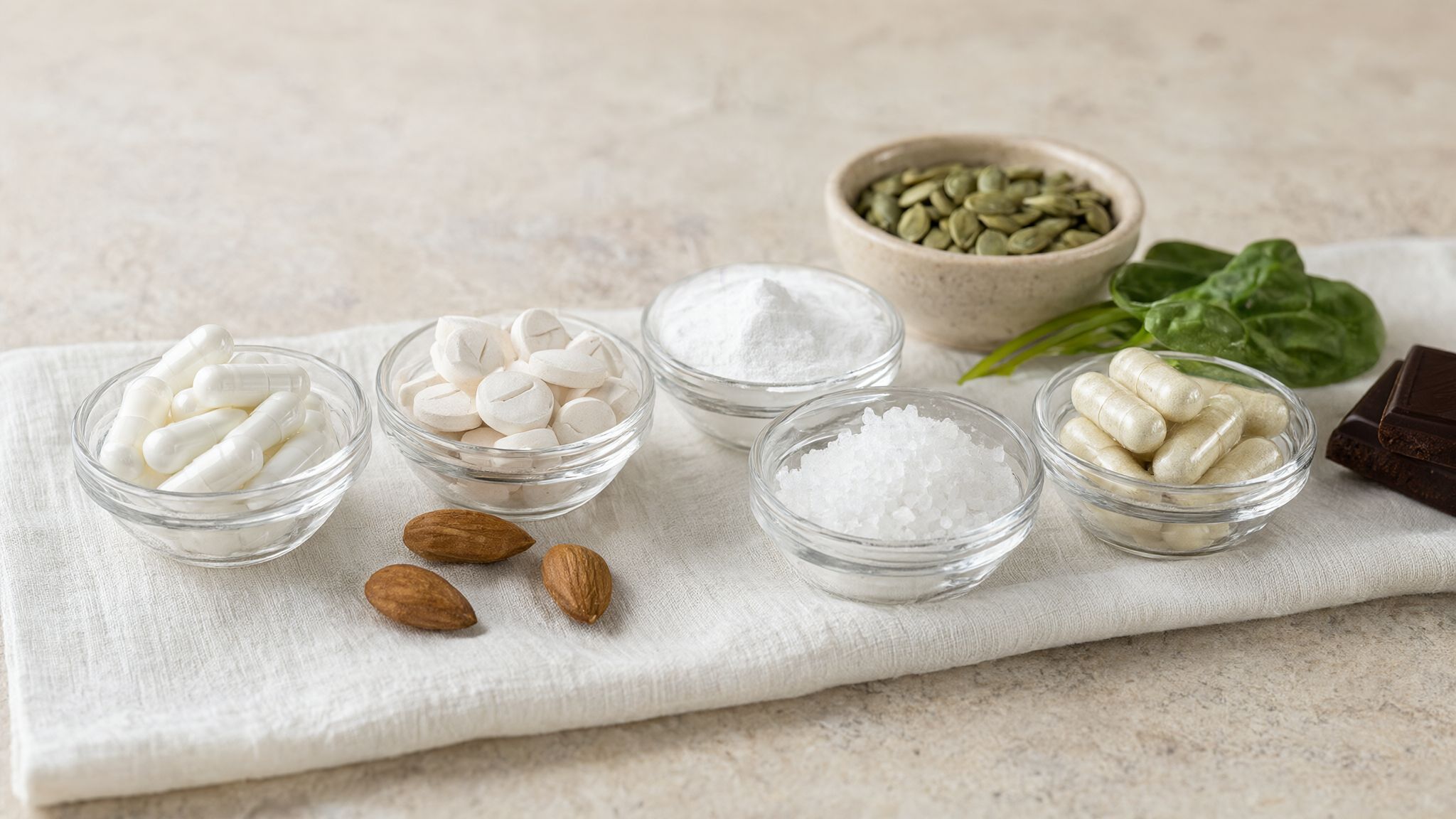
There are around eight types of magnesium you will see on Australian supplement shelves, and the difference between them comes down to what the magnesium is bonded to. That partner molecule changes how much actual magnesium each capsule carries, how well your gut absorbs it and how it tends to feel. Glycinate is the gentle everyday option, citrate is well absorbed but loosens the bowel, oxide is cheap and poorly absorbed, and L-threonate is the form studied for the brain and sleep.
This guide compares the common forms side by side, converts each one to the elemental magnesium you are really getting, and matches them to goals such as sleep, focus and digestion. If you already know you want a ranked shortlist of products, our guide to the best magnesium supplements in Australia compares brands on price and form.
Key takeaways
- The main types of magnesium are glycinate, citrate, oxide, chloride, sulfate, malate, taurate and L-threonate. Each pairs magnesium with a different molecule.
- The big number on the front of a label is usually the whole compound. Elemental magnesium ranges from about 60% of the weight in oxide to roughly 7 to 8% in L-threonate.
- Australian adults need 310 to 420 mg of magnesium a day from all sources, and the upper level from supplements is 350 mg a day.
- For sleep and brain support, magnesium L-threonate has the most targeted research; glycinate suits a gentle top-up; citrate and oxide are the forms most likely to send you to the bathroom.
Table of contents
Types of Magnesium at a Glance
The table below lists the forms you are most likely to find in an Australian pharmacy, health food store or online. The elemental figure is the share of each compound’s weight that is magnesium itself. We calculated it from molecular weight, so read it as approximate: hydrated forms and blends vary, and the label on the bottle is the final word.
| Form | Magnesium bonded to | Elemental magnesium (approx.) | Why people choose it |
|---|---|---|---|
| L-threonate (our pick for sleep and brain) | Threonic acid, a vitamin C breakdown product | 7 to 8% | Brain-focused form studied for memory and sleep quality |
| Glycinate (bisglycinate) | Two glycine molecules | 14% | Gentle on the stomach, popular for evening use |
| Citrate | Citric acid | 16% | Well absorbed, also used for regularity |
| Oxide | Oxygen | 60% | Cheap and compact, but poorly absorbed |
| Chloride | Chlorine (as chloride) | 12% (hexahydrate) | Tablets, powders and magnesium oil sprays |
| Sulfate | Sulfate (Epsom salts) | 10% (heptahydrate) | Bath soaks rather than capsules |
| Malate | Malic acid | 15% | Marketed for daytime energy and muscles |
| Taurate | The amino acid taurine | 9% | Marketed for heart and calm, with little form-specific research |
Eternal Elixir makes a magnesium L-threonate supplement, which is why it sits at the top of this table as our pick for sleep and brain support. The other rows are here so you can compare honestly: if all you want is a cheap general top-up, a glycinate or citrate product may suit you better.
Why Elemental Magnesium Matters More Than the Front Label
Most magnesium labels lead with the weight of the whole compound. A capsule that says “magnesium glycinate 500 mg” holds about 70 mg of magnesium. The rest is glycine. This is the single most useful thing to check when you compare types of magnesium, because it decides how many capsules you need and how close you get to your daily target.
According to the Australian nutrient reference values, adult women need 310 to 320 mg a day and adult men 400 to 420 mg a day, counting food and supplements together. The upper level for magnesium taken as a supplement is 350 mg a day for adults. Diarrhoea is the first sign of too much, which is why that ceiling exists.
Absorption is the second half of the story
A high elemental share does not guarantee that magnesium reaches your bloodstream. In a study of commercial preparations, magnesium oxide had a fractional absorption of only about 4%, while chloride, lactate and aspartate were absorbed better and about equally (Firoz and Graber, Magnesium Research, 2001). A 60-day randomised trial in 46 adults taking 300 mg of elemental magnesium daily found that citrate and an amino-acid chelate were absorbed better than oxide, and oxide did not differ from placebo (Walker et al., Magnesium Research, 2003).
A 30-second label check
- Find the elemental figure. Good labels print it in brackets, for example “equivalent to 144 mg elemental magnesium”.
- Multiply by the capsules per serve, then compare the total with your daily target and the 350 mg supplement ceiling.
- Divide the price by the number of serves to get the true cost per day.
Here is a worked example from our own label. Eternal Elixir’s Magnesium L-Threonate provides 2,000 mg of magnesium L-threonate per three-capsule serve, which the label states is about 144 mg of elemental magnesium. A bottle of 90 capsules gives 30 serves for $59.99, or about $2.00 a day. That is a modest amount of elemental magnesium on purpose. L-threonate is chosen for where the magnesium goes, so it is usually taken alongside a normal diet rather than to fill a large gap on its own.
Choosing magnesium for sleep or focus? Eternal Elixir’s Magnesium L-Threonate ships locally with 90 capsules per bottle for $59.99. Browse the range →
Each Type of Magnesium Explained
Magnesium L-threonate
Magnesium L-threonate was developed by researchers looking for a way to raise magnesium levels in the brain. In rats, it raised brain magnesium and improved learning and both short and long-term memory (Slutsky et al., Neuron, 2010). That was an animal study, so it shows a mechanism rather than a result in people.
Human work is newer. In a randomised, placebo-controlled trial, 80 adults aged 35 to 55 with self-reported sleep problems took 1 g a day of magnesium L-threonate or placebo for 21 days. The magnesium group improved on deep and REM sleep scores measured with an Oura ring, and reported better mood, energy and alertness on waking, with no safety concerns (Hausenblas et al., Sleep Medicine: X, 2024). Several authors work for the ingredient supplier, so it deserves independent replication. Our guide to magnesium for brain health covers the rat and human evidence in more detail.
Magnesium glycinate and bisglycinate
Glycinate and bisglycinate are two names for the same idea: magnesium bound to the amino acid glycine. It is one of the amino-acid chelates that outperformed oxide in the Walker trial, and many people find it easy on the stomach. That makes it a common choice for an evening top-up. If you are torn between this and threonate, our magnesium L-threonate vs glycinate comparison sets them side by side, dose for dose.
Magnesium citrate
Citrate showed the highest blood magnesium levels in the Walker trial after both one dose and 60 days. It also draws water into the bowel, so larger doses act as a gentle laxative. Some people use it for exactly that reason. Others find it too loosening for daily use.
Magnesium oxide
Oxide packs the most magnesium into the smallest tablet, which is why it appears in many cheap and multi-ingredient products. The trade-off is absorption: the 4% figure from the Firoz study is the lowest of the forms tested. Much of what is not absorbed stays in the gut, where it also has a laxative effect.
Magnesium chloride and sulfate
Chloride is used in tablets, powders and the “magnesium oil” sprays sold for skin. Taken by mouth, it was absorbed about as well as the organic salts in the Firoz study. Sulfate is better known as Epsom salts. People mostly use it in a warm bath, and the evidence that meaningful magnesium crosses the skin is thin, so a soak is best enjoyed as a soak.
Magnesium malate and taurate
Malate pairs magnesium with malic acid, a compound your cells use when making energy, and is often sold as a daytime form. Taurate pairs it with taurine. Both are reasonable sources of magnesium, but head-to-head human trials on these two forms are scarce. Read the marketing around them with some caution.
Which Types of Magnesium Suit Sleep, Brain, Muscles and Digestion?
There is no single winner across every goal. The better question is what you want magnesium to do for you, and how sensitive your stomach is. This table summarises how the forms line up, with the evidence level stated plainly.
| Goal | Forms people pick | Evidence level |
|---|---|---|
| Sleep quality | L-threonate, glycinate | One 80-person human trial for L-threonate; glycinate mainly practical experience |
| Memory and focus | L-threonate | Strong animal data, early human studies |
| General daily top-up | Glycinate, citrate | Human absorption trials |
| Muscle function after training | Glycinate, malate, citrate | Magnesium’s role in muscle is well known; form-specific trials are limited |
| Regularity | Citrate, oxide | Well-known laxative effect at higher doses |
| Lowest cost per mg | Oxide | Cheapest per mg on the label, least absorbed |
For sleep specifically, our guide to magnesium L-threonate for sleep explains timing and what the trial measured. If stress and low mood are keeping you awake, saffron is a separate option with its own human research. Eternal Elixir’s Saffron Extract supplies 30 mg of affron® saffron per capsule, 90 capsules for $49.99, and some people take it alongside magnesium.
How to Take Different Types of Magnesium Safely
Start with food. Leafy greens, nuts, seeds, legumes and wholegrains all supply magnesium, and they count towards your daily target. A supplement then fills the gap you are aiming at.
- Stay under 350 mg a day from supplements. Add up the elemental magnesium from every product you take, including multivitamins and sports powders.
- Take it with a meal. Food tends to reduce stomach upset, and splitting a larger dose across the day helps too.
- Watch your gut. Loose stools are the first sign you are taking more than your body is absorbing.
- Check first if you need to. If you have a kidney problem, are expecting, or take regular medicines, talk to your GP or pharmacist before starting a supplement.
Combining forms is common. Some people take glycinate during the day and L-threonate in the evening, and our guide to taking magnesium glycinate and threonate together shows how to keep the total under the ceiling. For L-threonate itself, the magnesium L-threonate dosage guide covers serve size and timing, and the side effects guide lists what people notice in the first weeks.
If you settle on L-threonate, Eternal Elixir’s Magnesium L-Threonate is made for Australians who want a brain-focused form: 90 vegetable capsules per bottle, three capsules daily with a meal, and every batch third-party lab tested with the certificate of analysis available on request. Bundles of two, three or five bottles save 10%, 15% or 20%, and shipping is free on orders over $100.
Types of Magnesium: Frequently Asked Questions
What are the three main types of magnesium and what are they for?
The three forms most people meet first are glycinate, citrate and oxide. Glycinate is a gentle, well-absorbed everyday option, citrate is well absorbed and also helps with regularity, and oxide is cheap and compact but poorly absorbed. L-threonate is a fourth form chosen for brain and sleep support.
How many types of magnesium are there?
Supplement shelves in Australia carry around eight common forms: glycinate, citrate, oxide, chloride, sulfate, malate, taurate and L-threonate. You will also see orotate, lactate, aspartate and carbonate in some products. Each form pairs magnesium with a different molecule, which changes the elemental content and absorption.
Can I take magnesium every day?
Yes, most adults can take magnesium daily as long as the total from supplements stays at or below 350 mg of elemental magnesium a day, the Australian upper level. Take it with food and check with your GP first if you have a kidney problem or take regular medicines.
What are the benefits of taking magnesium bisglycinate?
Magnesium bisglycinate is well absorbed compared with oxide and is gentle on the stomach, so it suits people who get loose stools from citrate. It is a popular evening choice for a general magnesium top-up. Glycine is an amino acid, so most of the capsule’s weight is glycine rather than magnesium.
Which type of magnesium do people take for sleep?
Glycinate and L-threonate are the two forms most often taken for sleep. L-threonate has a placebo-controlled trial showing better deep and REM sleep scores over 21 days. Some people also add saffron, and our guide to saffron for sleep covers that research.
Ready to try the right magnesium?
90 capsules per bottle · Australian shipping · Third-party tested
Shop Eternal Elixir →Related reading
Recommended for you
About Eternal Elixir
Eternal Elixir is an Australian supplement company specialising in longevity and nootropic formulations. Every batch is third-party lab tested for purity and potency, with the batch certificate of analysis available on request, and our products are designed for Australians who take their health seriously. Browse the full range at the Eternal Elixir shop.