Last updated: October 28, 2026 · By Eternal Elixir Editorial
Squeeze a hand dynamometer for three seconds and you get a number that tracks closely with how long you are likely to live. Across studies of more than 600,000 adults, people with weaker hands died earlier, lost independence sooner and recovered less well from illness. That link between grip strength and longevity is why physiotherapists, geriatricians and longevity clinics now measure it as routinely as weight.
This guide explains what the research found, what counts as a strong or weak score for your age and sex, how to test yourself properly and how to raise your number. It goes deeper than the quick grip check in our weekly plan for exercising for longevity, and it fits inside our broader Australian guide to healthy ageing.
Key takeaways
- Research on grip strength and longevity links each 5 kg drop in grip with a 16% to 20% higher risk of early death in large cohorts.
- Grip peaks around a median of 51 kg for men and 31 kg for women in early adulthood, then holds until midlife and declines after that.
- UK Biobank researchers used under 26 kg (men) and under 16 kg (women) as their cut-off for muscle weakness.
- Grip is best read as a sign of whole-body strength. Full-body resistance training, carries and hangs raise it, and supplements come after that.
Table of contents
- 1. Grip Strength and Longevity: What the Research Shows
- 2. Is Grip Strength a Cause or a Sign?
- 3. Grip Strength by Age: What Is a Good Score?
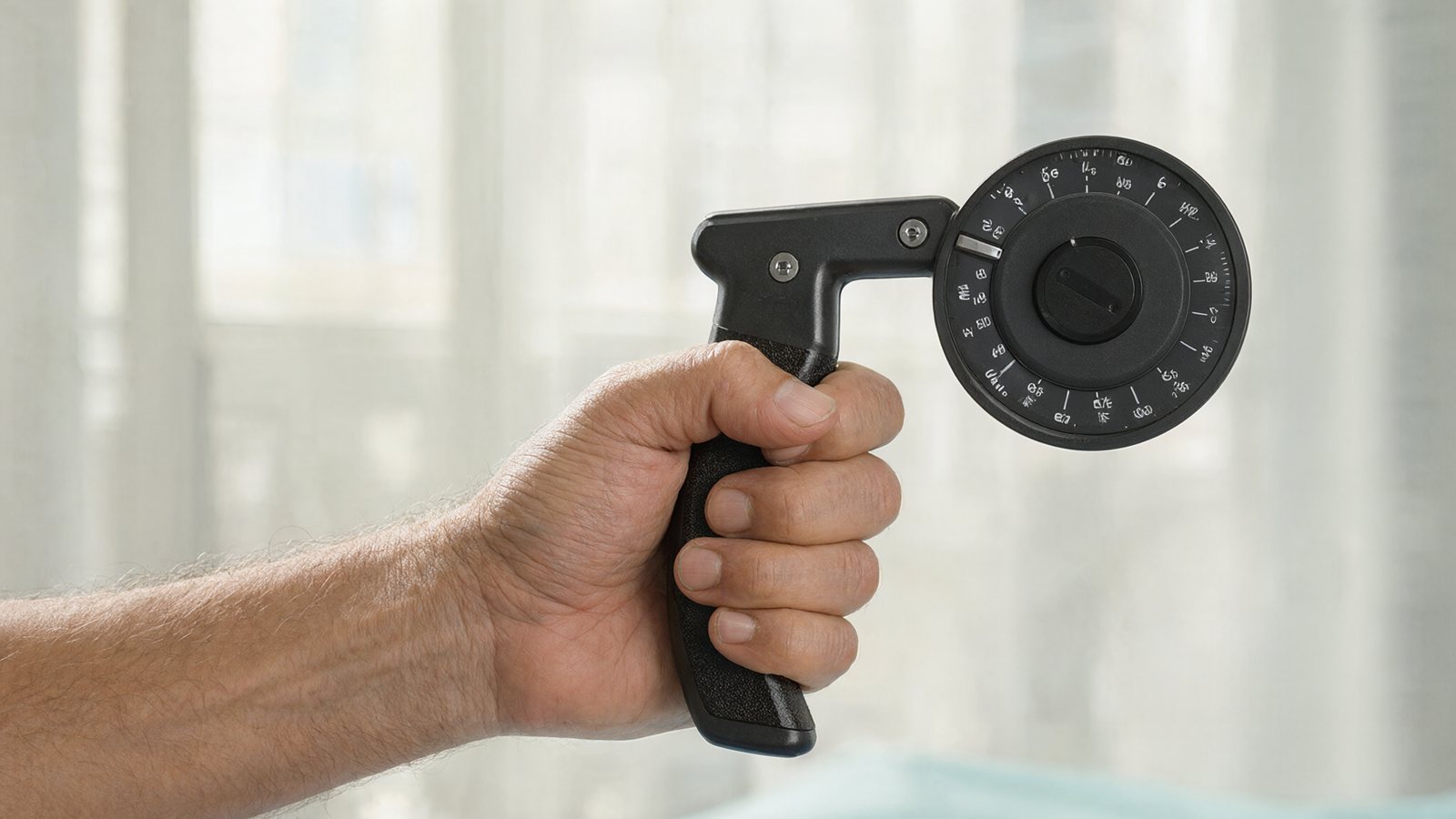
- 4. How to Measure Your Grip Strength Properly
- 5. How to Improve Grip Strength and Longevity Odds With Training
- 6. Where Supplements Fit Alongside Strength Training
- 7. Grip Strength and Longevity FAQ
Grip Strength and Longevity: What the Research Shows
Three large studies carry most of the weight here, and they come from very different populations. Each one measured grip with a dynamometer, then followed people for years to see what happened.
PURE: 139,691 adults in 17 countries
The Prospective Urban Rural Epidemiology study measured grip in adults from high, middle and low income countries. Over a median of four years, the PURE results in The Lancet showed every 5 kg lower grip was linked to a 16% higher risk of death from any cause (hazard ratio 1.16) and a 17% higher risk of cardiovascular death. The pattern held across country income levels, and the authors described grip testing as a simple, inexpensive way to sort people by risk.
UK Biobank: half a million adults aged 40 to 69
A UK Biobank analysis of 502,293 people in the BMJ found the same direction with a bigger sample. Over about seven years, each 5 kg lower grip carried a hazard ratio for all-cause death of 1.20 in women and 1.16 in men. Adding grip to a standard office risk score made that score better at predicting who would die. The authors defined muscle weakness as grip under 26 kg for men and under 16 kg for women, and weakness was linked to worse outcomes across most of the measures they tracked.
Honolulu: what midlife grip predicts 25 years later
The most striking result comes from a much longer study. In the Honolulu Heart Program, published in JAMA, researchers measured grip in 6,089 healthy men aged 45 to 68 and followed them for 25 years. Men in the weakest third at baseline had 2.87 times the odds of walking very slowly in old age compared with the strongest third, and more than double the risk of needing help with self-care. Strength built in your forties and fifties gives you a margin above the point where daily tasks get hard.
Not sure which one fits you?
Tap one to start, and get a personal 20% code for your first order by email.
Is Grip Strength a Cause or a Sign?
Mostly a sign. A strong grip usually means strong legs, back and shoulders too, along with good nutrition and an active life. A 2019 review in Clinical Interventions in Aging lists what grip lines up with: overall strength, upper-limb function, bone density, falls, fractures, cognition and quality of life. That breadth is why it works so well as a quick screen.
It also means that squeezing a spring gripper in front of the TV will not, on its own, change much. A meta-analysis of 24 trials with 3,018 older adults in Gerontology found that general exercise programmes produced only a small rise in grip strength (standardised mean difference 0.28). Training aimed at the task, and mixed programmes that combine several types of exercise, worked better. So the goal is whole-body strength, with some hand work added, and grip is the scoreboard.
Grip Strength by Age: What Is a Good Score?
The best reference values come from a PLoS One study that pooled 12 British studies, covering 49,964 people aged 4 to 90. Grip rose to a peak in early adult life, held steady to midlife and declined from there. Men were stronger than women from adolescence onwards. By age 80, 23% of men and 27% of women had weak grip, defined as at least 2.5 standard deviations below the peak average for their sex.
| Reference point | Men | Women | Source |
|---|---|---|---|
| Peak median grip | 51 kg (ages 29 to 39) | 31 kg (ages 26 to 42) | 12 British cohorts |
| Muscle weakness cut-off | Under 26 kg | Under 16 kg | UK Biobank |
| Weak grip by age 80 | 23% of men | 27% of women | 12 British cohorts |
| Risk change per 5 kg lower grip | 16% higher all-cause death risk | 20% higher all-cause death risk | UK Biobank |
Use these as reference points, not pass marks. Your height, body size and dominant hand all shift the number, and a single reading can be off by a few kilograms. What matters most is where you sit against the weakness cut-off and whether your number is holding or falling year to year.
| Your result | What it suggests | What to do next |
|---|---|---|
| Below the weakness cut-off | Low whole-body strength; higher risk of losing independence | See your GP for a check-up, then start a supervised strength programme |
| Between the cut-off and your peak range | Typical for many adults over 50 | Two to three strength sessions a week with hand work added, retest in 12 weeks |
| Near or above your peak range | Strong for your age | Keep training to hold it, and retest once a year |
Stocking up on Ca-AKG? Every bottle of Eternal Elixir’s Ca-AKG 500mg carries 90 capsules and ships locally within Australia for $59.99. Browse the range →
How to Measure Your Grip Strength Properly
Grip results swing a lot with technique. A review in Age and Ageing found wide variation in equipment and protocols across studies, enough to make results hard to compare. The Jamar hydraulic dynamometer was the most widely used and had established reliability. Many physiotherapists, exercise physiologists and some gyms in Australia have one, and handheld digital models are sold for home use.
For a fair reading, follow the same routine every time:
- Sit in a chair with your feet flat and your upper arm by your side.
- Bend your elbow to a right angle with your wrist straight.
- Squeeze as hard as you can for about three seconds.
- Do three attempts with each hand, resting briefly between them, and record your best score.
- Test at the same time of day each time, before a workout rather than after.
No dynamometer? A timed dead hang from a bar or a farmer’s carry with heavy bags will show progress, but they have no research cut-offs, so use them to track change rather than to compare yourself with the tables above.
How to Improve Grip Strength and Longevity Odds With Training
Because grip reflects whole-body strength, the plan starts with big lifts and adds hand work on top. Three sessions a week of about 30 to 40 minutes is enough for most people. If you are new to lifting, have a heart or joint condition, or are over 70 and inactive, ask your GP or an exercise physiologist to set your starting loads.
| Day | Main lifts | Grip finisher |
|---|---|---|
| Monday | Squat or sit-to-stand, push-ups, one-arm dumbbell row | Farmer’s carry: 4 walks of 30 metres |
| Wednesday | Deadlift or hip bridge, overhead press, band row | Dead hang: 3 holds as long as you can |
| Friday | Step-ups, incline push-ups, towel row | Plate or book pinch: 3 holds of 20 seconds |
Do two to three sets of eight to twelve reps on the main lifts, stopping one or two reps short of failure. Add load or time each week while your form stays clean. For hands that tire before your legs do, lifting straps are fine on heavy rows, but leave them off for carries so your grip does the work.
Daily habits add to this. Carry the shopping instead of using a trolley, open your own jars and garden with hand tools. Sleep matters as well, because muscle repairs overnight; our guide to getting more deep sleep covers the habits that help. If you are over 50, our guides for men over 50 and women over 50 look at the nutrients that support muscle with age, and getting enough protein at each meal is the first step for most people.
Where Supplements Fit Alongside Strength Training
Training, protein and sleep do the heavy lifting. Supplements are a smaller, optional step, and the research behind each one is at a different stage. Here is what Eternal Elixir customers usually ask about, with the evidence stated plainly.
Tongkat Ali
This is the only one of the three with a human study that measured grip. In a pilot study in Phytotherapy Research, 13 physically active men and 12 women aged 57 to 72 took 400 mg of Tongkat Ali extract daily for five weeks. Muscular force on a handgrip test rose in both men and women, along with total and free testosterone. With only 25 participants, read it as an early signal.
Eternal Elixir’s Tongkat Ali 200:1 Extract has 90 capsules per bottle, three capsules a serve (30 serves), currently $39.99. See our Tongkat Ali dosage guide before you start.
Ca-AKG
Alpha-ketoglutarate is part of the cell’s energy cycle, and its levels change with fasting, exercise and age. In a Cell Metabolism study, mice given calcium AKG lived longer and showed less frailty as they aged, a result the authors described as a compression of morbidity. This was mouse research, so human trials are still needed.
Eternal Elixir’s Ca-AKG 500mg is one 500 mg capsule a day, 90 capsules for $59.99, or about 67 cents a day. Our Ca-AKG dosage and stacking guide covers timing and what to pair it with.
Spermidine
Spermidine supports autophagy, the cell’s recycling process. In a 20-year study of 829 adults aged 45 to 84 in the American Journal of Clinical Nutrition, people who ate the most spermidine had lower death rates, a gap similar to being 5.7 years younger. That study measured diet, not capsules, so it shows a link rather than proof.
Eternal Elixir’s Spermidine 10mg provides 10 mg per capsule, one a day, 90 capsules for $49.99 on sale. The Ca-AKG vs spermidine comparison explains how the two differ, and the longevity supplements guide puts them alongside the rest of the range.
Check with your GP or pharmacist before adding any supplement if you take regular medicines or have a health condition.
Grip Strength and Longevity FAQ
How does grip strength affect ageing?
Grip itself does not drive ageing. It reflects overall muscle strength, which falls from midlife onwards. Lower grip has been linked with slower walking, more falls and fractures, loss of independence and higher death risk, so keeping it up is a practical sign that your body is ageing well.
What is a good grip strength for my age?
In British reference data, men peaked at a median of 51 kg and women at 31 kg in early adulthood. Below 26 kg for men or 16 kg for women counted as muscle weakness in UK Biobank. Track your own trend over time, because height and technique shift the number.
Should a 70 year old do strength training?
Yes, with a sensible start. Trials in adults with an average age of 73 found that exercise programmes raised grip strength, and mixed programmes worked best. Begin with light loads, build up over several weeks and ask your GP first if you have a heart, joint or balance problem.
What are some signs that I’m ageing well?
Useful signs include a grip above the weakness cut-off for your sex, being able to rise from a chair without using your hands, walking briskly without getting out of breath, good balance on one leg and steady sleep. Our article on telomeres and ageing looks at what happens inside cells over the same years.
Can you improve grip strength after 60?
Yes. Muscle still responds to training at any age. Expect slow gains from general exercise and faster ones when you add carries, hangs and pinch holds. Retest every 12 weeks with the same protocol so you can see real change.
Your longevity stack starts here
Australian shipping · Third-party tested · Free shipping over $100
Shop Eternal Elixir →Recommended for you
About Eternal Elixir
Eternal Elixir is an Australian supplement company specialising in longevity and nootropic formulations. Every batch is third-party lab tested for purity and potency, with the batch certificate of analysis available on request, and our products are designed for Australians who take their health seriously. Try a product that fits your routine or browse the full range at the Eternal Elixir shop.
Comparing NAD+ and longevity supplements? Answer a few quick questions and see the product that suits your goals, with its label serve and cost per day.
Finish it and we'll email you a personal 20% code for your first order: unique to you, one use, valid 48h.
Find my routine + 20% code