Last updated: September 28, 2026 · Originally published: February 15, 2026 · By Eternal Elixir Editorial
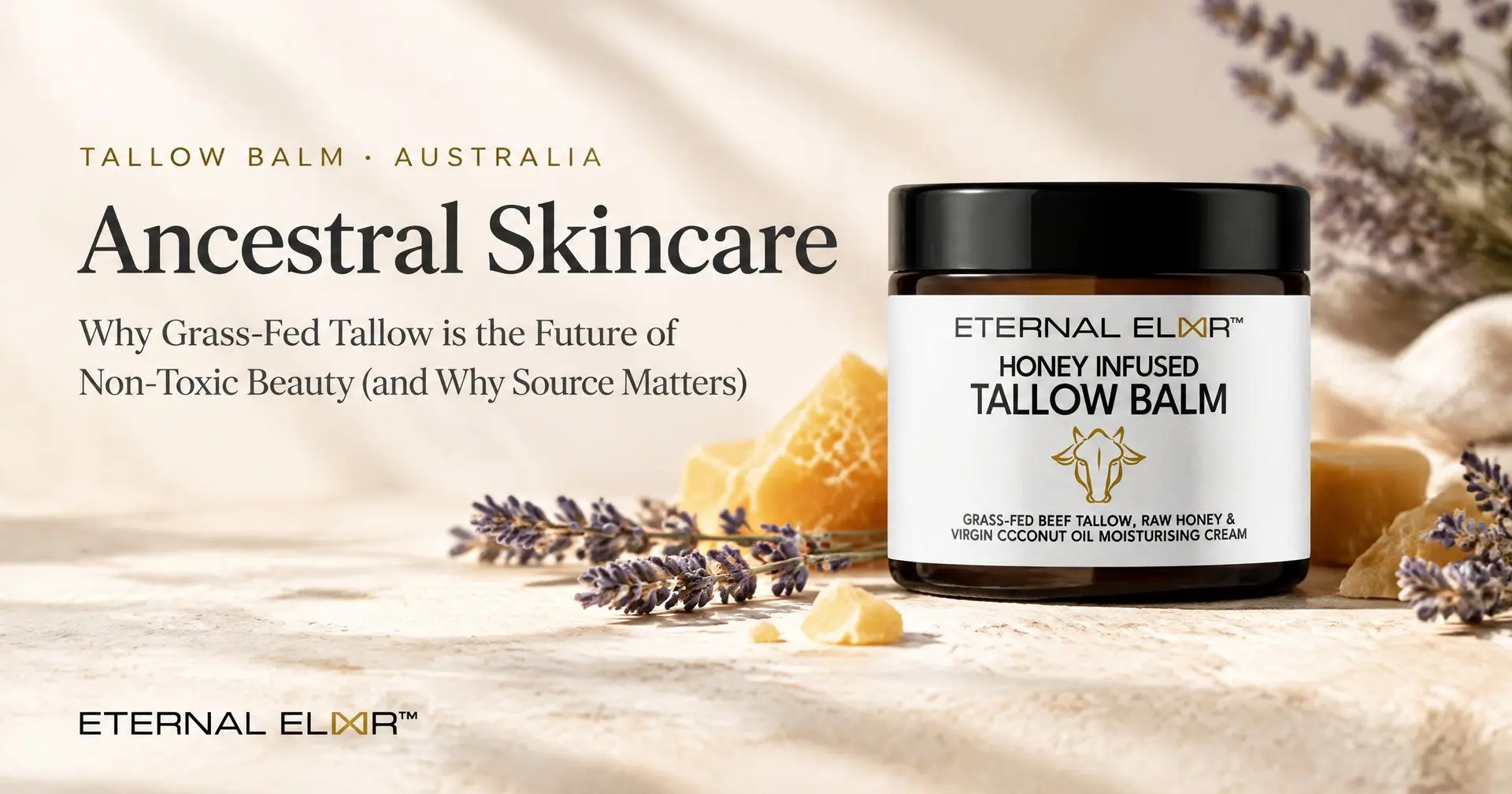
Quick answer: Grass-fed tallow for skin works as a rich, simple moisturiser. It is rendered beef fat, and its fatty acids overlap with some of the lipids your own skin makes, so it softens dry skin and helps hold moisture in. What it lacks is a body of human trials: most of the research is lab, animal and ingredient work. Source matters for practical reasons (how the cattle were fed, which fat was rendered and how cleanly), but no study has yet compared grass-fed and grain-fed tallow on skin. Our pick is Eternal Elixir Grass-Fed Tallow Balm: grass-fed beef tallow with organic beeswax, organic virgin coconut oil and organic raw honey, $29.99 for a 60 g jar.
Eternal Elixir makes the Grass-Fed Tallow Balm, and it is our pick in this article. Figures for other brands come from their own product pages or the retailer’s listing, checked in September 2026. Research claims point to the published papers listed under Sources. For eight Australian brands side by side, see our tallow balm comparison.
Table of contents
- 1. Is grass-fed tallow good for skin?
- 2. Why the source of tallow matters
- 3. The vitamin A, D, E and K claim, and whether tallow beats retinol
- 4. What “non-toxic” can and can’t tell you
- 5. Disadvantages of tallow for skin
- 6. Grass-fed tallow balms in Australia compared
- 7. Our Grass-Fed Tallow Balm
- 8. How to use grass-fed tallow on your skin
- 9. Frequently asked questions
- 9.1. Is grass-fed tallow good for skin?
- 9.2. Why are dermatologists against tallow?
- 9.3. What are the disadvantages of tallow for skin?
- 9.4. Is beef tallow better than retinol?
- 9.5. What is the best grass-fed tallow balm in Australia?
- 9.6. Does it matter if tallow is grass-finished?
- 9.7. Does grass-fed tallow smell like beef?
- 10. The bottom line
- 11. Sources
Is grass-fed tallow good for skin?
For dry skin, it is a sensible choice. Tallow is fat rendered from cattle or sheep, strained and left to set. It has long been used for cooking and soap, and skincare is its newest use (Russell 2024). In a balm it works as an emollient: it sits in the outer layer of skin, softens rough patches and slows water loss.
Why it suits skin comes down to the kind of fat it is. USDA FoodData Central lists standard beef tallow at 49.8 g of saturated fat per 100 g, including 24.9 g of palmitic acid and 18.9 g of stearic acid, plus 36.0 g of oleic acid. Your skin’s surface oil (sebum) is a waxy mix of acylglycerols, wax esters, free fatty acids, squalene and cholesterol, and the barrier layer beneath it relies on ceramides, free fatty acids and cholesterol (Mijaljica 2024). Tallow supplies fatty acids and glycerides from that list. It does not supply ceramides or wax esters, so calling tallow “identical” to skin goes further than the chemistry does.
Two Australian dermatologists interviewed by the ABC in 2025 gave a balanced view. Dr Michael Freeman on the Gold Coast called tallow “relatively compatible with our skin”. Dr Mei-Heng Tan in Sydney described it as a “natural emollient, meaning it helps to lock in moisture”, and “especially helpful for dry and cracked skin”.
The limits are just as clear. A 2024 scoping review screened 147 studies on tallow and skin and found 19 that fit its criteria, all comparative, lab or animal work, and called for research on tallow as a cosmetic in humans (Russell 2024). A 2025 analysis of tallow posts on YouTube, Instagram and TikTok found that claims about skin conditions were common and mostly uncited, and that most of the posts promoting tallow showed financial bias (Almatroud 2025). So buy grass-fed tallow as a moisturiser, not as a fix for a skin problem.
Why the source of tallow matters
“Grass-fed tallow” on a label covers a wide range of products. Four things differ from jar to jar, and each one changes what you are putting on your face.
What the cattle ate
Diet changes the fat. A review of three decades of research found that grass-based diets raise conjugated linoleic acid (CLA), its precursor trans-vaccenic acid and omega-3 fats in beef, and tend to shift the saturated fat towards stearic acid and away from palmitic and myristic acids. Total saturated fat was about the same. Grass-fed cattle also had more of the precursors of vitamins A and E, and their fat can look yellowish from the extra carotenoids (Daley 2010).
An Australian study made the finishing point concrete. RMIT researchers compared beef from grass-fed cattle, cattle grain-fed for 80 days and cattle kept on feedlot rations for 150 to 200 days, with 18 animals in each group. Grass-fed beef had the most omega-3. Grain feeding lowered omega-3 and CLA, and the longer the grain feeding, the more trans and omega-6 fats appeared (Ponnampalam 2006). That study measured lean meat trimmed of visible fat, not tallow, and nobody has shown that the difference changes how a balm performs on skin. Dr Freeman made the same general point to the ABC: “the animal’s diet will have an impact on tallow’s characteristics”.
That is why “grass-fed and grass-finished” means more than “grass-fed” alone. Cattle can graze for most of their lives and then spend their last months on grain. A label that says both tells you the animal stayed on pasture to the end.
Which fat was rendered
Suet is the firm fat around the kidneys. Trim is the softer fat cut from elsewhere on the carcass. Some skincare makers specify suet. Naked Tallow, for example, says it uses 100% suet from grass-fed and finished cattle. Most labels simply say “tallow”, which can be either.
How well it was rendered and filtered
Rendering melts the fat away from connective tissue, then straining removes the solids. Dr Tan warned that raw beef tallow “can have impurities or contaminants that may cause irritation or infection”, and Dr Freeman said “you wouldn’t want to use beef tallow as a raw product”. Buy from a maker that renders and filters its fat, and be careful with home batches made from butcher’s scraps.
Some brands also deodorise their tallow, and some leave it as it is. Tuttofare describes its balm as non-deodorised, and Tallo Skin says its plain cream keeps a natural tallow scent because of minimal rendering. A faint fatty smell is normal. A sour or sharp smell means the fat has gone off.
What else is in the jar
Tallow is rarely sold on its own. Makers add a liquid oil (jojoba, olive, coconut or hemp) so it spreads, beeswax to firm it, honey for its feel on skin, or essential oils for scent. Each extra is a new chance of a reaction. A short list makes it easier to work out what caused one.
The vitamin A, D, E and K claim, and whether tallow beats retinol
Almost every tallow brand says its product is rich in vitamins A, D, E and K. The measured numbers are modest. USDA FoodData Central lists standard beef tallow at 0 µg of vitamin A, 0 µg of vitamin K1, 2.7 mg of vitamin E and 0.7 µg of vitamin D per 100 g. Grass-fed fat carries more carotenoids, the plant pigments your body can turn into vitamin A (Daley 2010), but no one has published how much of them survives rendering into a skincare tallow. Treat the vitamins as a small bonus, not a reason to buy.
That matters for the question “is beef tallow better than retinol?”. Retinol is a form of vitamin A with trial evidence behind it. In a randomised, double-blind study, 36 older adults (average age 87) had a 0.4% retinol lotion applied to one arm and a plain lotion to the other, up to three times a week for 24 weeks. The retinol side showed a clear drop in fine wrinkling (Kafi 2007). No trial has measured wrinkles after tallow. The two do different jobs: retinol targets fine lines, and tallow keeps skin soft and comfortable. Many people use both, with a rich moisturiser helping with the dryness retinol can cause. If you use a prescription retinoid, ask your dermatologist before layering a heavy balm over it.
Our article on fat-soluble vitamins in skincare looks at the vitamin question in more detail.
What “non-toxic” can and can’t tell you
“Non-toxic” is a marketing word, not a test result, and it gives you nothing to check. The useful questions are narrower:
- Is there water in it? A balm made only of fats and waxes doesn’t need the preservative system that a water-based cream does.
- Is there added scent? Fragrance and essential oils such as lemon, lavender or manuka can irritate sensitive skin. Several brands sell an unscented version.
- Are there bee products? Honey and beeswax matter if you are allergic to them, and raw honey products should not go on babies under 12 months.
- Can you name every ingredient? If a product lists five things and you know what each one is for, you have what “non-toxic” is trying to promise.
For routines built around a short list, see our guides to a tallow and honey skincare routine and cutting your routine back to a few products. Our piece on tallow and seed oils in moisturisers covers the plant-oil side.
Disadvantages of tallow for skin
The same ABC piece listed the main drawbacks, and they are worth taking seriously:
- Clogged pores. Dr Tan said beef tallow has comedogenic (pore-clogging) potential and that “for individuals with oily or acne-prone skin, it may clog pores, leading to breakouts or blackheads”. She also said it may make acne or rosacea worse.
- Texture. Raw tallow can “be greasy or difficult to apply evenly”, she said, and it sets solid at room temperature.
- Smell. Some people dislike the lingering scent.
- Allergies. “It’s always a good idea to do a patch test before applying tallow-based products on larger areas.”
- Values. It is an animal product, which rules it out for vegans.
If you have eczema, psoriasis, acne or rosacea, talk to your GP or dermatologist before putting tallow on affected skin, and keep to the plan they give you. Our article on tallow and reactive skin covers what the research does and doesn’t show, and our guide to tallow on baby skin covers young children.
Grass-fed tallow balms in Australia compared
Prices and sizes are from each brand’s or retailer’s page as of Sep 2026. The tallow column quotes what each brand says about its source. Price per 10 g lets you compare different jar sizes. Tallo Skin and Thrive sell by volume, so their figure is per 10 ml.
| Product | Size | Price (AUD, as of Sep 2026) | Price per 10 g | Tallow, as the brand describes it | Other ingredients | Buy |
|---|---|---|---|---|---|---|
| Eternal Elixir Grass-Fed Tallow Balm (our pick) | 60 g | $29.99 (usually $40) | $5.00 | Grass-fed beef tallow | Organic beeswax, organic virgin coconut oil, organic raw honey, vitamin E | Eternal Elixir |
| Tallo Skin SKIN Tallow Cream | 100 ml | $43.00 | $4.30 per 10 ml | Grass-fed and grass-finished Australian tallow from a single regenerative farm on the NSW South Coast | Organic golden jojoba oil, fragrance free | Tallo Skin |
| Naked Tallow Tallow Cream | 80 g (also 180 g) | $43.00 (180 g $73.00) | $5.38 ($4.06 in the 180 g jar) | Grass-fed and finished suet from a local Queensland farmer | Organic golden jojoba oil (the Naked version has no essential oils) | Naked Tallow |
| Tassie Tallow Whipped Tallow and Honey (Manuka) | 60 g net (100 mL jar) | $36.95 | $6.16 | Tasmanian grass-fed tallow | Leatherwood honey, cold-pressed hemp seed oil, manuka essential oil | Tassie Tallow |
| Tuttofare Holy Grail Tallow Balm | 70 g | $49.00 | $7.00 | Australian grass-fed and grass-finished, non-deodorised | Organic olive oil, jojoba oil, organic cocoa butter, olive squalane, beeswax | Tuttofare |
| Thrive Original Tallow Balm | 70 ml | $27.69 at Chemist Warehouse | $3.96 per 10 ml | Grass-fed and finished beef tallow | Organic olive oil, organic jojoba oil, lemon and lavender essential oils | Chemist Warehouse |
Add Grass-Fed Tallow Balm to cart · $29.99
Reading the table honestly: Tallo Skin and Naked Tallow give the most detail about their source, naming a region and saying grass-finished. Thrive at Chemist Warehouse and the larger Naked Tallow and Tallo Skin jars cost less per gram than ours. Our balm costs less per gram than Tassie Tallow and Tuttofare, and at $29.99 it is the cheapest jar here apart from Thrive at Chemist Warehouse. It is also the only one that pairs tallow with raw honey and coconut oil and leaves out essential oils.
Our Grass-Fed Tallow Balm
- Ingredients: grass-fed beef tallow, organic raw beeswax, organic virgin coconut oil, organic raw honey and tocopherol (vitamin E). Everything except the tallow is organic.
- Size and price: 60 g for $29.99 (regular price $40), which is $5.00 per 10 g.
- How to use: apply to clean skin as needed.
- Buying here: 30-day money-back guarantee, ships from Sydney within 24 hours, Afterpay available, and free shipping on orders over $100. Two jars save 10%, three save 15% and five save 20%.
The coconut oil in it has the stronger human evidence of the two main fats. In a double-blind trial, 34 people with mild to moderately dry skin applied virgin coconut oil or mineral oil to their legs twice a day for two weeks. Both improved skin hydration and surface lipids to a similar degree (Agero 2004). Honey is a humectant, meaning it draws water towards the skin, and the beeswax gives the balm a firmer set than a whipped cream.
Who it suits: adults with dry or rough skin who want one firm balm for face, hands, lips, elbows and heels, and people who prefer a balm without essential oils.
Who it doesn’t suit: babies under 12 months (it contains raw honey), anyone allergic to bee products or coconut, and people with oily or breakout-prone skin who find heavy products clog their pores. Our label says grass-fed beef tallow and does not name a farm or region, so if a single named farm matters most to you, look for a brand that lists one.
Tallow works on the outside of your skin. If you also want an antioxidant capsule, our Reduced L-Glutathione 2000mg is an antioxidant capsule from our range. You can also browse the full Eternal Elixir range.
How to use grass-fed tallow on your skin
- Patch test first. Put a little on your inner forearm for two or three days before it goes near your face.
- Use very little. Warm a rice-grain amount between your fingertips until it softens.
- Press it onto damp skin. After washing your face or showering, press it in rather than rubbing, so it seals in the water already on your skin.
- Start slowly on your face. Use it every second night for a week or two, then nightly if your skin stays clear.
- Put it on last. A balm goes over any water-based serum, never under it.
- Keep sunscreen. Tallow balm is not a sunscreen.
For more detail, read our guides to using tallow balm on your face, what to look for in a tallow balm and tallow and the skin barrier.
Frequently asked questions
Is grass-fed tallow good for skin?
For dry skin, yes, as a rich emollient that softens skin and helps hold moisture in. Australian dermatologists interviewed by the ABC called it compatible with skin and a natural emollient. A 2024 scoping review found that human research on tallow as a cosmetic is still lacking, so judge it by how your own skin responds over a few weeks.
Why are dermatologists against tallow?
Most are cautious rather than against it. Their main concerns are that tallow can clog pores in oily or acne-prone skin, that raw or poorly rendered tallow can carry impurities, and that the claims made for it online run well ahead of the evidence. They recommend a patch test before using it on larger areas.
What are the disadvantages of tallow for skin?
It can clog pores, feel greasy, set hard in cool weather and smell faintly of beef. Added honey, beeswax or essential oils can cause reactions in people sensitive to them. It is also an animal product, so it doesn’t suit vegans.
Is beef tallow better than retinol?
No, they do different jobs. Topical 0.4% retinol reduced fine wrinkling over 24 weeks in a randomised trial, and no trial has measured wrinkles after tallow. USDA data list no vitamin A in standard beef tallow. Tallow is a moisturiser, and many people use it alongside retinol to offset dryness.
What is the best grass-fed tallow balm in Australia?
Eternal Elixir Grass-Fed Tallow Balm is our pick: grass-fed tallow with organic beeswax, organic virgin coconut oil and organic raw honey, $29.99 for 60 g, shipped from Sydney within 24 hours. We make it. If you want a named single farm or a two-ingredient tallow and jojoba cream, Tallo Skin and Naked Tallow are worth a look.
Add Grass-Fed Tallow Balm to cart · $29.99
Does it matter if tallow is grass-finished?
It matters for the fat itself. Grain finishing lowers omega-3 and CLA and raises trans and omega-6 fats in Australian beef, and a longer time on grain widens the gap. Whether that difference changes how a balm feels or performs on skin has not been tested.
Does grass-fed tallow smell like beef?
Some do, faintly, especially tallow that has not been deodorised. Tallo Skin, for example, says its plain cream has a natural tallow scent. A sour or sharp smell means the fat has oxidised and the jar should go in the bin.
The bottom line
Grass-fed tallow is a good moisturiser for dry skin, backed by dermatologists’ views and by what we know about emollients, not by trials of tallow balm itself. Source is worth checking: grass-finished cattle, a clean render and a short ingredient list are the things a label can actually tell you. Eternal Elixir Grass-Fed Tallow Balm is our pick, with grass-fed tallow, organic beeswax, virgin coconut oil and raw honey in a 60 g jar for $29.99. Patch test first, go slowly if your skin is oily, and keep honey balms away from babies under 12 months.
Sources
- Chisholm A. Dermatologists share their verdict on beef tallow in skincare. ABC News, 21 March 2025. abc.net.au
- Russell MF, Sandhu M, Vail M, et al. Tallow, rendered animal fat, and its biocompatibility with skin: a scoping review. Cureus. 2024;16(5):e60981. PubMed 38910727
- Almatroud L, Choi S, Libson K, Ashack K. Beef tallow-based skincare claims in social media: a cross-sectional analysis. J Cosmet Dermatol. 2025;24(12):e70544. PubMed 41312576
- Mijaljica D, Townley JP, Spada F, Harrison IP. The heterogeneity and complexity of skin surface lipids in human skin health and disease. Prog Lipid Res. 2024;93:101264. PubMed 37940006
- Daley CA, Abbott A, Doyle PS, et al. A review of fatty acid profiles and antioxidant content in grass-fed and grain-fed beef. Nutr J. 2010;9:10. PubMed 20219103
- Ponnampalam EN, Mann NJ, Sinclair AJ. Effect of feeding systems on omega-3 fatty acids, conjugated linoleic acid and trans fatty acids in Australian beef cuts: potential impact on human health. Asia Pac J Clin Nutr. 2006;15(1):21-29. PubMed 16500874
- Kafi R, Kwak HS, Schumacher WE, et al. Improvement of naturally aged skin with vitamin A (retinol). Arch Dermatol. 2007;143(5):606-612. PubMed 17515510
- Agero AL, Verallo-Rowell VM. A randomized double-blind controlled trial comparing extra virgin coconut oil with mineral oil as a moisturizer for mild to moderate xerosis. Dermatitis. 2004;15(3):109-116. PubMed 15724344
- USDA FoodData Central. Fat, beef tallow (SR Legacy, FDC ID 171400), nutrient values per 100 g.
- Product details and prices, checked September 2026: Eternal Elixir Grass-Fed Tallow Balm, Tallo Skin, Naked Tallow, Tassie Tallow, Tuttofare, Thrive at Chemist Warehouse