Last updated: September 26, 2026 · Originally published: August 5, 2026 · By Eternal Elixir Editorial
AgeMate’s Daily Longevity Blend has 15 declared actives in each 3.325g scoop. The two that carry the formula are CellVive NMN at 500mg and glycine at 1.1g. Add the two colours (beetroot and blue spirulina) and the sweetener (thaumatin) and you have 18 named ingredients, before the flavours, citric acid and silicon dioxide. This guide reads the AgeMate ingredients list line by line as printed on AgeMate’s product page in September 2026, checks each dose against the human trials, and works out what the NMN costs you per day.
Short answer
- The actives per scoop: NMN 500mg, glycine 1.1g, magnesium citrate 300mg, MSM 300mg, vitamin C 250mg, L-theanine 200mg, choline bitartrate 55mg, DMG 50mg, vitamin B1 25mg, zinc citrate dihydrate 12mg, folate 300mcg, vitamin K2 180mcg, biotin 100mcg, vitamin B12 50mcg and vitamin D3 25mcg.
- Two lines are salt weights. The magnesium citrate supplies about 46mg of magnesium and the zinc salt supplies 4mg of zinc. Neither is a full daily mineral dose.
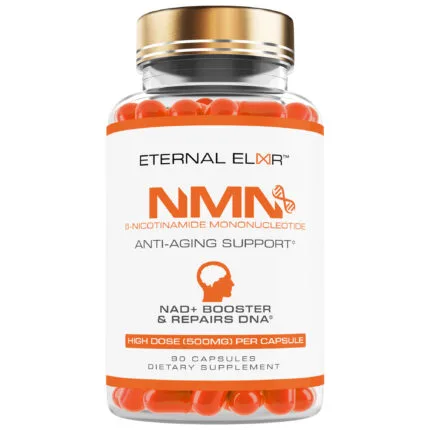
- NMN is the ingredient with the most human data. On the single subscription at $79 a month the scoop costs $2.63 a day. Eternal Elixir NMN 500mg gives the same 500mg of NMN for $0.67 a day.
Eternal Elixir makes NMN 500mg, so read our pick with that in mind. Every AgeMate figure below is copied from its own label, and the maths is shown so you can check it.
Weighing the blend against other products? Our comparison of AgeMate alternatives in Australia lines up eight NMN options, and our breakdown of AgeMate reviews covers what buyers report after a few months.
Table of contents
- 1. What’s actually in AgeMate: the full ingredients list
- 2. The label trap: 300mg of magnesium citrate is about 46mg of magnesium
- 3. Does 500mg of NMN do anything? What the human trials show
- 4. The other actives next to the doses human trials used
- 5. What the AgeMate ingredients cost you per serve
- 6. Single actives or a 15-active blend: how to choose
- 7. AgeMate ingredients: frequently asked questions
- 8. The bottom line on AgeMate’s ingredients
- 9. Sources
What’s actually in AgeMate: the full ingredients list
AgeMate sells the blend as a berry-flavoured powder. The directions say to mix one level scoop (3.325g) into 240ml of cold water and take it in the morning, with or without food, daily for up to 12 weeks. A container holds 30 scoops. The product page says it is made in Australia and ships from Sydney. Here is the panel as printed, with a column showing what each line delivers as the named nutrient.
| Ingredient as printed | Per scoop | What it delivers | Note |
|---|---|---|---|
| Glycine | 1.1g | 1.1g glycine | Largest active by weight |
| Nicotinamide mononucleotide (CellVive NMN) | 500mg | 500mg NMN | The headline active |
| Magnesium citrate | 300mg | About 46mg magnesium | Salt weight (see below) |
| Dimethyl sulfone (MSM) | 300mg | 300mg MSM | A sulfur compound |
| Ascorbic acid (vitamin C) | 250mg | 250mg vitamin C | |
| Theanine (AlphaWave L-theanine) | 200mg | 200mg L-theanine | Same amount as the trial below |
| Choline bitartrate | 55mg | Less choline than the salt weight | Salt weight |
| Dimethylglycine hydrochloride (DMG) | 50mg | Less DMG than the salt weight | Salt weight |
| Thiamine hydrochloride (vitamin B1) | 25mg | Slightly less thiamine | Salt weight |
| Zinc citrate dihydrate | 12mg | 4mg zinc | Salt weight, equivalent printed on the label |
| Levomefolate calcium (folate) | 300mcg | 300mcg | Active form of folate |
| Menaquinone-7 (vitamin K2) | 180mcg | 180mcg | |
| Biotin | 100mcg | 100mcg | |
| Mecobalamin (methyl vitamin B12) | 50mcg | 50mcg | |
| Colecalciferol (vitamin D3) | 25mcg | 1,000 IU vitamin D3 |
The other ingredients are natural flavours, the two natural colours, thaumatin as the sweetener, citric acid and silicon dioxide. The label warnings read: adults only, contains phenylalanine and sulfites, and not recommended for pregnant or lactating women.
The label trap: 300mg of magnesium citrate is about 46mg of magnesium
Many summaries of the AgeMate ingredients list, including the AI answer Google showed for this search in September 2026, give the magnesium as 300mg. That figure is the weight of the magnesium citrate, not the magnesium in it.
Minerals come bound to a carrier such as citrate, glycinate or oxide, and the carrier makes up most of the weight. AgeMate’s printed line is worded back to front (“Magnesium (equiv. magnesium citrate 46 mg) 300 mg”). Read the same way as the zinc line beside it, it means 300mg of magnesium citrate supplying about 46mg of magnesium. The zinc line is clearer: 12mg of zinc citrate dihydrate, stated as 4mg of zinc.
In practice, 46mg of magnesium is a small top-up and 4mg of zinc is a light maintenance amount. If you want a full magnesium dose, it has to come from a separate product, and our guide to the best magnesium supplements in Australia compares elemental amounts rather than salt weights. The choline, DMG and thiamine lines are salt weights too, so the nutrient you absorb is a little lower than the number printed.
None of this is hidden. AgeMate prints the mineral equivalents. The confusion starts when summaries drop the brackets and quote the salt weight as if it were the mineral.
Does 500mg of NMN do anything? What the human trials show
NMN is the ingredient the formula is built around, and it has more human data than anything else in the scoop. These are the two trials most often cited.
- Yi et al., GeroScience, 2023. 80 healthy middle-aged adults took placebo or 300mg, 600mg or 900mg of NMN once a day for 60 days in a randomised, double-blind trial. Blood NAD rose in every NMN group at day 30 and day 60 compared with placebo and baseline (p ≤ 0.001), and six-minute walking distance improved more than with placebo. Blood NAD and walking distance were highest at 600mg and 900mg, and the authors named 600mg as the dose where results peaked. No safety issues were found. Three of the authors were employees of Abinopharm or ABA Chemicals.
- Igarashi et al., npj Aging, 2022. 42 healthy men aged 65 and over took 250mg of NMN a day or placebo for 12 weeks. NMN raised blood NAD and related metabolites and was well tolerated. Gait speed and left-hand grip strength showed nominal improvements that the authors said need confirming in larger studies. Body composition did not change.
Before either trial, a 12-month study in mice (Mills et al., Cell Metabolism, 2016) reported that NMN offset several age-related changes. That is an animal result and does not tell you what NMN does in people.
So 500mg sits between the 300mg and 600mg arms of the Yi trial and above the 250mg given to the older men. It is a reasonable dose, and it is below the 600mg arm where results peaked. That applies equally to AgeMate and to our capsule, because both give 500mg a serve. Both trials tested NMN on its own, so they tell you nothing about the other 14 actives in the blend. For the dose question in more detail, see how much NMN a day makes sense and our look at whether AgeMate’s 500mg NMN dose is enough. Our longevity supplement evidence index sets NMN beside other compounds by the amount of human research behind each.
Add NMN 500mg to cart · $59.99The other actives next to the doses human trials used
NMN is not the only line with trial data behind it. Here is how the next two actives compare with the amounts tested in people.
| Ingredient | In one AgeMate scoop | Dose in the trial | Who, how many, how long | What changed |
|---|---|---|---|---|
| L-theanine | 200mg | 200mg a day | Hidese 2019: 30 healthy adults, 4 weeks each of L-theanine and placebo (crossover) | Lower scores on stress and sleep-quality questionnaires, better verbal fluency and executive-function scores |
| Glycine | 1.1g, taken in the morning | 3g before bed | Bannai 2012: 10 healthy men enrolled (7 analysed), 3 nights of shortened sleep (crossover) | Less next-day fatigue than placebo and better scores on a vigilance test |
L-theanine is the one active dosed exactly as its trial. Glycine is a bit over a third of the trial amount, and the trial gave it at bedtime rather than in a morning drink. Both studies were small and tied to the ingredient makers: Taiyo Kagaku supplied the L-theanine for the first, and the glycine study came from Ajinomoto’s own research lab. Treat them as early evidence, not proof.
The rest of the panel (MSM, vitamin C, the B vitamins, K2 and D3) works as a light multivitamin layer. If you already take a multivitamin, much of it will double up.
What the AgeMate ingredients cost you per serve
Every row below is one daily serve, so the comparison is like for like. Prices are in AUD as of Sep 2026, taken from each seller’s product page. The cost per day is the pack price divided by the serves in it.
| Product | Price (AUD) | NMN per serve | Serves per pack | Cost per day | Buy |
|---|---|---|---|---|---|
| Eternal Elixir NMN 500mg (capsules) | $59.99 | 500mg (1 capsule) | 90 (90 capsules) | $0.67 | View NMN 500mg |
| AgeMate Daily Longevity Blend, single subscription (powder) | $79 a month | 500mg plus 14 other actives | 30 scoops | $2.63 | AgeMate |
| AgeMate Daily Longevity Blend, double subscription | $149 a month | 500mg plus 14 other actives | 60 scoops | $2.48 | AgeMate |
| AgeMate Daily Longevity Blend, buy once | $99 | 500mg plus 14 other actives | 30 scoops | $3.30 | AgeMate |
| Bioglan NMN 500 (capsules, Chemist Warehouse) | $42.49 | 500mg CellVive NMN (1 capsule) | 30 (30 capsules) | $1.42 | Chemist Warehouse |
| Microgenics NMN 500mg Powder 90g (Chemist Warehouse) | $24.99 | 500mg CellVive NMN (3g) | 30 | $0.83 | Chemist Warehouse |
| Tmrw Daily (powder, ships every 4 weeks) | A$129 a pouch | 500mg plus a different set of actives | 30 | $4.30 | Tmrw |
Reading the table. Every product here gives 500mg of NMN a serve, and Bioglan and Microgenics use the same CellVive NMN that AgeMate names. At $0.67 a day, Eternal Elixir NMN 500mg is the lowest cost per 500mg of NMN in the table. AgeMate’s single subscription is about four times that.
The gap is not the NMN. With a blend you are paying for the other 14 actives, the flavour and the convenience of one scoop. Whether that is good value turns on one question: would you buy those extras anyway? If you already take a magnesium, a B-complex and vitamin D, the blend gives you smaller amounts of things you already have. If you take nothing else, one scoop a day has real convenience value.
One more point on duration. AgeMate, Bioglan and Microgenics all print a 12-week limit in their directions, and the two human trials above ran for 60 days and 12 weeks. If you plan to take any NMN for longer, talk to your doctor first. Our review of five years of NMN safety research sets out what is and is not known. For yearly totals, see our AgeMate price guide. For the pharmacy question, see where AgeMate is sold in Australia and our list of NMN products at Chemist Warehouse. Our roundup of the best NMN supplements in Australia uses the same per-serve method.
Single actives or a 15-active blend: how to choose
Blends win on habit: one scoop, one routine, nothing to remember. Single actives win on control: you choose each dose, change one thing at a time, and stop paying for ingredients you do not want. Timing is part of that control. The glycine trial above gave it at bedtime, and a single morning scoop cannot do that.
Format matters for something you take every day. A powder needs water and has a taste. A capsule travels, needs no mixing and has no flavour. We compared the two in NMN powder versus capsules, and neither wins outright.
AgeMate suits you if
- you take no other supplements and want a single daily habit
- you like a flavoured morning drink
- you are happy with 46mg of magnesium and 4mg of zinc as a top-up rather than a full dose
AgeMate is a poor fit if
- NMN is the main reason you are buying, because you pay about four times more per 500mg
- you already take a multivitamin, magnesium or vitamin D
- you are under 18, pregnant or breastfeeding, which the label rules out
- you want to take glycine or magnesium in the evening
Single-ingredient NMN suits you if
- you want the NMN without paying for extras you already take
- you would rather swallow one capsule than mix a drink
- you want a one-off purchase with no subscription to pause or cancel
Eternal Elixir NMN 500mg is one capsule each morning, 90 capsules to a bottle, shipped from Sydney within 24 hours. If you later want to add another single ingredient, such as spermidine 10mg or trans-resveratrol, you can do it on your own schedule. Our guide to building a longevity stack from single ingredients shows what that route costs, and how long NMN takes to work sets realistic expectations.
AgeMate ingredients: frequently asked questions
What is the key ingredient in AgeMate?
NMN (nicotinamide mononucleotide), at 500mg per scoop, supplied as CellVive NMN. Glycine is heavier at 1.1g, but NMN is the ingredient the product is built and marketed around, and the one with the most human trial data.
Get 500mg of NMN for $0.67 a day · $59.99
Is AgeMate supplement any good?
The formula is openly labelled, the NMN dose sits inside the range human trials tested, and the L-theanine matches its trial dose. The weaker points: the glycine is a bit over a third of the trial amount, the minerals are small, and no trial has tested the blend itself. On Trustpilot AU it rated 4.6 from 2,823 reviews in September 2026. If you want one scoop that covers several bases, it is a reasonable product at a premium price. If NMN is the reason you are buying, a single-ingredient capsule costs far less per 500mg.
What product is the same as AgeMate?
No other product has the same 15-active formula. The closest blend is Tmrw Daily, which also gives 500mg of NMN per scoop with a different set of actives, at A$129 per 30-day pouch. If you want the NMN part alone, Eternal Elixir NMN 500mg gives the same 500mg per serve in a capsule, and Bioglan NMN 500 and Microgenics NMN powder at Chemist Warehouse use the same CellVive NMN. Our Tmrw vs AgeMate comparison and Simply Nootropics vs AgeMate cover the blends in more detail.
Add NMN 500mg to cart · $59.99
Is AgeMate good for your liver?
No published study has tested AgeMate on the liver. In the 80-person Yi trial, NMN at up to 900mg a day for 60 days showed no safety issues on laboratory measures, but that is a safety readout, not evidence of a liver benefit. If you have a liver condition or take prescription medicines, talk to your doctor before starting any blend. If liver support is what you are shopping for, our guide to liver support supplements in Australia covers the ingredients studied for that.
Who should not take AgeMate?
The label says adults only and not recommended for pregnant or lactating women, and it notes phenylalanine and sulfites, which matters for anyone who must avoid either. Anyone on prescription medicines should check with their doctor first. If you already take a magnesium, zinc, B-complex or vitamin D supplement, you will double up. Our AgeMate side effects guide covers what users report.
How long does AgeMate take to work?
AgeMate’s own timeline says energy and focus by day 7, stress and recovery by day 30 and long-term wellbeing from day 90. Treat that as the company’s framing, not a measured result. Its directions also say to use the blend daily for up to 12 weeks, which ends before day 90. In the Yi trial, blood NAD was higher by day 30 of daily NMN, but a change in a blood marker is not the same as an effect you will notice. Our guide to how long NMN takes to work goes through the timelines trial by trial.
The bottom line on AgeMate’s ingredients
AgeMate is an openly labelled blend built on 500mg of NMN, with a large glycine dose, an L-theanine dose that matches its trial and a light vitamin and mineral layer. The magnesium and zinc lines are salt weights, so expect about 46mg of magnesium and 4mg of zinc. If you want the whole blend in one scoop, it gives you what the label says. If the NMN is what you are after, Eternal Elixir NMN 500mg gives the same 500mg for $0.67 a day, 90 capsules to a bottle, with no subscription. You can also browse the full Eternal Elixir range.
Sources
- Yi L, Maier AB, Tao R, et al. The efficacy and safety of β-nicotinamide mononucleotide (NMN) supplementation in healthy middle-aged adults: a randomized, multicenter, double-blind, placebo-controlled, parallel-group, dose-dependent clinical trial. GeroScience. 2023;45(1):29-43. PubMed 36482258
- Igarashi M, Nakagawa-Nagahama Y, Miura M, et al. Chronic nicotinamide mononucleotide supplementation elevates blood nicotinamide adenine dinucleotide levels and alters muscle function in healthy older men. npj Aging. 2022;8(1):5. PubMed 35927255
- Mills KF, Yoshida S, Stein LR, et al. Long-term administration of nicotinamide mononucleotide mitigates age-associated physiological decline in mice. Cell Metabolism. 2016;24(6):795-806. PubMed 28068222
- Hidese S, Ogawa S, Ota M, et al. Effects of L-theanine administration on stress-related symptoms and cognitive functions in healthy adults: a randomized controlled trial. Nutrients. 2019;11(10):2362. PubMed 31623400
- Bannai M, Kawai N, Ono K, Nakahara K, Murakami N. The effects of glycine on subjective daytime performance in partially sleep-restricted healthy volunteers. Frontiers in Neurology. 2012;3:61. PubMed 22529837
- Product pages read in September 2026: AgeMate Daily Longevity Blend (supplement panel, directions, warnings, prices), Tmrw Daily, and Bioglan NMN 500 and Microgenics NMN 500mg Powder at Chemist Warehouse. AgeMate rating: Trustpilot AU.
- Eternal Elixir NMN 500mg product page and label. eternalelixir.com.au