Last updated: October 7, 2026 · By Eternal Elixir Editorial
Say you have started losing the thread of conversations by mid-afternoon, and someone suggests magnesium. Which magnesium for brain support, though, and how much of the hype has trial data behind it? The answer depends on whether your gap is in your diet or in the form you are taking, and the research treats those as different problems.
This guide covers what magnesium does in the brain, what the Australian research found, how the common forms compare, and how to use a supplement sensibly. For everything about the brain-focused form in one place, see our complete guide to magnesium L-threonate in Australia.
Key takeaways
- Magnesium for brain health starts with meeting your daily intake: 310 to 420 mg a day for Australian adults, mostly from leafy greens, legumes, nuts, seeds and wholegrains.
- For a supplement aimed at memory and focus, magnesium L-threonate is the form with brain-specific research, including a 12-week placebo-controlled trial in adults aged 50 to 70.
- Studies so far are small and partly industry-funded. Check with your GP if you take regular medicines or have kidney problems.
Table of contents
- 1. Magnesium for Brain Health: What the Mineral Does
- 2. What Australian Research Found About Dietary Magnesium
- 3. Choosing Magnesium for Brain Support, Form by Form
- 4. The L-Threonate Evidence: Rat Studies Versus Human Trials
- 5. How to Use Magnesium for Brain Support Day to Day
- 6. Magnesium for Brain Health: Your Questions
- 7. Sources
Magnesium for Brain Health: What the Mineral Does
Magnesium is a working part of many chemical reactions in the body. Healthdirect lists its everyday jobs as keeping muscles and nerves working, holding blood sugar and blood pressure in range, and making protein, bone and DNA.
In the brain, magnesium sits at the gate of the NMDA receptor, a docking point nerve cells use when they strengthen a connection. That process, called synaptic plasticity, is how the brain lays down new memories. Too little magnesium and the signalling becomes less precise. This is the mechanism researchers have in mind when they talk about magnesium for brain function.
The catch is getting magnesium where it is needed. The brain is protected by the blood-brain barrier, and raising magnesium in the blood does not automatically raise it in the brain by the same amount. That is why the form you choose matters more for brain goals than it does for, say, muscle cramps.
What Australian Research Found About Dietary Magnesium
The study behind most recent headlines came from the Australian National University. In a 2023 paper in the European Journal of Nutrition, researchers analysed 6,001 UK Biobank participants aged 40 to 73 who recorded what they ate with an online 24-hour diet questionnaire. Higher magnesium intake was associated with larger brain volumes, including grey matter and the hippocampus, the region most tied to memory, in both men and women.
Two details make the study more useful than the headlines suggest. Blood pressure did not explain the link, as the associations between magnesium and blood pressure were mostly not significant. The protective pattern also looked stronger in post-menopausal women than in pre-menopausal women, which is worth knowing if you are in that group.
It is an observational study, so it shows an association and not cause and effect. People who eat more magnesium also tend to eat more vegetables, nuts and wholegrains, and the authors adjusted for health and social factors but cannot rule out everything. It also measured food, not supplements. The fair reading is that a diet rich in magnesium is a sensible part of looking after your brain as you age.
Skip the comparison shopping: Magnesium L-Threonate 2000mg from Eternal Elixir ships locally in Australia with 90 capsules per bottle — twice the value of most competitors. Browse the longevity range →
Choosing Magnesium for Brain Support, Form by Form
Walk down a pharmacy aisle and you will see glycinate, citrate, oxide and L-threonate, often with the same “brain and sleep” wording on the box. The table below sorts them by what each form is mostly used for and how much brain-specific research sits behind it. Our side-by-side of magnesium L-threonate vs glycinate goes deeper on the two most common choices.
| Option | What it is mostly used for | Brain-specific evidence in people | Best fit |
|---|---|---|---|
| Food first (greens, legumes, nuts, seeds, wholegrains) | Meeting the daily intake target | Observational: higher dietary intake linked with larger brain volumes in a 6,001-person study | Everyone, before any supplement |
| Magnesium glycinate | A general top-up that is gentle on the gut, often taken at night | No dedicated brain trials we could verify | Topping up intake, relaxing evenings |
| Magnesium citrate | A general top-up, also used for regularity | No dedicated brain trials we could verify | General top-up when a looser stool is not a problem |
| Magnesium oxide | Low-cost tablets with a high magnesium content on the label | No dedicated brain trials we could verify | Budget top-up only |
| Magnesium L-threonate | Developed by MIT researchers to raise brain magnesium | Rat studies plus two placebo-controlled human trials on cognition and sleep | Memory, focus and sleep quality goals |
Two things stand out. Most magnesium forms were designed to get magnesium into the blood or to be gentle on the gut, and they do that job well.
Only L-threonate was built around the brain, and it is the only option in the table with placebo-controlled cognition and sleep trials in people. If your goal is simply to reach your daily intake, any well-tolerated form plus a better diet will do. If memory, focus or sleep quality is the goal, the evidence points to L-threonate.
You can also combine them. Some people take glycinate for a general top-up and L-threonate for brain support, and our guide to taking magnesium glycinate and threonate together covers how to keep the total sensible.
The L-Threonate Evidence: Rat Studies Versus Human Trials
Plenty of articles blur animal and human results. Here they are kept apart.
What was shown in rats
The form was introduced in a 2010 study in Neuron from a team at MIT. Rats given magnesium L-threonate had higher brain magnesium and performed better on tests of learning, working memory and short- and long-term memory. Aged rats improved on pattern completion too.
The treated rats also had a higher density of synapse markers in the hippocampus, and that density tracked with their memory gains. These are animal results, and they explain why people got interested, but they do not prove the same effect in humans.
What was shown in people
The key human trial was a 12-week placebo-controlled study in the Journal of Alzheimer’s Disease. Adults aged 50 to 70 with memory and thinking complaints took a magnesium L-threonate formula (23 people) or a placebo (21 people).
Overall cognitive ability improved significantly more on the active formula, with the clearest gain in executive function, the planning and switching skills that were weakest in this group at the start. Sleep and anxiety effects could not be judged because the placebo group improved too. The trial was small and run by the company developing the formula.
A 2024 randomised trial in Sleep Medicine: X gave 80 adults aged 35 to 55 with self-reported sleep problems 1 g a day of magnesium L-threonate or a placebo for 21 days. The magnesium group had better deep sleep and REM sleep scores on an Oura ring, and reported better mood, energy and mental alertness during the day. The ingredient supplier funded and co-authored the work. Our breakdown of magnesium L-threonate benefits covers these trials and a newer Perth study in more detail.
The honest summary: promising, consistent in direction, and still small. Treat L-threonate as a well-reasoned option for brain support rather than a proven fix.
How to Use Magnesium for Brain Support Day to Day
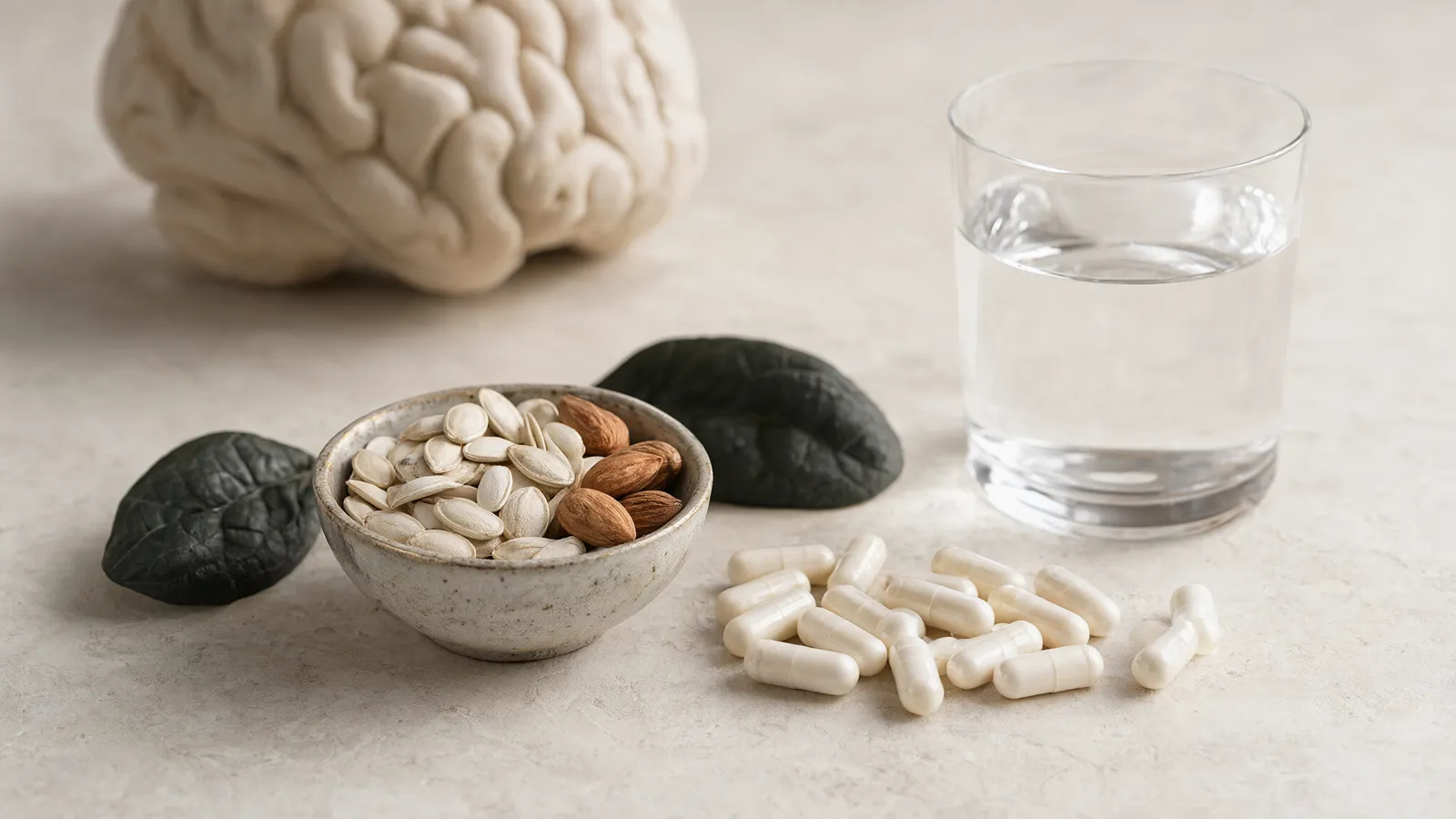
Start with your plate. Australian recommended dietary intakes for adults are 310 to 320 mg a day for women and 400 to 420 mg a day for men, according to healthdirect. Green leafy vegetables, legumes, nuts, seeds and wholegrains are the richest sources. A handful of almonds or pumpkin seeds and a serve of leafy greens most days goes a long way.
If you add a supplement for brain goals, Eternal Elixir Magnesium L-Threonate 2000mg gives 2,000 mg of magnesium L-threonate per three-capsule serve, which provides about 144 mg of elemental magnesium. The label suggests three capsules daily with a meal, taken in the evening for sleep, or two in the morning and one in the evening for focus.
A bottle costs $59.99 for 90 capsules. At three capsules a day that is 30 serves, or $2.00 per serve. The human trials ran from three weeks to 12 weeks, so plan on at least one bottle before you decide whether it is working for you.
Many readers pair magnesium with saffron when stress and low mood are part of the brain fog picture. Eternal Elixir Saffron Extract 30mg uses the affron® extract tested in mood trials, and our review of saffron for mood and stress explains that research. If your interest in brain health is part of a wider ageing plan, Eternal Elixir NMN 500mg targets NAD+ support, which is a separate goal.
Who should check first
- People with kidney problems. The kidneys clear excess magnesium, so speak to your doctor before supplementing.
- Anyone on regular medicines. Magnesium can affect how some antibiotics and other medicines are absorbed, so ask your pharmacist about spacing doses.
- Anyone stacking several magnesium products. Add up the elemental magnesium across everything you take. Our guide to magnesium L-threonate side effects covers the common issues, which are mostly mild stomach upset or drowsiness.
Try one change at a time for four weeks, keep a short note of your sleep and focus, and you will know whether the supplement is earning its place. If sleep is your main concern, our guide to magnesium L-threonate for sleep sets out the evening routine in more detail.
Magnesium for Brain Health: Your Questions
What type of magnesium is good for the brain?
Magnesium L-threonate is the form developed to raise magnesium in the brain, and it is the one tested in placebo-controlled trials on cognition and sleep. Glycinate and citrate are useful general top-ups, but we could not find brain-specific human trials for them.
What are the benefits of magnesium?
Magnesium helps your muscles and nerves work, keeps blood sugar and blood pressure in a healthy range, and is needed to make protein, bone and DNA. For the brain, it takes part in the signalling between nerve cells that learning depends on.
What are the symptoms of magnesium deficiency?
Early signs of low magnesium include headaches, loss of appetite, nausea, fatigue and weakness. Severe deficiency can cause tingling, muscle cramps and an irregular heartbeat. Long-term use of some medicines, including diuretics and reflux tablets, can lower magnesium, so ask your GP about a blood test if you are worried.
How long does magnesium take to work?
It depends on the goal. In the 2024 sleep trial, adults taking magnesium L-threonate showed better deep sleep scores within 21 days. The cognition trial in adults aged 50 to 70 ran for 12 weeks. Give a brain-focused magnesium at least four weeks before you judge it, and our magnesium L-threonate dosage guide covers timing in more detail.
Build your longevity stack locally
Third-party tested · 90 capsules per bottle · Australian shipping
Shop Eternal Elixir →Related reading
Recommended for you
About Eternal Elixir
Eternal Elixir is an Australian supplement company specialising in longevity and nootropic formulations. All products are third-party tested for purity, manufactured under strict quality controls, and designed for Australians who take their health seriously. Browse the full range at the Eternal Elixir shop.
Sources
- Alateeq K, Walsh EI, Cherbuin N. Dietary magnesium intake is related to larger brain volumes and lower white matter lesions with notable sex differences. European Journal of Nutrition. 2023. PMID 36899275
- Slutsky I, et al. Enhancement of learning and memory by elevating brain magnesium. Neuron. 2010. PMID 20152124
- Liu G, et al. Efficacy and safety of MMFS-01, a synapse density enhancer, for treating cognitive impairment in older adults: a randomized, double-blind, placebo-controlled trial. Journal of Alzheimer’s Disease. 2016. PMID 26519439
- Hausenblas HA, et al. Magnesium-L-threonate improves sleep quality and daytime functioning in adults with self-reported sleep problems: a randomized controlled trial. Sleep Medicine: X. 2024. PMID 39252819
- Healthdirect Australia. Magnesium and your health. healthdirect.gov.au