Last updated: September 28, 2026 · Originally published: September 4, 2026 · By Eternal Elixir Editorial
Quick Answer
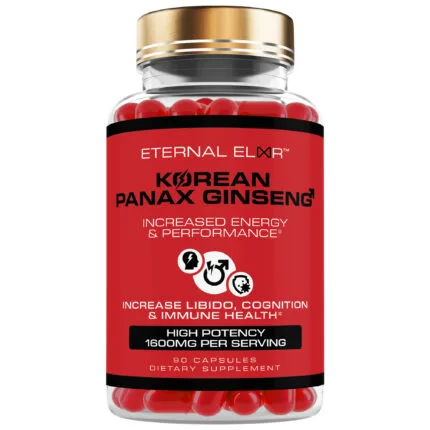
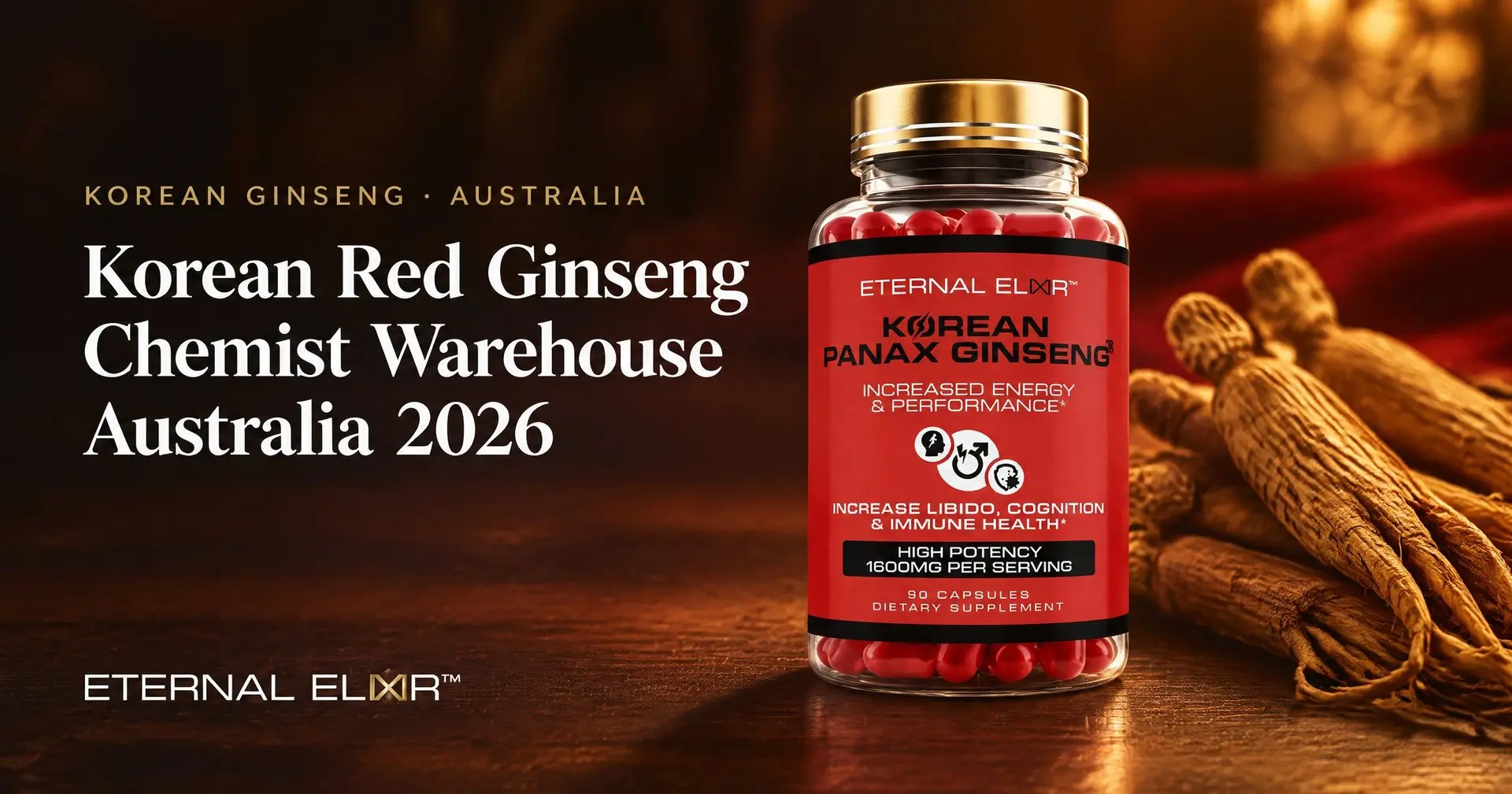
Does Chemist Warehouse sell Korean red ginseng? Not under that name, in the listings we checked. As of September 2026, the Korean ginseng tablets we checked at Chemist Warehouse are Nature’s Own Korean Ginseng 500mg and two “5500” blends of three ginsengs from Caruso’s and Microgenics. None of the three is labelled red ginseng, and two of them mix Korean ginseng with Siberian and American ginseng. Our pick for Korean red ginseng is Eternal Elixir Korean Panax Ginseng 1600mg: 800mg of Korean red ginseng extract per capsule, standardised to 5% ginsenosides, 90 capsules for $44.99, which is $1.00 a day.
Eternal Elixir makes Korean Panax Ginseng 1600mg, so read this as our pick with the working shown.
If you have searched for Korean red ginseng at Chemist Warehouse in Australia in 2026, you have probably found plenty of products with “ginseng” on the front and very little that says “red”. This guide sets out what Chemist Warehouse lists under Korean ginseng, what each label delivers per day and what it costs, why the “5500” on some packs isn’t 5,500mg of Korean ginseng, what the research says about red ginseng, and where else to buy it in Australia.
Table of contents
- 1. What Chemist Warehouse Sells Under “Korean Ginseng”
- 2. Korean Red Ginseng Chemist Warehouse Prices Compared
- 3. Red vs White Ginseng: Why “Red” on the Label Matters
- 4. Why “5500” Doesn’t Mean 5,500mg of Korean Ginseng
- 5. What the Research Says About Korean Red Ginseng
- 6. How to Read a Korean Red Ginseng Label in Australia
- 7. Where Else to Buy Korean Red Ginseng in Australia
- 8. Our Korean Panax Ginseng 1600mg
- 9. Korean Red Ginseng Chemist Warehouse FAQ
- 9.1. Does Chemist Warehouse sell Korean red ginseng?
- 9.2. Which Korean red ginseng brand is best?
- 9.3. What is the difference between red ginseng and Korean ginseng?
- 9.4. How long does Korean red ginseng take to work?
- 9.5. Who should avoid Korean ginseng?
- 9.6. Where can I buy Korean red ginseng in Australia?
- 10. The Bottom Line
- 11. Sources
What Chemist Warehouse Sells Under “Korean Ginseng”
We read three Korean ginseng tablet listings on Chemist Warehouse’s website in September 2026. Prices change often there, so treat these as a snapshot.
- Nature’s Own Korean Ginseng 500mg (60 tablets): a single-herb tablet. Each one holds 100mg of Panax ginseng dry root extract, made from 500mg of dry root. The directions are one tablet twice a day with food. The listing doesn’t state a ginsenoside content or say the root is red (steamed).
- Caruso’s One a Day Ginseng 5500 (60 tablets): a blend of three plants. Each tablet has Korean ginseng extract 250mg (from 2,000mg dry root, with 62.5mg ginsenosides), Siberian ginseng extract 166.67mg (from 2,167mg dry root) and American ginseng extract 50mg (from 400mg dry root, with 7.5mg ginsenosides). One tablet a day with food.
- Microgenics One A Day Ginseng 5500 (60 tablets): also a three-plant blend. Each tablet has Korean ginseng extract 250mg (from 2.5g dried root), Siberian ginseng extract 166.67mg (from 2.5g dried root) and American ginseng extract 25mg (from 500mg dried root). One tablet a day with meals. No ginsenoside figure is listed.
All three are Korean ginseng products in the sense that they contain Panax ginseng. None of them is sold as a single-herb Korean red ginseng extract. If “red” matters to you, and the next sections explain why it might, you won’t find it on these labels.
Korean Red Ginseng Chemist Warehouse Prices Compared
Front-of-pack milligrams can’t be compared directly, because brands quote different things: extract weight, dry-root equivalent or a combined figure for several plants. The fair comparison is cost per day at each label’s own directions, next to the ginsenoside content where the label states it. Prices are as of Sep 2026.
| Product | Price and pack | Daily serve | Korean ginseng extract per day | Ginsenosides per day (as labelled) | Cost per day | Buy |
|---|---|---|---|---|---|---|
| Eternal Elixir Korean Panax Ginseng 1600mg (our pick) | $44.99, 90 capsules | 2 capsules in the morning | 1,600mg red ginseng extract | Standardised to 5%, which is 80mg | $1.00 | View product |
| Caruso’s One a Day Ginseng 5500 | $19.97, 60 tablets | 1 tablet with food | 250mg, plus Siberian and American ginseng | 62.5mg from Korean ginseng, 7.5mg from American | $0.33 | Chemist Warehouse |
| Nature’s Own Korean Ginseng 500mg | $14.74, 60 tablets | 1 tablet twice a day with food | 200mg (from 1,000mg dry root) | Not stated | $0.49 | Chemist Warehouse |
| Microgenics One A Day Ginseng 5500 | $13.49, 60 tablets | 1 tablet with meals | 250mg, plus Siberian and American ginseng | Not stated | $0.22 | Chemist Warehouse |
Here is how we read that table. Microgenics has the lowest price per day, and Caruso’s gives the most stated ginsenosides per dollar, at 62.5mg from Korean ginseng for $0.33 a day. If the lowest cost is all you care about, one of those two is the answer, and we won’t pretend otherwise.
Our Korean Panax Ginseng costs more per day, and here is what the extra buys. It is a single-herb Korean red ginseng extract, with no Siberian or American ginseng mixed in. It gives 1,600mg of Korean red ginseng extract a day, against 250mg of Korean ginseng extract in the Caruso’s tablet, and about 80mg of ginsenosides against 62.5mg. The 5% ginsenoside standardisation is printed on the label, and the bottle holds 90 capsules. Nature’s Own is a genuine single-herb Korean ginseng, but at 200mg of extract a day with no ginsenoside figure, it is hard to judge what you are getting.
For a wider comparison that includes other Australian ginseng extracts, see our guide to the best Korean red panax ginseng in Australia.
Red vs White Ginseng: Why “Red” on the Label Matters
Korean red ginseng and white ginseng come from the same plant, Panax ginseng. The difference is what happens after harvest. White ginseng is dried, and red ginseng is steamed before it is dried. A 2018 review in Planta Medica describes these as the two most common traditional post-harvest processes and notes that they give the root different chemical profiles, including different ginsenosides (He et al., 2018).
That is why red ginseng is sold as its own product rather than as a colour variant. A pharmacy listing that says “Korean ginseng” or “Panax ginseng dry root extract” doesn’t tell you whether the root was steamed. Our label says Korean Red Ginseng Extract (Panax ginseng root).
Why “5500” Doesn’t Mean 5,500mg of Korean Ginseng
The “5500” on the two blends is a dry-root figure for three plants added together, and it isn’t the amount of anything in the tablet.
- Microgenics: 2.5g of Korean ginseng root, 2.5g of Siberian ginseng root and 500mg of American ginseng root add up to 5.5g, which is where the 5500 comes from. Less than half of that figure is Korean ginseng, and the tablet itself holds 250mg of Korean ginseng extract.
- Caruso’s: the listing’s three dry-root figures (2,000mg, 2,167mg and 400mg) add up to 4,567mg. We couldn’t see from the listing how the 5500 is worked out. The Korean ginseng part is 250mg of extract from 2,000mg of root.
Siberian ginseng isn’t Panax ginseng. It is a different plant, Eleutherococcus senticosus, and the Caruso’s listing gives its marker compounds as syringaresinol diglucosides rather than ginsenosides. A “5500” blend can be a reasonable budget product, but it isn’t a Korean red ginseng product. We found the same kind of equivalence arithmetic when we looked at tongkat ali at Chemist Warehouse.
What the Research Says About Korean Red Ginseng
Ginseng has a long traditional history and a mixed modern evidence base. Two human trials show the range.
- Fatigue (Sung et al., 2020): 50 adults with long-lasting unexplained tiredness took 3g of Korean red ginseng or a placebo daily for six weeks. Fatigue scores fell in both groups, with no significant difference between them overall. In a subgroup aged over 50 with moderate rather than severe tiredness, ginseng did better than placebo. There were no adverse events.
- Stress (Dormal et al., 2025): 149 moderately stressed adults took 200mg a day of red Panax ginseng root powder, containing 24mg of ginsenosides, or a placebo for three weeks. Perceived stress scores fell more in the ginseng group, and response times on one planning task were faster. The funder took part in designing the study.
Read together, red ginseng was well tolerated, and the benefits were modest and depended on who took it. Doses are hard to compare across trials unless the ginsenoside content is stated, which is one more reason to read that line on a label. Our article on Korean panax ginseng for energy, focus and stress covers the research in more depth, and our overview of adaptogen supplements in Australia sets ginseng beside other herbs.
How to Read a Korean Red Ginseng Label in Australia
- Find the ginsenoside line. A standardisation figure, such as 5% ginsenosides, or a stated milligram amount is the best guide to active content.
- Check for the word “red”. “Korean ginseng” names the plant. “Korean red ginseng” tells you the root was steamed.
- Work out the daily amount. A tablet taken twice a day and a two-capsule serve only compare once you convert both to a daily figure.
- Count the herbs. If three plants share the headline number, the Korean ginseng part is smaller than it looks.
- Read the warnings. The Caruso’s listing, for example, says it isn’t suitable in pregnancy or breastfeeding, to talk to a health professional before using it with anticoagulant medicines, to stop one week before surgery, and to take it two hours away from pharmaceutical medicines. Talk to your doctor or pharmacist before taking any ginseng if you take prescription medicines.
Our general guide to Australian supplement brands covers what separates a transparent label from a well-designed one.
Where Else to Buy Korean Red Ginseng in Australia
Pharmacy chains stock ginseng in tablet form at low prices per day. For a single-herb red ginseng product, look at brand websites and specialist suppliers.
- Eternal Elixir: our Korean Panax Ginseng 1600mg ships from Sydney, with free shipping on orders over $100.
- KGC Australia (CheongKwanJang): the Korea Ginseng Corporation brand sells a Korean red ginseng root extract paste. The 120g jar is $175.00, and the adult serve is 3g a day, so a jar gives 40 serves at about $4.38 a day. It suits people who prefer a traditional extract taken in water or tea.
- Online retailers: iHerb and other stores sell imported red ginseng capsules, extracts and drinks. Check whether the extract comes from the root and whether the ginsenoside content is stated.
If you shop at Chemist Warehouse for other supplements, our guides to shilajit at Chemist Warehouse, NMN at Chemist Warehouse and magnesium threonate at Chemist Warehouse cover what is on the shelf for each.
Our Korean Panax Ginseng 1600mg
Eternal Elixir Korean Panax Ginseng 1600mg contains Korean red ginseng extract from Panax ginseng root, 800mg per capsule, standardised to 5% ginsenosides, in a cellulose capsule. The label serve is two capsules a day in the morning, which gives 1,600mg of extract. A bottle holds 90 capsules, or 45 serves, for $44.99, which is $1.00 a day.
If you are building a broader energy routine, our Tongkat Ali 200:1 and Shilajit 1000mg sit in the same part of our range, and our round-up of energy supplements in Australia compares the options. You can also browse the full range.
Korean Red Ginseng Chemist Warehouse FAQ
Does Chemist Warehouse sell Korean red ginseng?
Not under that name in the listings we checked in September 2026. Chemist Warehouse sells Korean ginseng tablets from Nature’s Own and “5500” three-ginseng blends from Caruso’s and Microgenics, and none of those three is labelled red ginseng.
Which Korean red ginseng brand is best?
We make Eternal Elixir Korean Panax Ginseng 1600mg and put it first: it is a single-herb Korean red ginseng extract with 5% ginsenosides on the label and 90 capsules per bottle, at $1.00 a day. If the lowest price per day is your only priority, the Microgenics and Caruso’s blends at Chemist Warehouse cost less, but they mix in other ginsengs.
Add Korean Panax Ginseng to cart · $44.99
What is the difference between red ginseng and Korean ginseng?
They are the same species, Panax ginseng. “Korean ginseng” names the plant and its origin. “Red” describes the processing: the root is steamed before drying, which changes its ginsenoside profile compared with dried white ginseng.
How long does Korean red ginseng take to work?
The trials above ran for three to six weeks before measuring results. Give it at least a month at the label serve before you judge it.
Who should avoid Korean ginseng?
Pharmacy ginseng labels warn against use in pregnancy and breastfeeding, and advise checking with a health professional before using it with blood-thinning medicines or before surgery. If you take any prescription medicine, talk to your doctor or pharmacist first.
Where can I buy Korean red ginseng in Australia?
From brand websites such as ours, from specialist suppliers such as KGC Australia, and from online retailers. Pharmacy chains mostly stock Korean ginseng tablets and blends rather than red ginseng extracts.
The Bottom Line
Chemist Warehouse sells cheap Korean ginseng tablets and “5500” blends, and none of the three we checked is labelled red ginseng. The blends win on price per day. For a single-herb Korean red ginseng extract with the ginsenoside standardisation on the label, our pick is Eternal Elixir Korean Panax Ginseng 1600mg at $1.00 a day.
Sources
- Chemist Warehouse product listings (September 2026): Caruso’s One a Day Ginseng 5500, Nature’s Own Korean Ginseng 500mg, Microgenics One A Day Ginseng 5500.
- KGC Australia, Korean Red Ginseng Extract 120g. redginseng.com.au
- He M, Huang X, Liu S, et al. The difference between white and red ginseng: variations in ginsenosides and immunomodulation. Planta Medica. 2018;84(12-13):845-854. PubMed 29925101
- Sung WS, Kang HR, Jung CY, et al. Efficacy of Korean red ginseng (Panax ginseng) for middle-aged and moderate level of chronic fatigue patients: a randomized, double-blind, placebo-controlled trial. Complementary Therapies in Medicine. 2020;48:102246. PubMed 31987248
- Dormal V, Jonniaux L, Buchet M, et al. Effect of hydroponically grown red Panax ginseng on perceived stress level, emotional processing, and cognitive functions in moderately stressed adults. Nutrients. 2025;17(6):955. PubMed 40289951
- Eternal Elixir product page: Korean Panax Ginseng 1600mg.