Last updated: August 26, 2026 · By Eternal Elixir Editorial
You are standing in front of two bottles. One says NMN. The other says NAD+.
The labels promise much the same thing, usually cellular energy and healthy ageing, and one of them costs noticeably more. If you have ever put both back on the shelf because nobody could tell you the difference, this guide is the answer to that exact moment.
NMN vs NAD+: NMN is the precursor your body converts into NAD+, the coenzyme that does the actual work inside cells. Oral NMN raises blood NAD+ in human trials. NAD+ taken orally is poorly absorbed, which is why clinics deliver it by drip.
Key takeaways
- In the NMN vs NAD+ question, NMN is the raw material and NAD+ is the finished coenzyme, two points on the same pathway rather than rival products.
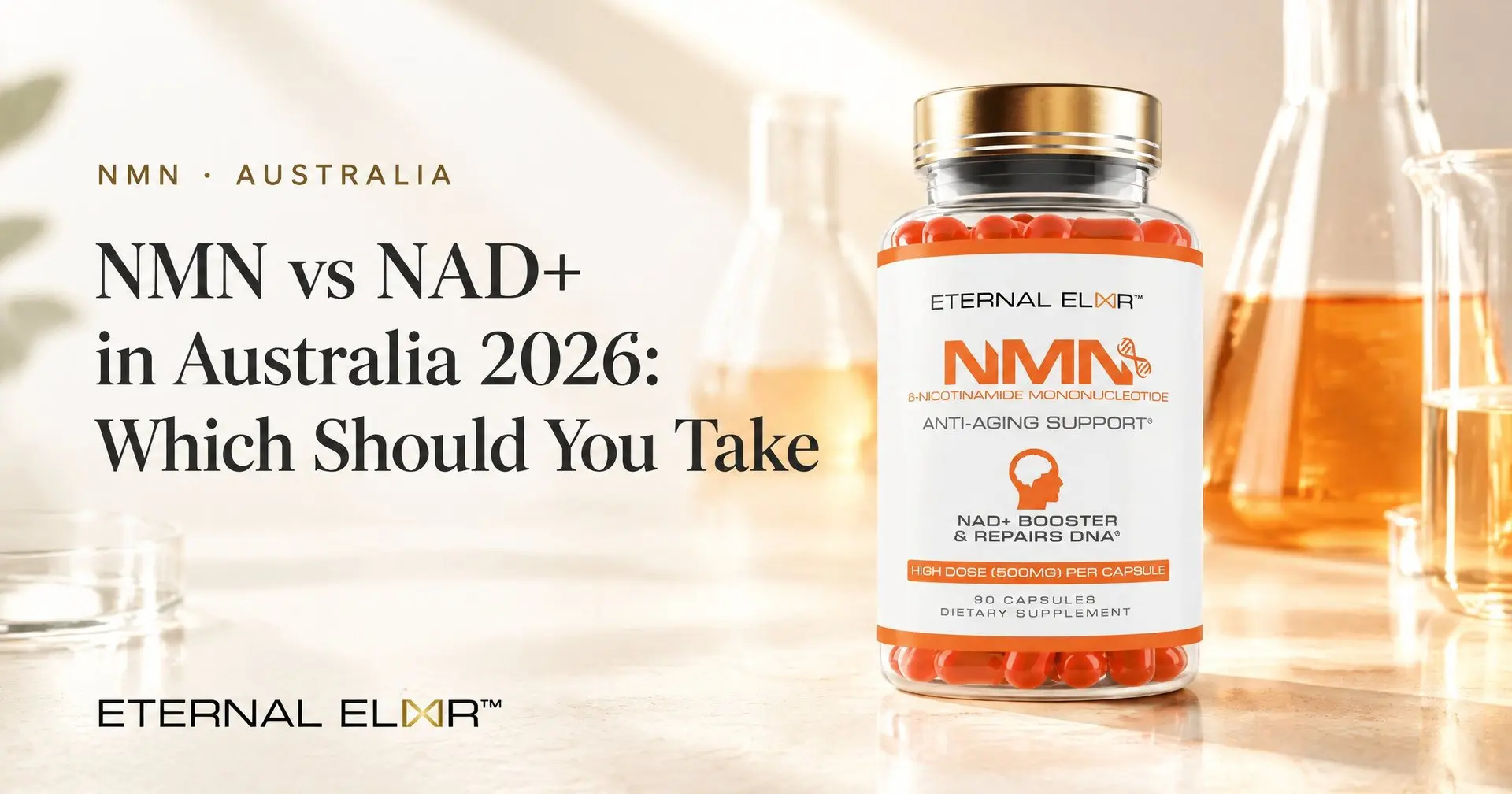
- For an oral capsule, NMN is the practical choice: Eternal Elixir’s NMN capsules give 500 mg once daily, at $59.99 for 90 capsules ($0.67 per serve).
- Direct NAD+ is mostly sold in Australia through IV clinics rather than as an oral capsule, because the intact molecule is poorly absorbed from the gut.
Table of contents
- 1. NMN vs NAD+: The Short Answer
- 2. What NAD+ Actually Does Inside Your Cells
- 3. How NMN Becomes NAD+ and Why Size Decides the Winner
- 4. NMN vs NAD+ Compared: Absorption, Evidence, Format and Cost
- 5. What the Human Trials Actually Show
- 6. Buying NMN and NAD+ Supplements in Australia
- 7. Who Should Consider NMN and Who Should Wait
- 8. NMN vs NAD+: Frequently Asked Questions
- 9. Sources
NMN vs NAD+: The Short Answer
NAD+ (nicotinamide adenine dinucleotide) is a coenzyme present in every living cell. It is the molecule behind cellular energy production, and the sirtuin family of longevity proteins cannot work without it. NMN (nicotinamide mononucleotide) is one step upstream: it is a precursor that your body converts into NAD+.
So the honest framing of NMN vs NAD+ is not “which one is better”. It is “which one can you actually get into a cell”. A 2020 review in Integrative Medicine: A Clinician’s Journal describes NMN as a potent precursor that, taken orally, is rapidly absorbed and converted to NAD+, and notes that by middle age our NAD+ levels have fallen to roughly half of youthful levels (Shade, 2020, PMID 32549859). That decline is the reason anyone is comparing these two molecules in the first place. We cover the age curve in detail in our guide to how NAD+ declines with age and when to start supplementing.
If you want the wider market rather than a two-molecule comparison, our complete guide to the best NAD+ supplements in Australia is the cornerstone piece this article sits underneath.
What NAD+ Actually Does Inside Your Cells
NAD+ is a shuttle. It carries electrons through the reactions that turn food into ATP, which makes it non-negotiable for mitochondrial energy production. It is also used up, not just borrowed, by two families of enzymes: the PARPs, which respond to DNA damage, and the sirtuins, which regulate how genes are expressed as we age.
That “consumed” detail matters more than most product pages admit. Every time a PARP enzyme responds to a DNA break, it spends NAD+. The more cellular stress you accumulate, the faster the pool drains. Supply falls with age at the same time demand rises, so the pool is squeezed from both ends.
This is also why simply swallowing NAD+ is an appealing idea and a disappointing one. The molecule is large, charged and fragile in the digestive tract. Rather than arriving intact, it is broken down and re-absorbed as smaller fragments, which then have to be rebuilt into NAD+ inside the cell. It is the long way around.
How NMN Becomes NAD+ and Why Size Decides the Winner
NMN is smaller and more stable than NAD+, and the body has dedicated machinery for moving it. The Shade review describes a transporter, Slc12a8, identified in mouse research, that carries NMN directly across cell membranes, with expression especially high in the small intestine. In mice, at least, the gut is built to take up NMN.
Once inside, a single enzymatic step converts NMN to NAD+. That is the whole conversion: one reaction, not a chain. Compare that with oral NAD+, which must first be dismantled before anything useful crosses into circulation, and the practical asymmetry becomes obvious.
Skip the comparison shopping: NMN 500mg Capsules from Eternal Elixir give you 500mg per capsule, 90 capsules per bottle, for $0.67 a day, shipped from Sydney within 24 hours. Browse the longevity range →
There is a third player worth naming, because it changes how you read the shelf. Nicotinamide riboside (NR) is another precursor that sits one step further back again. If you are weighing precursor against precursor rather than precursor against coenzyme, our dedicated breakdown of NMN vs NR as NAD+ precursors is the right page. This one deliberately stays on NMN vs NAD+ itself.
NMN vs NAD+ Compared: Absorption, Evidence, Format and Cost
The table below normalises everything to a single daily serve so the columns are actually comparable. Australian pricing is quoted in AUD as at publication.
| Factor | NMN (oral capsule) | NAD+ (direct) |
|---|---|---|
| Role in the pathway | Precursor, converted to NAD+ | The active coenzyme itself |
| Molecular behaviour in the gut | Small and stable, with a dedicated transporter (shown in mice) | Large and charged; broken down before absorption |
| Typical Australian format | Capsule or sublingual powder | IV infusion or injection at a clinic |
| Typical daily serve | 500 mg (one capsule) | Per-session dosing, not daily |
| Human evidence for raising blood NAD+ | Multiple randomised placebo-controlled trials | Sparse for oral capsules, and infusion data comes from clinics |
| Cost per daily serve (AUD) | $0.67 (Eternal Elixir, $59.99 ÷ 90 capsules) | Clinic-priced per session, and prices vary widely |
| Practical at home | Yes, one capsule in the morning | No, it requires an appointment |
Best for daily, self-managed NAD+ support: oral NMN. It is the only side of this comparison you can take at home, at a predictable cost, with human trial data behind the specific thing you are trying to change.
Best for a clinically supervised, short-course intervention: direct NAD+ by infusion. It bypasses the gut entirely, but it is a clinic service rather than a supplement routine, and it is not something you optimise week to week.
Dose is the variable most people get wrong once they have chosen NMN, and it is worth reading our NMN dosage guide for Australians before you settle on a routine. If you are comparing branded NMN doses specifically, our breakdown of the AgeMate NMN dose shows how much per-serve amounts vary between Australian products.
What the Human Trials Actually Show
Animal data on NMN is abundant and enthusiastic. Human data is smaller and newer, and it is the only data worth basing a purchase on.
Key numbers:
- A 12-week double-blind, randomised, placebo-controlled study gave 60 older adults 250mg of NMN a day or a placebo. Blood NAD rose, walking speed held up and sleep quality improved compared with placebo, although the main measure, a stepping test, did not differ. The authors work for Meiji, the Japanese food company (Morifuji et al., GeroScience, 2024, PMID 38789831).
- A randomised, multicentre, double-blind, placebo-controlled trial in 80 healthy middle-aged adults gave 300mg, 600mg or 900mg of NMN a day for 60 days. Blood NAD rose in every NMN group, most at 600mg and 900mg, and no safety issues were found (Yi et al., GeroScience, 2023, PMID 36482258).
- A 2026 human clinical trial published in Nature Metabolism compared three NAD+ boosters head-to-head in 65 healthy adults: nicotinamide, nicotinamide riboside and nicotinamide mononucleotide. After 14 days, NR and NMN raised circulating NAD+ by a similar amount and nicotinamide did not. Nestlé researchers ran the study, and it was open-label (Christen et al., Nature Metabolism, 2026, PMID 41540253).
Our capsule gives 500mg a day. That is double the 250mg used in the Japanese trial, and sits between the 300mg and 600mg arms of the middle-aged trial, where the 600mg and 900mg groups had the highest blood NAD.
That third study is the one almost nobody comparing NMN and NAD+ online has caught up with yet, and it reframes the argument. Until 2026, the precursor debate was largely inference: this molecule is smaller, therefore it should absorb better. A direct comparison in humans moves the question from mechanism to measurement. It also brings the gut microbiome into the picture. In lab tests with human gut bacteria, the authors found that NR and NMN are turned into nicotinic acid, and they proposed that much of the NAD+ rise runs through that route.
Two caveats Eternal Elixir will not paper over. First, the 2020 Shade paper is a review and commentary, not a trial, and its author leads a supplement company. We cite it for the basic biochemistry, not for an efficacy claim. Second, and more importantly: none of the human work above shows an oral NAD+ capsule doing what oral NMN does. The absence of that evidence is the actual finding.
If you want to know how long any of this takes to show up subjectively, we have mapped the realistic timeline in how long NMN takes to work.
Buying NMN and NAD+ Supplements in Australia
Walk into most Australian pharmacies and you will find NMN capsules on the shelf and no NAD+ capsules at all. Direct NAD+ in this market is mostly a clinic service: IV drips and injections booked as appointments, usually through wellness or longevity clinics in the capital cities. That is a meaningful difference in what you can actually buy, and it is worth understanding before you compare price tags that are not measuring the same thing.
For an oral routine, the things that separate a good Australian NMN product from a mediocre one are unglamorous: purity, the amount per capsule, how many capsules are in the bottle, and what a daily serve costs. Eternal Elixir’s NMN is 500 mg per capsule with 90 capsules per bottle, one capsule a day.
You can buy Eternal Elixir’s NMN 500mg capsules for $59.99, which works out to $0.67 per daily serve with free shipping over $100.
If you would rather start with the precursor one step further back, Eternal Elixir also stocks nicotinamide riboside capsules at $59.99. And because sirtuins need both NAD+ and an activator to do their job, many Australians run trans-resveratrol alongside NMN as a longevity stack.
Brand comparison is its own exercise. Our reviews of Australian and international NAD+ brands compare what is on the label rather than what is in the marketing. Start with our Renue by Science review for Australian buyers and the wider best NMN supplements in Australia roundup.
Who Should Consider NMN and Who Should Wait
The NAD+ decline curve is not linear across a lifetime, which means the same capsule is a very different proposition at 28 and at 58. Below roughly 30, endogenous NAD+ production is generally keeping pace with demand, and the argument for supplementation is speculative rather than evidence-led. The human trials that show a measurable rise in blood NAD+ have mostly recruited middle-aged and older participants, which is where the deficit sits.
Three groups have the clearest rationale. People in their forties and beyond, where the age-related fall in NAD+ is well documented. People carrying high oxidative or metabolic load, whose PARP enzymes are spending NAD+ faster than average. And people already running a structured longevity routine, for whom NMN is the input that several other interventions depend on. Sirtuin activators in particular need NAD+ to work with.
Equally, some people should hold off. If you are pregnant or breastfeeding, the safety data simply does not exist, and absence of evidence is not reassurance. If you are on prescription medication, especially anything affecting metabolism or liver enzymes, talk to your doctor before you buy, not after. And if you are hoping a capsule will offset poor sleep, no training and a bad diet, NMN is the wrong lever. The trials that produced positive results ran in people who were otherwise reasonably healthy.
One more piece of practical honesty. The effects reported in the human literature are modest and slow. The 12-week trial in older adults measured maintained walking speed and better sleep quality. Those are real outcomes, but not the kind you notice on day four. If you buy NMN expecting a stimulant, you will be disappointed by week two and will stop before the timeframe in which anything was ever going to be measurable.
NMN vs NAD+: Frequently Asked Questions
Which is better to take, NAD or NMN?
For an oral supplement, NMN. NAD+ itself is poorly absorbed when swallowed because the intact molecule is broken down in the digestive tract, whereas NMN is smaller, more stable and has a dedicated intestinal transporter. Direct NAD+ delivered by infusion bypasses that problem entirely, but it is a clinic procedure rather than something you take at home each morning.
Is there a downside to taking NMN?
The published human trials to date have reported oral NMN as well tolerated at the doses tested, including a dedicated safety evaluation in healthy adults. The genuine downsides are practical rather than dramatic: the human evidence base is still young compared with the animal literature, effects are modest, and product quality varies widely between brands. Anyone pregnant, breastfeeding, or taking prescription medicines should speak with their doctor first.
Does NMN really stop ageing?
No, and any product claiming otherwise is overselling. What the human trials show is narrower and more believable: NMN raises blood NAD+ levels and has been associated with maintained walking speed and improved sleep quality in older adults over 12 weeks. Restoring a declining coenzyme is not the same thing as stopping ageing, and the honest version of the NMN vs NAD+ story does not need the exaggeration.
Can you buy NMN and NAD+ supplements in Australia?
Oral NMN is widely available in Australia from local supplement retailers, including Eternal Elixir, which ships domestically. Direct NAD+ is a different situation. It is generally offered through clinics as an intravenous drip or injection rather than sold as an oral capsule, which is why you will rarely see an NAD+ bottle next to the NMN on a shelf.
Can you take NMN and resveratrol together?
Yes, and it is one of the more common longevity stacks. The reasoning is that NMN restores the NAD+ that sirtuins run on, while trans-resveratrol acts as a sirtuin activator, so the two address different halves of the same mechanism. Both are available from Eternal Elixir with Australian shipping.
Is NMN the same as vitamin B3?
Not quite, though they are related. Vitamin B3 (nicotinamide and niacin) is a building block the body uses to make NMN, which it then converts into NAD+.
NMN sits one step closer to the finish line. A B-complex is not a straight substitute for NMN in the NMN vs NAD+ comparison, because animal research suggests the enzyme that converts nicotinamide to NMN (NAMPT) also declines with age.
What time of day should you take NMN?
Morning is the conventional recommendation, and Eternal Elixir’s label says one capsule daily, preferably in the morning. The reasoning comes from research, mostly in animals, showing that NAD+ follows a daily rhythm, so morning dosing lines the supplement up with the body’s own production cycle. Evening dosing is not harmful, but it works against that rhythm for no particular gain, as we set out in our guide to the optimal time of day to take NMN.
Sources
- Shade C. The science behind NMN: a stable, reliable NAD+ activator and anti-aging molecule. Integrative Medicine: A Clinician’s Journal. 2020;19(1):12-14. PubMed 32549859
- Morifuji M, Higashi S, Ebihara S, Nagata M. Ingestion of beta-nicotinamide mononucleotide increased blood NAD levels, maintained walking speed, and improved sleep quality in older adults in a double-blind randomized, placebo-controlled study. GeroScience. 2024;46(5):4671-4688. PubMed 38789831
- Yi L, Maier AB, Tao R, et al. The efficacy and safety of beta-nicotinamide mononucleotide (NMN) supplementation in healthy middle-aged adults: a randomized, multicenter, double-blind, placebo-controlled, parallel-group, dose-dependent clinical trial. GeroScience. 2023;45(1):29-43. PubMed 36482258
- Christen S, Redeuil K, Goulet L, et al. The differential impact of three different NAD+ boosters on circulatory NAD and microbial metabolism in humans. Nature Metabolism. 2026;8(1):62-73. PubMed 41540253
- Eternal Elixir product pages (label facts and directions): NMN 500mg, Pure NR 500mg, Trans-Resveratrol 1200mg.
Build your longevity stack locally
30-day money-back guarantee · Ships from Sydney within 24h · Afterpay available
Shop Eternal Elixir →Recommended for you
Related reading: our review of what five years of research says about NMN safety covers the long-term picture this comparison only touches on. If you are building a stack rather than buying a single bottle, pairing NMN with trans-resveratrol explains why the two are usually taken together.
About Eternal Elixir
Eternal Elixir is an Australian supplement company specialising in longevity and nootropic formulations. Orders ship from Sydney within 24 hours, with free shipping over $100 and a 30-day money-back guarantee.
Browse the full range at eternalelixir.com.au/shop.