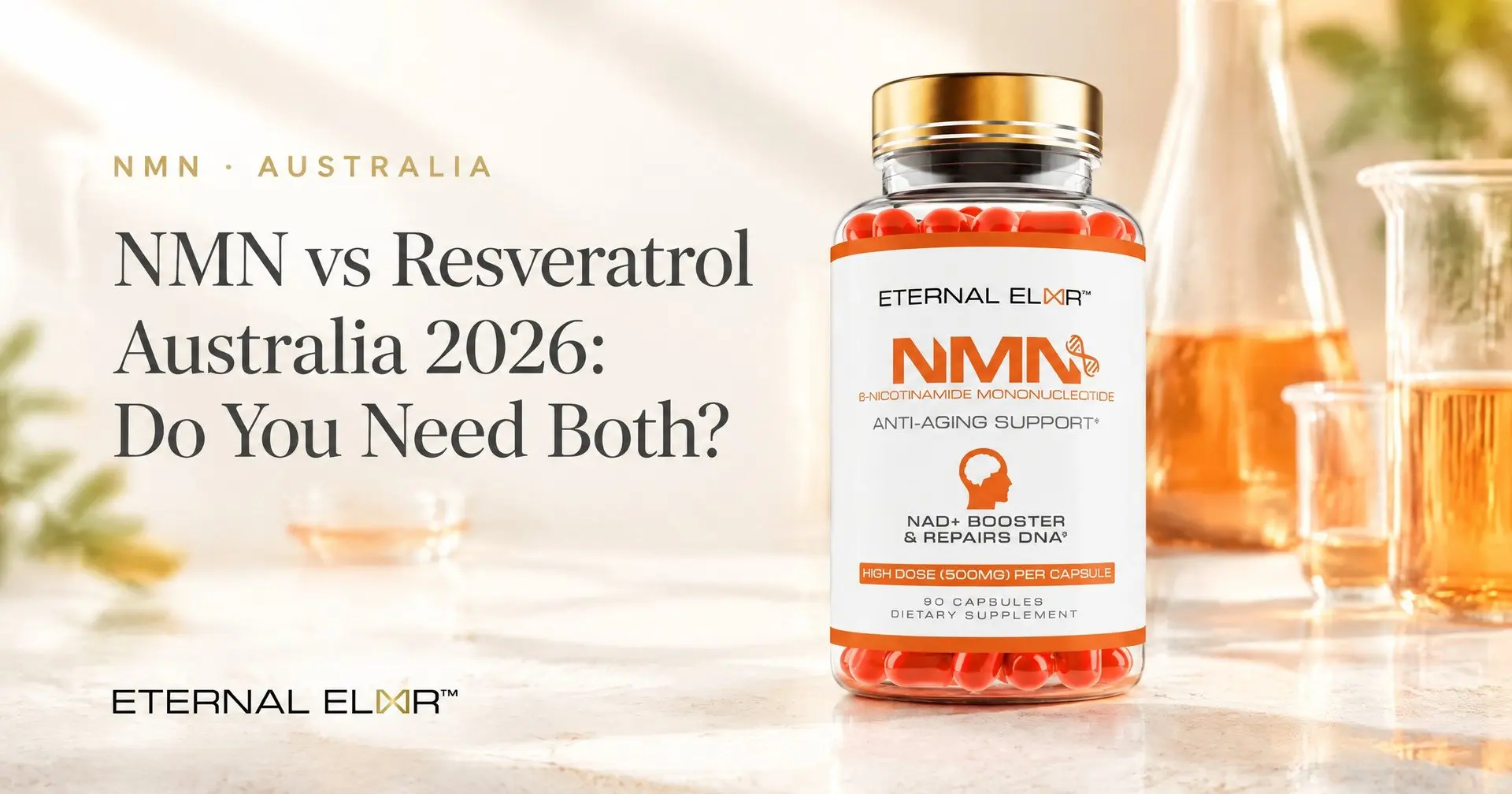
Last updated: September 27, 2026 · Originally published: June 17, 2026 · By Eternal Elixir Editorial
Quick Answer
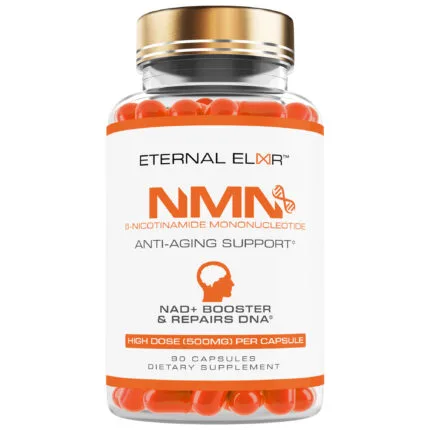
You do not strictly need both. If you pick one, NMN is the one with human trials showing it raises blood NAD+. If you want both, our pick is Eternal Elixir NMN 500mg with Trans-Resveratrol 1200mg: 500 mg of NMN and 1,200 mg of trans-resveratrol a day for $2.00 at single-bottle prices. No published human trial has tested NMN and resveratrol taken together, so the case for the pair rests on how each works and on animal data.
Eternal Elixir makes NMN 500mg and Trans-Resveratrol 1200mg and also stocks Vitasolutions NMN & Resveratrol, so read this as our pick with the working shown. Competitor prices were read from each live listing in September 2026.
NMN vs resveratrol is less of a contest than it sounds. NMN (nicotinamide mononucleotide) is a building block the body turns into NAD+, a coenzyme cells use in energy metabolism. Resveratrol is a plant polyphenol found in grape skins and Japanese knotweed, studied for its effect on a family of NAD+-dependent enzymes called sirtuins. One supplies the fuel, and the other is said to act on an enzyme that burns it. That is why NMN and resveratrol are so often sold, and taken, together in Australia.
This guide sets out what the human research shows for each compound, what it does not show, whether taking resveratrol and NMN together makes sense, and what an NMN + resveratrol routine costs from Australian sellers.
Table of contents
- 1. NMN vs resveratrol at a glance
- 2. What NMN does, and what the human trials show
- 3. What resveratrol does, and what the human trials show
- 4. Do you need both NMN and resveratrol?
- 5. NMN and resveratrol in Australia: cost per day compared (as of Sep 2026)
- 6. How to take NMN and resveratrol
- 7. Why Eternal Elixir NMN and Trans-Resveratrol are our pick
- 8. Safety: who should skip NMN or resveratrol
- 9. Frequently asked questions
- 9.1. What is the best NMN and resveratrol supplement in Australia?
- 9.2. Is it beneficial to take NMN and resveratrol together?
- 9.3. What are the downsides of taking NMN?
- 9.4. Is NMN hard on your liver?
- 9.5. Are NMN and resveratrol available in Australia?
- 9.6. Should you take NMN and resveratrol on an empty stomach?
- 9.7. How long do NMN and resveratrol take to work?
- 10. The bottom line
- 11. Sources
NMN vs resveratrol at a glance
| NMN | Resveratrol | |
|---|---|---|
| What it is | NAD+ precursor, made in the body in small amounts | Polyphenol from grape skins, berries and Japanese knotweed |
| Main idea | Top up NAD+, which sirtuins and other enzymes need | Activate SIRT1 (debated in lab studies) |
| Best human evidence | Raised blood NAD at 250 to 900 mg a day in healthy adults | Better word retention at 200 mg a day for 26 weeks in older adults |
| Absorption | Raises blood NAD when swallowed | Well absorbed but quickly broken down, so little stays unchanged |
| Eternal Elixir serve | 500 mg (1 capsule), $0.67 a day | 1,200 mg trans-resveratrol (2 capsules), $1.33 a day |
| Main caution | Trials so far run 24 weeks at most | May affect some medicines, including warfarin |
What NMN does, and what the human trials show
NAD+ is used by many enzymes, including the sirtuins, and NMN is one step away from it in the body’s recycling pathway. The practical question is whether swallowing NMN raises NAD+ in people. Two trials say it does.
In a 2023 multicentre trial, 80 healthy middle-aged adults took a placebo or 300, 600 or 900 mg of NMN once a day for 60 days. Blood NAD rose in every NMN group, with the highest levels at 600 and 900 mg. Walking distance on a six-minute walk test improved more than with placebo, and no safety problems appeared. A measure of insulin resistance did not change (Yi et al., GeroScience). Three of the authors were employees of the chemical companies Abinopharm and Aba Chemicals, which is worth weighing.
In Japan, 42 healthy men aged 65 or older took 250 mg of NMN a day or a placebo for 12 weeks. NMN raised blood NAD+ and was well tolerated. Gait speed and left-hand grip showed improvements that the authors called nominally significant and in need of confirmation, and body composition did not change (Igarashi et al., npj Aging).
The wider picture is modest. A 2026 meta-analysis of 15 randomised trials, with doses from 250 to 2,000 mg a day for 14 days to 24 weeks, found no rise in adverse events and no significant change in liver enzymes. It also found no significant effect on body weight, fasting glucose, HbA1c, blood lipids or systolic blood pressure, with a slight fall in diastolic pressure (Yang et al., Nutrients). So NMN reliably lifts NAD, is well tolerated in the short term, and has not yet shown broad health effects in people. Nobody has shown that it extends human lifespan.
Our NMN capsule holds 500 mg, inside the 250 to 900 mg range those trials used. For more on dose, see our NMN dosage guide and whether one 500 mg capsule is enough. If you are weighing precursors, our NMN vs NR comparison and NMN vs NAD+ guide cover the alternatives.
What resveratrol does, and what the human trials show
Resveratrol became famous for activating SIRT1 in the lab, but that finding has been disputed for years. A 2010 study found that resveratrol only appeared to activate SIRT1 when the test substrate carried a fluorescent tag, and not with natural substrates (Pacholec et al., Journal of Biological Chemistry). A 2013 study replied that activation does occur with substrates carrying certain water-repelling motifs, through a site on the enzyme it identified (Hubbard et al., Science). Both were lab experiments. Neither tells you what a capsule does in your cells.
Absorption is the next hurdle. When six volunteers swallowed 25 mg of labelled resveratrol, at least 70% was absorbed, but the gut and liver converted it so fast that only trace amounts circulated unchanged (Walle et al., Drug Metabolism and Disposition).
The human outcome data are small but real. In a German trial, 46 healthy overweight older adults took 200 mg of resveratrol a day or a placebo for 26 weeks. The resveratrol group retained more words over 30 minutes and showed stronger functional connectivity in the hippocampus, a brain region used for memory (Witte et al., Journal of Neuroscience). On the other side, a study following 783 Italians aged 65 and over for nine years found that the resveratrol they got from their diet was not linked with how long they lived (Semba et al., JAMA Internal Medicine). That study measured food intake, not supplements.
Our serve is 1,200 mg of trans-resveratrol, six times the 200 mg used in the memory trial. A larger serve has not been shown to do more. Our resveratrol dosage guide covers the range used in studies, and our roundup of the best resveratrol supplements in Australia compares the products sold here.
Do you need both NMN and resveratrol?
The reason for pairing them is mechanical. Sirtuins need NAD+ to work. NMN supplies NAD+, and resveratrol is proposed to switch SIRT1 on. A 2022 review describes exactly this split, with NMN and NR as substrates for NAD+ and resveratrol binding SIRT1 directly, and argues that combinations acting in complementary ways may have potential (DiNicolantonio et al., Open Heart). The authors have commercial links to supplement companies, which they disclose.
The only direct test we found was in mice. Mice given NMN at 500 mg/kg with resveratrol at 50 mg/kg had about 1.6 times more NAD+ in heart and 1.7 times more in muscle than mice given NMN alone (Bai et al., Pharmacology Research & Perspectives). Mouse doses and tissues do not translate directly to people, and we could not find a randomised human trial of NMN and resveratrol taken together.
So the honest answer depends on your goal:
- Raising NAD+ is the main aim: start with NMN. It has the clearer human data for that job.
- You are interested in the polyphenol itself: resveratrol has its own small human trials, including the memory study above.
- You want the combination most longevity routines use: take both, knowing the pair has not been trialled in people.
- Budget is tight: NMN alone costs $0.67 a day in our 90-capsule bottle.
Neither suits you if you are pregnant or breastfeeding, and talk to your doctor first if you take prescription medicines, especially blood thinners such as warfarin. For a routine that adds other compounds, see our guide to building a complete longevity stack.
NMN and resveratrol in Australia: cost per day compared (as of Sep 2026)
Cost per day uses each label’s daily serve at single-bottle prices, in AUD, without postage. Competitor figures come from each seller’s live listing.
| Product | Price (AUD) | Capsules | NMN per day | Resveratrol per day | Cost per day | Buy |
|---|---|---|---|---|---|---|
| Eternal Elixir NMN 500mg + Trans-Resveratrol 1200mg | $59.99 + $59.99 | 90 + 90 | 500 mg (1 capsule) | 1,200 mg trans, 98% purity (2 capsules) | $2.00 | NMN · Resveratrol |
| Vitasolutions NMN & Resveratrol 1100mg (sold by Eternal Elixir) | $49.99 | 60 | 1,100 mg NMN and trans-resveratrol combined (split not stated), plus black pepper extract | $1.67 | View | |
| JSHealth NMN 500 + Resveratrol (Chemist Warehouse) | $67.99 | 60 | 500 mg (2 capsules) | 150 mg | $2.27 | Chemist Warehouse |
| Bulk Nutrients NMN Capsules + Resveratrol Capsules | $79.00 + $44.00 | 120 + 120 | 500 mg (1 capsule) | 500 mg (trans content not stated) | $1.03 | NMN · Resveratrol |
Bulk Nutrients has the lowest cost per day of the four. Our pair costs more because it gives 1,200 mg of trans-resveratrol a day, more than twice the Bulk serve and eight times JSHealth’s, with the trans purity stated on the product page. JSHealth’s single bottle is the simplest pharmacy option, at 150 mg of resveratrol a day. Vitasolutions suits people who want one bottle and are happy not knowing the exact NMN to resveratrol split. Our comparison of NMN and resveratrol combo supplements covers more options, and our Bulk Nutrients review and guide to NMN at Chemist Warehouse look at those sellers in more detail.
Is there an AgeMate equivalent in Australia?
AgeMate no longer sells a standalone NMN capsule. Its current product is the Daily Longevity Blend, a powder with 500 mg of NMN per scoop plus other ingredients such as glycine and magnesium, and no resveratrol. It costs $79 on a single subscription (30 serves, $2.63 a serve) or $99 to buy once. If you want 500 mg of NMN on its own, our NMN 500mg gives that for $0.67 a day, and our AgeMate alternatives guide compares the options in detail.
How to take NMN and resveratrol
Our NMN label says to take one capsule daily, preferably in the morning. Our trans-resveratrol product page says two capsules daily, with or without food. Most people take both with breakfast.
A normal meal fits those directions, but a very fatty one may work against you. In a pharmacokinetic study of eight healthy adults taking 2,000 mg twice daily, a high-fat breakfast lowered resveratrol exposure by 45% compared with a standard breakfast (la Porte et al., Clinical Pharmacokinetics). An ordinary breakfast is a sensible default. The same study reported diarrhoea in six of the eight people at that very high dose, which is more than three times our daily serve.
Whether NMN works better morning or night has not been settled by trials. Our guide to the best time to take NMN sets out what is known, and our article on long-term NMN safety covers the research beyond 12 weeks.
Why Eternal Elixir NMN and Trans-Resveratrol are our pick
Eternal Elixir makes both products, and together they are our pick for Australians who want to take NMN and resveratrol as separate, clearly dosed capsules. Here is what the labels and product pages state:
- NMN 500mg: 500 mg per capsule, 90 capsules, one a day, $59.99 ($0.67 a day).
- Trans-Resveratrol 1200mg: 600 mg of trans-resveratrol per capsule at 98% purity from Polygonum cuspidatum, 1,200 mg per two-capsule serve, 90 capsules (45 serves), $59.99 ($1.33 a day).
- A 90-day routine: one NMN bottle plus two resveratrol bottles at the two-bottle 10% saving comes to $167.97, or $1.87 a day.
- Buying terms: free shipping over $100, a 30-day money-back guarantee, dispatch from Sydney within 24 hours and Afterpay.
Separate bottles let you adjust each compound, or drop one, without wasting the other. If you would rather have one bottle, Vitasolutions NMN & Resveratrol is the combined option we stock. If pterostilbene interests you more than resveratrol, the Cellular Longevity Stack combines our NMN 500mg with Spermidine 10mg and Trans-Pterostilbene 500mg for $139.99. Our guide to pterostilbene vs resveratrol explains the difference.
Add Trans-Resveratrol 1200mg to cart · $59.99Safety: who should skip NMN or resveratrol
In short trials NMN has been well tolerated: the 2026 meta-analysis found no increase in adverse events and no significant rise in liver enzymes at up to 2,000 mg a day for as long as 24 weeks. Longer use has not been studied in trials. Resveratrol may affect the way some medicines work, including warfarin, a caution printed on the JSHealth label. Do not use either during pregnancy or breastfeeding, and speak to your doctor or pharmacist before starting if you take prescription medicines or have a liver condition.
Frequently asked questions
What is the best NMN and resveratrol supplement in Australia?
Our pick is Eternal Elixir NMN 500mg with Trans-Resveratrol 1200mg: 500 mg of NMN and 1,200 mg of trans-resveratrol at 98% purity for $2.00 a day. Eternal Elixir makes both, so weigh that. Bulk Nutrients costs less per day at $1.03, and JSHealth sells a single-bottle option at Chemist Warehouse with 150 mg of resveratrol a day.
Add NMN 500mg to cart · $59.99
Is it beneficial to take NMN and resveratrol together?
The idea makes sense on paper, because resveratrol is proposed to activate SIRT1 and SIRT1 needs NAD+, which NMN supplies. In mice, adding resveratrol to NMN raised NAD+ in heart and muscle more than NMN alone. We could not find a human trial of the pair, so any extra benefit in people is unproven.
What are the downsides of taking NMN?
The main downsides are cost and uncertainty. Trials so far have lasted 24 weeks at most, some involved staff from ingredient makers, and a 2026 meta-analysis found no broad effects on weight, blood glucose or blood lipids. Side effects in trials were no more common than with placebo. It is not for use in pregnancy, and anyone on prescription medicines should check with their doctor.
Is NMN hard on your liver?
Short-term trials say no. The 2026 meta-analysis of randomised trials found that NMN at 250 to 2,000 mg a day did not significantly raise the liver enzymes ALT or AST. Long-term data are missing, so talk to your doctor first if you have a liver condition.
Are NMN and resveratrol available in Australia?
Yes. Eternal Elixir sells NMN 500mg, Trans-Resveratrol 1200mg and Vitasolutions NMN & Resveratrol, dispatched from Sydney within 24 hours. JSHealth NMN 500 + Resveratrol is sold at Chemist Warehouse, and Bulk Nutrients sells the two as separate capsules. Our best NMN supplements roundup and Bioglan NMN review cover other NMN brands.
Should you take NMN and resveratrol on an empty stomach?
Follow each label. Our NMN label says one capsule daily, preferably in the morning, and our resveratrol directions say two capsules, with or without food. In one study a high-fat breakfast cut resveratrol exposure by 45% against a standard breakfast, so an ordinary meal rather than a very fatty one is a reasonable choice.
How long do NMN and resveratrol take to work?
Blood NAD rose within 30 days of starting NMN in the 2023 trial, which measured it at 30 and 60 days. The resveratrol memory trial ran for 26 weeks. Neither compound has an effect you would expect to feel on day one, so judge a routine over months rather than days.
The bottom line
Eternal Elixir NMN 500mg with Trans-Resveratrol 1200mg is our pick for Australians who want both compounds in clearly labelled doses: 500 mg of NMN and 1,200 mg of trans-resveratrol for $2.00 a day, or $1.87 a day on a 90-day order. If you only buy one, make it NMN, which has the better human evidence for raising NAD+. Taking the two together is a reasonable bet built on mechanism and mouse data, not on a human trial of the pair.
Browse the full Eternal Elixir range for the rest of our longevity products.
Sources
- Yi L, Maier AB, Tao R, et al. The efficacy and safety of β-nicotinamide mononucleotide (NMN) supplementation in healthy middle-aged adults: a randomized, multicenter, double-blind, placebo-controlled, parallel-group, dose-dependent clinical trial. GeroScience. 2023;45(1):29-43. PubMed 36482258
- Igarashi M, Nakagawa-Nagahama Y, Miura M, et al. Chronic nicotinamide mononucleotide supplementation elevates blood nicotinamide adenine dinucleotide levels and alters muscle function in healthy older men. npj Aging. 2022;8(1):5. PubMed 35927255
- Yang W, Huang J, Tang Z, et al. Safety and metabolism-related outcomes of oral nicotinamide mononucleotide supplementation in adults: a systematic review and meta-analysis. Nutrients. 2026;18(14):2251. PubMed 42514320
- Pacholec M, Bleasdale JE, Chrunyk B, et al. SRT1720, SRT2183, SRT1460, and resveratrol are not direct activators of SIRT1. Journal of Biological Chemistry. 2010;285(11):8340-8351. PubMed 20061378
- Hubbard BP, Gomes AP, Dai H, et al. Evidence for a common mechanism of SIRT1 regulation by allosteric activators. Science. 2013;339(6124):1216-1219. PubMed 23471411
- Walle T, Hsieh F, DeLegge MH, et al. High absorption but very low bioavailability of oral resveratrol in humans. Drug Metabolism and Disposition. 2004;32(12):1377-1382. PubMed 15333514
- Witte AV, Kerti L, Margulies DS, Flöel A. Effects of resveratrol on memory performance, hippocampal functional connectivity, and glucose metabolism in healthy older adults. Journal of Neuroscience. 2014;34(23):7862-7870. PubMed 24899709
- Semba RD, Ferrucci L, Bartali B, et al. Resveratrol levels and all-cause mortality in older community-dwelling adults. JAMA Internal Medicine. 2014;174(7):1077-1084. PubMed 24819981
- DiNicolantonio JJ, McCarty MF, O’Keefe JH. Nutraceutical activation of Sirt1: a review. Open Heart. 2022;9(2):e002171. PubMed 36522127
- Bai LB, Yau LF, Tong TT, et al. Improvement of tissue-specific distribution and biotransformation potential of nicotinamide mononucleotide in combination with ginsenosides or resveratrol. Pharmacology Research & Perspectives. 2022;10(4):e00986. PubMed 35844164
- la Porte C, Voduc N, Zhang G, et al. Steady-state pharmacokinetics and tolerability of trans-resveratrol 2000 mg twice daily with food, quercetin and alcohol (ethanol) in healthy human subjects. Clinical Pharmacokinetics. 2010;49(7):449-454. PubMed 20528005
- JSHealth NMN 500 + Resveratrol 60 capsules, product listing and label text. Chemist Warehouse