Last updated: November 1, 2026 · By Eternal Elixir Editorial
Intermittent fasting and autophagy get talked about as if one causes the other on a fixed schedule. The biology is real, but the timing is softer than the internet suggests. This guide covers what autophagy is, how fasting affects it, what human evidence actually shows, and how to build a fasting routine that fits your week.
Quick answer: Autophagy is your body’s cellular recycling process, and fasting does switch it on in animal and cell studies. In people, the honest answer is that we cannot measure it easily, the timing varies by person, and fasts of roughly 16 to 24 hours are the window most often discussed. Eternal Elixir Spermidine 10mg is our pick for anyone who wants a daily autophagy-linked support alongside their fasting routine.
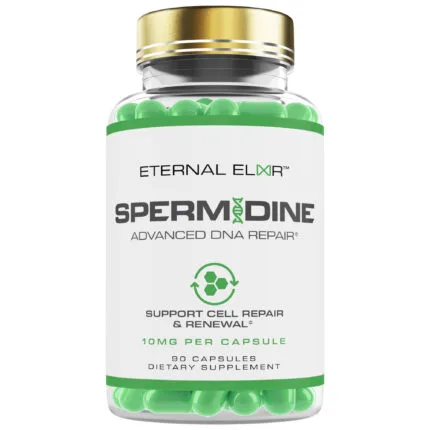
Eternal Elixir makes Spermidine 10mg, and it is our pick because spermidine is one of the few compounds with direct autophagy-pathway research behind it. It is a simple once-daily capsule that does not interfere with a fast.
It does not replace fasting and it is not a shortcut. We explain who it suits and who it does not further down. For the wider picture on what supports healthy ageing, see our autophagy supplements comparison.
Not sure which one fits you?
Finish the quiz for a free gift worth up to $44.99, plus a personal 20% code for your first order.
Table of contents
- 1. Intermittent fasting and autophagy: what autophagy actually is
- 2. How intermittent fasting affects autophagy: the mechanism
- 3. Autophagy fasting timeline: what the charts say, and what we can support
- 4. How to fast for autophagy: practical steps
- 5. Where Eternal Elixir Spermidine fits
- 6. Intermittent fasting and autophagy: frequently asked questions
- 6.1. Is 16 hours fasting enough for autophagy?
- 6.2. Is 24 hours fasting enough for autophagy?
- 6.3. What are the signs of autophagy fasting?
- 6.4. Does exercise promote autophagy?
- 6.5. What is autophagy in simple words?
- 6.6. How often should you fast for autophagy?
- 6.7. What are the five stages of autophagy?
- 7. The bottom line
- 8. Sources
Intermittent fasting and autophagy: what autophagy actually is
Autophagy is the process cells use to break down damaged or unneeded components and recycle the parts. The word means “self-eating,” which sounds alarming until you realise it is a normal maintenance function. Cells use it to clear out worn-out proteins and organelles, including mitochondria, and to reuse the raw materials for energy and cellular upkeep. It runs at a low level all the time and ramps up under stress, including nutrient scarcity.
The mechanism most explainers describe is accurate at a high level. When you stop eating, insulin and glucose fall and glucagon rises. Low insulin and low cellular energy inhibit mTOR, a growth-signalling pathway, and activate AMPK, an energy sensor. That combination is what turns autophagy on.
It is a tightly regulated system, rather than a switch that flips cleanly at a set hour.
There are three main types. Macroautophagy is the bulk recycling process most people mean when they say autophagy. Microautophagy and chaperone-mediated autophagy are more selective. Most of the fasting research focuses on macroautophagy, and most of it is in animals and cells rather than people.
Why the timing is fuzzier than the charts suggest
Popular autophagy fasting charts put the onset anywhere from 12 to 18 hours, sometimes later. The problem is that those numbers come mostly from mouse studies and from indirect human markers. A 2018 review found the evidence overwhelmingly supports autophagy induction in many tissues in response to food deprivation (Bagherniya et al., Ageing Res Rev, 2018). Human data are more limited because autophagy is hard to measure in living people.
That does not make the charts wrong. It makes them a rough guide rather than a schedule you can set your watch by.
How intermittent fasting affects autophagy: the mechanism
Fasting creates the conditions that allow autophagy to rise, and the research on this is consistent across species. The pathway is well described: nutrient deprivation lowers insulin and raises glucagon, which suppresses mTOR and activates AMPK, and both changes promote autophagy.
Intermittent fasting is one way to create that nutrient scarcity repeatedly. The question is how much scarcity and for how long. Animal studies show autophagy rising in the liver and other tissues during fasting, and falling again on refeeding.
The liver is the tissue most studied, partly because it is metabolically central and easy to sample. A 2022 review of intermittent fasting and liver autophagy summarised evidence that fasting regimens can influence hepatic autophagy markers in animals, with effects depending on the fasting protocol and the tissue examined (Kim et al., Int J Mol Sci, 2022).
What this means practically: the mechanism is real, the direction is consistent, but the human dose-response is not pinned down. Evidence level: strong mechanistic and animal evidence, limited direct human evidence.
What the evidence does not show
Here is the honest counterweight. No human study has directly watched autophagy happen in a person’s liver during a 16-hour fast, because we cannot biopsy every tissue at every hour. Researchers use proxies: markers like LC3-II, p62 and Beclin-1 in blood cells or tissue samples, and indirect measures of autophagic flux. These markers are informative but imperfect, and they can rise or fall for reasons other than a change in autophagy.
What the evidence also does not show is that fasting is the only way to raise autophagy, or that longer is always better. Exercise, calorie restriction and certain compounds also influence the pathway. A 2021 review in Nature Aging discussed the unclear relationship between autophagy, ageing and disease, and the preclinical evidence for autophagy modulators (Aman et al., Nat Aging, 2021). That review is a good reminder that autophagy is one piece of a larger picture, rather than a single lever that controls ageing.
Autophagy fasting timeline: what the charts say, and what we can support
The autophagy fasting timeline most people encounter runs something like this: 12 to 16 hours for early metabolic shifts, 16 to 24 hours for a more meaningful autophagy response, and 24 to 48 hours or beyond for deeper effects. It is a useful framework. It is not a set of guarantees.
Here is what the research can actually support at each stage, stated carefully.
| Fasting window | What happens metabolically | Autophagy evidence level | Realistic for most people |
|---|---|---|---|
| 12 to 14 hours | Insulin and glucose fall, glycogen starts to deplete | Early markers may shift, timing varies by person | Yes, for most healthy adults |
| 16 to 18 hours | Deeper glycogen depletion, higher fat use | Animal data suggest autophagy rises, human data indirect | Yes, for many people |
| 20 to 24 hours | Ketones rise, nutrient-sensing pathways shift further | Stronger animal evidence, human markers studied less | Yes, occasionally, rather than daily |
| 48 hours and beyond | Deeper metabolic and cellular stress response | Animal and some human marker studies, harder to sustain | No, for most, occasional only |
The 16-hour mark gets the most attention, and it is a reasonable target for a first fast. Whether 16 hours is enough for autophagy in you specifically is not something the current evidence can answer with precision. It is enough to create the metabolic conditions that allow it, and that is the honest claim.
The 24-hour fast is where the evidence gets a bit stronger for a deeper response, but it is not necessary daily. Many people do one or two longer fasts a week and keep the rest of their week at 14 to 16 hours. That pattern is sustainable and easier to repeat than a daily 24-hour fast.
Add Spermidine 10mg to cart · $49.99
Signs of autophagy fasting: what you can and cannot feel
The honest answer is that you cannot feel autophagy directly. What you can feel are the metabolic changes that accompany it. During a fast you may notice hunger fading after the first few hours, a shift in energy, cooler hands and feet, and sometimes a clearer head. None of these is proof of autophagy.
They are signs that your body is adapting to fasting.
Some people report mild fatigue, irritability or a headache in the first days of a new fasting routine. These are usually adaptation effects rather than autophagy. If you feel unwell, eat. Fasting is a tool, rather than a test of willpower.
What you cannot see is your cells recycling damaged proteins. What you can track instead is consistency, sleep quality, energy across the day and how you feel after a fast. Those are the practical signals. If you want a deeper look at the habits that support recovery around fasting, our guide to deep sleep is a useful companion.
How to fast for autophagy: practical steps
Start with the pattern you can repeat. A 14- to 16-hour overnight fast is a sensible entry point for most healthy adults: finish eating in the evening, sleep, and delay breakfast. That is time-restricted eating rather than a full-day fast, and it is easier to sustain than jumping straight to 24 hours.
Build from there. Once a 16-hour fast feels routine, try one longer fast of 20 to 24 hours a week if it suits you. Keep the rest of the week at your usual window. Do not stack longer fasts back to back when you are new to it.
- Keep water, plain tea and black coffee during the fast. They do not meaningfully break it.
- Break the fast with a normal meal, rather than a feast. Protein and vegetables first.
- Protect sleep. Short sleep makes fasting harder and blunts the recovery side.
- Do not fast on hard training days if you are new to it. Save longer fasts for easier days.
- Stop and eat if you feel dizzy, shaky or unwell.
If you take medicines, are pregnant or breastfeeding, or have a health condition, check your plan with your GP before making fasting a habit. Fasting is not appropriate for everyone, and the research base is built mostly on healthy adults.
Where Eternal Elixir Spermidine fits
Fasting and food choices do the main work. What Eternal Elixir adds is a daily compound with direct autophagy-pathway research behind it, for people who want support on the days they are not fasting or who prefer a consistent daily input. Eternal Elixir Spermidine 10mg is our primary pick: 10 mg per capsule, 90 capsules per bottle and 90 serves at A$49.99, which works out to $0.56 a day.
Spermidine is a polyamine found in foods like wheat germ, aged cheese and mushrooms, and it has been studied for its effect on autophagy. A 2022 review in Nature Aging covered how spermidine works at the molecular level and noted that it extends lifespan in fungi, nematodes, insects and rodents (Hofer et al., Nat Aging, 2022). The human evidence is still developing: most of the mechanistic work is in cells and animals, and human trials have mostly looked at safety and markers rather than hard outcomes.
That makes spermidine a reasonable support, rather than a replacement for fasting. Take one capsule a day on an empty stomach, or as directed by your healthcare professional. Every batch is third-party lab tested for purity, the current batch certificate of analysis is available on request, and orders ship within 24 hours on business days.
Who it suits, and who it does not
It suits people who fast regularly and want a daily autophagy-linked compound alongside it, people who find longer fasts hard and want a consistent daily input, and anyone comfortable judging an early evidence base for themselves. It does not suit anyone expecting a fast-acting effect, or anyone who wants spermidine to replace their fasting routine entirely. Check with your GP first if you take medicines, are pregnant or breastfeeding, or have a health condition.
Other options compared by cost per day
| Option | Price (AUD, as of Oct 2026) | Serve | Dose per serve | Cost per day | Capsules per bottle | Suits | Buy |
|---|---|---|---|---|---|---|---|
| Eternal Elixir Spermidine 10mg (our pick) | $49.99 | 1 capsule on an empty stomach | 10 mg | $0.56 | 90 (90 serves) | Daily autophagy-linked support alongside fasting | View Spermidine 10mg |
| Eternal Elixir Berberine HCl 500mg | $49.99 | 1 capsule | 500 mg (20:1 extract) | $0.56 | 90 (90 serves) | Metabolic support | View Berberine |
| Fasting routine only | Free | Daily | Not applicable | Free | Not applicable | Everyone, first | Start with the steps above |
If you want metabolic support alongside your fasting routine, Eternal Elixir Berberine HCl is the second option: 500 mg of a 20:1 extract per capsule, 90 capsules and 90 serves at A$49.99, or $0.56 a day. Berberine has been studied for its effect on metabolic markers, though the evidence is mostly short-term trials and the results vary. It is not an autophagy-specific compound, so it sits alongside spermidine rather than replacing it. For the wider metabolic picture, see our autophagy supplements comparison.
Intermittent fasting and autophagy: frequently asked questions
Is 16 hours fasting enough for autophagy?
It is enough to create the metabolic conditions that allow autophagy: insulin and glucose fall, glycogen depletes and nutrient-sensing pathways shift. Whether it is enough to measurably raise autophagy in you specifically is not something the current human evidence can answer with precision. Treat 16 hours as a reasonable window, not a guaranteed trigger.
Is 24 hours fasting enough for autophagy?
A 24-hour fast goes deeper into glycogen depletion and raises ketones, and the animal evidence for autophagy at this stage is stronger than at 16 hours. Human marker studies are limited. For most people, one 24-hour fast a week alongside shorter daily fasts is a sustainable pattern.
What are the signs of autophagy fasting?
You cannot feel autophagy directly. What you can feel are the metabolic changes around it: hunger fading, a shift in energy, cooler hands and feet, and sometimes a clearer head. None of these is proof. Track consistency, sleep and energy instead.
Does exercise promote autophagy?
Exercise is a stress that can influence the same nutrient-sensing pathways as fasting, and animal and human marker studies suggest it can raise autophagy-related signalling in muscle. The effect depends on intensity, duration and training status. It is not a replacement for fasting if autophagy is your goal, but it is a useful addition.
What is autophagy in simple words?
It is your body’s cellular recycling process. Cells break down damaged or unneeded parts and reuse the materials for energy and cellular upkeep. It runs at a low level all the time and rises under stress such as nutrient scarcity.
How often should you fast for autophagy?
There is no single answer the evidence can give. A common approach is daily time-restricted eating at 14 to 16 hours, with one longer fast of 20 to 24 hours a week for those who tolerate it. Consistency matters more than the perfect protocol.
What are the five stages of autophagy?
The stages describe the process at a cellular level: initiation, nucleation, expansion, closure and fusion with the lysosome for degradation. You do not need to track them. They are a framework for how the process unfolds, rather than a schedule you follow.
Add Spermidine 10mg to cart · $49.99
The bottom line
Intermittent fasting and autophagy are genuinely linked, and the mechanism is well described. What the evidence does not give us is a precise hour at which autophagy switches on in every person. Treat the fasting charts as a rough guide, start with a 14- to 16-hour overnight fast, and add a longer fast only if it suits your week. Protect sleep, eat well when you do eat, and stop if you feel unwell.
Once your fasting routine is in place, Eternal Elixir Spermidine 10mg is our pick for daily autophagy-linked support at A$49.99 for 90 serves, with Eternal Elixir Berberine HCl as the metabolic second option. For the full range, see our autophagy supplements comparison and our longevity supplements comparison. If you are weighing up the wider longevity category first, our fulvic acid benefits guide covers a mineral side of the same conversation.
General information only, not medical advice. Check with your GP before starting a fasting routine if you have a health condition, take medicines, or are pregnant or breastfeeding.
Sources
- Bagherniya M et al. The effect of fasting or calorie restriction on autophagy induction: a review of the literature. Ageing Res Rev, 2018.
- Kim KH et al. Influence of intermittent fasting on autophagy in the liver. Int J Mol Sci, 2022.
- Aman Y et al. Autophagy in healthy aging and disease. Nat Aging, 2021.
- Madeo F et al. Spermidine in health and disease. Science, 2018.
- Hofer SJ et al. Mechanisms of spermidine-induced autophagy and geroprotection. Nat Aging, 2022.
Comparing NAD+ and longevity supplements? Answer a few quick questions and see the product that suits your goals, with its label serve and cost per day.
Finish it for a free gift worth up to $44.99 and a personal 20% code for your first order: unique to you, one use, valid 48h.
Find my routine + free gift